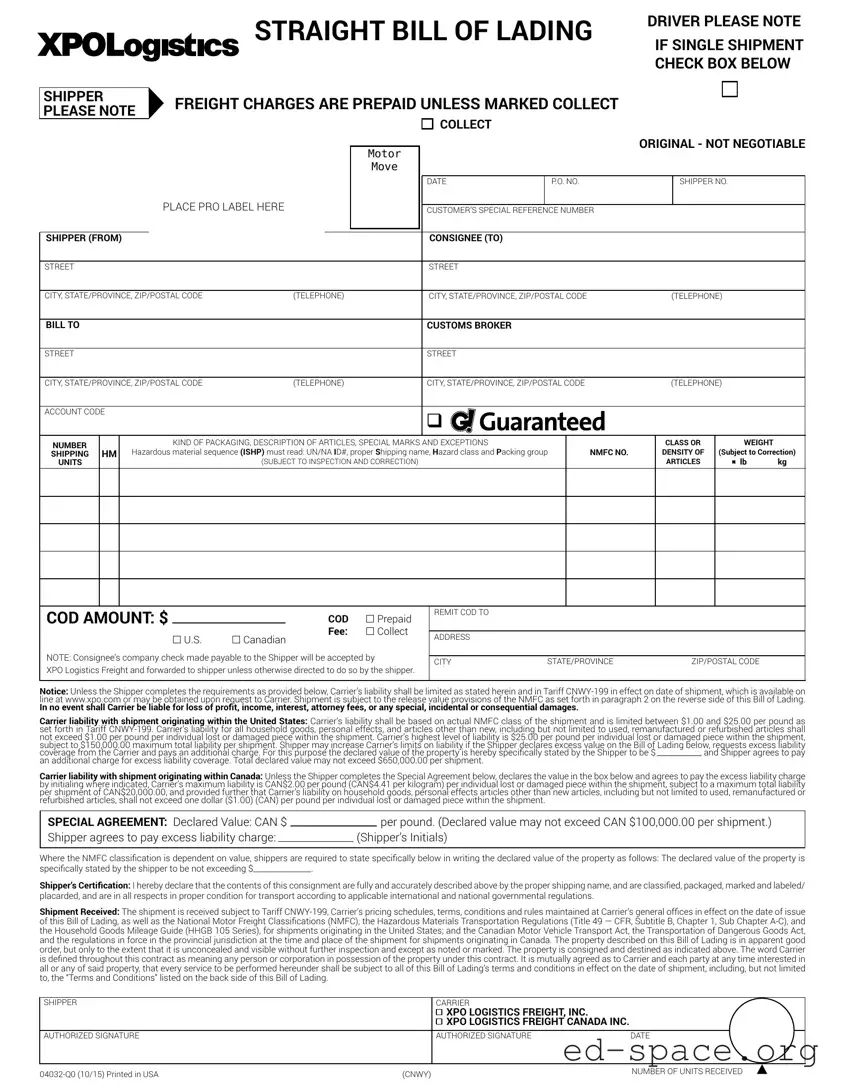
The Xpo Logistics Bill of Lading form serves as a crucial document in the transportation and logistics industry, encapsulating essential details for the shipment process. This form is designed to facilitate the movement of goods from the shipper to the consignee, ensuring that all parties involved have a clear understanding of the shipment's particulars. It includes vital information such as the shipper and consignee's addresses, contact numbers, and any special references related to the shipment. Additionally, the form outlines the payment structure, indicating whether freight charges are prepaid or collected upon delivery. A specific section addresses hazardous materials, requiring shippers to provide necessary identification and classification details. The liability clauses are also prominently featured, detailing the carrier's responsibility in case of loss or damage, which varies based on the type of goods being shipped. Moreover, shippers have the option to declare an excess value for their shipments, allowing for additional coverage if needed. This form not only streamlines the shipping process but also protects the interests of all parties involved by establishing clear terms and conditions for the transport of goods.
|
|
|
|
|
|
STRAIGHT BILL OF LADING |
DRIVER PLEASE NOTE |
|
|
|
|
|
|
IF SINGLE SHIPMENT |
|
|
|
|
|
|
|||
|
|
|
|
|
|
|
|
|
|
|
|
|
|
|
CHECK BOX BELOW |
|
|
|
|
|
|
|
|
SHIPPER |
|
FREIGHT CHARGES ARE PREPAID UNLESS MARKED COLLECT |
|
||||
PLEASE NOTE |
|
|
|||||
|
|
|
COLLECT |
|
|||
|
|
|
|
|
|
|
|
ORIGINAL - NOT NEGOTIABLE
|
|
Motor |
|
|
|
|
Move |
|
|
|
|
DATE |
P.O. NO. |
SHIPPER NO. |
PLACE PRO LABEL HERE |
|
CUSTOMER’S SPECIAL REFERENCE NUMBER |
|
|
SHIPPER (FROM) |
|
CONSIGNEE (TO) |
|
|
STREET |
|
STREET |
|
|
CITY, STATE/PROVINCE, ZIP/POSTAL CODE |
(TELEPHONE) |
CITY, STATE/PROVINCE, ZIP/POSTAL CODE |
(TELEPHONE) |
|
BILL TO |
|
CUSTOMS BROKER |
|
|
STREET |
|
STREET |
|
|
CITY, STATE/PROVINCE, ZIP/POSTAL CODE |
(TELEPHONE) |
CITY, STATE/PROVINCE, ZIP/POSTAL CODE |
(TELEPHONE) |
|
ACCOUNT CODE |
|
|
|
|
|
|
|
|
|
NUMBER |
KIND OF PACKAGING, DESCRIPTION OF ARTICLES, SPECIAL MARKS AND EXCEPTIONS |
|
CLASS OR |
WEIGHT |
|
|
Hazardous material sequence (ISHP) must read: UN/NA ID#, proper Shipping name, Hazard class and Packing group |
NMFC NO. |
DENSITY OF |
(Subject to Correction) |
|||
SHIPPING HM |
||||||
UNITS |
(SUBJECT TO INSPECTION AND CORRECTION) |
|
ARTICLES |
lb |
kg |
|
COD AMOUNT: $ |
|
|
COD |
Prepaid |
|
U.S. |
|
Fee: |
Collect |
|
Canadian |
|
||
NOTE: Consignee’s company check made payable to the Shipper will be accepted by
XPO Logistics Freight and forwarded to shipper unless otherwise directed to do so by the shipper.
REMIT COD TO
ADDRESS
CITY |
STATE/PROVINCE |
ZIP/POSTAL CODE |
Notice: Unless the Shipper completes the requirements as provided below, Carrier’s liability shall be limited as stated herein and in Tariff
In no event shall Carrier be liable for loss of prot, income, interest, attorney fees, or any special, incidental or consequential damages.
Carrier liability with shipment originating within the United States: Carrier’s liability shall be based on actual NMFC class of the shipment and is limited between $1.00 and $25.00 per pound as set forth in Tariff
coverage from the Carrier and pays an additional charge. For this purpose the declared value of the property is hereby specically stated by the Shipper to be $, and Shipper agrees to pay an additional charge for excess liability coverage. Total declared value may not exceed $650,000.00 per shipment.
Carrier liability with shipment originating within Canada: Unless the Shipper completes the Special Agreement below, declares the value in the box below and agrees to pay the excess liability charge by initialing where indicated, Carrier’s maximum liability is CAN$2.00 per pound (CAN$4.41 per kilogram) per individual lost or damaged piece within the shipment, subject to a maximum total liability per shipment of CAN$20,000.00, and provided further that Carrier’s liability on household goods, personal effects articles other than new articles, including but not limited to used, remanufactured or refurbished articles, shall not exceed one dollar ($1.00) (CAN) per pound per individual lost or damaged piece within the shipment.
SPECIAL AGREEMENT: Declared Value: CAN $ |
|
|
per pound. (Declared value may not exceed CAN $100,000.00 per shipment.) |
|
Shipper agrees to pay excess liability charge: |
|
|
(Shipper’s Initials) |
|
|
|
|
|
|
Where the NMFC classi cation is dependent on value, shippers are required to state speci cally below in writing the declared value of the property as follows: The declared value of the property is specically stated by the shipper to be not exceeding $_______________.
Shipper’s Certi cation: I hereby declare that the contents of this consignment are fully and accurately described above by the proper shipping name, and are classied, packaged, marked and labeled/ placarded, and are in all respects in proper condition for transport according to applicable international and national governmental regulations.
Shipment Received: The shipment is received subject to Tariff
SHIPPER
AUTHORIZED SIGNATURE
CARRIER
XPO LOGISTICS FREIGHT, INC.
XPO LOGISTICS FREIGHT CANADA INC.
AUTHORIZED SIGNATURE |
DATE |
(CNWY) |
NUMBER OF UNITS RECEIVED |
|
|
| Fact Name | Details |
|---|---|
| Type of Bill of Lading | This is a Straight Bill of Lading, indicating that the goods are to be delivered to a specific consignee without the option for negotiation. |
| Freight Charges | Freight charges are prepaid by default unless marked as collect on the form. |
| Carrier Liability in the U.S. | For shipments originating within the United States, the carrier's liability is limited to between $1.00 and $25.00 per pound, with a maximum total liability of $150,000.00 per shipment. |
| Carrier Liability in Canada | For shipments originating in Canada, the carrier's maximum liability is CAN$2.00 per pound, with a total liability cap of CAN$20,000.00 per shipment. |
| Declared Value | Shippers can declare a value for their shipment, which must not exceed $650,000.00 in the U.S. or CAN$100,000.00 in Canada. |
| Governing Laws | Shipments originating in the U.S. are governed by the National Motor Freight Classification (NMFC) and relevant federal regulations, while those from Canada are subject to the Canadian Motor Vehicle Transport Act and the Transportation of Dangerous Goods Act. |
Filling out the Xpo Logistics Bill of Lading form is an important step in the shipping process. This form ensures that all necessary information about the shipment is documented accurately. Below are clear steps to help you complete the form correctly.
What is the purpose of the Xpo Logistics Bill of Lading form?
The Xpo Logistics Bill of Lading serves as a legal document that outlines the details of a shipment. It acts as a receipt for the goods being transported and includes essential information such as the shipper's and consignee's addresses, the nature of the cargo, and payment terms. This document is crucial for both the shipper and the carrier to ensure that the shipment is handled correctly and that liability is clearly defined.
What information is required to complete the Bill of Lading?
To complete the Bill of Lading, you need to provide several key details. This includes the date, purchase order number, shipper and consignee information (including names, addresses, and phone numbers), the type and description of the goods, and any special instructions or references. Additionally, you must specify the payment terms, such as whether freight charges are prepaid or collect.
How does liability work under the Bill of Lading?
Liability under the Bill of Lading is limited as specified in the document. For shipments originating within the United States, the carrier's liability is based on the National Motor Freight Classification (NMFC) class and is limited to between $1.00 and $25.00 per pound, with a maximum total liability of $150,000.00 per shipment. For shipments from Canada, the maximum liability is CAN$2.00 per pound, subject to a maximum of CAN$20,000.00 per shipment. Shippers can increase liability limits by declaring excess value and paying an additional charge.
What should I do if I am shipping hazardous materials?
If you are shipping hazardous materials, it is essential to comply with specific regulations. You must provide the UN/NA ID number, proper shipping name, hazard class, and packing group on the Bill of Lading. This ensures that the carrier is aware of the nature of the cargo and can take appropriate safety measures during transportation.
Can I declare a higher value for my shipment?
Yes, you can declare a higher value for your shipment by filling out the designated section on the Bill of Lading. The declared value must not exceed the specified limits, which are $650,000.00 per shipment for U.S. shipments and CAN $100,000.00 for Canadian shipments. You will also need to initial to confirm your agreement to pay the excess liability charge.
What happens if the information on the Bill of Lading is incorrect?
If the information on the Bill of Lading is incorrect, it may lead to issues with the shipment, including delays or liability disputes. It is crucial to review all details carefully before finalizing the document. In case of errors, you should contact the carrier immediately to rectify the information.
How can I track my shipment once it has been sent?
To track your shipment, you can visit the Xpo Logistics website and use the tracking feature. You will need the tracking number provided on the Bill of Lading. This allows you to monitor the status of your shipment in real time and receive updates on its progress.
What should I do if my shipment is lost or damaged?
If your shipment is lost or damaged, you should report the issue to Xpo Logistics as soon as possible. Document the condition of the shipment and gather any relevant information from the Bill of Lading. The carrier's liability terms will apply, so understanding the limits of liability is important when filing a claim.
Incomplete Information: One common mistake is failing to fill out all required fields. Essential details such as the shipper's and consignee's addresses, contact numbers, and shipment descriptions must be accurately provided to avoid delays.
Incorrect Declared Value: Shippers often misstate the declared value of the property. This can lead to misunderstandings about liability and insurance coverage. It's crucial to ensure that the declared value does not exceed the specified limits.
Neglecting Hazardous Material Requirements: When shipping hazardous materials, shippers sometimes overlook the necessary details, such as the UN/NA ID number and proper shipping name. These omissions can result in significant legal and safety issues.
Improper Payment Terms: Failing to clearly indicate whether freight charges are prepaid or collect can create confusion. Marking the appropriate box is essential to ensure the correct payment method is applied.
Missing Signatures: Many individuals forget to sign the Bill of Lading. An unsigned document may not be considered valid, which can complicate the shipping process and affect liability claims.
Ignoring Special Instructions: Shippers sometimes neglect to include special instructions or references that could assist in the handling of the shipment. Providing these details can facilitate smoother processing and delivery.
When shipping goods, the Xpo Logistics Bill of Lading form is a crucial document. However, it is often accompanied by several other forms and documents that help ensure a smooth shipping process. Here’s a brief overview of some commonly used documents that work alongside the Bill of Lading.
Each of these documents plays a significant role in the shipping process, ensuring that everything runs smoothly from pickup to delivery. By understanding their purposes, shippers can navigate the logistics of transporting goods more effectively.
When filling out the Xpo Logistics Bill of Lading form, attention to detail is crucial. Here is a list of things you should and shouldn't do:
Here are nine common misconceptions about the Xpo Logistics Bill of Lading form, along with clarifications to help you understand its purpose and implications.
Understanding these misconceptions can help you navigate the shipping process more effectively and ensure compliance with all requirements.
When filling out and using the Xpo Logistics Bill of Lading form, it is crucial to ensure accuracy and compliance. Below are key takeaways to guide you through the process:
Proper completion of the Xpo Logistics Bill of Lading form is essential for smooth transportation and to protect your interests. Review all sections thoroughly before submission.