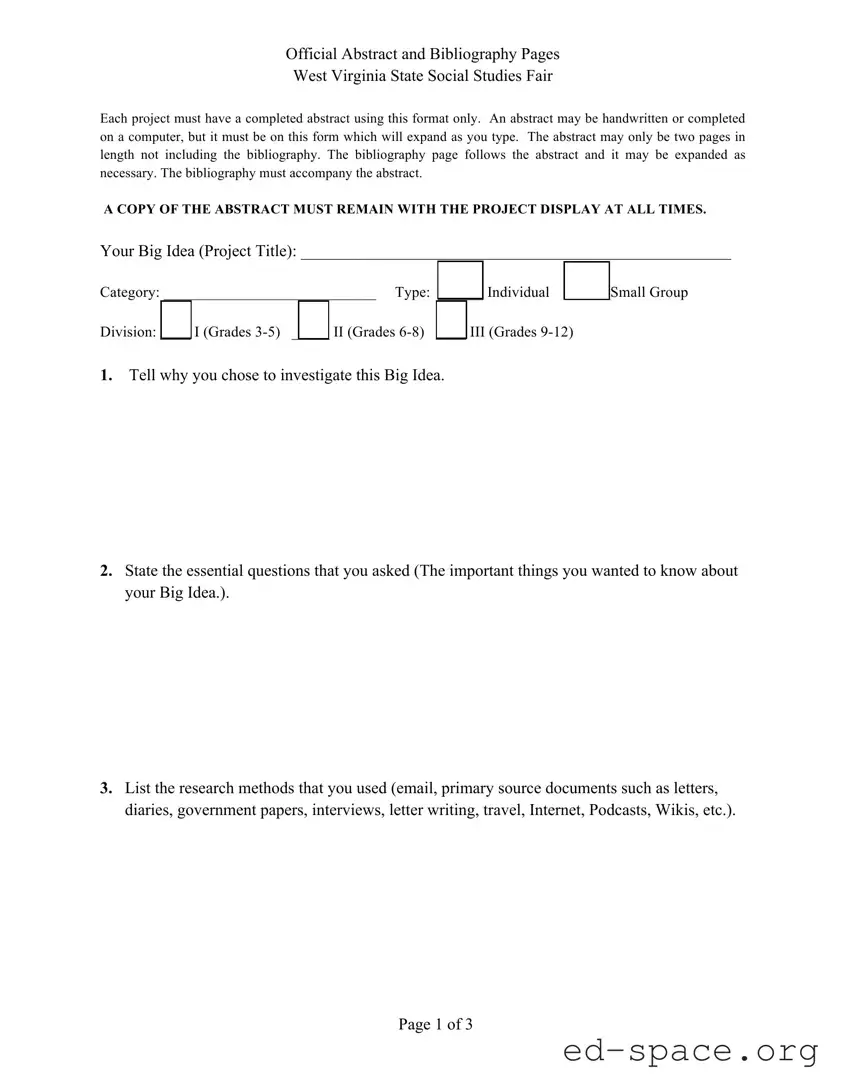
The West Virginia Abstract Social Studies Fair form is an essential component for students participating in the fair. This form requires a comprehensive abstract that outlines the project, adhering strictly to the provided format. Students can handwrite or type their abstracts, which must fit within a two-page limit, excluding the bibliography. Each project must include a bibliography that lists all sources used, and this bibliography can be extended as needed. A crucial rule is that a copy of the abstract must remain with the project display at all times. The form prompts students to articulate their project title, category, and division while guiding them through several key questions. These questions help students reflect on their research journey, including why they chose their topic, the essential questions they sought to answer, and the research methods they employed. Additionally, students must validate their sources, summarize their findings, and draw conclusions. Finally, the form encourages students to suggest improvements or future predictions based on their research. This structured approach not only aids in organizing thoughts but also enhances the overall presentation of their projects.

Official Abstract and Bibliography Pages
West Virginia State Social Studies Fair
Each project must have a completed abstract using this format only. An abstract may be handwritten or completed on a computer, but it must be on this form which will expand as you type. The abstract may only be two pages in length not including the bibliography. The bibliography page follows the abstract and it may be expanded as necessary. The bibliography must accompany the abstract.
A COPY OF THE ABSTRACT MUST REMAIN WITH THE PROJECT DISPLAY AT ALL TIMES.
Your Big Idea (Project Title): ____________________________________________________
Category: ____________________________ Type: ______ Individual ______Small Group
Division: ____ I (Grades
1.Tell why you chose to investigate this Big Idea.
2.State the essential questions that you asked (The important things you wanted to know about your Big Idea.).
3.List the research methods that you used (email, primary source documents such as letters, diaries, government papers, interviews, letter writing, travel, Internet, Podcasts, Wikis, etc.).
Page 1 of 3
4.How did you validate your sources of information?
5.Write a brief summary of your project.
6.State your conclusion.
7.Suggest a way to change or improve the outcome, or make a future prediction about what you anticipate based on what you have learned.
Complete Your Bibliography on the Following Page
Page 2 of 3
Bibliography Page
You must use a bibliographic format which includes the author, title, place of publication,
publisher, and publication date.
Here is one of many sites for bibliography formats that include audiovisuals, Internet,
newspapers,
http://www.fcps.edu/KeyMS/library/bibliography.html
Page 3 of 3
| Fact Name | Description |
|---|---|
| Abstract Requirement | Each project must include a completed abstract using the designated format, which can be handwritten or typed. |
| Length Limit | The abstract is limited to two pages, not including the bibliography. |
| Bibliography Necessity | A bibliography must accompany the abstract and can be expanded as necessary. |
| Project Display | A copy of the abstract must remain with the project display at all times. |
| Essential Questions | Participants must state the essential questions they sought to answer regarding their Big Idea. |
| Governing Law | The West Virginia State Social Studies Fair is governed by state educational guidelines and policies. |
Filling out the West Virginia Abstract Social Studies Fair form is a straightforward process that requires attention to detail. This form is essential for presenting your project effectively. Follow these steps to ensure your abstract and bibliography are completed accurately.
What is the purpose of the West Virginia Abstract Social Studies Fair form?
The form is designed to help students summarize their social studies projects. It requires them to present their findings in a structured manner, which includes an abstract and a bibliography. This format ensures that all necessary information is included and clearly communicated.
How long can the abstract be?
The abstract can be a maximum of two pages in length, not including the bibliography. This limitation encourages students to be concise and focus on the most important aspects of their research.
Can the abstract be handwritten?
Yes, the abstract may be handwritten or typed on a computer. However, it must be completed on the official form provided. The form is designed to expand as you type, making it easy to fit your content within the required format.
What information must be included in the bibliography?
The bibliography must include key details such as the author, title, place of publication, publisher, and publication date. This ensures that all sources are properly credited and can be referenced by others.
Is it necessary to keep a copy of the abstract with the project display?
Yes, a copy of the abstract must remain with the project display at all times. This allows judges and viewers to easily access and understand the project without needing to ask for additional information.
What types of research methods can be listed in the abstract?
Students can list a variety of research methods, including email correspondence, primary source documents, interviews, travel, Internet research, podcasts, and wikis. This diversity reflects the different ways students can gather information for their projects.
What should students include in their project summary?
The project summary should provide a brief overview of the research conducted and the findings. It should highlight the key points that define the project and explain its significance in a clear and straightforward manner.
How can students suggest improvements or future predictions in their projects?
Students should think critically about their findings and suggest ways to improve the outcome of their research. They can also make predictions based on what they have learned, providing insights into how their topic may evolve in the future.
Filling out the West Virginia Abstract Social Studies Fair form can be an exciting endeavor, but it’s easy to make mistakes along the way. Here are six common pitfalls to avoid:
Many participants forget that the bibliography is just as important as the abstract itself. Without it, your project may not meet the required standards.
The abstract must be limited to two pages, not including the bibliography. Some students mistakenly think they can include additional pages, which can lead to disqualification.
When listing research methods, it’s crucial to explain how you validated your sources. Omitting this step can weaken the credibility of your project.
Using the wrong format for your bibliography can lead to confusion. Ensure that you follow the required format, including all necessary details such as author, title, and publication date.
A vague or missing conclusion can leave judges unsure about your findings. Clearly state your conclusions to provide a strong finish to your project.
Remember, a copy of the abstract must remain with your project display at all times. Failing to do so may result in your project being incomplete.
By being mindful of these common mistakes, you can enhance the quality of your submission and increase your chances of success at the West Virginia Social Studies Fair.
The West Virginia Abstract Social Studies Fair form serves as a crucial foundation for students participating in the fair. However, several other documents complement this form, ensuring that participants present their research effectively and comprehensively. Below are five essential forms and documents that are often used alongside the Abstract Social Studies Fair form.
Incorporating these documents alongside the West Virginia Abstract Social Studies Fair form not only enriches the research experience but also equips students with essential skills for academic success. Together, they create a comprehensive framework that encourages thorough investigation and effective presentation.
The West Virginia Abstract Social Studies Fair form shares similarities with several other documents used in educational and research contexts. Below is a list of seven documents that have comparable features:
When filling out the West Virginia Abstract Social Studies Fair form, it's important to follow certain guidelines to ensure your submission is complete and meets the requirements. Here’s a helpful list of things to do and things to avoid.
By following these guidelines, you can create a strong and effective abstract that clearly communicates your project and its findings. Good luck with your submission!
Misconceptions about the West Virginia Abstract Social Studies Fair form can lead to confusion and errors in project submissions. Here are nine common misunderstandings:
Understanding these misconceptions can help participants navigate the requirements of the West Virginia Abstract Social Studies Fair form more effectively. Clarity in these areas can lead to a smoother experience in preparing and presenting projects.
Filling out the West Virginia Abstract Social Studies Fair form is an essential step for students participating in the fair. Here are some key takeaways to keep in mind: