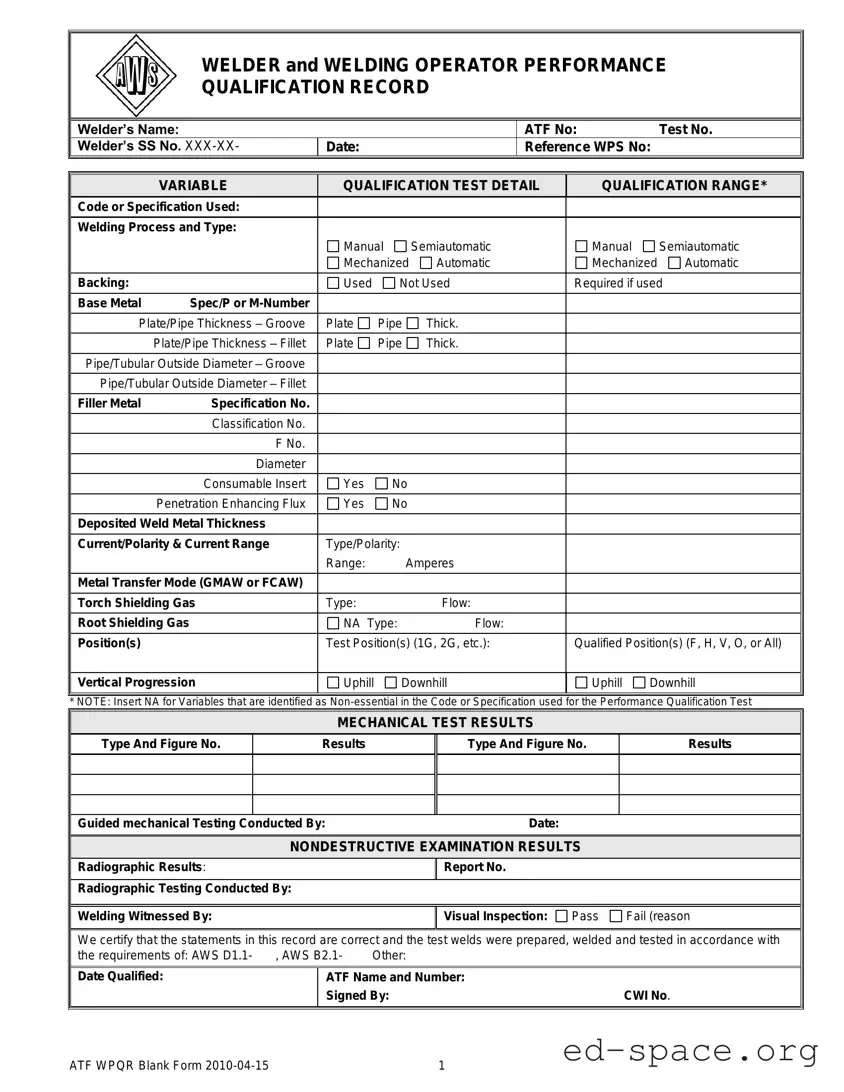
The Welder Performance Qualification Record form is an essential document that ensures welders meet industry standards and specifications. It captures critical information about the welder, including their name, identification numbers, and the specific test they have completed. This form details the variables associated with the qualification test, such as the welding process used—whether manual, semiautomatic, or automatic—as well as the type of base metal and filler metal specifications. It also outlines the thickness of the materials and the various positions in which the welder is qualified to work. The form includes results from mechanical tests and non-destructive examinations, such as radiographic testing and visual inspections, which validate the quality of the welds produced. Additionally, the form requires certification by a qualified individual, confirming that all statements are accurate and that the tests comply with relevant codes, like AWS D1.1. Overall, this record is vital for maintaining safety and quality in welding operations, making it imperative for welders and employers to complete and maintain it diligently.
WELDER and WELDING OPERATOR PERFORMANCE
QUALIFICATION RECORD
|
Welder’s Name: |
|
|
|
|
ATF No: |
|
Test No. |
||||||
|
Welder’s SS No. |
|
Date: |
|
|
Reference WPS No: |
|
|
||||||
|
|
|
|
|
|
|
|
|
|
|||||
|
|
VARIABLE |
|
|
QUALIFICATION TEST DETAIL |
|
|
QUALIFICATION RANGE* |
|
|||||
|
Code or Specification Used: |
|
|
|
|
|
|
|
|
|
|
|
||
|
|
|
|
|
|
|
|
|
|
|
|
|
||
|
Welding Process and Type: |
|
|
|
|
|
|
|
|
|
|
|
||
|
|
|
|
|
Manual |
Semiautomatic |
|
|
Manual |
|
Semiautomatic |
|||
|
|
|
|
|
Mechanized |
Automatic |
|
|
Mechanized |
Automatic |
||||
|
|
|
|
|
|
|
|
|
|
|||||
|
Backing: |
|
|
|
Used |
Not Used |
|
|
Required if used |
|||||
|
|
|
|
|
|
|
|
|
|
|
|
|
|
|
|
Base Metal |
Spec/P or |
|
|
|
|
|
|
|
|
|
|
|
|
|
|
|
|
|
|
|
|
|
|
|
|
|||
|
Plate/Pipe Thickness – Groove |
|
Plate |
Pipe |
Thick. |
|
|
|
|
|
|
|||
|
|
|
|
|
|
|
|
|
|
|
|
|
||
|
|
Plate/Pipe Thickness – Fillet |
|
Plate |
Pipe |
Thick. |
|
|
|
|
|
|
||
|
|
|
|
|
|
|
|
|
|
|
|
|
||
|
Pipe/Tubular Outside Diameter – Groove |
|
|
|
|
|
|
|
|
|
|
|
||
|
|
|
|
|
|
|
|
|
|
|
|
|
||
|
Pipe/Tubular Outside Diameter – Fillet |
|
|
|
|
|
|
|
|
|
|
|
||
|
|
|
|
|
|
|
|
|
|
|
|
|
|
|
|
Filler Metal |
Specification No. |
|
|
|
|
|
|
|
|
|
|
|
|
|
|
|
|
|
|
|
|
|
|
|
|
|
|
|
|
|
Classification No. |
|
|
|
|
|
|
|
|
|
|
|
|
|
|
|
|
|
|
|
|
|
|
|
|
|
|
|
|
|
F No. |
|
|
|
|
|
|
|
|
|
|
|
|
|
|
|
|
|
|
|
|
|
|
|
|
|
|
|
|
|
Diameter |
|
|
|
|
|
|
|
|
|
|
|
|
|
|
|
|
|
|
|
|
|
|
|
|
|
|
|
|
|
Consumable Insert |
|
Yes |
No |
|
|
|
|
|
|
|
|
|
|
|
|
|
|
|
|
|
|
|
|
|
|
|
|
|
|
Penetration Enhancing Flux |
|
Yes |
No |
|
|
|
|
|
|
|
|
|
|
|
|
|
|
|
|
|
|
|
|
|
|
||
|
Deposited Weld Metal Thickness |
|
|
|
|
|
|
|
|
|
|
|
||
|
|
|
|
|
|
|
|
|
|
|
|
|||
|
Current/Polarity & Current Range |
|
Type/Polarity: |
|
|
|
|
|
|
|
|
|||
|
|
|
|
|
Range: |
Amperes |
|
|
|
|
|
|
||
|
|
|
|
|
|
|
|
|
|
|
|
|
||
|
Metal Transfer Mode (GMAW or FCAW) |
|
|
|
|
|
|
|
|
|
|
|
||
|
|
|
|
|
|
|
|
|
|
|
|
|||
|
Torch Shielding Gas |
|
Type: |
|
Flow: |
|
|
|
|
|
|
|||
|
|
|
|
|
|
|
|
|
|
|
||||
|
Root Shielding Gas |
|
NA Type: |
Flow: |
|
|
|
|
|
|
||||
|
|
|
|
|
|
|
|
|
||||||
|
Position(s) |
|
|
|
Test Position(s) (1G, 2G, etc.): |
|
|
Qualified Position(s) (F, H, V, O, or All) |
||||||
|
|
|
|
|
|
|
|
|
||||||
|
Vertical Progression |
|
Uphill |
Downhill |
|
|
Uphill |
Downhill |
||||||
|
|
|
|
|
|
|
|
|
|
|
|
|
|
|
* NOTE: Insert NA for Variables that are identified as
|
|
|
|
MECHANICAL TEST RESULTS |
|
|
||
|
Type And Figure No. |
|
|
Results |
|
Type And Figure No. |
Results |
|
|
|
|
|
|
|
|
|
|
|
|
|
|
|
|
|
|
|
|
|
|
|
|
|
|
|
|
|
|
|
|
|
|
|
|
|
|
Guided mechanical Testing Conducted By: |
|
Date: |
|
|
|||
|
|
|
|
|
|
|
|
|
|
|
|
NONDESTRUCTIVE EXAMINATION RESULTS |
|
|
|||
|
Radiographic Results: |
|
|
|
Report No. |
|
|
|
|
|
|
|
|
|
|
||
|
Radiographic Testing Conducted By: |
|
|
|
|
|||
|
|
|
|
|
|
|
|
|
|
|
|
|
|
|
|
|
|
|
Welding Witnessed By: |
|
|
|
Visual Inspection: Pass |
Fail (reason |
) |
|
|
|
|
|
|||||
|
We certify that the statements in this record are correct and the test welds were prepared, welded and tested in accordance with |
|||||||
|
the requirements of: AWS D1.1- |
, AWS B2.1- |
Other: |
|
|
|||
|
|
|
|
|
|
|||
|
Date Qualified: |
|
ATF Name and Number: |
|
|
|||
|
|
|
|
Signed By: |
CWI No. |
|
||
|
|
|
|
|
|
|
||
ATF WPQR Blank Form |
|
|
1 |
|
|
|||
| Fact Name | Details |
|---|---|
| Purpose | The Welder Performance Qualification Record form is designed to document a welder's qualifications, ensuring they meet industry standards for specific welding processes. |
| Key Components | This form includes essential information such as the welder's name, test number, welding processes, and base metal specifications. |
| Welding Processes | It categorizes welding processes into manual, semiautomatic, mechanized, and automatic, allowing for a comprehensive assessment of skills. |
| Qualification Range | The form specifies the qualification range for thickness and diameter of materials, which is crucial for determining the welder's capability. |
| Non-Destructive Testing | Results from non-destructive examinations, such as radiographic testing, are documented to verify the integrity of the welds. |
| Governing Codes | In many states, the AWS D1.1 and AWS B2.1 codes govern the qualifications outlined in this record, ensuring compliance with national standards. |
| Certification | The form requires signatures from qualified inspectors, affirming that the testing was conducted in accordance with the specified codes and standards. |
Filling out the Welder Performance Qualification Record form requires careful attention to detail. Each section of the form is crucial for accurately documenting a welder's qualifications and test results. Below are the steps to guide you through the process of completing the form.
What is the purpose of the Welder Performance Qualification Record form?
The Welder Performance Qualification Record form serves to document a welder's qualifications and capabilities. It is essential for demonstrating that a welder has the necessary skills to perform welding tasks according to specific standards. This record helps ensure that welds meet industry requirements for safety and quality.
Who needs to fill out this form?
This form must be completed by welders and welding operators who are seeking to validate their skills. It is often required by employers, regulatory bodies, or clients to confirm that the welder has successfully passed qualification tests relevant to their work environment.
What information is required on the form?
The form requires various details, including the welder’s name, Social Security number, test number, and the date of qualification. Additionally, it captures specifics about the welding process, base metal specifications, filler metal used, and the results of mechanical and non-destructive testing. Each section is designed to provide a comprehensive overview of the welder's qualifications.
What are the different welding processes listed on the form?
The form outlines several welding processes, including manual, semiautomatic, mechanized, and automatic welding. Each process has its own set of techniques and equipment, and the qualification record must specify which methods the welder is qualified to use.
What is the significance of the qualification range?
The qualification range indicates the limits within which the welder is certified to work. This includes factors such as plate thickness, pipe diameter, and the positions in which the welder can operate. Understanding this range is crucial for ensuring that the welder is assigned tasks that match their qualifications.
What does the non-destructive examination section entail?
This section documents the results of non-destructive testing methods, such as radiographic tests. It verifies that the welds meet quality standards without damaging the material. A pass or fail result is recorded, along with the reasons for any failures, ensuring transparency and accountability in the qualification process.
How is the form certified as accurate?
The form includes a certification statement that must be signed by a qualified individual, often a Certified Welding Inspector (CWI). This signature confirms that the information provided is accurate and that the testing was conducted according to the relevant standards. This adds a layer of credibility to the qualifications documented in the record.
What happens if a welder does not pass the qualification tests?
If a welder does not pass the qualification tests, they will not be able to obtain the certification outlined in the record. This may require the welder to undergo additional training or practice before retaking the tests. Employers may also need to consider alternative options for fulfilling welding tasks until the welder successfully qualifies.
How often should the Welder Performance Qualification Record be updated?
The record should be updated whenever a welder completes a new qualification test or if there are changes in their skills, processes, or equipment used. Regular updates ensure that the record accurately reflects the welder's current capabilities, which is vital for compliance and safety in the workplace.
Failing to include the Welder’s Name and ATF No. This information is crucial for identifying the individual who completed the qualification.
Not specifying the Welding Process and Type. Each process has different requirements, and omitting this can lead to incorrect qualifications.
Leaving out the Reference WPS No. This number links the qualification to a specific welding procedure specification, which is essential for compliance.
Incorrectly filling in the Position(s). Ensure that the test and qualified positions are accurately recorded to reflect the welder's capabilities.
Neglecting to document the Non-destructive Examination Results. These results are vital for confirming the quality of the welds.
Failing to obtain the necessary signatures. The record must be signed by the welder and the Certified Welding Inspector (CWI) to validate the qualification.
The Welder Performance Qualification Record (WPQR) is a vital document that outlines a welder's qualifications and skills. It serves as proof that a welder has successfully completed tests that demonstrate their ability to perform welding tasks according to specific standards. In addition to the WPQR, there are several other forms and documents that are often used in conjunction with it. Each of these documents plays a crucial role in ensuring that welding practices meet industry standards and safety requirements.
These documents, along with the Welder Performance Qualification Record, create a comprehensive framework for maintaining high standards in welding practices. Together, they help ensure that welders are qualified, procedures are followed, and inspections are conducted, ultimately contributing to the safety and reliability of welded structures.
The Welder Performance Qualification Record (WPQR) form is an essential document in the welding industry, certifying a welder's skills and qualifications. Several other documents serve similar purposes, ensuring that personnel meet industry standards and safety requirements. Here’s a list of eight documents that share similarities with the WPQR:
When filling out the Welder Performance Qualification Record form, attention to detail is essential. Here’s a list of dos and don’ts to ensure accuracy and compliance.
Following these guidelines will help ensure that the Welder Performance Qualification Record is completed correctly and meets the necessary standards.
Misconception 1: The Welder Performance Qualification Record (WPQR) is only necessary for certification.
Many people believe that the WPQR is solely for obtaining certification. However, it serves a broader purpose. The WPQR documents a welder's skills and qualifications, ensuring they meet industry standards. This record is crucial for employers to verify that their welders can perform tasks safely and effectively.
Misconception 2: The WPQR is a one-time requirement.
Some assume that once a WPQR is completed, it remains valid indefinitely. In reality, qualifications can expire or become outdated. Factors such as changes in welding processes, materials, or industry standards may necessitate requalification. Regular updates to the WPQR help maintain compliance and skill relevance.
Misconception 3: Only certain welding processes require a WPQR.
It is a common belief that only specific welding processes need a WPQR. In truth, the WPQR is essential for various welding methods, including manual, semiautomatic, and automatic processes. Regardless of the technique, documenting qualifications is vital for ensuring safety and quality across all welding practices.
Misconception 4: The WPQR is only for experienced welders.
Many think that only seasoned professionals need a WPQR. However, this record is equally important for novice welders. It helps them establish a baseline of skills and competencies, providing a formal acknowledgment of their training and abilities as they enter the workforce.
Misconception 5: The WPQR does not require regular review or oversight.
Some individuals believe that once a WPQR is filled out, it can be filed away without further attention. In fact, regular reviews and updates are essential to ensure accuracy and compliance with current standards. Engaging in periodic assessments keeps the record relevant and reflects any advancements in the welder's skills or changes in applicable codes.
Filling out the Welder Performance Qualification Record form is a crucial step in documenting a welder's skills and qualifications. Here are key takeaways to consider:
Following these guidelines will help ensure that the Welder Performance Qualification Record form is completed correctly and serves its intended purpose effectively.