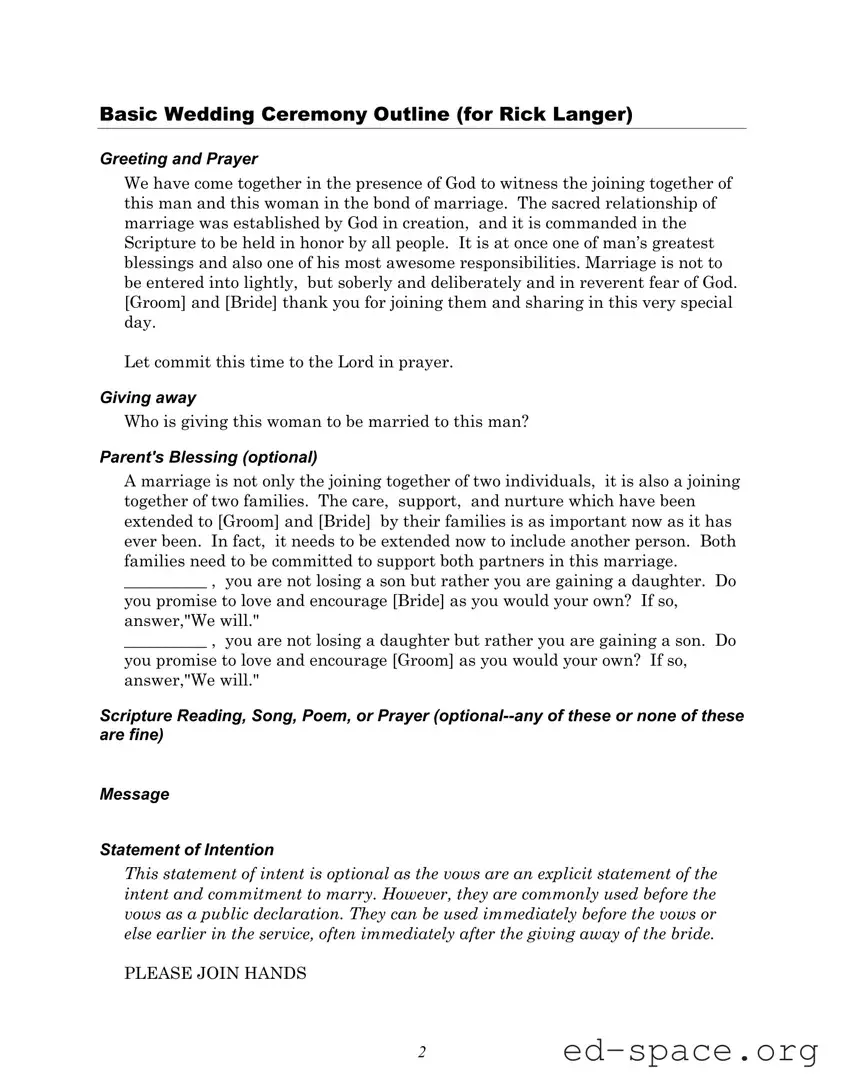
The Wedding Ceremony Script form serves as a vital tool for couples preparing to exchange their vows. It outlines the structure of the ceremony, ensuring that every important element is included and organized. This form typically encompasses various sections such as the introduction, readings, vows, and the pronouncement of marriage. Each component plays a significant role in creating a meaningful experience for the couple and their guests. Additionally, the form may include prompts for personal touches, allowing couples to infuse their unique stories and preferences into the ceremony. By utilizing this script, couples can effectively communicate their desires to officiants, ensuring that the ceremony reflects their values and traditions. Overall, the Wedding Ceremony Script form is essential for crafting a memorable and personalized wedding experience.

Basic Wedding Ceremony Outline (for Rick Langer)
Greeting and Prayer
We have come together in the presence of God to witness the joining together of this man and this woman in the bond of marriage. The sacred relationship of marriage was established by God in creation, and it is commanded in the Scripture to be held in honor by all people. It is at once one of man’s greatest blessings and also one of his most awesome responsibilities. Marriage is not to be entered into lightly, but soberly and deliberately and in reverent fear of God. [Groom] and [Bride] thank you for joining them and sharing in this very special day.
Let commit this time to the Lord in prayer.
Giving away
Who is giving this woman to be married to this man?
Parent's Blessing (optional)
A marriage is not only the joining together of two individuals, it is also a joining together of two families. The care, support, and nurture which have been extended to [Groom] and [Bride] by their families is as important now as it has ever been. In fact, it needs to be extended now to include another person. Both families need to be committed to support both partners in this marriage.
__________ , you are not losing a son but rather you are gaining a daughter. Do
you promise to love and encourage [Bride] as you would your own? If so, answer,"We will."
__________ , you are not losing a daughter but rather you are gaining a son. Do
you promise to love and encourage [Groom] as you would your own? If so, answer,"We will."
Scripture Reading, Song, Poem, or Prayer
Message
Statement of Intention
This statement of intent is optional as the vows are an explicit statement of the intent and commitment to marry. However, they are commonly used before the vows as a public declaration. They can be used immediately before the vows or else earlier in the service, often immediately after the giving away of the bride.
PLEASE JOIN HANDS
2
lawful wedded wife; and do you pledge before God and man to love, honor, and protect her through sunshine and shadow alike; keeping yourself unto her alone until death shall separate you? If so, answer “I Do”?
lawful wedded husband; and do you pledge before God and man to be to him a loving and true wife, through sunshine and shadow alike, keeping yourself unto him alone, until death shall separate you? If so, answer “I Do”
Vows
[Groom] , repeat after me:
I [Groom] take you [Bride], to be my wife, to have and to hold, from this day forward, for better or for worse, for richer or for poorer,
in sickness and in health, to love and to cherish, excluding all others,
as long as we both shall live. With God as my witness,
I give you my pledge.
[Bride], repeat after me:
I [Bride] take you [Groom] , to be my husband, to have and to hold, from this day forward, for better or for worse, for richer or for poorer, in sickness and in health, to love and to cherish, excluding all others,
as long as we both shall live. With God as my witness,
I give you my pledge.
Rings
You have chosen to seal you vows by the giving and receiving of rings. The ring forms a perfect circle, without a beginning or an end, and is thereby a symbol of eternity and signifies the duration of the commitment you are making. The gold of which the rings are made signify the purity and value of the relationship into which you enter. Let us now exchange these rings.
[Groom] /[Bride] You have the privilege of placing this ring on [Bride]/[Groom] finger in virtue of the exclusive covenant relationship into which you now enter. Repeat after me: I give you this ring, as a symbol of my vow, and with all that I am, and with all that I have, I will honor you.
3
Lighting of unity candle/Song (optional)
Prayer of Blessing
Pronouncement
And now, by the authority invested in me as a minister of the Gospel, and in accordance with the laws of the State of California, I now pronounce you man and wife. You may kiss the bride.
Introduction
It is my pleasure to introduce to you, for the very first time, Mr. and Mrs. [Last Name].
Recessional
Questions to consider
1.Do we want to include the Parent’s Blessing? If so, are there any special family dynamics which need to be resolved ahead of time?
2.Do we want to personalize vows or use traditional vows? (If you want personalized vows, please discuss with pastor ahead of time. Some sample vows are given below.)
3.Are there any special people we would like to include in the service itself? (For example, a friend or relative you would like to have do a special reading or a prayer of blessing etc.)
4.Have we made plans for songs/music and decided where we want them included in the service?
5.Do we have any special requests for the content of the message? (evangelistic message included, special verses, etc.)
4

Other sample services and ideas
These sample services and alternative vows and readings are taken in large measure from the Pastor’s Service Manual for the EFCA. Individual pastors do not follow these examples
EFCA Pastor’s Manual Ceremony
Call to worship
I delight greatly in the LORD; my soul rejoices in my God; For he has clothed me with garments of salvation and arrayed me in a robe of righteousness, as a bridegroom adorns his head like a priest, and as a bride adorns herself with jewels. (Isaiah 61:10)
Dear friends, God is love. Whoever lives in love lives in God, and God in him. In this way, love is made complete among us… (1 John 4:16)
Today we celebrate how wide and long and high and deep the love of Christ is, and we want to know this love that surpasses
Invocation
Invite God’s presence and recognize that marriage is part of his good plan. Ask God’s Spirit to supervise the service and sanctify all that happens.
Welcome
Greet the guests on behalf of the bride and groom. A few personal comments regarding the couple would be appropriate although not necessary.
Song or Special Music: Optional
Statement on Marriage:
Dearly beloved, we are assembled here in the presence of God, to join this Man and this Woman in holy marriage; which is instituted of God, regulated by His commandments, blessed by our Lord Jesus Christ, and to be held in honor among all men. Let us therefore reverently remember that God has established and sanctified marriage, for the welfare and happiness of mankind. Our Savior has declared that a man shall leave his father and mother and cleave unto his wife. By His apostles, He has instructed those who enter into this relation to cherish a mutual esteem and love; to bear with each other’s infirmities and
5
things; to pray for and encourage each other in the things which pertain to God; and to live together as the heirs of the grace of life.
Vows of Intent
These vows may also precede the Vows after the Charge, as two parts of the same Vows. Used at this point in the service, the implication is that the Bride’s Father is hearing these as a condition of giving his daughter.
G****, will you have this woman to be your wedded wife, to live together in holy marriage? Will you love her, comfort her, honor and keep her and forsaking all others, keep only unto her as long as you both shall live? (Groom answers, “I will.”)
B****, will you have this man to be your wedded husband, to live together in holy marriage? Will you love him, comfort him, honor and keep him and forsak- ing all others, keep only unto him as long as you both shall live? (Bride answers, “I will.”)
Giving of the Bride
Who gives this woman to be married to this man? Father: “Her mother and I.” (The father, guardian, brother or friend of the woman shall put the woman’s right hand in the right hand of the man. She may give him a kiss. At this point the wedding party may move forward to the
Song or Special Music Optional
Scripture passages to consider
Genesis
Song
Isaiah
1 Corinthians 13 - The love chapter
Ephesians
2 Peter
6
Message
Vows
The pastor may say, “Will you now make your vows to one another?” The man and the woman are to face each other, holding hands. The Bride gives her flowers to the Maid of Honor.
The Groom repeats the vow after the pastor as follows:
I, G****, take you B****, to be my wedded wife, / to have and to hold from this day forward, / for better for worse, / for richer, for poorer, / in sickness and in health, / to love and to cherish, till death us do part, / according to God’s holy plan / and with God’s gracious help.
[Alternative ending: …according to God’s holy ordinance; / and thereto I pledge to you my
The Bride repeats the vow after the pastor as follows:
I, B****, take you, G****, to be my wedded husband, / to have and to hold from this day forward, / for better for worse, / for richer, for poorer, / in sickness and in health, / to love and to cherish, till death us do part, / according to God’s holy plan / and with God’s gracious help.
Giving of Rings
You have determined to seal your vows by the giving and receiving of rings. Rings are a sacred symbol, signaling to others that you are in an exclusive commitment to your beloved. The precious metal from which they are forged reminds you of the precious possession you have in marriage. And the infinite circle they form remind you that your new relationship is never to end.
G****, indicating your responsibility to B**** to receive her into your care and keeping, I give you this ring to place on her finger, as both a symbol and promise that you receive her. Just as this ring circles her finger, so you are to encompass her with strength and protecting love.
Groom (repeating after the pastor):
B****, this ring I give you / as a constant reminder / of my abiding love and commitment.
B****, indicating your responsibility to G****, to receive him into your care and devotion, I give you this ring to place on his finger as both a symbol and promise that you receive him. Just as this ring circles his finger, so you are to encompass him with strength and protecting love.
Bride (repeating after the pastor):
G****, this ring I give you / as a constant reminder / of my abiding love and commitment.
7
[Alternative: This ring I give you / in token and pledge / of our constant faith and abiding love.]
Optional: Unity Candle
Special music is often done during the Unity Candle ceremony. Another alter- native is the reading of Gen.
Prayer of Dedication
Couples may kneel if a kneeling bench is provided. The Lord’s Prayer may be spoken or sung at the conclusion of this prayer.
Our eternal Father, send your blessing upon G**** and B****, whom we bless in your name, that they may live faithfully together. May they keep the vows they have made, and may they remain ever in perfect love and peace
Pronouncement
For inasmuch as G**** and B**** have consented together in holy wedlock, and have witnessed the same before God and this company, and thereto have pledged their faith each to the other, and have declared the same by joining hands and by giving and receiving rings, I pronounce that they are husband and wife together, in the name of the Father and of the Son and of the Holy Spirit. Those whom God has joined together, let not man put asunder.
Kiss
You may kiss your bride.
Benediction
“The LORD bless you and keep you; The LORD make His face shine upon you and be gracious unto you. The LORD turn his face toward you and give you peace” (Numbers
Presentation of Couple
(The bride retrieves her flowers from the Maid of Honor and the couple turns to face the congregation.) It gives me great delight to introduce to you Mr. and Mrs_____________.
8

Special elements & alternative wordings and readings
Call to Worship
Of all the honored guests at this occasion, the One most special, most honored, will be the Lord God Almighty, our heavenly Father and loving Savior. In mercy, he will shield us from his shining presence. His voice, which unleashed is like the sound of many waters, will only whisper silently in hearts. But he is certainly here, for the creation of a home is his doing as surely as the creation of oceans or oaks. While this is G**** and B****’s special day, we would be remiss not to acknowledge such a royal Visitor, such a holy Guest. It is his presence that will make this day truly significant. It is his listening that makes these vows so
Invocation
Lord, we invite you to take the place of honor at this wedding. We are grateful that you would come. To think that the God who is robed in unapproachable light would bring his glory to this service, that the King who reigns over all the universe from his sapphire throne would bring his dignity and grandeur to this ceremony, that the Savior who blessed little children and the Creator of roses would bring his tenderness and beauty to this celebration leaves us in awe. Loving Father, thank you for being here with us. May G**** and B**** have a special sense and appreciation of the privilege of your presence. We know that this warm favor is only ours through the graces of Jesus Christ so it is in his name we pray this. Amen.
Statements on Marriage
G**** and B****, marriage is an honorable estate whose bond and covenant was instituted by God in creation. Our Lord Jesus Christ adorned and beautified this holy estate by his presence and first miracle at a wedding in Cana of Galilee.
Marriage signifies to us the mystery of the union between Christ and his church. And Scripture commands that marriage be honored among all people. Therefore, no one should enter this state of life unadvisedly, lightly, or wantonly; but reverently, discreetly, advisedly, soberly, and in the fear of God; duly considering the causes for which matrimony was ordained.
At the beginning of the Bible, we discover the first instance of the marriage state when Adam discovers Eve and exclaims, “This at last is bone from my bones and flesh from my flesh.” So intimate is this oneness between male and female that in the New Testament Paul uses it to illustrate the intimacy between Christ and the church. He also draws a clear line separating the distinctive functions of
9
husband and wife, when he instructs the woman to be
Charge to Family and Friends: A brief challenge to recognize the holiness of this new union and to do all in their power to support it, holding this couple to their vows. (This might also be after the rings and unity candle.)
Thanks to Parents: Personal words to families and/or friends. Flowers or some other token of love and honor may be given at this point.
Prayer or Blessing by Parents: If there are believing parents, the families/ parents may gather with Bride and Groom for prayers together. These may be quiet, while music plays, or prayed for all to hear, perhaps by the fathers.
Professions of Faith
Many couples want to make their Christian faith explicit, especially when there are many unbelievers present. They may repeat a creed, have a Bible text read, offer words of testimony, have the pastor summarize their testimonies, or be sure the pastor’s charge includes the elements of the gospel.
Communion
Following the Ring Ceremony, just before or after the Unity Candle.
There are differences of opinion whether or not Communion belongs in a wedding ceremony. Those arguing against suggest that since the Lord’s Supper is meant to be a meal for the entire congregation, and since that is seldom practical in a wedding, it is inappropriate. On the other hand, other pastors believe that having a believing couple partake affords them an opportunity to express their faith through this very significant Christian symbol. Think through your theological approach. Special music may provide a suitable background to this solemn moment.
Family Blessing, or Vows to Receive Children
Occasionally, someone comes to the marriage with children. Vows such as these might be useful after the wedding vows.
________, when you marry ________ you are also making a commitment to
her/his children. To love ________ means you want to love and care for her/his
children as well. You have asked to make this commitment publicly so I put before you these questions:
10
•Do you understand that in marrying _______ you agree to love her/his children even as you love her/him? I do.
•Do you promise to love and care for her/his children as you would your own? I do.
•Will you work with _______ to create a home where these children will learn about the love of God in Christ, both through your teaching and your example? I will.
•Will you make it your practice to pray for and with these children? I will.
Blessing of the Couple by Older Children
The following provides an opportunity for the couple to pledge their care for a new blended family, and for the children to bless the couple. The children gather with the couple and the pastor begins…
Today we celebrate not only a new relationship between G**** and B****, but also the beginning of new relationships between their children—
touched by the covenant their parents enter into today. It will both complicate and enrich their lives. They, too, will have much to contribute and will need to help create a home and a way of life in which all of you will grow into the best people you can be. G**** and B****, as you give yourselves to one another in love and loyalty, do you promise always to keep room in your life together for
___children’s names___? Will you commit yourselves to respect and honor them as individuals? Do you pledge now to cherish, encourage and tenderly care for them as long as they need you? Yes, we do.
The children will now give their blessing to this marriage:
We (I) wish to offer to both of you our blessing and congratulations. We love you deeply and we are delighted that you have found each other. We want you to know that just as you have always loved and supported us, we promise our love and our support for your new relationship. It is our wish for you that you live fully and deeply and that your lives together will be richer and more fulfilling than either could be alone.
Pronouncement
And now, having heard you make these pledges of your affection and take these vows of fidelity, I do, by virtue of the authority vested in me, as a minister of the gospel and in accordance with the laws of God and the State of ______,
pronounce you husband and wife, no longer two, but now one, in the name of the Father and of the Son and of the Holy Spirit.
Or…
Inasmuch as G**** and B**** have consented together to marriage, and have made their vows before God and these witness, and have symbolized their vows by giving and receiving rings, I pronounce that they are husband and wife. Those whom God has joined, let no one separate.
11
| Fact Name | Description |
|---|---|
| Purpose | The Wedding Ceremony Script form is used to outline the structure and content of a wedding ceremony, ensuring all essential elements are included. |
| State-Specific Requirements | Different states may have specific requirements for what must be included in the ceremony script, such as vows, readings, and legal declarations. |
| Governing Laws | In states like California, the Family Code governs marriage ceremonies, while in New York, the Domestic Relations Law provides the necessary guidelines. |
| Signature Requirement | Typically, the officiant and witnesses must sign the script to validate the ceremony, although specific requirements can vary by state. |
| Customization | The script can be customized to reflect the couple's personalities, beliefs, and cultural traditions, making each ceremony unique. |
| Legal Implications | Failure to adhere to state laws in the script can result in an invalid marriage, so it is crucial to ensure compliance with local regulations. |
Filling out the Wedding Ceremony Script form is an important step in planning a wedding. Completing this form accurately will help ensure that the ceremony reflects the couple's wishes and preferences. Follow the steps below to fill out the form correctly.
What is the Wedding Ceremony Script form?
The Wedding Ceremony Script form is a document that helps couples outline the details of their wedding ceremony. It serves as a guide for officiants, ensuring that the ceremony reflects the couple's wishes and includes all necessary elements, such as vows, readings, and rituals. This form can help streamline the planning process and ensure that nothing is overlooked on the big day.
Who should fill out the Wedding Ceremony Script form?
Typically, the couple getting married will fill out this form. However, it can also involve input from the officiant, wedding planner, or family members. It’s important that the couple's preferences and personalities shine through in the script, so open communication is essential during this process.
What information is required on the form?
The form generally asks for key details such as the names of the couple, the date and location of the ceremony, and any specific readings or rituals they wish to include. Additionally, it may request information about the officiant and any special requests or personal touches that the couple desires. This ensures that the ceremony is uniquely theirs.
Can we customize the Wedding Ceremony Script?
Absolutely! The Wedding Ceremony Script form is designed to be flexible. Couples are encouraged to personalize their scripts to reflect their values, beliefs, and relationship. Whether it’s including a favorite poem, a cultural tradition, or specific vows, customization is not only allowed but encouraged.
How far in advance should we complete the form?
It is advisable to complete the Wedding Ceremony Script form several weeks before the wedding date. This allows ample time for revisions and discussions with the officiant. Completing the form early ensures that everyone involved has a clear understanding of the ceremony and can prepare accordingly.
What if we need help filling out the form?
If you find yourself unsure about how to fill out the form, don’t hesitate to seek assistance. Many officiants are happy to guide couples through the process. Additionally, wedding planners can provide valuable insights and suggestions to help you create a meaningful ceremony script.
Is there a deadline for submitting the form?
While specific deadlines may vary based on the officiant or venue, it’s generally a good idea to submit the completed form at least two weeks prior to the wedding. This allows enough time for the officiant to review the details and make any necessary adjustments, ensuring a smooth ceremony.
What happens after we submit the form?
Once you submit the Wedding Ceremony Script form, your officiant will review it and may reach out for any clarifications or additional information. They will then use the details provided to prepare for your ceremony. This preparation is crucial for ensuring that the ceremony runs smoothly and aligns with your vision.
Not providing complete names for all parties involved. It is important to include the full names of the couple, as well as any officiants or participants.
Forgetting to specify the date and time of the ceremony. This information is crucial for scheduling and coordination.
Neglecting to mention the location of the ceremony. Providing a complete address helps avoid confusion on the day of the event.
Omitting details about the ceremony style. Indicating whether the ceremony is religious, civil, or themed ensures that the script aligns with the couple's vision.
Failing to include personal vows or readings. If the couple wishes to incorporate unique elements, these should be clearly noted in the form.
Not specifying the order of events. A clear outline helps the officiant and participants understand their roles during the ceremony.
Ignoring the need for special requests. Any unique rituals or traditions should be mentioned to ensure they are included.
Using unclear or ambiguous language. Clear and direct instructions help avoid misunderstandings.
Overlooking the need for contact information. Providing a phone number or email for follow-up questions is essential.
Submitting the form without reviewing it. Double-checking all entries can prevent errors and ensure accuracy.
Planning a wedding involves a variety of important documents that help ensure the ceremony goes smoothly. Each of these forms serves a specific purpose, contributing to the overall organization and legality of the event. Below is a list of documents commonly used alongside the Wedding Ceremony Script form.
Each of these documents plays a vital role in the wedding planning process. By organizing and preparing these forms, couples can focus on enjoying their special day without unnecessary stress.
The Wedding Ceremony Script form shares similarities with several other documents commonly used in wedding planning and ceremonies. Below is a list of six such documents, each highlighting how they relate to the Wedding Ceremony Script form.
When filling out the Wedding Ceremony Script form, it's important to follow certain guidelines to ensure clarity and effectiveness. Below is a list of things you should and shouldn't do.
Many couples planning their wedding may encounter various misconceptions about the Wedding Ceremony Script form. Understanding the truth behind these misconceptions can help ensure a smooth and meaningful ceremony. Here are ten common misunderstandings:
By dispelling these misconceptions, couples can approach their wedding ceremony with confidence and clarity, ensuring a memorable experience for everyone involved.
When preparing for a wedding ceremony, utilizing a Wedding Ceremony Script form can streamline the process. Here are key takeaways to consider:
By keeping these points in mind, couples can create a memorable and smooth wedding ceremony that reflects their love and commitment.