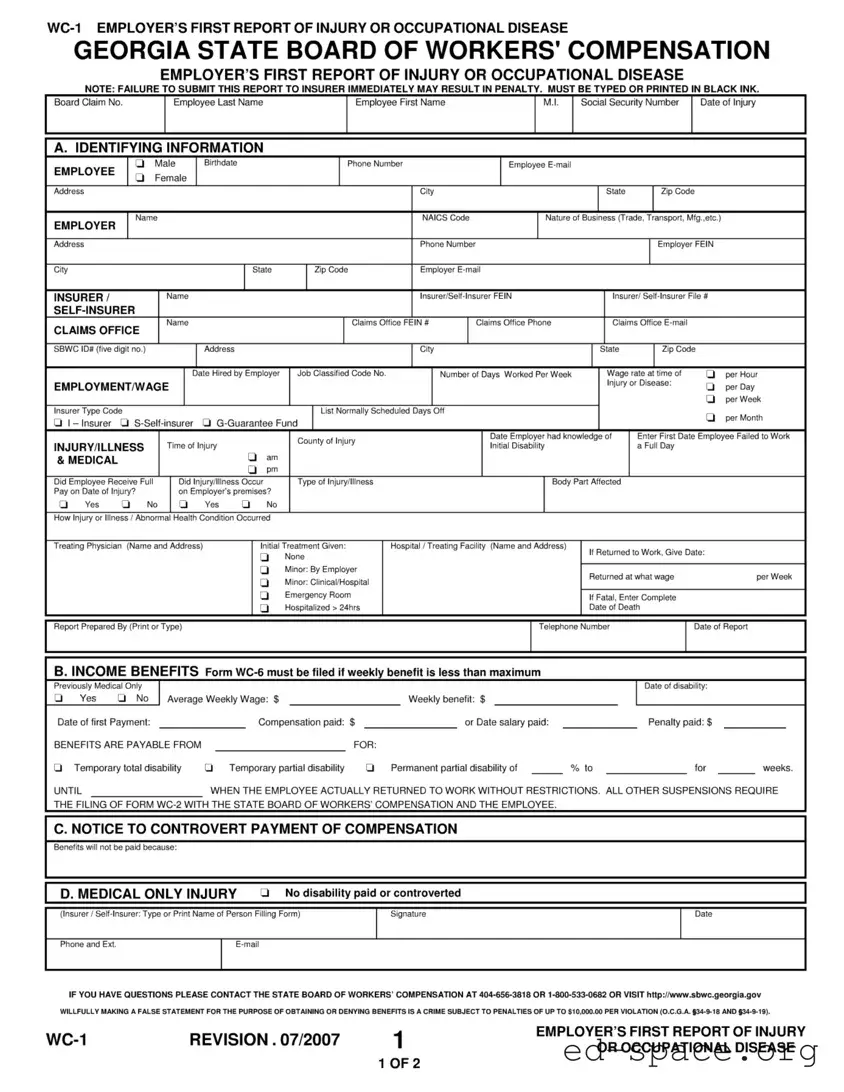
The WC-1 form, known as the Employer’s First Report of Injury or Occupational Disease, is a crucial document in the workers' compensation process in Georgia. This form must be completed promptly by employers following any workplace injury or occupational disease. It captures essential details such as the employee’s identifying information, the nature of the injury, and the circumstances surrounding it. Employers are required to submit this report to their insurance company or self-insurer claims office immediately upon knowledge of the injury, as delays can lead to penalties. The form also includes sections for reporting wage information and income benefits, ensuring that employees receive the compensation they are entitled to. Additionally, the WC-1 serves as a communication tool, informing both the insurer and the injured employee about the status of the claim. Understanding the WC-1 form is vital for employers, employees, and insurers alike, as it lays the groundwork for the subsequent steps in the workers' compensation process.
| Fact Name | Details |
|---|---|
| Form Title | Employer's First Report of Injury or Occupational Disease |
| Governing Law | O.C.G.A. § 34-9-18 and § 34-9-19 |
| Submission Requirement | This form must be submitted immediately to the insurer or self-insurer. |
| Penalties | Failure to submit the report may result in penalties. |
| Employee Information | Includes employee's name, address, Social Security number, and date of injury. |
| Medical Treatment | Initial treatment options must be indicated, including hospitalization details. |
Filling out the WC-1 form is an important step in reporting an employee's injury or occupational disease in Georgia. It is essential to provide accurate information to ensure compliance with state regulations. The following steps will guide you through the process of completing this form correctly.
After completing the form, it must be submitted to the insurance company or self-insurer claims office immediately. Remember, failure to submit this report promptly may result in penalties. Keep a copy for your records, as it may be needed for future reference.
What is the WC-1 form in Georgia?
The WC-1 form, also known as the Employer's First Report of Injury or Occupational Disease, is a document that employers must complete when an employee suffers a work-related injury or illness. This form is essential for initiating the workers' compensation process and must be submitted to the employer's insurance company or self-insurer claims office promptly.
When should the WC-1 form be submitted?
The WC-1 form should be submitted immediately after the employer becomes aware of the injury or occupational disease. Timely reporting is crucial, as failure to do so may result in penalties for the employer. It is important to ensure that the form is filled out accurately and completely to avoid delays in processing the claim.
What information is required on the WC-1 form?
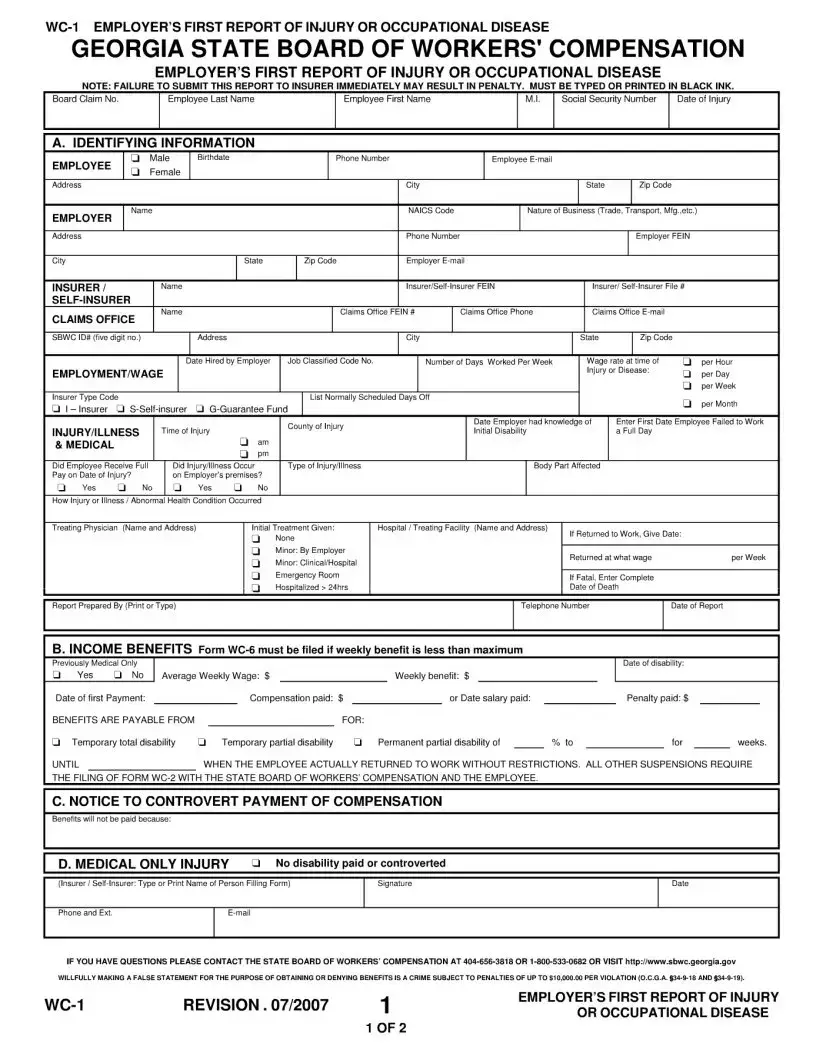
The WC-1 form requires detailed information about the employee, the employer, and the circumstances of the injury. This includes the employee's name, Social Security number, date of injury, nature of the injury, and details about the employer and insurance provider. Additionally, it asks for information regarding the employee's wage rate and whether they received full pay on the date of injury.
What happens if the injury is serious?
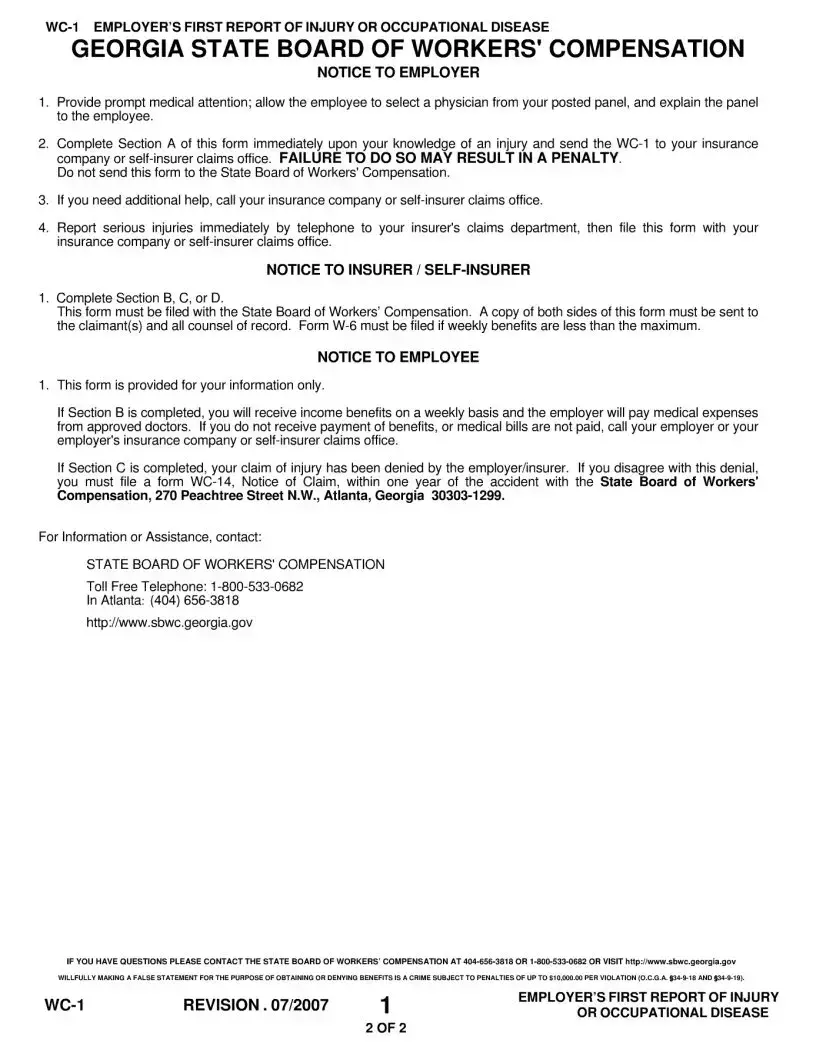
If the injury is serious, the employer must report it immediately to the insurer's claims department by telephone. Following this verbal report, the WC-1 form should be completed and sent to the insurance company or self-insurer claims office. This ensures that the employee receives the necessary medical attention and that the claim is processed without unnecessary delays.
What should employees know about the WC-1 form?
Employees should understand that the WC-1 form is primarily for their employer's use. If the form indicates that benefits will be provided, employees can expect to receive weekly income benefits and have their medical expenses covered by approved doctors. If the claim is denied, employees have the right to appeal the decision by filing a WC-14 form within one year of the incident.
What are the consequences of submitting false information on the WC-1 form?
Submitting false information on the WC-1 form is considered a serious offense. It is classified as a crime and can result in penalties of up to $10,000 per violation. Employers and employees alike should ensure that all information provided is truthful and accurate to avoid legal repercussions.
How does the WC-1 form relate to other forms in the workers' compensation process?
The WC-1 form is just the first step in the workers' compensation process. Depending on the circumstances, additional forms may be required. For example, if the weekly benefits are less than the maximum allowed, a WC-6 form must be filed. If there are disputes regarding the claim, the WC-14 form can be used to contest a denial.
Who should be contacted for questions regarding the WC-1 form?
If there are any questions or concerns about the WC-1 form or the workers' compensation process, it is advisable to contact the employer's insurance company or self-insurer claims office. Additionally, the State Board of Workers' Compensation can provide guidance and assistance in navigating the claims process.
What should employers do if they need assistance with the WC-1 form?
Employers needing assistance with the WC-1 form should reach out to their insurance company or self-insurer claims office. They can provide guidance on completing the form accurately and help ensure compliance with state regulations. Prompt communication is key to managing workers' compensation claims effectively.
Inaccurate Employee Information: Failing to provide correct details such as the employee's name, Social Security number, or birthdate can lead to delays or complications in processing the claim.
Missing Injury Details: Not specifying the date, time, and nature of the injury can result in insufficient information for the insurer to assess the claim properly.
Neglecting Employer Information: Omitting essential employer details, such as the employer's address or FEIN, may hinder the claim process.
Incorrect Wage Reporting: Providing inaccurate wage information or failing to specify the wage rate at the time of injury can affect the calculation of benefits.
Failure to Sign the Form: Not signing the form or having an authorized person sign can lead to the rejection of the claim.
Submitting to the Wrong Entity: Sending the form to the State Board of Workers’ Compensation instead of the insurance company or self-insurer can cause unnecessary delays.
Ignoring Submission Deadlines: Delaying the submission of the WC-1 form may result in penalties and complications in the claim process.
The WC-1 Georgia form is essential for reporting workplace injuries or occupational diseases. Several other forms and documents are often used in conjunction with the WC-1 to ensure proper handling of claims and benefits. Below is a list of these documents, along with a brief description of each.
Using these forms correctly helps streamline the claims process and ensures that both employees and employers understand their rights and responsibilities. Accurate and timely submissions are crucial for the effective management of workers' compensation claims.
The WC-1 Georgia form serves as a crucial document for reporting workplace injuries or occupational diseases. Several other documents share similarities with the WC-1 in terms of purpose and required information. Below is a list of seven such documents, each explained in relation to the WC-1.
When filling out the WC-1 Georgia form, it’s important to follow specific guidelines to ensure accuracy and compliance. Here are some dos and don’ts:
Understanding the WC-1 Georgia form is crucial for employers and employees involved in workplace injuries. However, several misconceptions can lead to confusion and mismanagement of claims. Below are seven common misconceptions about the WC-1 form:
This is incorrect. The WC-1 form should be sent directly to the insurance company or self-insurer claims office, not to the State Board.
While the employer initiates the report, the insurer or self-insurer must also complete relevant sections before submission.
Submitting the form is mandatory regardless of the perceived severity of the injury. Failure to do so may result in penalties.
Employers must inform employees about the WC-1 process, especially regarding their rights and the benefits they may receive.
The form must be typed or printed in black ink only, as per the guidelines provided.
Timely submission is critical. The employer must complete the form immediately upon knowledge of the injury.
In some cases, additional forms such as the WC-6 or WC-14 may be necessary depending on the circumstances of the claim.
By addressing these misconceptions, employers and employees can better navigate the workers' compensation process in Georgia.
Key Takeaways for the WC-1 Georgia Form: