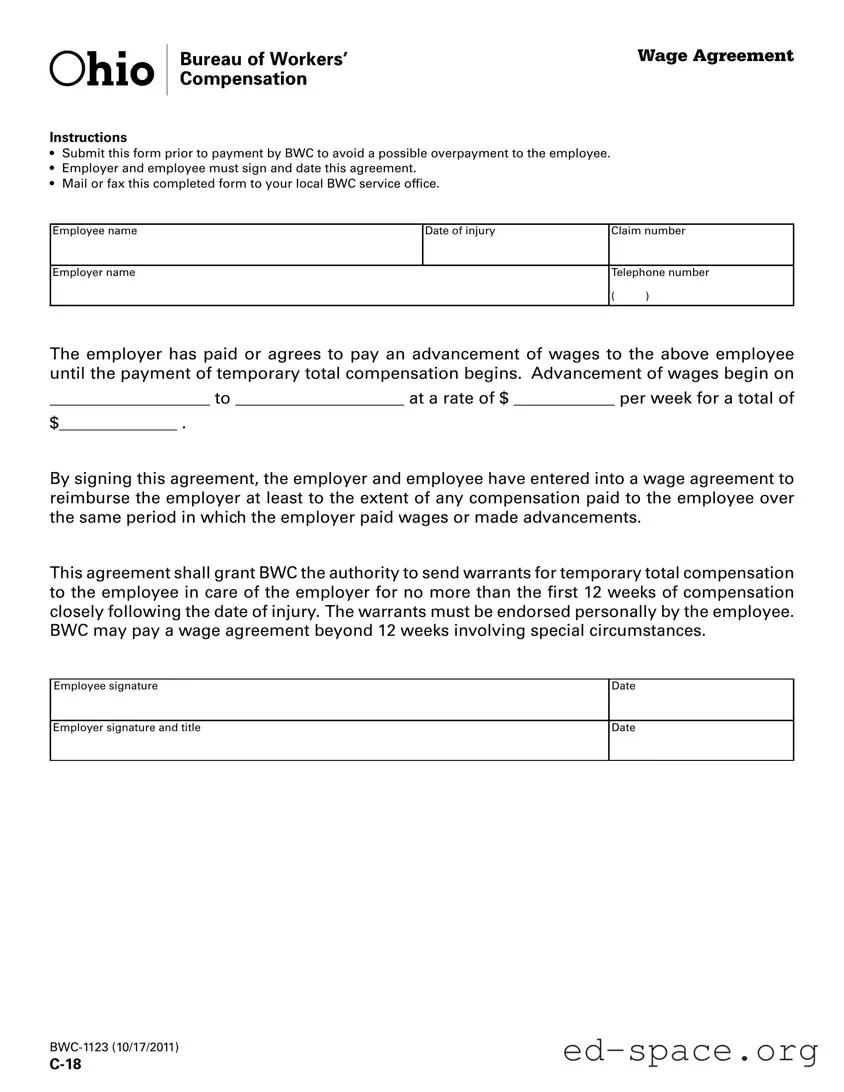
The Wage Agreement Ohio form plays a crucial role in the interaction between employers, employees, and the Bureau of Workers' Compensation (BWC). Designed to facilitate wage advancements during a period of temporary total compensation, this form must be submitted before any payment is made by the BWC to prevent potential overpayments to the employee. It requires both the employer and employee to provide their signatures and dates, ensuring mutual agreement on the terms outlined. The form captures essential details such as the employee's name, date of injury, claim number, and employer information, including a contact telephone number. The specifics of the wage advancement, including the start and end dates and the weekly rate, are also documented. By signing this agreement, both parties acknowledge that the employer will receive reimbursement for any wages paid during the time the employee is receiving compensation from the BWC. Notably, the form grants the BWC the authority to send compensation warrants directly to the employer for a maximum of 12 weeks, simplifying the process for all involved. The employee must endorse these warrants personally, ensuring that funds are managed appropriately. In certain circumstances, the BWC may extend this wage agreement beyond the initial 12-week period, providing additional support when necessary.
Wage Agreement
INSTRUCTIONS
•Submit this form prior to payment by BWC to avoid a possible overpayment to the employee.
•Employer and employee must sign and date this agreement.
•Mail or fax this completed form to your local BWC service ofice.
Employee name |
Date of injury |
Claim number |
|
|
|
|
|
Employer name |
|
Telephone number |
|
|
|
( |
) |
|
|
|
|
The employer has paid or agrees to pay an advancement of wages to the above employee until the payment of temporary total compensation begins. Advancement of wages begin on
___________________ to ____________________ at a rate of $ ____________ per week for a total of
$______________ .
By signing this agreement, the employer and employee have entered into a wage agreement to reimburse the employer at least to the extent of any compensation paid to the employee over the same period in which the employer paid wages or made advancements.
This agreement shall grant BWC the authority to send warrants for temporary total compensation to the employee in care of the employer for no more than the irst 12 weeks of compensation closely following the date of injury. The warrants must be endorsed personally by the employee. BWC may pay a wage agreement beyond 12 weeks involving special circumstances.
Employee signature
Date
Employer signature and title
Date
| Fact Name | Details |
|---|---|
| Purpose | This form is used to establish a wage agreement between an employer and an employee, allowing the employer to pay an advancement of wages until temporary total compensation begins. |
| Signatures Required | Both the employer and employee must sign and date the form to validate the agreement. |
| Submission Instructions | The completed form should be mailed or faxed to the local Bureau of Workers' Compensation (BWC) service office before any payment is made. |
| Governing Law | This form is governed by Ohio workers' compensation laws, specifically related to temporary total compensation and wage advancements. |
After completing the Wage Agreement Ohio form, it should be submitted to avoid any potential overpayment issues. Both the employer and employee must sign the document, and it should be sent to the local BWC service office via mail or fax.
What is the purpose of the Wage Agreement Ohio form?
The Wage Agreement Ohio form is designed to formalize an arrangement between the employer and employee regarding the advancement of wages during the period before temporary total compensation begins. This agreement helps to prevent potential overpayments to the employee by the Bureau of Workers' Compensation (BWC).
Who needs to sign the Wage Agreement Ohio form?
Both the employer and the employee are required to sign and date the Wage Agreement Ohio form. This ensures that both parties acknowledge and agree to the terms outlined in the agreement.
What information is required to complete the form?
The form requires several key pieces of information, including the employee's name, date of injury, claim number, employer's name, and the employer's telephone number. Additionally, the form must specify the period during which wage advancements will be made and the amount of those advancements.
How long can the wage advancements be made under this agreement?
Wage advancements can be made for a maximum of 12 weeks following the date of injury. However, under special circumstances, the BWC may approve wage agreements that extend beyond this 12-week period.
What happens if the employer pays wages that exceed the compensation amount?
If the employer pays wages that exceed the amount of temporary total compensation, the agreement stipulates that the employer will be reimbursed at least to the extent of the compensation paid to the employee during the same period.
How should the completed form be submitted?
The completed Wage Agreement Ohio form should be mailed or faxed to the local BWC service office. It is essential to submit the form prior to any payment being made to ensure compliance and avoid overpayment issues.
What is the role of BWC in this agreement?
The BWC is responsible for sending warrants for temporary total compensation to the employee, in care of the employer, for the duration specified in the agreement. The employee must personally endorse these warrants to receive the compensation.
What should be done if there are special circumstances requiring an extension of the wage agreement?
In cases where special circumstances arise that necessitate an extension beyond the standard 12-week period, the employer or employee should contact the BWC to discuss the situation and determine the appropriate steps to take for approval.
Neglecting to submit the form on time. The Wage Agreement form must be submitted before any payment is made by BWC to prevent potential overpayment issues.
Failure to obtain signatures. Both the employer and employee must sign and date the agreement. Without these signatures, the form is incomplete.
Incorrectly filling in the dates. The period for which the advancement of wages is provided must be clearly stated. Ensure the start and end dates are accurate.
Omitting the claim number. This number is crucial for processing. Without it, the BWC may not be able to link the agreement to the correct claim.
Leaving the wage amount blank. Specify the weekly rate of pay and total amount clearly. Missing this information can delay processing.
Not mailing or faxing to the correct BWC service office. Ensure that the completed form is sent to the appropriate local office to avoid processing delays.
Ignoring the endorsement requirement. The employee must endorse the warrants personally. Failing to do so can result in complications with receiving payments.
The Wage Agreement Ohio form is an important document used to outline the terms of wage advancements made by an employer to an employee following a workplace injury. Several other forms and documents are commonly utilized in conjunction with this agreement to ensure proper compliance and communication between all parties involved. Below is a list of these related forms.
These forms collectively support the administration of workers' compensation claims and ensure that both employers and employees fulfill their obligations. Proper use of these documents helps facilitate a smoother claims process and protects the rights of all parties involved.
The Wage Agreement Ohio form serves a specific purpose in managing wage advancements for employees. However, several other documents share similar functions or processes. Here’s a look at four such documents:
When filling out the Wage Agreement Ohio form, it's essential to follow certain guidelines to ensure accuracy and compliance. Here’s a list of things to do and avoid:
Misconceptions about the Wage Agreement Ohio form can lead to confusion for both employers and employees. Here are seven common misunderstandings:
Understanding these points can help ensure compliance with the Wage Agreement Ohio form and facilitate smoother interactions with the BWC.
When filling out and using the Wage Agreement Ohio form, keep the following key points in mind: