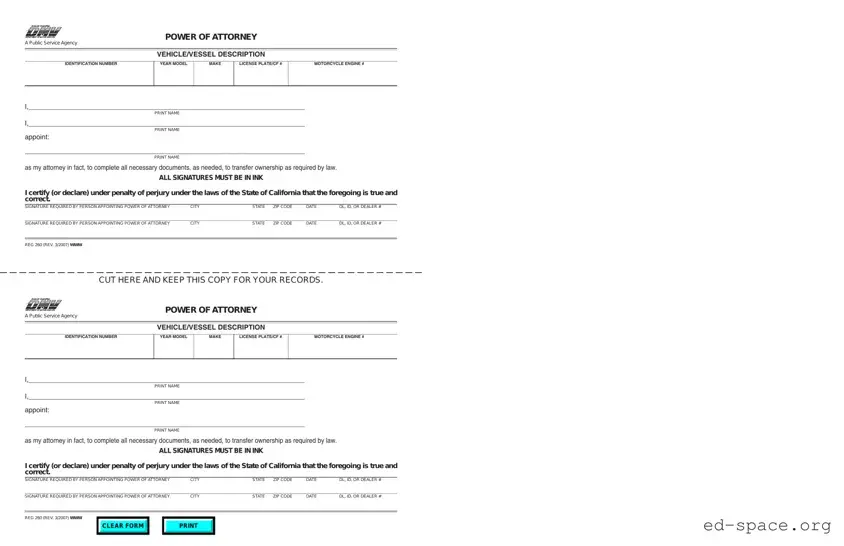
The Vehicle Power of Attorney (POA) REG 260 form is an essential document for vehicle owners in the United States, particularly when they need to delegate authority regarding their vehicle to another individual. This form allows the vehicle owner to authorize someone else to act on their behalf in matters related to the vehicle, such as transferring title, registering the vehicle, or obtaining a duplicate title. By completing the REG 260, the vehicle owner can ensure that their interests are protected while also streamlining processes that may otherwise require their personal presence. The form typically requires specific information, including the vehicle’s identification details, the name and contact information of the designated agent, and the duration of the granted authority. This clarity helps prevent misunderstandings and ensures that the designated agent can effectively manage the vehicle-related tasks assigned to them. Understanding the implications and requirements of the Vehicle POA REG 260 form is crucial for any vehicle owner who may find themselves in a situation where they cannot be present to handle these matters personally.
POWER OF ATTORNEY
A Public Service Agency
VEHICLE/VESSEL DESCRIPTION
IDENTIFICATION NUMBER
YEAR MODEL
MAKE
LICENSE PLATE/CF #
MOTORCYCLE ENGINE #
I,________________________________________________________________________
PRINT NAME
I,________________________________________________________________________
PRINT NAME
appoint:
_________________________________________________________________________
PRINT NAME
as my attorney in fact, to complete all necessary documents, as needed, to transfer ownership as required by law.
ALL SIGNATURES MUST BE IN INK
I certify (or declare) under penalty of perjury under the laws of the State of California that the foregoing is true and correct.
SIGNATURE REQUIRED BY PERSON APPOINTING POWER OF ATTORNEY |
CITY |
STATE |
ZIP CODE |
DATE |
DL, ID, OR DEALER # |
|
|
|
|
|
|
SIGNATURE REQUIRED BY PERSON APPOINTING POWER OF ATTORNEY |
CITY |
STATE |
ZIP CODE |
DATE |
DL, ID, OR DEALER # |
|
|
|
|
|
|
|
|
|
|
|
|
REG 260 (REV. 3/2007) WWW |
|
|
|
|
|
CUT HERE AND KEEP THIS COPY FOR YOUR RECORDS.
POWER OF ATTORNEY
A Public Service Agency
VEHICLE/VESSEL DESCRIPTION
IDENTIFICATION NUMBER
YEAR MODEL
MAKE
LICENSE PLATE/CF #
MOTORCYCLE ENGINE #
I,________________________________________________________________________
PRINT NAME
I,________________________________________________________________________
PRINT NAME
appoint:
_________________________________________________________________________
PRINT NAME
as my attorney in fact, to complete all necessary documents, as needed, to transfer ownership as required by law.
ALL SIGNATURES MUST BE IN INK
I certify (or declare) under penalty of perjury under the laws of the State of California that the foregoing is true and correct.
SIGNATURE REQUIRED BY PERSON APPOINTING POWER OF ATTORNEY |
CITY |
STATE |
ZIP CODE |
DATE |
DL, ID, OR DEALER # |
|
|
|
|
|
|
SIGNATURE REQUIRED BY PERSON APPOINTING POWER OF ATTORNEY |
CITY |
STATE |
ZIP CODE |
DATE |
DL, ID, OR DEALER # |
REG 260 (REV. 3/2007) WWW
CLEAR FORM
| Fact Name | Details |
|---|---|
| Purpose | The Vehicle POA REG 260 form allows an individual to grant power of attorney to another person for vehicle-related transactions. |
| Governing Law | This form is governed by the laws of the state in which it is filed, specifically under vehicle code regulations. |
| Usage | It is commonly used for tasks such as title transfers, registration, and obtaining duplicate titles. |
| Signature Requirement | The form must be signed by the vehicle owner, indicating their consent to delegate authority. |
| Validity | The power of attorney granted through this form remains valid until revoked by the principal. |
| Notarization | In some states, notarization may be required to enhance the form's legal standing. |
| Revocation Process | To revoke the power of attorney, the principal must submit a written notice to the agent and any relevant authorities. |
| Accessibility | The form is typically available through state Department of Motor Vehicles (DMV) websites and offices. |
Once you have the Vehicle POA REG 260 form in hand, it's time to fill it out accurately. This form is essential for designating someone to act on your behalf regarding vehicle matters. Follow these steps to ensure you complete it correctly.
After filling out the form, double-check all the information to ensure accuracy. Once everything is correct, you can submit the form to the appropriate agency or give it to the designated individual. This will empower them to act on your behalf regarding your vehicle.
What is the Vehicle POA REG 260 form?
The Vehicle Power of Attorney (POA) REG 260 form is a legal document that allows you to appoint someone else to act on your behalf regarding vehicle-related matters. This can include tasks such as transferring ownership, registering a vehicle, or handling other administrative duties with the Department of Motor Vehicles (DMV). By using this form, you grant specific authority to another individual, making it easier for them to assist you with your vehicle needs.
Who can be designated as an agent on the REG 260 form?
You can designate any individual as your agent, provided they are at least 18 years old and capable of handling the responsibilities you assign to them. This could be a family member, friend, or even a professional, such as a lawyer or a dealership representative. It is essential to choose someone you trust, as they will have the authority to act on your behalf regarding your vehicle.
How do I complete the REG 260 form?
To complete the REG 260 form, you will need to fill in your personal information, such as your name, address, and vehicle details. You will also need to provide the name and address of the person you are appointing as your agent. Ensure that all information is accurate and complete. After filling out the form, both you and your agent must sign it. It is advisable to keep a copy for your records.
Do I need to have the REG 260 form notarized?
No, the Vehicle POA REG 260 form does not require notarization. However, some individuals may choose to have it notarized for added security and validation. If you decide to notarize the document, it can help reinforce its legitimacy, especially in situations where the agent may need to present the form to third parties.
Can I revoke the Vehicle POA REG 260 form once it is completed?
Yes, you have the right to revoke the Vehicle POA at any time. To do this, you should create a written notice stating that you are revoking the authority granted to your agent. It is important to inform your agent and any relevant parties, such as the DMV, about the revocation to prevent any confusion or unauthorized actions.
Is there a specific time frame for the Vehicle POA to remain valid?
The Vehicle POA REG 260 form does not have a set expiration date. It remains valid until you revoke it or until the specific task for which it was created is completed. If you have appointed an agent for a particular transaction, once that transaction is finalized, the authority may no longer be necessary.
What should I do if my agent is unable to fulfill their duties?
If your agent is unable to fulfill their duties, you can revoke the current POA and appoint a new agent. It is crucial to act quickly to ensure that your vehicle-related matters are handled without delay. Be sure to communicate with your new agent about your expectations and the specific tasks you need assistance with.
Can I use the REG 260 form for multiple vehicles?
Yes, the REG 260 form can be used for multiple vehicles. You will need to list each vehicle on the form, providing the necessary details for each one. This allows your agent to act on your behalf for all specified vehicles, streamlining the process and reducing the need for multiple forms.
Where can I obtain the Vehicle POA REG 260 form?
The Vehicle POA REG 260 form is available through the Department of Motor Vehicles (DMV) website or at your local DMV office. You can also find it at various legal document websites. Ensure that you are using the most current version of the form to avoid any issues during processing.
Incomplete Information: One of the most common mistakes is leaving sections blank. Each part of the form needs to be filled out to ensure it is processed correctly.
Incorrect Vehicle Details: Providing wrong information about the vehicle, such as the VIN (Vehicle Identification Number) or license plate number, can lead to delays or rejections.
Not Signing the Form: Forgetting to sign the form is a simple yet critical oversight. Without a signature, the form is not valid.
Using an Outdated Version: Ensure you are using the most current version of the Vehicle POA REG 260 form. Using an outdated form can result in complications.
Missing Notarization: Some situations require the form to be notarized. Failing to get it notarized when necessary can render it ineffective.
Incorrect Dates: Entering the wrong date or failing to date the form can cause confusion. Always double-check the dates you provide.
Not Providing Identification: Some forms require a copy of your ID to be submitted alongside. Omitting this can lead to processing delays.
Ignoring Instructions: Each form comes with specific instructions. Not following these can lead to errors that may complicate the process.
Submitting Without a Review: Rushing to submit the form without reviewing it for errors can result in mistakes that could have been easily fixed.
When dealing with vehicle transactions, several forms and documents may accompany the Vehicle Power of Attorney (POA) REG 260 form. Each document serves a specific purpose and can help streamline the process, ensuring that everything is in order. Below is a list of common documents that you might encounter.
Gathering these documents can facilitate a smoother transaction and help avoid potential issues down the line. Understanding each document's role will empower you to navigate the vehicle transfer process with confidence.
The Vehicle POA REG 260 form, which allows an individual to authorize someone else to act on their behalf regarding vehicle-related matters, shares similarities with several other documents. Here’s a list of seven similar documents and how they relate to the Vehicle POA REG 260 form:
When filling out the Vehicle POA REG 260 form, it's essential to follow certain guidelines to ensure accuracy and compliance. Here are four key dos and don'ts:
The Vehicle Power of Attorney (POA) REG 260 form is often misunderstood. Here are seven common misconceptions about this form, along with clarifications.
Understanding these misconceptions can help ensure that the Vehicle POA REG 260 form is used correctly and effectively.
The Vehicle Power of Attorney (POA) REG 260 form allows a designated person to act on behalf of the vehicle owner in specific matters. Understanding how to fill out and use this form is essential for a smooth transaction.
Understanding these key points will help ensure that the Vehicle POA REG 260 form is used effectively and in accordance with your intentions.