Homepage Blank VBA VA 21-526EZ PDF Form
Content Overview

The VBA VA 21-526EZ form plays a crucial role in the process of applying for disability compensation from the Department of Veterans Affairs. Designed specifically for veterans, this form streamlines the application process, allowing individuals to submit their claims for service-connected disabilities efficiently. By utilizing this form, veterans can provide essential information about their military service, medical history, and the specific disabilities they are seeking compensation for. The form is not only user-friendly but also incorporates a series of questions that guide applicants through the necessary details required for a successful claim. Timeliness is of the essence; submitting the 21-526EZ promptly can significantly impact the speed at which claims are processed. Additionally, the form allows veterans to include supporting documentation, which can bolster their claims and provide the VA with a comprehensive understanding of their situation. Understanding the nuances of this form is vital for veterans seeking to secure the benefits they deserve.


Document Preview

When submitting a claim(s) for Veterans Disability Compensation and Related Compensation Benefits the following information tells you what you
need to do and what VA will do during the FDC Program (Optional Expedited Process) or the Standard Claim Process:
1. HOW TO SUBMIT A CLAIM
Submit your claim on a VA Form 21-526EZ (Attached). Make sure you complete and sign your application. The information on pages 2 through 8
describes the evidence you need to submit, how VA will help you obtain evidence and what the evidence must show to support your claim.
2. WHAT YOU NEED TO DO
The table on page 2 describes the information and evidence you need to submit based on whether you wish to have your claim considered in the FDC
Program (Optional Expedited Process) or in the Standard Claim Process. You will need to indicate how you want your claim to be processed by
checking the appropriate box in Item 1, on page 9 of this form.
Want to apply electronically? You can apply online at www.va.gov. If you sign in or create an account, we can prefill parts of your application and
save your work in progress. You can also upload all your supporting documents with your claim, and submit it through the Fully Developed Claims
(FDC) program, then track claim status online. Get Started at https://www.va.gov/disability/how-to-file-claim/.
NOTE: You may wish to contact an accredited veterans service officer (VSO) to assist you with your application. For a list of accredited veterans
service organizations go to https://www.va.gov/ogc/recognizedvsos.asp. You may also contact your state office of veterans affairs at
https://www.va.gov/statedva.htm, should you need further assistance with the application process.
Want your claim processed faster? The FDC Program is the fastest way to get your claim processed without any risk to participate! To participate in
making a claim for veterans disability compensation or related compensation benefits, submit your claim in accordance with the "FDC Program" shown
on the following information pages 2 through 8. If you are making a claim for veterans non service-connected pension benefits, use VA Form
21P-527EZ, Application for Pension. If you are making a claim for survivor benefits, use VA Form 21P-534EZ, Application for DIC, Death Pension,
and/or Accrued Benefits. VA forms are available at www.va.gov/vaforms. A separate expedited claims processing program available for current active
duty Servicemembers is explained on page 5 under Compensation Claims Submitted Prior to Discharge.
NOTE: Participation in the FDC Program is optional and will not affect the benefits to which you are entitled. If you file a claim in the FDC Program
and it is determined that other records exist and VA needs the records to decide your claim, then VA will simply remove the claim from the FDC
Program and process it in the Standard Claim Process. If you wish to file your claim in the FDC Program, see FDC Program (Optional Expedited
Process) on page 2 . If you wish to file your claim under the process in which VA traditionally processes claims, see Standard Claim Process on page 2.
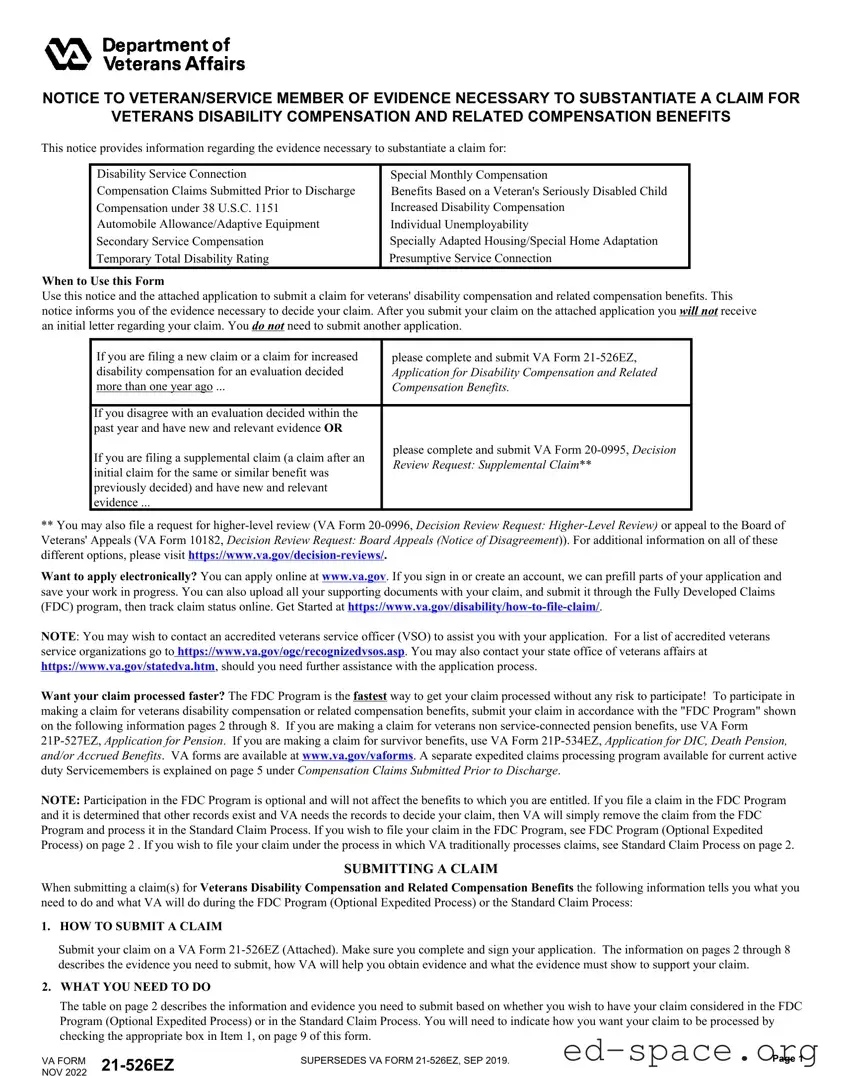
NOTICE TO VETERAN/SERVICE MEMBER OF EVIDENCE NECESSARY TO SUBSTANTIATE A CLAIM FOR
VETERANS DISABILITY COMPENSATION AND RELATED COMPENSATION BENEFITS
VA FORM
NOV 2022
21-526EZ
Page 1
SUPERSEDES VA FORM 21-526EZ, SEP 2019.
This notice provides information regarding the evidence necessary to substantiate a claim for:
Compensation Claims Submitted Prior to Discharge
Disability Service Connection
Benefits Based on a Veteran's Seriously Disabled Child
Increased Disability Compensation
Individual Unemployability
Special Monthly Compensation
Specially Adapted Housing/Special Home Adaptation
Automobile Allowance/Adaptive Equipment
Presumptive Service Connection
Compensation under 38 U.S.C. 1151
Secondary Service Compensation
Temporary Total Disability Rating
SUBMITTING A CLAIM
When to Use this Form
Use this notice and the attached application to submit a claim for veterans' disability compensation and related compensation benefits. This
notice informs you of the evidence necessary to decide your claim. After you submit your claim on the attached application you will not receive
an initial letter regarding your claim. You do not need to submit another application.
please complete and submit VA Form 20-0995, Decision
Review Request: Supplemental Claim**
If you are filing a new claim or a claim for increased
disability compensation for an evaluation decided
more than one year ago ...
If you disagree with an evaluation decided within the
past year and have new and relevant evidence OR
If you are filing a supplemental claim (a claim after an
initial claim for the same or similar benefit was
previously decided) and have new and relevant
evidence ...
please complete and submit VA Form 21-526EZ,
Application for Disability Compensation and Related
Compensation Benefits.
** You may also file a request for higher-level review (VA Form 20-0996, Decision Review Request: Higher-Level Review) or appeal to the Board of
Veterans' Appeals (VA Form 10182, Decision Review Request: Board Appeals (Notice of Disagreement)). For additional information on all of these
different options, please visit https://www.va.gov/decision-reviews/.
SPECIAL CIRCUMSTANCES
VA FORM 21-526EZ, NOV 2022 Page 2
Under the special circumstances shown below, you must also submit along with your claim the following:
If you were treated at a Veterans Center, submit a completed VA Form 21-4142
If claiming dependents, submit a completed VA Form 21-686c, Application Request to Add and/or Remove Dependents. If claiming a
child in school between the ages of 18 and 23; also submit a completed VA Form 21-674, Request for Approval of School Attendance. If
claiming benefits for a seriously disabled (helpless) child, also submit all, relevant, private medical treatment records pertaining to the
child's pertinent disabilities
If claiming Individual Unemployability, submit a completed VA Form 21-8940, Veteran's Application for Increased Compensation
Based on Unemployability
If claiming any mental health conditions(s), submit a completed VA Form 21-0781, Statement in Support of Claimed Mental Health
Disorder(s) Due to an In-Service Traumatic Event(s).
FDC Program (Optional Expedited Process) Standard Claim Process
You must:
• Submit all relevant private treatment records, if they exist
• Identify any relevant treatment records available at a Federal
Facility, such as a VA medical center
• Identify the location and sufficient information to obtain your
National Guard and Reserve personnel and service treatment
records (if applicable)
If your claim involves a disability that you had before entering service
and that was made worse by service, please provide any information or
evidence in your possession regarding the health condition that existed
before your entry into service.
NOTE: If you decide to submit your claim through the FDC Program,
please indicate FDC in Item 1 of the application on page 8.
If you know of evidence not in your possession and want VA to try to get
it for you;
You must:
• Complete and sign VA Form 21-4142, Authorization to Disclose
Information to the Department of Veterans Affairs (VA) and VA Form
21-4142a, General Release for Medical Provider Information to the
Department of Veterans Affairs (VA), identifying any private medical
records you wish VA to request for you
• Give VA enough information about other relevant evidence so that we
can request it from the person or agency that has it
If the holder of the evidence declines to give it to VA, asks for a fee to
provide it, or otherwise cannot get the evidence, VA will notify you and
provide you with an opportunity to submit the information or evidence. It
is your responsibility to make sure we receive all requested records that
are not in the possession of a Federal department or agency.
If your claim involves a disability that you had before entering service and
that was made worse by service, please provide any information or
evidence in your possession regarding the health condition that existed
before your entry into service.
You must:
• Send the information and evidence along with your claim
If you submit additional information or evidence after you submit your
"fully developed" claim, then VA will remove the claim from the FDC
Program (Optional Expedited Process) and process it in the Standard
Claim Process. If we decide your claim before one year from the date
we receive the claim, you will still have the remainder of the one-year
period to submit additional information or evidence necessary to
support the claim.
You are strongly encouraged to:
• Send any information or evidence as soon as you can
You have up to one year from the date we receive the claim to submit the
information and evidence necessary to support your claim. If within 30
days, you do not provide any evidence or do not provide us with the
information needed to assist you with obtaining evidence, we may decide
your claim prior to the expiration of the one year period. If we decide the
claim before one year from the date we receive the claim, you will still
have the remainder of the one year period to submit additional information
or evidence necessary to support the claim.
If any of the special circumstances in the table below titled "Special
Circumstances" applies to you;
You must:
• Send the information and evidence identified in the "Special
Circumstances" table below at the same time as your claim
If any of the special circumstances in the table below titled "Special
Circumstances" applies to you;
You are strongly encouraged to:
• Send the information and evidence identified in the "Special
Circumstances" table below at the same time as your claim. If you do
not submit the needed information or evidence with your claim but it is
needed to make a decision, VA will request it from you.
5. WHAT THE EVIDENCE MUST SHOW TO SUPPORT YOUR CLAIM
The table below provides a guide to the evidence tables showing what evidence you must provide to support your claim.
3. HOW VA WILL HELP YOU OBTAIN EVIDENCE FOR YOUR CLAIM
The table below describes the information and evidence VA will assist you in obtaining based on whether you wish to have your claim considered in
the FDC Program (Optional Expedited Process) or in the Standard Claim Process.
4. WHERE TO SEND INFORMATION AND EVIDENCE
You may send your application and any evidence in support of your claim by using the following methods shown in the table below.
Under the special circumstances shown below, you must also submit along with your claim the following:
If claiming Specially Adapted Housing or Special Home Adaptation, submit a completed VA Form 26-4555, Application in Acquiring
Specially Adapted Housing or Special Home Adaptation Grant
If claiming Auto Allowance, submit a completed VA Form 21-4502, Application for Automobile or Other Conveyance and Adaptive Equipment
If claiming additional benefits because you or your spouse require Aid and Attendance, submit a completed VA Form 21-2680, Examination
for Housebound Status or Permanent Need for Regular Aid and Attendance; or if claiming Aid and Attendance based on nursing home
attendance, a VA Form 21-0779, Request for Nursing Home Information in Connection with Claim for Aid and Attendance
NOTE: VA forms are available online at www.va.gov/vaforms.
SPECIAL CIRCUMSTANCES (Continued)
MAIL TO
SUBMIT ONLINE
Department of Veterans Affairs
Evidence Intake Center
PO Box 4444
Janesville, WI 53547-4444
FDC Program (Optional Expedited Process) Standard Claim Process
VA will:
• Retrieve relevant records from a Federal facility, such as a VA
medical center, that you adequately identify and authorized VA to
obtain
• Provide a medical examination for you, or get a medical opinion, if
we determine it is necessary to decide your claim
VA will:
• Retrieve relevant records from a Federal facility, such as a VA medical
center, that you adequately identify and authorized VA to obtain
• Provide a medical examination for you, or get a medical opinion, if we
determine it is necessary to decide your claim
• Make every reasonable effort to obtain relevant records not held by a
Federal facility that you adequately identify and authorize VA to
obtain. These may include records from State or local governments and
privately held evidence and information you tell us about, such as a
private doctor or hospital records from current or former employers
VA gov: www.va.gov
Direct Upload: AccessVA
If you are claiming... See the evidence table titled...
Individual Unemployability
You have a qualifying disability that arose as a result of a presumption
of exposure
You have a disability that was caused or aggravated by your service Disability Service Connection
Your service-connected disability(ies) causes you to be in need of aid and
attendance or the be confined to your residence
You have a disability caused or aggravated by VA medical treatment,
vocational rehabilitation, or compensated work therapy
Adapting and/or purchasing a residence
Adapting and/or purchasing a vehicle
Presumptive Service Connection
Secondary Service Connection
Compensation Claims Submitted Prior to Discharge
Temporary Total Disability Rating
Increased Disability Compensation
Compensation Under 38 U.S.C. 1151
Special Monthly Compensation
Special Adapted Housing or Special Home Adaptation
Special Monthly Compensation
Helpless Child
Your service-connected disability caused or aggravated an additional
disability
Your service-connected disability has worsened
Compensation and you are a service person who is about to be discharged
Your service-connected disability caused you to be hospitalized or to
undergo surgery or other treatment
Your service-connected disability(ies) prevents you from getting or
keeping substantial employment
A Severely Disabled Spouse
Auto Allowance
A Severely Disabled Child
VA FORM 21-526EZ, NOV 2022 Page 3
Disability Service Connection
To support a claim for service connection, the evidence must show:
VA FORM 21-526EZ, NOV 2022 Page 4
EVIDENCE TABLES
To support a claim for service connection based upon a period of active duty for training, the evidence must show:
To support a claim for service connection based upon a period of inactive duty training, the evidence must show:
In order to file a supplemental claim, you must submit or identify new and relevant evidence.
• To qualify as new, the evidence must not have been part of the evidentiary record at the time of the prior decision.
Presumptive Service Connection
• You served in a recognized location that qualifies you for the presumption of exposure; AND/OR
To support a claim for presumptive service connection the evidence must show:
• You have a current disability that qualifies you for the presumption of service connection. This may be shown by medical evidence or by lay
evidence of persistent and recurrent symptoms of disability that are visible or observable.
Under certain circumstances, VA may presume that certain current diseases were caused by service, even if there is no specific evidence proving
this in your particular claim. Service connection is presumed for certain diseases for the following veterans:
• Former prisoners of war;
• Veterans who have certain chronic or tropical diseases that become evident within a specific period of time after discharge from service;
• Veterans who were exposed to ionizing radiation, mustard gas, or Lewisite while in service;
• Veterans who were exposed to certain herbicides, such as by service in/on:
o Vietnam or qualifying offshore waters, from January 9, 1962, through May 7, 1975;
o a unit determined by VA or the Department of Defense to have operated in the Korean DMZ, from September 1, 1967, through
August 31, 1971;
o individuals who performed service in the Air Force or Air Force Reserve and regularly and repeatedly operated, maintained, or
served onboard C-123 aircraft known to have used to spray an herbicide agent during the Vietnam era;
o Thailand at any United States or Royal Thai base, from January 9, 1962, through June 30, 1976;
o Laos, from December 1, 1965, through September 30, 1969;
o Cambodia at Mimot or Krek, Kampong Cham Province, from April 16, 1969, through April 30, 1969;
o Guam or American Samoa, or in the territorial waters thereof, from January 9, 1962, through July 31, 1980;
o Johnston Atoll or on a ship that called at Johnston Atoll, from January 1, 1972, through September 30, 1977.
• A relationship exists between your current disability and an injury, disease, symptoms, or event in service. This may be shown by medical
records or medical opinions or, in certain cases, by lay evidence.
• You have a current physical or mental disability. This may be shown by medical evidence or by lay evidence of persistent and recurrent
symptoms of disability that are visible or observable; AND
• You had an injury in service, or a disease that began in or was made permanently worse during service, or there was an event in service that
caused an injury or disease; AND
• You were disabled during active duty for training due to disease or injury incurred or aggravated in the line of duty; AND
• You have a current physical or mental disability. This may be shown by medical evidence or by lay evidence of persistent and recurrent
symptoms of disability that are visible or observable; AND
• There is a relationship between your current disability and the disease or injury incurred or aggravated during active duty for training. This
may be shown by medical records or medical opinions or, in certain cases, by lay evidence.
• You were disabled during inactive duty training due to an injury incurred or aggravated in the line of duty or an acute myocardial infarction,
cardiac arrest, or cerebrovascular accident during inactive duty training; AND
• You have a current physical or mental disability. This may be shown by medical evidence or by lay evidence of persistent and recurrent
symptoms of disability that are visible or observable; AND
• There is a relationship between your current disability and your inactive duty training. This may be shown by medical records or medical
opinions or, in certain cases, by lay evidence.
• In order to be considered relevant, the additional evidence must tend to prove or disprove a matter at issue in the claim.
• Veterans who served in the Gulf War:
• Veterans who served at Camp Lejeune for no less than 30 days (consecutive or nonconsecutive) between August 1, 1953 and December 31,
1987; or
o On or after August 2, 1990, and served in:
o On or after September 11, 2001, and served in:
§ Bahrain; Iraq; the neutral zone between Iraq and Saudi Arabia; Kuwait; Oman; Qatar; Saudi Arabia; Somalia; United Arab
Emirates; the Gulf of Aden; the Gulf of Oman; the Persian Gulf; the Arabian Sea; the Red Sea; Afghanistan; Israel; Egypt;
Turkey; Syria; or Jordan; OR
§ Afghanistan; Djibouti; Egypt; Jordan; Lebanon; Syria; Yemen; or Uzbekistan.
Temporary Total Disability Rating
In order to support a claim for a temporary total disability rating due to hospitalization, the evidence must show:
• You were treated for more than 21 days for a service-connected disability at a VA or other approved hospital; OR
• You underwent hospital observation at VA expense for a service-connected disability for more than 21 days.
VA FORM 21-526EZ, NOV 2022 Page 5
EVIDENCE TABLES (Continued)
In order to support a claim for a temporary total disability rating due to surgical or other treatment performed by a VA or other approved
hospital or outpatient facility, the evidence must show:
• The surgery required convalescence of at least one month; OR
• One major joint or more was immobilized by a cast without surgery.
• The surgery resulted in severe postoperative residuals, such as incompletely healed surgical wounds, stumps of recent amputations, therapeutic
immobilizations, house confinement, or the required use of a wheelchair or crutches; OR
• The surgery or treatment was for a service-connected disability; AND
Secondary Service Connection
To support a claim for compensation based upon an additional disability that was caused or aggravated by a service-connected disability, the
evidence must show:
• You currently have a physical or mental disability shown by medical evidence or by lay evidence of persistent and recurrent symptoms of
disability that are visible or observable, in addition to your service-connected disability; AND
• Your service-connected disability either caused or aggravated your additional disability. This may be shown by medical records or medical
opinions or, in certain cases, by lay evidence. However, VA may presume service-connection for cardiovascular disease developing in a
claimant with certain service-connected amputation(s) of one or both lower extremities.
Increased Disability Compensation
If VA previously granted service connection for your disability and you are seeking an increased evaluation of your service-connected disability,
we need medical or lay evidence to show a worsening or increase in severity and the effect that worsening or increase has on your ability to work.
Compensation Claims Submitted Prior to Discharge
Under the Benefits Delivery at Discharge (BDD) program you can submit a disability claim 90 to 180 days prior to your anticipated separation date
from active duty. Claims are accepted from active duty Servicemembers, including reservists serving on active duty in an Active Guard Reserve
(AGR) role under 10 U.S.C. and full-time National Guard members serving in an AGR role under 32 U.S.C.
BDD program participants can have their VA medical examinations conducted while they are still on active duty. You are encouraged to file your
claim as close to the 180 day mark as possible to ensure your examinations can be scheduled and completed prior to your discharge from active duty.
The BDD program requires that Servicemembers be available to report for examinations for 45 days following submission of a disability claim.
Claims and additional contentions received with less than 90 days remaining on active duty, claim types that are excluded from the BDD program, or
where the Servicemember is unable to report for an examination within the BDD required time frame will be processed under the standard VA
claims process, the Fully Developed Claim (FDC) program or any other qualifying program.
BDD Program Criteria for Claim(s) for Disability Compensation and Related Compensation Benefits Submitted Prior to Separation from
Active Duty:
• be within 90 to 180 days of discharge;
• complete a VA Form 21-526EZ.
• provide an anticipated release from active duty date; and
• submit copies of service treatment records for the current period of service with the BDD claim;
• be available to report for examinations for 45 days following the submission of a disability claim;
Individual Unemployability
In order to support a claim for a total disability rating based on individual unemployability, the evidence must show:
In order to support a claim for an extra-scheduler evaluation based on exceptional circumstances, the evidence must show:
• That your service-connected disability or disabilities are sufficient, without regard to other factors, to prevent you from performing the mental
and/or physical tasks required to get or keep substantially gainful employment; AND
• Generally, you meet certain disability percentage requirements as specified in 38 Code of Federal Regulations 4.16 (i.e. one disability ratable
at 60 percent or more, OR more than one disability with one disability ratable at 40 percent or more and a combined rating of 70 percent or
more).
• That your service-connected disability or disabilities present such an exceptional or unusual disability picture, due to such factors as marked
interference with employment or frequent periods of hospitalization, that application of the regular schedular standards is impractical.
• provide a completed Separation Health Assessment - Part A Self Assessment
(obtain from: www.benefits.va.gov/compensation/dbq_publicdbqs.asp);
VA FORM 21-526EZ, NOV 2022 Page 6
EVIDENCE TABLES (Continued)
Compensation Under 38 U.S.C. 1151
• An additional disability or disabilities; OR
• An aggravation of an existing injury or disease; AND
• The disability was the direct result of VA fault such as carelessness, negligence, lack of proper skill, or error in judgment, or not a reasonably
expected result or complication of the VA care or treatment; OR
• The direct result of participation in a VA Veterans Readiness and Employment or compensated work therapy program.
In order to support a claim for compensation under 38 U.S.C. 1151, the evidence must show that, as a result of VA hospitalization, medical or
surgical treatment, examination, or training, you have:
Special Monthly Compensation
In order to support a claim for increased benefits based on the need for aid and attendance, the evidence must show that, due to your service-
connected disability or disabilities:
• You require the aid of another person in order to perform personal functions required in everyday living, such as bathing, feeding, dressing
yourself, attending to the wants of nature, adjusting prosthetic devices, or protecting yourself from the hazards of your daily environment (38
Code of Federal Regulation 3.352(a)); OR
• You are bedridden, in that your disability or disabilities requires that you remain in bed apart from any prescribed course of convalescence or
treatment (38 Code of Federal Regulation 3.352(a)).
In order to support a claim for increased benefits based on an additional disability or being housebound, the evidence must show:
• You have a single service-connected disability evaluated as 100 percent disabling AND an additional service-connected disability, or
disabilities, evaluated as 60 percent or more disabling; OR
• You have a single service-connected disability evaluated as 100 percent disabling AND, due solely to your service-connected disability or
disabilities, you are permanently and substantially confined to your immediate premises.
In order to support a claim for increased benefits based on your spouse's need for aid and attendance, per the provisions of 38 C.F.R. § 3.351(c),
the evidence must show:
• Your spouse is blind or so nearly blind as to have corrected visual acuity of 5/200 or less, in both eyes, or concentric contraction of the visual
field to 5 degrees or less; OR
Your spouse is a patient in a nursing home because of mental or physical incapacity; OR
• Your spouse requires the aid of another person in order to perform personal functions required in everyday living, such as bathing, feeding,
dressing, attending to the wants of nature, adjusting prosthetic devices, or protecting him or her from the hazards of his or her daily environment
(See 38 C.F.R. § 3.352(a) for complete explanation).
IMPORTANT: For additional benefits to be payable for a spouse, the veteran must be entitled to compensation and evaluated as 30 percent or more
disabling.
Specially Adapted Housing or Special Home Adaptation
To support your claim for specially adapted housing (SAH), the evidence must show you are a:
• Veteran entitled to compensation under 38 U.S.C. Chapter 11 for a permanent and totally disabling qualifying condition; OR
• Servicemember on active duty who has a permanent and totally disabling qualifying condition incurred or aggravated in the line of duty.
To support that you have a qualifying condition for SAH the evidence must show:
• Permanent but not total disability due to blindness in both eyes, (having central visual acuity of 20/200 or less in the better eye with the use of
a standard correcting lens); OR
• Amyotrophic lateral sclerosis (ALS); OR
• Loss or loss of use of both upper extremities precluding use of the arms at or above the elbow; OR
• A severe burn injury, meaning full thickness or sub-dermal burns that have resulted in contractures with limitation of motion of:
o two or more extremities; OR
o at least one extremity and the trunk.
• Loss (amputation) or loss of use of:
o both lower extremities; OR
o one lower extremity and one upper extremity affecting balance or propulsion; OR
o one lower extremity plus residuals of organic disease or injury affecting balance or propulsion creating a need for regular, constant use of a
wheelchair, braces, crutches or canes as a normal mode of getting around (although getting around by other methods may occasionally be
possible); OR
EVIDENCE TABLES (Continued)
To support your claim for SAH the evidence may alternatively show you are a:
• Veteran who served and became permanently disabled from a qualifying condition on or after September 11, 2001; OR
• Servicemember on active duty who was permanently disabled in the line of duty from a qualifying condition on or after the same date.
• Veteran entitled to compensation under 38 U.S.C. Chapter 11 for a qualifying condition; OR
• Servicemember on active duty who has a qualifying condition incurred or aggravated in the line of duty.
• Loss (amputation) or loss of use of:
o one or more lower extremities, severely affecting the functions of balance or propulsion and creating a need for regular, constant use of a
wheelchair, braces, crutches or canes as a normal mode of getting around (although getting around by other methods may occasionally be
possible).
To support that you have a qualifying condition under the alternative service criteria the evidence must show:
To support your claim for a special home adaptation (SHA) grant the evidence must show you are a:
• the loss, or permanent loss of use, of at least a foot or a hand; OR
Permanent and total disability from loss, or loss of use, of both hands; OR
• Permanent and total disability from a severe burn injury meaning
o deep partial thickness burns that have resulted in contractures with limitation of motion of two or more extremities or of at least one
extremity and the trunk; OR
o full thickness or sub-dermal burns that have resulted in contracture(s) with limitation of motion of one or more extremities or the trunk; OR
o residuals of inhalation injury (including, but not limited to, pulmonary fibrosis, asthma, and chronic obstructive pulmonary disease).
To support that you have a qualifying condition for SHA the evidence must show:
NOTE - You may be entitled to only adaptive equipment if you have ankylosis ("freezing") of at least one knee or one hip due to service-connected
disability. Medical evidence, including a VA examination, will show these things. VA will provide an examination if it determines that one is
necessary.
Auto Allowance
To support a claim for automobile allowance or adaptive equipment, the evidence must show that you have a service-connected disability resulting in:
• the loss, or permanent loss of use, of at least a foot or a hand; OR
• permanent impairment of vision of both eyes, resulting in:
o vision of 20/200 or less in the better eye with corrective glasses; OR
o vision of 20/200 or better, if there is a severe defect in your peripheral vision; OR
• deep partial thickness or full thickness burns resulting in scar formation that cause contractures and limit motion of one or more extremities of
the trunk and preclude effective operation of an automobile; OR
• amyotrophic lateral sclerosis (ALS).
Page 7 VA FORM 21-526EZ, NOV 2022
Specially Adapted Housing or Special Home Adaptation (Continued)
Helpless Child
To support a claim for benefits based on a veteran's child being helpless, the evidence must show that the child, before his or her 18th birthday,
became permanently incapable of self-support due to a mental or physical disability.
IMPORTANT: For additional benefits to be payable for a child, the veteran must be entitled to compensation and evaluated as 30 percent or more
disabling.
How VA Determines the Effective Date
If we grant your claim, the beginning date of your entitlement or increased entitlement to benefits will generally be based on the following factors:
If VA received your claim prior to or within one year of your separation from the military, entitlement will be from the day following the date of your
separation as long as the disability was present at that time.
• When we received your claim; OR
• When the evidence shows a level of disability that supports a certain rating under the rating schedule.
6. ADDITIONAL INFORMATION
How VA Determines the Disability Rating
• Nature and symptoms of the condition;
• Severity and duration of the symptoms; AND
• Impact of the condition and symptoms on employment.
Examples of evidence that you should tell us about or give to us that may affect how we assign a disability evaluation include the following:
• Statements discussing your disability symptoms from people who have witnessed how the symptoms affect you.
• Information about on-going treatment records, including VA or other Federal treatment records, you have not previously told us about;
• Social Security determinations;
• Statements from employers as to job performance, lost time, or other information regarding how your condition(s) affect your ability to work;
OR
When we find disabilities to be service-connected, we assign a disability rating. That rating can be changed if there are changes in your condition.
Depending on the disability involved, we will assign a rating from 0 percent to as much as 100 percent. VA uses a schedule for evaluating disabilities
that is published as title 38, Code of Federal Regulations, Part 4. In rare cases, we can assign a disability level other than the levels found in the
schedule for a specific condition if your impairment is not adequately covered by the schedule.
We consider evidence of the following in determining disability rating:
For more information on VA benefits, visit our web site at www.va.gov.
You are entitled to a hearing at any time in the claims process. If you wish to have a hearing or have other questions, contact VA online through
Ask VA: https://ask.va.gov or call us toll-free at 1-800-827-1000 (TTY:711).
VA forms are available at www.va.gov/vaforms.
Page 8
VA FORM 21-526EZ, NOV 2022
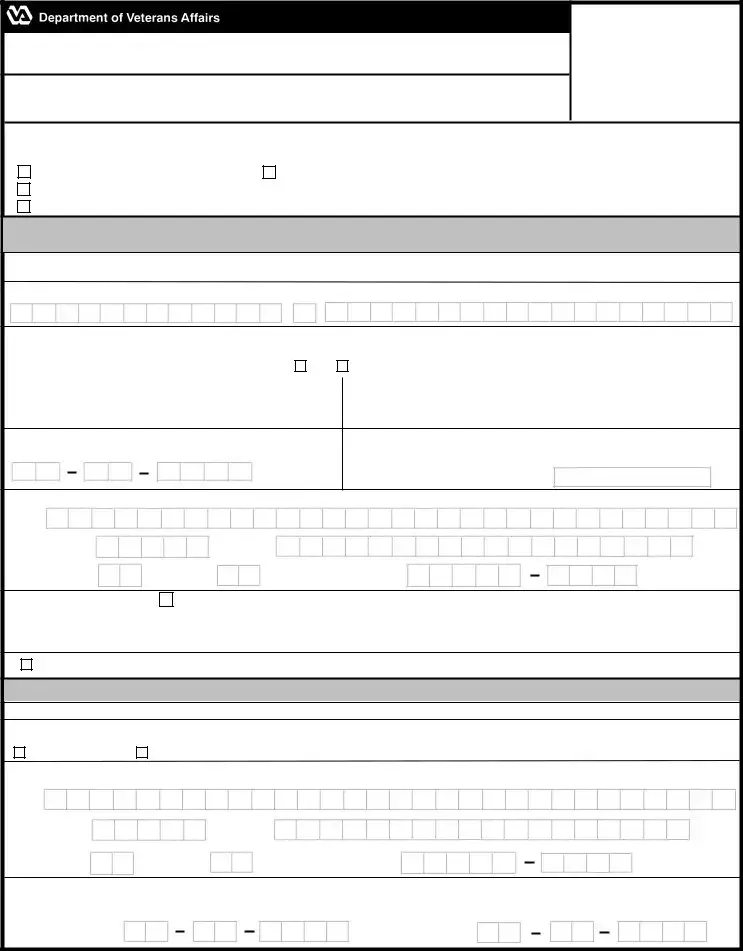
SECTION II: CHANGE OF ADDRESS
SECTION I: VETERAN'S IDENTIFICATION INFORMATION
(If claim is not an original claim, only Section I, IV (if applicable), V and a signature are required)
Page 9
OMB Control No. 2900-0747
Respondent Burden: 25 minutes
Expiration Date: 11/30/2025
VA DATE STAMP
(DO NOT WRITE IN THIS SPACE)
IMPORTANT: Please read the Privacy Act and Respondent Burden on Page 14 before completing the form. Use this form to
determine your eligibility for compensation. For more information, you can contact us online through Ask VA: https://ask.va.gov.
Ask us a question online or call us toll-free at 1-800-827-1000 (TTY: 711). If you prefer you may complete and submit the form online
at
www.va.gov. VA forms are available at www.va.gov/vaforms.
2. VETERAN/SERVICEMEMBER'S NAME (First, Middle Initial, Last)
3. SOCIAL SECURITY NUMBER (SSN)
6. DATE OF BIRTH (MM-DD-YYYY)
4. HAVE YOU EVER FILED A CLAIM WITH VA?
(If "Yes," provide your file
number in Item 5)
5. VA FILE NUMBER
11. EMAIL ADDRESS (Optional)
APPLICATION FOR DISABILITY COMPENSATION AND RELATED
COMPENSATION BENEFITS
10. CURRENT MAILING ADDRESS (Number and street or rural route, P.O. Box, City, State, ZIP Code and Country)
13B. NEW ADDRESS (Number and street or rural route, P.O. Box, City, State, ZIP Code and Country)
9. TELEPHONE NUMBER
(Optional) (Include Area Code)
VA FORM
NOV 2022
SUPERSEDES VA FORM 21-526EZ, SEP 2019.
21-526EZ
No. &
Street
Apt./Unit Number City
ZIP Code/Postal Code
State/Province
Country
No. &
Street
Apt./Unit Number
City
ZIP Code/Postal Code
State/Province
Country
7. SERVICE NUMBER/DOD ID NUMBER (If applicable)
NOTE: You may either complete the form online or by hand. If completed by hand, print the information requested in ink, neatly, and legibly, insert one
letter per box, and completely fill in each applicable check box to help expedite processing of the form.
8. BDD CLAIMS ONLY: PROVIDE THE DATE OR ANTICIPATED DATE OF
RELEASE FROM ACTIVE DUTY (MM-DD-YYYY)
13A. TYPE OF ADDRESS CHANGE (Complete if applicable) (Check only one box)
NOTE: If you are temporarily or permanently changing your address, complete Items 13A through 13C.
13C. EFFECTIVE DATE(S) OF NEW ADDRESS (If your change of address is temporary, complete both the beginning and ending date of your temporary address)
(If your change of address is permanent, please enter your effective date in the beginning date only)
Year
Day
Month
BEGINNING DATE:
ENDING DATE:
Year
Day
Month
12. IF YOU ARE CURRENTLY A VA EMPLOYEE, CHECK THE BOX (Includes Work Study/Internship) (If you are not a VA employee skip to Section II, if applicable).
FDC PROGRAM
IDES (Select this option only if you have been referred to the IDES Program by your Military Service Department)
BDD Program Claim (Select this option only if you meet the criteria for the BDD Program specified on Instruction Page 5)
STANDARD CLAIM PROCESS
Enter International Phone Number (If applicable)
I agree to receive electronic correspondence from VA in regards to my claim.
YES NO
TEMPORARY
PERMANENT
1. SELECT THE TYPE OF CLAIM PROGRAM/PROCESS THAT APPLIES TO YOU. NOTE: Your claim will be processed as described on pages 1 through 8 unless one of
the following special programs is selected. See Instruction pages 1 through 3 for definitions of the Fully Developed Claim (FDC) Program (Optional Expedited Process) or the
Standard Claim Process.
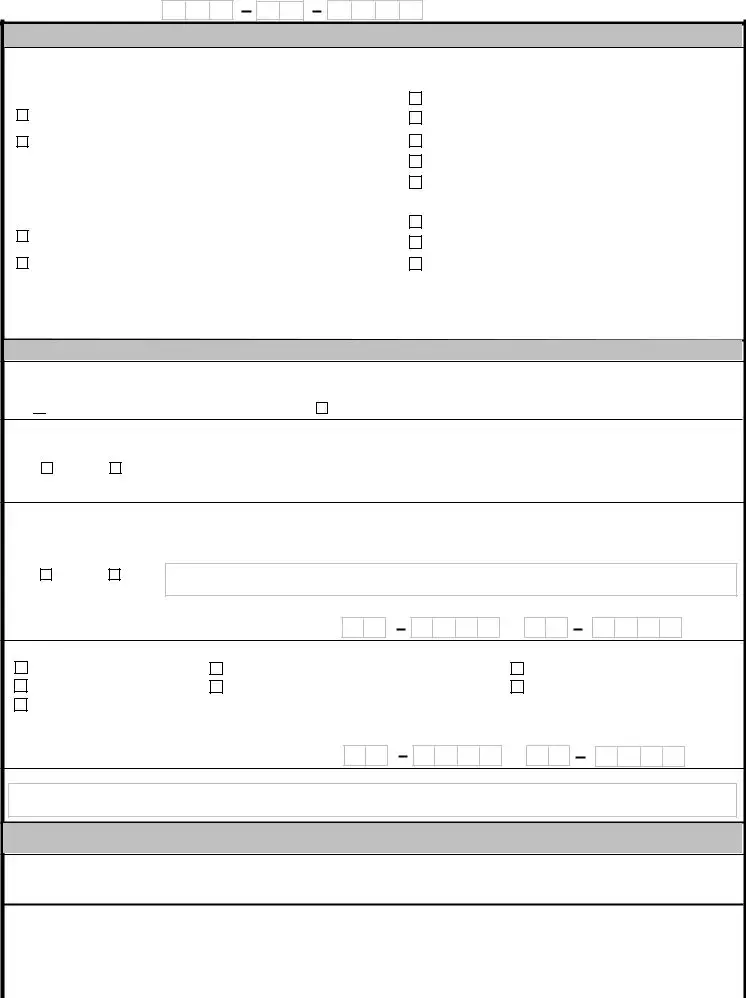
SECTION III: HOMELESS INFORMATION
IMPORTANT: The following questions (Items 14A through 14F) should only be completed if you are currently homeless or at risk of becoming homeless.
If this item does not apply to you, skip to Section IV.
Page 10
VA FORM 21-526EZ, NOV 2022
VETERAN'S SOCIAL SECURITY NO.
14A. ARE YOU CURRENTLY HOMELESS?
(If "Yes," complete Item 14B regarding your living situation)
14B. CHECK THE BOX THAT APPLIES TO YOUR LIVING SITUATION:
14C. ARE YOU CURRENTLY AT RISK OF BECOMING HOMELESS?
(If "Yes," complete Item 14D regarding your living situation)
14D. CHECK THE BOX THAT APPLIES TO YOUR LIVING SITUATION:
14E. POINT OF CONTACT (Name of person VA can contact in order to get in touch with you)
14F. POINT OF CONTACT TELEPHONE NUMBER (Include Area Code)
LIVING IN A HOMELESS SHELTER
NOT CURRENTLY IN A SHELTERED ENVIRONMENT (e.g., living in a
car or tent)
STAYING WITH ANOTHER PERSON
FLEEING CURRENT RESIDENCE
OTHER (Specify)
HOUSING WILL BE LOST IN 30 DAYS
LEAVING PUBLICLY FUNDED SYSTEM OF CARE (e.g., homeless
shelter)
OTHER (Specify)
YES
NO
YES
NO
Enter International Phone Number
(If applicable)
15A. ARE YOU CLAIMING ANY CONDITIONS RELATED TO TOXIC EXPOSURES? NOTE: See Page 4 of the Instructions for further information on the evidence needed to
support your claim for presumptive service connection. (You can also refer to the following websites for more information: PACT ACT (https://www.va.gov/PACT) and
PUBLIC HEALTH MILITARY EXPOSURES (https://www.publichealth.va.gov/exposures/index.asp))
SECTION IV: EXPOSURE INFORMATION
YES (If "Yes," complete Items 15B, 15C, 15D and 15E) NO (If "No," skip to Item 16, Section V: Claim Information)
YES NO
15B. DID YOU SERVE IN ANY OF THE FOLLOWING GULF WAR HAZARD LOCATIONS?
Iraq; Kuwait; Saudi Arabia; the neutral zone between Iraq and Saudi Arabia; Bahrain; Qatar; the United Arab Emirates; Oman; Yemen; Lebanon; Somalia; Afghanistan;
Israel; Egypt; Turkey; Syria; Jordan; Djibouti; Uzbekistan; the Gulf of Aden; the Gulf of Oman; the Persian Gulf; the Arabian Sea; and the Red Sea.
WHEN DID YOU SERVE IN THESE LOCATIONS? (MM-YYYY)
Note: Please provide an approximate time frame (month and year).
YES NO
Please list other location(s) where you served, if not listed above:
ASBESTOS
MILITARY OCCUPATIONAL SPECIALTY (MOS)-related toxin
SHAD (Shipboard Hazard and Defense)
CONTAMINATED WATER AT CAMP LEJEUNE
OTHER (Specify)
MUSTARD GAS
15D. HAVE YOU BEEN EXPOSED TO ANY OF THE FOLLOWING? (Check all that apply)
15E. IF YOU WERE EXPOSED MULTIPLE TIMES, PLEASE PROVIDE ALL ADDITIONAL DATES AND LOCATIONS OF POTENTIAL EXPOSURE
JULY 1968
Example 3. LEFT KNEE, SECONDARY TO RIGHT KNEE
Example 2. DIABETES
Example 1. HEARING LOSS
6/11/2008
EXAMPLES OF DISABILITY(IES)
DECEMBER 1972
16. LIST THE CURRENT DISABILITY(IES) OR SYMPTOMS THAT YOU CLAIM ARE RELATED TO YOUR MILITARY SERVICE AND/OR SERVICE-CONNECTED
DISABILITY (If applicable, identify whether a disability is due to a service-connected disability; confinement as a prisoner of war; exposure to Agent Orange, asbestos, mustard
gas, ionizing radiation, or Gulf War environmental hazards; or a disability for which compensation is payable under 38 U.S.C. 1151)
NOTE: List your claimed conditions below. See the following three examples for guidance on how to complete Section V.
EXAMPLES OF EXPOSURE
TYPE
EXAMPLES OF DATES
NOISE HEAVY EQUIPMENT OPERATOR IN SERVICE
AGENT ORANGE SERVICE IN VIETNAM WAR
INJURED LEFT KNEE WHEN BRACE ON
RIGHT KNEE FAILED
EXAMPLES OF HOW THE
DISABILITY(IES) RELATES TO SERVICE
SECTION V: CLAIM INFORMATION
(For additional space, use Section XIII: Claim Information (Addendum))
FROM:
TO:
WHEN DID YOU SERVE IN THESE LOCATIONS? (MM-YYYY)
Note: Please provide an approximate time frame (month and year).
FROM: TO:
RADIATION
WHEN WERE YOU EXPOSED? (MM-YYYY)
Note: Please provide an approximate time-frame (month and year).
FROM: TO:
15C. DID YOU SERVE IN ANY OF THE FOLLOWING HERBICIDE (e.g., Agent Orange) LOCATIONS?
Republic of Vietnam to include the 12 nautical mile territorial waters; Thailand at any United States or Royal Thai base; Laos; Cambodia at Mimot or Krek; Kampong Cham
Province; Guam or American Samoa; or in the territorial waters thereof; Johnston Atoll or a ship that called at Johnston Atoll; Korean demilitarized zone; aboard (to include
repeated operations and maintenance with) a C-123 aircraft known to have been used to spray an herbicide agent (during service in the Air Force and Air Force Reserves).

Form Specifications

Fact Name Details
Purpose The VBA VA 21-526EZ form is used by veterans to apply for disability compensation and related benefits.
Eligibility Eligible applicants include veterans with service-connected disabilities or conditions.
Submission Method The form can be submitted online, by mail, or in person at a regional VA office.
Required Information Applicants must provide personal information, service history, and details about their disabilities.
Supporting Documents Documentation such as medical records and service records may be required to support the claim.
Processing Time The processing time for claims can vary, often taking several months to complete.
State-Specific Forms Some states may have additional forms or requirements; check local VA offices for details.
Governing Laws Federal laws, including Title 38 of the U.S. Code, govern the disability compensation process.
Veteran Assistance Veterans can seek assistance from accredited representatives or organizations when filling out the form.
Updates The form and related processes may change; it’s important to use the most current version available on the VA website.

VBA VA 21-526EZ: Usage Guidelines

Filling out the VBA VA 21-526EZ form is an important step in the claims process. Follow these steps carefully to ensure that your application is completed correctly and submitted without delay.

  1. Start by downloading the VBA VA 21-526EZ form from the official VA website or obtain a physical copy from your local VA office.
  2. Read the instructions provided with the form. This will help you understand what information is needed.
  3. Begin filling out the form with your personal information. This includes your full name, Social Security number, and contact details.
  4. Provide your military service details. Include your branch of service, service dates, and any relevant discharge information.
  5. List any disabilities you are claiming. Be specific and include the dates of diagnosis and treatment if applicable.
  6. Attach any necessary supporting documents. This may include medical records or other evidence that supports your claim.
  7. Review the completed form for accuracy. Make sure all sections are filled out completely and correctly.
  8. Sign and date the form. Your signature is essential for processing your claim.
  9. Submit the form. You can do this online, by mail, or in person at your local VA office.

After submission, you will receive confirmation from the VA. Keep a copy of your completed form and any correspondence for your records. This will help you track the progress of your claim.

Your Questions, Answered

What is the VBA VA 21-526EZ form?

The VBA VA 21-526EZ form is an application used by veterans to apply for disability compensation and related benefits from the Department of Veterans Affairs (VA). This form is designed to simplify the application process, allowing veterans to submit their claims more efficiently.

Who is eligible to use the VBA VA 21-526EZ form?

Eligibility for the VBA VA 21-526EZ form generally includes veterans who have served in active military, naval, or air service and have a disability that was incurred or aggravated during their service. Certain dependents may also be eligible to apply on behalf of a veteran.

How can I obtain the VBA VA 21-526EZ form?

The VBA VA 21-526EZ form can be obtained online through the VA’s official website. It is also available at local VA offices, veteran service organizations, and through various community resources. Additionally, veterans can request a paper form by contacting the VA directly.

What information do I need to complete the VBA VA 21-526EZ form?

To complete the VBA VA 21-526EZ form, veterans will need to provide personal information, including their Social Security number, service history, and details about their disability. Supporting documentation, such as medical records and service records, may also be required to substantiate the claim.

Can I submit the VBA VA 21-526EZ form online?

Yes, the VBA VA 21-526EZ form can be submitted online through the VA’s eBenefits portal. This method allows for a quicker processing time and provides veterans with immediate confirmation of their submission. It is important to ensure that all required information is complete before submitting the form online.

What happens after I submit the VBA VA 21-526EZ form?

After submission, the VA will review the application and any supporting documents. Veterans may be contacted for additional information or to schedule a medical examination. Once the review is complete, the VA will issue a decision regarding the claim and notify the veteran of the outcome.

How long does it take to process the VBA VA 21-526EZ form?

The processing time for the VBA VA 21-526EZ form can vary based on several factors, including the complexity of the claim and the volume of applications being processed. Generally, it may take several months to receive a decision. Veterans can check the status of their claim through the VA’s website or by contacting the VA directly.

What should I do if my claim is denied?

If a claim submitted using the VBA VA 21-526EZ form is denied, veterans have the right to appeal the decision. The appeal process involves submitting a Notice of Disagreement (NOD) and may require additional evidence to support the claim. It is advisable to seek assistance from a qualified veteran service organization or legal representative during this process.

Common mistakes

  1. Incomplete Information: Many individuals fail to provide all the necessary details. Missing sections can lead to delays or denials.

  2. Incorrect Social Security Number: Entering an incorrect Social Security number can cause significant issues. Ensure that this number is accurate.

  3. Not Signing the Form: A common oversight is neglecting to sign the form. Without a signature, the application is not valid.

  4. Failure to Attach Supporting Documents: Some applicants forget to include required documentation. This can include medical records or service records.

  5. Misunderstanding Eligibility Requirements: Applicants sometimes misinterpret the eligibility criteria. It’s crucial to review these requirements carefully before applying.

  6. Submitting the Form to the Wrong Office: Sending the form to an incorrect address can lead to significant delays. Make sure to verify the submission address.

Documents used along the form

The VBA VA 21-526EZ form is essential for veterans applying for disability compensation benefits. However, several other forms and documents are often required to support the application process. Below is a list of these documents, each serving a specific purpose in the evaluation of a veteran’s claim.

  • VA Form 21-4138: This is a statement in support of claim. Veterans use this form to provide additional information or evidence that may help in the evaluation of their claim.
  • VA Form 21-534EZ: This form is for Dependency and Indemnity Compensation (DIC) benefits. It is used by surviving spouses or dependents of veterans who have passed away due to service-related issues.
  • VA Form 21-22: This form designates a representative for the veteran. It allows veterans to appoint an accredited representative or organization to assist them with their claims.
  • VA Form 21-4142: This is a release of information form. Veterans use it to authorize the VA to obtain medical records from private healthcare providers.
  • VA Form 21-526: An older version of the disability compensation application. While the 21-526EZ is preferred, this form may still be relevant for certain claims.
  • DD Form 214: This document is the Certificate of Release or Discharge from Active Duty. It provides proof of military service and is critical for establishing eligibility for benefits.
  • VA Form 21-0779: This form is used to apply for aid and attendance benefits. It helps veterans demonstrate their need for additional assistance due to disabilities.
  • VA Form 21-8940: This is the application for increased compensation based on unemployability. Veterans use it to claim benefits if they are unable to work due to service-connected disabilities.

Gathering these documents can streamline the claims process and improve the chances of a successful outcome. Each form plays a vital role in providing the necessary evidence and information to support a veteran’s claim for benefits.

Similar forms

The VBA VA 21-526EZ form is a key document used by veterans to apply for disability compensation benefits. Several other forms serve similar purposes or complement the application process. Here are seven documents that are comparable to the VA 21-526EZ form:

  • VA Form 21-526: This is the traditional application for disability compensation. Like the 21-526EZ, it collects information about the veteran's service and medical conditions but is more detailed and often requires additional documentation.
  • VA Form 21-527EZ: This form is used for applying for pension benefits. Similar to the 21-526EZ, it streamlines the process for veterans seeking financial assistance based on income and service-related factors.
  • VA Form 21-534EZ: This form is for survivors seeking Dependency and Indemnity Compensation (DIC). It shares a simplified format with the 21-526EZ to help eligible survivors receive benefits efficiently.
  • VA Form 21-4142: This is a release of information form. It allows the VA to obtain medical records from healthcare providers, which is crucial for supporting claims made on the 21-526EZ.
  • VA Form 21-4192: This form is used by employers to provide information about a veteran’s employment history. It is often necessary for claims related to employability, similar to how the 21-526EZ is used for disability claims.
  • VA Form 21-0966: This form is a Intent to File a Claim. It allows veterans to reserve a date for their claim while they gather necessary documents, similar to the preparatory nature of the 21-526EZ.
  • VA Form 21-0781: This document is used to report stressor events for PTSD claims. It complements the information provided in the 21-526EZ by detailing specific incidents that may have led to a veteran’s condition.

Each of these forms plays a role in the benefits application process, making it easier for veterans to access the support they need.

Dos and Don'ts

When filling out the VBA VA 21-526EZ form, it is important to follow specific guidelines to ensure a smooth application process. Below is a list of things you should and shouldn't do.

  • Do read the instructions carefully before starting the form.
  • Do provide accurate and complete information to avoid delays.
  • Do double-check your Social Security number and other identifying information.
  • Do sign and date the form at the end.
  • Don't leave any required fields blank; fill them in to the best of your ability.
  • Don't submit the form without making copies for your records.
  • Don't forget to include any necessary supporting documents.

By adhering to these guidelines, you can help facilitate the processing of your application.

Misconceptions

There are several misconceptions about the VBA VA 21-526EZ form that can lead to confusion. Understanding the truth behind these misconceptions can help individuals navigate the application process more effectively.

  • Misconception 1: The form is only for veterans with service-related injuries.
  • This form is actually for any veteran seeking benefits, including those with non-service-related issues.

  • Misconception 2: You must have a lawyer to fill out the form correctly.
  • While legal assistance can be helpful, many individuals successfully complete the form on their own.

  • Misconception 3: The 21-526EZ form is the same as the standard 21-526 form.
  • The 21-526EZ is a simplified version, designed to make the application process easier and faster.

  • Misconception 4: Submitting the form guarantees immediate benefits.
  • Submitting the form is just the first step; benefits are awarded after a review process that may take time.

  • Misconception 5: You can only apply for benefits once.
  • Veterans can apply multiple times if their circumstances change or if they wish to seek additional benefits.

  • Misconception 6: All veterans qualify for benefits regardless of their service.
  • Eligibility depends on specific criteria, including length of service and discharge status.

  • Misconception 7: The form must be submitted in person.
  • The 21-526EZ can be submitted online, by mail, or in person, providing flexibility for applicants.

  • Misconception 8: Only veterans can fill out the form.
  • While veterans are the primary applicants, dependents can also fill out the form under certain circumstances.

Key takeaways

When filling out the VBA VA 21-526EZ form, it is essential to keep several key points in mind to ensure a smooth application process. Here are some important takeaways:

  • Understand the Purpose: The VBA VA 21-526EZ form is primarily used to apply for disability compensation and related benefits. Familiarizing yourself with its purpose will help you provide the necessary information.
  • Gather Required Documentation: Before starting the form, collect all relevant documents, including service records and medical evidence. This preparation will streamline the process and reduce delays.
  • Be Thorough and Accurate: Complete every section of the form with precise and detailed information. Incomplete or incorrect entries can lead to processing delays or even denial of benefits.
  • Review Before Submission: After filling out the form, take the time to review all entries. Ensure that all information is correct and that you have signed and dated the application.
  • Follow Up on Your Application: After submission, keep track of your application status. You can contact the VA or check online to ensure your application is being processed.

By keeping these points in mind, individuals can navigate the application process more effectively and increase their chances of a successful outcome.