Homepage Blank USCIS I-9 PDF Form
Content Overview

The USCIS I-9 form is a crucial document for both employers and employees in the United States, playing a vital role in verifying the identity and employment eligibility of individuals hired for work. This form requires new hires to present specific types of identification, which can include a passport, driver's license, or social security card, among others. Employers must complete the I-9 within three days of an employee's start date, ensuring compliance with federal immigration laws. Additionally, the form must be kept on file for a designated period, even after the employee leaves the company. Understanding the I-9 process is essential for maintaining a lawful workforce and avoiding potential penalties. Mistakes in completing or retaining the form can lead to serious consequences, so it's important to handle it with care and attention to detail. As the workforce continues to evolve, staying informed about the I-9 form's requirements and updates is key for both employers and employees alike.
Document Preview

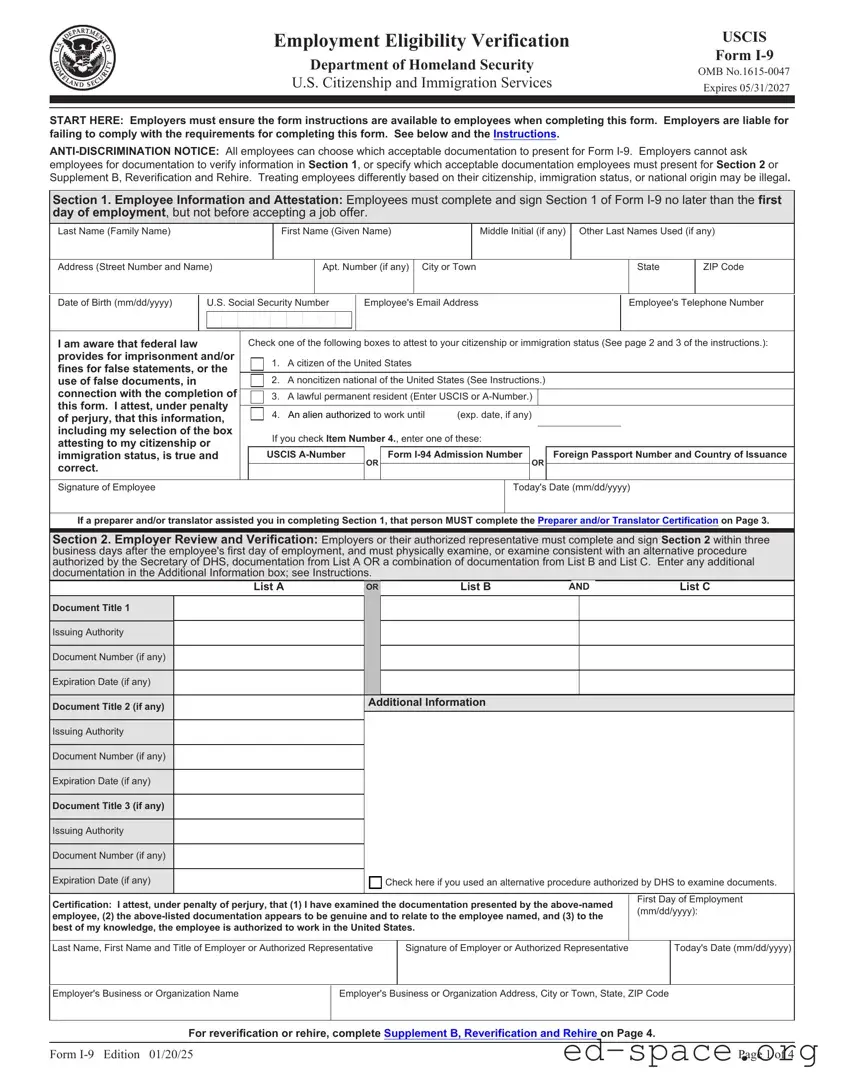
Employment Eligibility Verification
Department of Homeland Security
U.S. Citizenship and Immigration Services
USCIS
Form I-9
OMB No.1615-0047
Expires 05/31/2027
START HERE: Employers must ensure the form instructions are available to employees when completing this form. Employers are liable for
failing to comply with the requirements for completing this form. See below and the Instructions.
ANTI-DISCRIMINATION NOTICE: All employees can choose which acceptable documentation to present for Form I-9. Employers cannot ask
employees for documentation to verify information in Section 1, or specify which acceptable documentation employees must present for Section 2 or
Supplement B, Reverification and Rehire. Treating employees differently based on their citizenship, immigration status, or national origin may be illegal.
Section 1. Employee Information and Attestation: Employees must complete and sign Section 1 of Form I-9 no later than the first
day of employment, but not before accepting a job offer.
Last Name (Family Name) First Name (Given Name) Middle Initial (if any) Other Last Names Used (if any)
Address (Street Number and Name) Apt. Number (if any) City or Town State ZIP Code
Date of Birth (mm/dd/yyyy) U.S. Social Security Number Employee's Email Address Employee's Telephone Number
I am aware that federal law
provides for imprisonment and/or
fines for false statements, or the
use of false documents, in
connection with the completion of
this form. I attest, under penalty
of perjury, that this information,
including my selection of the box
attesting to my citizenship or
immigration status, is true and
correct.
Check one of the following boxes to attest to your citizenship or immigration status (See page 2 and 3 of the instructions.):
1. A citizen of the United States
2. A noncitizen national of the United States (See Instructions.)
3. A lawful permanent resident (Enter USCIS or A-Number.)
4. An alien authorized to work until (exp. date, if any)
If you check Item Number 4., enter one of these:
USCIS A-Number
OR
Form I-94 Admission Number
OR
Foreign Passport Number and Country of Issuance
Signature of Employee Today's Date (mm/dd/yyyy)
If a preparer and/or translator assisted you in completing Section 1, that person MUST complete the Preparer and/or Translator Certification on Page 3.
Section 2. Employer Review and Verification: Employers or their authorized representative must complete and sign Section 2 within three
business days after the employee's first day of employment, and must physically examine, or examine consistent with an alternative procedure
authorized by the Secretary of DHS, documentation from List A OR a combination of documentation from List B and List C. Enter any additional
documentation in the Additional Information box; see Instructions.
List A
OR
List B
AND
List C
Document Title 1
Issuing Authority
Document Number (if any)
Expiration Date (if any)
Document Title 2 (if any)
Additional Information
Issuing Authority
Check here if you used an alternative procedure authorized by DHS to examine documents.
Document Number (if any)
Expiration Date (if any)
Document Title 3 (if any)
Issuing Authority
Document Number (if any)
Expiration Date (if any)
Certification: I attest, under penalty of perjury, that (1) I have examined the documentation presented by the above-named
employee, (2) the above-listed documentation appears to be genuine and to relate to the employee named, and (3) to the
best of my knowledge, the employee is authorized to work in the United States.
First Day of Employment
(mm/dd/yyyy):
Last Name, First Name and Title of Employer or Authorized Representative Signature of Employer or Authorized Representative Today's Date (mm/dd/yyyy)
Employer's Business or Organization Name Employer's Business or Organization Address, City or Town, State, ZIP Code
For reverification or rehire, complete Supplement B, Reverification and Rehire on Page 4.
Form I-9 Edition 01/20/25 Page 1 of 4
LISTS OF ACCEPTABLE DOCUMENTS
All documents containing an expiration date must be unexpired.
* Documents extended by the issuing authority are considered unexpired.
Employees may present one selection from List A or a
combination of one selection from List B and one selection from List C.
Examples of many of these documents appear in the Handbook for Employers (M-274).
LIST A
Documents that Establish Both Identity
and Employment Authorization
OR
LIST B
Documents that Establish Identity
LIST C
Documents that Establish Employment
Authorization
AND
1. U.S. Passport or U.S. Passport Card
1. Driver's license or ID card issued by a State or
outlying possession of the United States
provided it contains a photograph or
information such as name, date of birth,
sex, height, eye color, and address
1. A Social Security Account Number card,
unless the card includes one of the following
restrictions:
(1) NOT VALID FOR EMPLOYMENT
(2) VALID FOR WORK ONLY WITH
INS AUTHORIZATION
(3) VALID FOR WORK ONLY WITH
DHS AUTHORIZATION
2. Permanent Resident Card or Alien
Registration Receipt Card (Form I-551)
3. Foreign passport that contains a
temporary I-551 stamp or temporary
I-551 printed notation on a machine-
readable immigrant visa
2. ID card issued by federal, state or local
government agencies or entities, provided it
contains a photograph or information such as
name, date of birth, sex, height, eye color,
and address
4. Employment Authorization Document
that contains a photograph (Form I-766)
2. Certification of report of birth issued by the
Department of State (Forms DS-1350,
FS-545, FS-240)
3. School ID card with a photograph
5. For an individual temporarily authorized
to work for a specific employer because
of his or her status or parole:
a. Foreign passport; and
b. Form I-94 or Form I-94A that has
the following:
(1) The same name as the
passport; and
(2) An endorsement of the
individual's status or parole as
long as that period of
endorsement has not yet
expired and the proposed
employment is not in conflict
with any restrictions or
limitations identified on the form.
4. Voter's registration card
3. Original or certified copy of birth certificate
issued by a State, county, municipal
authority, or territory of the United States
bearing an official seal
5. U.S. Military card or draft record
6. Military dependent's ID card
4. Native American tribal document
7. U.S. Coast Guard Merchant Mariner Card
5. U.S. Citizen ID Card (Form I-197)
8. Native American tribal document
6. Identification Card for Use of Resident
Citizen in the United States (Form I-179)
9. Driver's license issued by a Canadian
government authority
7. Employment authorization document
issued by the Department of Homeland
Security
For examples, see Section 7 and
Section 13 of the M-274 on
uscis.gov/i-9-central.
The Form I-766, Employment
Authorization Document, is a List A, Item
Number 4. document, not a List C
document.
For persons under age 18 who are
unable to present a document
listed above:
10. School record or report card
6. Passport from the Federated States of
Micronesia (FSM) or the Republic of the
Marshall Islands (RMI) with Form I-94 or
Form I-94A indicating nonimmigrant
admission under the Compact of Free
Association Between the United States
and the FSM or RMI
11. Clinic, doctor, or hospital record
12. Day-care or nursery school record
Acceptable Receipts
May be presented in lieu of a document listed above for a temporary period.
For receipt validity dates, see the M-274.
Receipt for a replacement of a lost,
stolen, or damaged List A document.
Form I-94 issued to a lawful
permanent resident that contains an
I-551 stamp and a
photograph of the
individual.
Form I-94 with “RE” notation or
refugee stamp issued to a refugee.
OR
Receipt for a replacement of a lost, stolen, or
damaged List B document.
Receipt for a replacement of a lost, stolen, or
damaged List C document.
*Refer to the Employment Authorization Extensions page on I-9 Central for more information.
Form I-9 Edition 01/20/25 Page 2 of 4
Supplement A,
Preparer and/or Translator Certification for Section 1
Department of Homeland Security
U.S. Citizenship and Immigration Services
USCIS
Form I-9
Supplement A
OMB No. 1615-0047
Expires 05/31/2027
Last Name (Family Name) from Section 1. First Name (Given Name) from Section 1.
Middle initial (if any) from Section 1.
Instructions: This supplement must be completed by any preparer and/or translator who assists an employee in completing Section 1
of Form I-9. The preparer and/or translator must enter the employee's name in the spaces provided above. Each preparer or translator
must complete, sign, and date a separate certification area. Employers must retain completed supplement sheets with the employee's
completed Form I-9.
I attest, under penalty of perjury, that I have assisted in the completion of Section 1 of this form and that to the best of my
knowledge the information is true and correct.
Signature of Preparer or Translator
Date (mm/dd/yyyy)
Last Name (Family Name) First Name (Given Name) Middle Initial (if any)
Address (Street Number and Name)
City or Town State ZIP Code
I attest, under penalty of perjury, that I have assisted in the completion of Section 1 of this form and that to the best of my
knowledge the information is true and correct.
Signature of Preparer or Translator
Date (mm/dd/yyyy)
Last Name (Family Name) First Name (Given Name) Middle Initial (if any)
Address (Street Number and Name)
City or Town State ZIP Code
I attest, under penalty of perjury, that I have assisted in the completion of Section 1 of this form and that to the best of my
knowledge the information is true and correct.
Signature of Preparer or Translator
Date (mm/dd/yyyy)
Last Name (Family Name) First Name (Given Name) Middle Initial (if any)
Address (Street Number and Name)
City or Town State ZIP Code
I attest, under penalty of perjury, that I have assisted in the completion of Section 1 of this form and that to the best of my
knowledge the information is true and correct.
Signature of Preparer or Translator
Date (mm/dd/yyyy)
Last Name (Family Name) First Name (Given Name)
Middle Initial (if any)
Address (Street Number and Name)
City or Town State ZIP Code
Form I-9 Edition 01/20/25 Page 3 of 4
Supplement B,
Reverification and Rehire (formerly Section 3)
USCIS
Form I-9
Supplement B
OMB No. 1615-0047
Expires 05/31/2027
Department of Homeland Security
U.S. Citizenship and Immigration Services
Last Name (Family Name) from Section 1. First Name (Given Name) from Section 1.
Middle initial (if any) from Section 1.
Instructions: This supplement replaces Section 3 on the previous version of Form I-9. Only use this page if your employee requires
reverification, is rehired within three years of the date the original Form I-9 was completed, or provides proof of a legal name change. Enter
the employee's name in the fields above. Use a new section for each reverification or rehire. Review the Form I-9 instructions before
completing this page. Keep this page as part of the employee's Form I-9 record. Additional guidance can be found in the
Handbook for Employers: Guidance for Completing Form I-9 (M-274)
New Name (if applicable)Date of Rehire (if applicable)
Date (mm/dd/yyyy)
Last Name (Family Name) First Name (Given Name)
Middle Initial
Reverification: If the employee requires reverification, your employee can choose to present any acceptable List A or List C documentation to show
continued employment authorization. Enter the document information in the spaces below.
Document Title Document Number (if any) Expiration Date (if any) (mm/dd/yyyy)
I attest, under penalty of perjury, that to the best of my knowledge, this employee is authorized to work in the United States, and if the
employee presented documentation, the documentation I examined appears to be genuine and to relate to the individual who presented it.
Name of Employer or Authorized Representative Signature of Employer or Authorized Representative
Today's Date (mm/dd/yyyy)
Additional Information (Initial and date each notation.)
Check here if you used an
alternative procedure authorized
by DHS to examine documents.
Date of Rehire (if applicable) New Name (if applicable)
Date (mm/dd/yyyy)
Last Name (Family Name) First Name (Given Name) Middle Initial
Reverification: If the employee requires reverification, your employee can choose to present any acceptable List A or List C documentation to show
continued employment authorization. Enter the document information in the spaces below.
Document Title Document Number (if any) Expiration Date (if any) (mm/dd/yyyy)
I attest, under penalty of perjury, that to the best of my knowledge, this employee is authorized to work in the United States, and if the
employee presented documentation, the documentation I examined appears to be genuine and to relate to the individual who presented it.
Name of Employer or Authorized Representative Signature of Employer or Authorized Representative
Today's Date (mm/dd/yyyy)
Additional Information (Initial and date each notation.)
Check here if you used an
alternative procedure authorized
by DHS to examine documents.
Date of Rehire (if applicable) New Name (if applicable)
Date (mm/dd/yyyy)
Last Name (Family Name) First Name (Given Name) Middle Initial
Reverification: If the employee requires reverification, your employee can choose to present any acceptable List A or List C documentation to show
continued employment authorization. Enter the document information in the spaces below.
Document Title Document Number (if any)
Expiration Date (if any) (mm/dd/yyyy)
I attest, under penalty of perjury, that to the best of my knowledge, this employee is authorized to work in the United States, and if the
employee presented documentation, the documentation I examined appears to be genuine and to relate to the individual who presented it.
Name of Employer or Authorized Representative Signature of Employer or Authorized Representative
Today's Date (mm/dd/yyyy)
Additional Information (Initial and date each notation.)
Check here if you used an
alternative procedure authorized
by DHS to examine documents.
Form I-9 Edition 01/20/25 Page 4 of 4

Form Specifications

Fact Name Description
Purpose The USCIS I-9 form is used to verify the identity and employment authorization of individuals hired for employment in the United States.
Who Needs to Complete It Both employers and employees must complete the I-9 form. Employers must verify the employee’s identity and eligibility to work.
Completion Timeline Employees must complete Section 1 of the I-9 form on or before their first day of work. Employers must complete Section 2 within three business days of the employee’s start date.
Document Requirements Employees must provide documents that establish their identity and employment authorization. The documents must be from the lists provided on the I-9 form.
Retention Period Employers are required to retain completed I-9 forms for three years after the date of hire or one year after the employee's termination, whichever is longer.
State-Specific Forms Some states may have additional requirements or specific forms that supplement the I-9. For example, California requires employers to follow the California Labor Code Section 1171.5.
Penalties for Non-Compliance Employers who fail to properly complete and retain I-9 forms may face civil penalties, which can vary based on the severity of the violation.
Electronic I-9s Employers can choose to complete and store I-9 forms electronically, provided they comply with the regulations set forth by the USCIS.

USCIS I-9: Usage Guidelines

Filling out the USCIS I-9 form is an essential step for employers and employees alike. Once you have the form ready, you can begin the process of providing the necessary information. This form verifies the identity and employment authorization of individuals hired for work in the United States. Follow these steps carefully to ensure that the form is completed accurately.

  1. Begin by downloading the latest version of the I-9 form from the USCIS website.
  2. In Section 1, enter your full name, including your first name, middle initial (if applicable), and last name.
  3. Provide your address, including street number, city, state, and zip code.
  4. Fill in your date of birth, using the format MM/DD/YYYY.
  5. Indicate your citizenship or immigration status by checking the appropriate box: citizen, non-citizen national, or lawful permanent resident.
  6. If you are not a citizen, provide your Alien Registration Number or Admission Number in the designated space.
  7. Sign and date the form in the appropriate section to certify that the information is correct.

Next, it’s time for your employer to complete Section 2 of the form. They will need to review your documents and verify your identity and eligibility to work in the U.S. Make sure to have the necessary identification documents ready for them to inspect.

  1. Your employer will record the document title, issuing authority, document number, and expiration date (if applicable) of the identification you provide.
  2. They will then complete the certification section, including their name, title, and the date of completion.
  3. Finally, your employer must retain the completed I-9 form for a specified period and make it available for inspection if required.

Completing the I-9 form accurately is crucial for compliance with U.S. immigration laws. Make sure all information is correct and up to date to avoid any potential issues.

Your Questions, Answered

What is the purpose of the USCIS I-9 form?

The USCIS I-9 form, officially known as the Employment Eligibility Verification form, serves a critical function in the hiring process. It is designed to verify the identity and employment authorization of individuals hired for employment in the United States. Both employers and employees must complete this form. Employers are responsible for ensuring that the form is filled out correctly and retained for a specified period, while employees must provide valid documentation that proves their eligibility to work in the country.

Who is required to complete the I-9 form?

All employers in the United States must complete the I-9 form for each new employee hired after November 6, 1986. This requirement applies to citizens, non-citizen nationals, and lawful permanent residents, as well as individuals with specific work authorizations. It is important to note that the form must be completed within three days of the employee's start date. Failure to comply can result in penalties for the employer.

What documents are acceptable for the I-9 form?

The I-9 form requires employees to present documentation that establishes both identity and employment authorization. The documents are categorized into three lists: List A, List B, and List C. List A documents, such as a U.S. passport or a Permanent Resident Card, prove both identity and work authorization. List B documents, like a driver's license, establish identity only, while List C documents, such as a Social Security card, confirm employment authorization. Employees must provide either one document from List A or one from List B and one from List C.

How long must employers keep the I-9 form on file?

Employers are required to retain the completed I-9 forms for a specific duration. The form must be kept for three years after the date of hire or for one year after the employee's termination, whichever is longer. It is crucial for employers to maintain these records in a secure location, as they may be subject to inspection by government officials. Failure to retain the I-9 forms can lead to fines and other penalties.

Common mistakes

  1. Not completing the form in a timely manner. Employers must ensure that the I-9 form is filled out within three days of the employee's start date.

  2. Failing to provide accurate information. Any discrepancies, such as misspelled names or incorrect dates, can lead to complications.

  3. Using expired documents. Employees must present valid documentation that proves their identity and employment eligibility.

  4. Not signing the form. Both the employer and employee must sign the I-9 form to validate it.

  5. Neglecting to review the completed form. Employers should double-check for completeness and accuracy before submission.

  6. Incorrectly filling out Section 1. Employees must provide their information accurately, including their legal name and date of birth.

  7. Not keeping records of the I-9 forms. Employers are required to retain completed forms for a specific period and may face penalties for non-compliance.

  8. Assuming that the I-9 form is only needed for new hires. The form must be completed for any employee who is working in the U.S., regardless of their employment status.

Documents used along the form

The USCIS I-9 form is essential for verifying an employee's identity and eligibility to work in the United States. However, several other forms and documents often accompany the I-9 to ensure compliance with employment laws and regulations. Below is a list of commonly used forms and documents that may be relevant in the hiring process.

  • W-4 Form: This form allows employees to indicate their tax withholding preferences. It helps employers calculate the amount of federal income tax to withhold from an employee's paycheck.
  • State Tax Withholding Form: Similar to the W-4, this form is used for state income tax withholding. Each state has its own version, and it ensures compliance with state tax laws.
  • Employment Application: This document collects a candidate's personal information, work history, and qualifications. It serves as a preliminary assessment of the applicant's fit for the position.
  • Background Check Consent Form: Employers often require this form to obtain permission from candidates to conduct background checks. This can include criminal history, employment verification, and credit checks.
  • Form I-765: This form is used by individuals applying for work authorization in the U.S. It is particularly relevant for non-citizens seeking employment.
  • Form I-551: Also known as a Permanent Resident Card or Green Card, this document proves a person's lawful permanent resident status in the U.S. It may be presented as proof of work eligibility.
  • Form I-20: Issued to international students, this form certifies eligibility for a student visa. It may be necessary for students seeking on-campus employment.
  • Form DS-2019: This form is used for individuals in the Exchange Visitor Program. It allows certain foreign nationals to work in the U.S. under specific conditions.
  • Social Security Card: This card verifies an individual's Social Security number, which is essential for tax purposes and employment verification.

Understanding these forms and documents can streamline the hiring process and help ensure compliance with federal and state regulations. Each plays a crucial role in maintaining a lawful and efficient workplace.

Similar forms

  • W-4 Form: Similar to the I-9, the W-4 form is used for employment purposes. It helps employers determine the correct amount of federal income tax to withhold from an employee's paycheck.
  • Form 1099: This document is used to report income other than wages, salaries, and tips. Like the I-9, it is a critical part of the employment process, ensuring proper tax reporting.
  • Employment Application: An employment application collects personal information from job candidates. It serves to verify qualifications, similar to how the I-9 verifies employment eligibility.
  • Form I-765: This form is used to apply for work authorization in the U.S. Like the I-9, it is essential for individuals seeking to legally work in the country.
  • Form I-20: Issued to international students, the I-20 confirms eligibility for a student visa. It plays a role in employment eligibility, similar to the I-9.
  • Form I-94: This document records the arrival and departure of non-U.S. citizens. It is used to verify legal status, much like the I-9 verifies employment eligibility.

Dos and Don'ts

When filling out the USCIS I-9 form, it is essential to follow certain guidelines to ensure accuracy and compliance. Below is a list of ten things to do and avoid during this process.

  • Do read the instructions carefully before starting the form.
  • Do provide accurate and truthful information.
  • Do complete the form in a timely manner, ideally within three days of starting employment.
  • Do ensure that all required sections are filled out completely.
  • Do keep a copy of the completed form for your records.
  • Don't leave any sections blank unless instructed to do so.
  • Don't use correction fluid or erase any mistakes; instead, cross out errors and write the correct information.
  • Don't sign the form before completing all sections.
  • Don't forget to provide proper identification documents when requested.
  • Don't submit the form to USCIS; it should be kept by the employer.

Misconceptions

The USCIS I-9 form is essential for verifying employment eligibility in the United States. However, several misconceptions surround this form. Here are eight common misunderstandings:

  1. The I-9 form is only for new hires.

    This is incorrect. While the form is primarily used for new employees, it must also be completed for any employee whose work authorization status changes.

  2. Employers must keep I-9 forms for only one year.

    In reality, employers must retain I-9 forms for three years after the date of hire or for one year after the employee's termination, whichever is longer.

  3. Only U.S. citizens need to complete the I-9 form.

    This misconception overlooks the fact that all employees, regardless of citizenship status, must complete the I-9 to verify their eligibility to work.

  4. Employers can choose which documents to accept.

    Employers must accept specific documents listed in the I-9 instructions. They cannot selectively accept documents based on their preference.

  5. The I-9 form is optional.

    This is false. Completing the I-9 form is a legal requirement for all employers hiring employees in the U.S.

  6. Once completed, the I-9 form does not need to be updated.

    If an employee's work authorization expires or changes, the employer must update the I-9 form accordingly.

  7. Employers can ask for any documentation from employees.

    Employers must adhere to the I-9 guidelines regarding acceptable documents. They cannot request additional documentation beyond what is required.

  8. Failure to complete the I-9 form has no consequences.

    Not completing the I-9 can result in significant penalties for employers, including fines and legal repercussions.

Key takeaways

Understanding the USCIS I-9 form is crucial for both employers and employees. Here are some key takeaways to help you navigate this important document:

  • Purpose of the I-9 Form: The I-9 form is used to verify an employee's identity and eligibility to work in the United States.
  • Who Needs to Fill It Out: All employers must have a completed I-9 form for each employee hired after November 6, 1986, regardless of their citizenship status.
  • Filling Out the Form: Employees must complete Section 1 of the I-9 form on or before their first day of work. This section requires personal information such as name, address, and date of birth.
  • Document Verification: Employers must review and verify the documents presented by the employee to establish identity and work authorization. This is done in Section 2 of the form.
  • Retention of the Form: Employers are required to keep the completed I-9 forms for three years after the date of hire or one year after the employee's termination, whichever is later.
  • Penalties for Non-Compliance: Failing to properly complete and retain I-9 forms can lead to significant fines and penalties for employers, so it’s essential to stay compliant.

By understanding these key points, both employers and employees can ensure a smoother process when it comes to employment eligibility verification.