Homepage Blank U.S. DoL PDF Form
Content Overview

The U.S. Department of Labor (DoL) form plays a crucial role in various labor-related processes, serving as a key document for employers, employees, and government agencies alike. This form is often required for reporting workplace injuries, filing wage complaints, or applying for unemployment benefits. Understanding the requirements and implications of the DoL form is essential for ensuring compliance with labor laws. It typically includes sections that gather information about the parties involved, details of the incident or complaint, and any relevant supporting documentation. By accurately completing this form, individuals can effectively communicate their concerns and seek the appropriate remedies available under the law. Navigating the complexities of this form can seem daunting, but clarity and attention to detail can lead to positive outcomes for those involved.
Document Preview

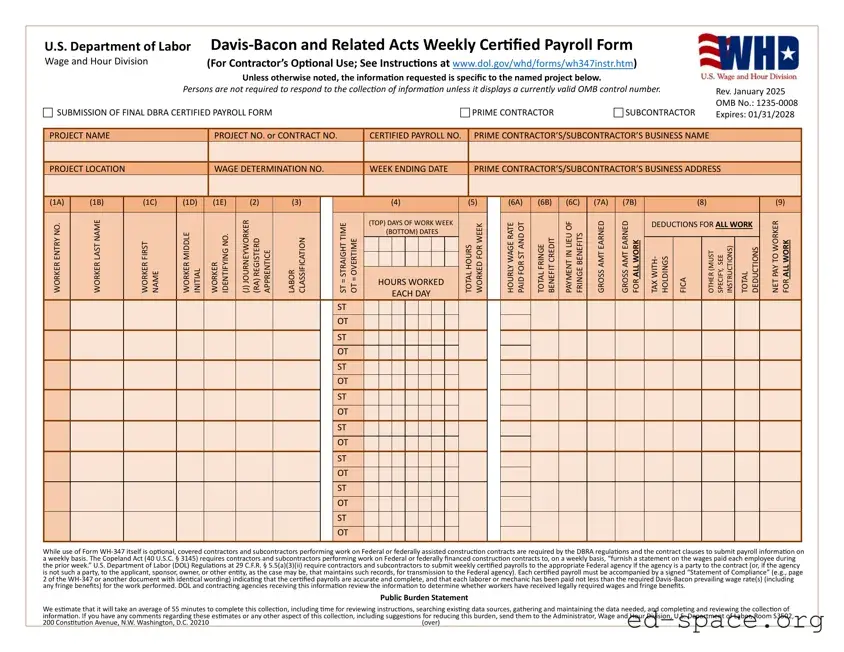
Rev. January 2025
OMB No.: 1235-0008
Expires: 01/31/2028
U.S. Department of Labor
Wage and Hour Division
Davis-Bacon and Related Acts Weekly Cerfied Payroll Form
(For Contractors Oponal Use; See Instrucons at
www.dol.gov/whd/forms/wh347instr.htm
)
Unless otherwise noted, the informaon requested is specific to the named project below.
Persons are not required to respond to the collecon of informaon unless it displays a currently valid OMB control number.
SUBMISSION OF FINAL DBRA CERTIFIED PAYROLL FORM PRIME CONTRACTOR SUBCONTRACTOR
PROJECT NAME PROJECT NO. or CONTRACT NO. CERTIFIED PAYROLL NO. PRIME CONTRACTOR’S/SUBCONTRACTOR’S BUSINESS NAME
PROJECT LOCATION WAGE DETERMINATION NO. WEEK ENDING DATE PRIME CONTRACTOR’S/SUBCONTRACTOR’S BUSINESS ADDRESS
(1A) (1B) (1C) (1D) (1E) (2) (3) (4) (5) (6A) (6B) (6C) (7A) (7B) (8) (9)
WORKER ENTRY NO.
WORKER LAST NAME
WORKER FIRST
NAME
WORKER MIDDLE
INITIAL
WORKER
IDENTIFYING NO.
(J) JOURNEYWORKER
(RA) REGISTERD
APPRENTICE
LABOR
CLASSIFICATION
ST = STRAIGHT TIME
OT = OVERTIME
(TOP) DAYS OF WORK WEEK
(BOTTOM) DATES
TOTAL HOURS
WORKED FOR WEEK
HOURLY WAGE RATE
PAID FOR ST AND OT
TOTAL FRINGE
BENEFIT CREDIT
PAYMENT IN LIEU OF
FRINGE BENEFITS
GROSS AMT EARNED
GROSS AMT EARNED
FOR ALL WORK
DEDUCTIONS FOR ALL WORK
NET PAY TO WORKER
FOR ALL WORK
TAX WITH-
HOLDINGS
FICA
OTHER (MUST
SPECIFY, SEE
INSTRUCTIONS)
TOTAL
DEDUCTIONS
HOURS WORKED
EACH DAY
ST
OT
ST
OT
ST
OT
ST
OT
ST
OT
ST
OT
ST
OT
ST
OT
While use of Form WH-347 itself is oponal, covered contractors and subcontractors performing work on Federal or federally assisted construcon contracts are required by the DBRA regulaons and the contract clauses to submit payroll informaon on
a weekly basis. The Copeland Act (40 U.S.C. § 3145) requires contractors and subcontractors performing work on Federal or federally financed construcon contracts to, on a weekly basis, “furnish a statement on the wages paid each employee during
the prior week.” U.S. Department of Labor (DOL) Regulaons at 29 C.F.R. § 5.5(a)(3)(ii) require contractors and subcontractors to submit weekly cerfied payrolls to the appropriate Federal agency if the agency is a party to the contract (or, if the agency
is not such a party, to the applicant, sponsor, owner, or other enty, as the case may be, that maintains such records, for transmission to the Federal agency). Each cerfied payroll must be accompanied by a signed Statement of Compliance” (e.g., page
2 of the WH-347 or another document with idencal wording) indicang that the cerfied payrolls are accurate and complete, and that each laborer or mechanic has been paid not less than the required Davis-Bacon prevailing wage rate(s) (including
any fringe benefits) for the work performed. DOL and contracng agencies receiving this informaon review the informaon to determine whether workers have received legally required wages and fringe benefits.
Public Burden Statement
We esmate that it will take an average of 55 minutes to complete this collecon, including me for reviewing instrucons, searching exisng data sources, gathering and maintaining the data needed, and compleng and reviewing the collecon of
informaon. If you have any comments regarding these esmates or any other aspect of this collecon, including suggesons for reducing this burden, send them to the Administrator, Wage and Hour Division, U.S. Department of Labor, Room S3502,
200 Constuon Avenue, N.W. Washington, D.C. 20210 (over)
PROJECT NAME PROJECT NO. or CONTRACT NO. PAYROLL NO. PRIME CONTRACTOR’S/SUBCONTRACTOR’S BUSINESS NAME
PROJECT LOCATION WEEK ENDING DATE CERTIFYING OFFICIALs NAME AND TITLE
I paid or supervised the payment of the laborers or mechanics working on the above project during the stated me period. I cerfy the following:
The payroll informaon submied with this statement is correct and complete for the above project during the above period, and the wage and fringe benefit rates paid to the workers,
including credit taken for the reasonably ancipated costs of a bona fide fringe benefit plan, fund or program, are not less than the applicable wage and fringe benefits rates for the
classificaon(s) of work actually performed, as specified in the wage determinaon(s) incorporated into the contract.
All regular payrolls and all other basic records that the contractor is required to maintain for this payroll period are complete and accurate and will be made available upon request from the
agency or the Department of Labor.
The classificaons reported for each laborer or mechanic are the classificaon(s) of work that each worker actually performed.
Any workers paid as apprences during the above period are duly registered in a bona fide apprenceship program registered with the Office of Apprenceship, Employment and Training
Administraon, United States Department of Labor (“OA”), or a State Apprenceship Agency (“SAA”) recognized by Department of Labor. I have verified the registered apprenceship program
informaon provided below as accurate and applicable to any apprences idenfied on page 1 of this form.
APPRENTICESHIP PROGRAM NAME REGISTERED NAME OF LABOR CLASSIFICATION
OA SAA
OA SAA
OA SAA
Fringe benefits have been paid in cash and/or to bona fide fringe benefit plans, funds, or programs. Where the contractor is claiming an hourly credit for their contribuons to or reasonably
ancipated costs of a bona fide fringe benefit plan, fund, or program, provide plan informaon and the hourly credit claimed for each worker listed on the previous page of this form.
HOURLY CREDIT FOR FRINGE BENEFITS
If an amount is listed in (6B) on the first page of this cerfied payroll form, enter the hourly credit claimed under each plan name, type and number for each worker and check whether the plan is funded or unfunded.
NAME OF WORKER
FB NAME FB NAME FB NAME FB NAME FB NAME FB NAME
TOTAL
HOURLY
CREDIT
FB TYPE
FB TYPE
FB TYPE
FB TYPE
FB TYPE
FB TYPE
PLAN NO. PLAN NO. PLAN NO. PLAN NO. PLAN NO. PLAN NO.
Funded Unfunded Funded Unfunded Funded Unfunded Funded Unfunded Funded Unfunded Funded Unfunded
Hourly Credit
$
Hourly Credit
$
Hourly Credit
$
Hourly Credit
$
Hourly Credit
$
Hourly Credit
$ $
Hourly Credit
$
Hourly Credit
$
Hourly Credit
$
Hourly Credit
$
Hourly Credit
$
Hourly Credit
$ $
Hourly Credit
$
Hourly Credit
$
Hourly Credit
$
Hourly Credit
$
Hourly Credit
$
Hourly Credit
$ $
Hourly Credit
$
Hourly Credit
$
Hourly Credit
$
Hourly Credit
$
Hourly Credit
$
Hourly Credit
$ $
Hourly Credit
$
Hourly Credit
$
Hourly Credit
$
Hourly Credit
$
Hourly Credit
$
Hourly Credit
$ $
Hourly Credit
$
Hourly Credit
$
Hourly Credit
$
Hourly Credit
$
Hourly Credit
$
Hourly Credit
$ $
Hourly Credit
$
Hourly Credit
$
Hourly Credit
$
Hourly Credit
$
Hourly Credit
$
Hourly Credit
$ $
Hourly Credit
$
Hourly Credit
$
Hourly Credit
$
Hourly Credit
$
Hourly Credit
$
Hrly Credit
$ $
All workers on the project have been paid the full weekly wages earned, and no rebates or deducons have been or will be made either directly or indirectly, other than permissible
deducons as defined in 29 CFR part 3.
ADDITIONAL REMARKS
SIGNATURE OF CERTIFYING OFFICIAL DATE TELEPHONE NUMBER EMAIL ADDRESS
( __ __ __ ) __ __ __ __ __ __ __
THE WILLFUL FALSIFICATION OF ANY OF THE ABOVE STATEMENTS MAY SUBJECT THE CONTRACTOR OR SUBCONTRACTOR TO CIVIL OR CRIMINAL PROSECUTION (SEE SECTION 1001 OF TITLE 18 AND SECTION 3729 OF TITLE 31 OF THE UNITED STATES
CODE), AS WELL AS DEBARMENT FROM FUTURE FEDERAL AND FEDERALLY-ASSISTED CONTRACTS. INFORMATION REPORTED IN CERTIFIED PAYROLLS MAY BE SUBJECT TO DISCLOSURE IN RESPONSE TO A FREEDOM OF INFORMATION ACT REQUEST.

Form Specifications

Fact Name Description
Purpose The U.S. Department of Labor (DoL) form is used to collect information for compliance with labor laws and regulations.
Common Forms Commonly used forms include the I-9 for employment eligibility verification and the W-2 for wage reporting.
State-Specific Forms Many states have their own forms that align with state labor laws, such as the California Labor Code or New York Labor Law.
Submission Requirements Forms must be completed accurately and submitted within specified time frames to avoid penalties.
Record Keeping Employers are required to keep copies of completed forms for a designated period, often three to five years.
Updates and Changes The DoL periodically updates forms to reflect changes in laws or regulations, so staying informed is essential.

U.S. DoL: Usage Guidelines

Filling out the U.S. Department of Labor form is an important step in ensuring that your application is processed smoothly. It requires attention to detail and accuracy. Follow the steps below to complete the form correctly.

  1. Begin by gathering all necessary information. This may include personal details, employment history, and any relevant documentation.
  2. Read the instructions carefully. Each section of the form will have specific guidelines that need to be followed.
  3. Start filling out the form with your personal information. This typically includes your name, address, and contact details.
  4. Move on to employment details. Provide accurate information about your job title, employer, and dates of employment.
  5. Complete any additional sections as required. This may include questions about your work experience or specific circumstances related to your application.
  6. Review your entries for accuracy. Double-check all information to ensure there are no mistakes or omissions.
  7. Sign and date the form. This step is crucial as it confirms that the information provided is true and complete.
  8. Make a copy of the completed form for your records before submitting it.
  9. Submit the form as instructed, whether by mail or electronically, depending on the requirements.

Once you have submitted the form, you may need to wait for a response. It's a good idea to keep track of your submission and follow up if necessary. Being proactive can help ensure that your application is processed in a timely manner.

Your Questions, Answered

What is the purpose of the U.S. Department of Labor (DoL) form?

The U.S. Department of Labor (DoL) form serves various purposes, depending on the specific type of form being used. Generally, these forms are designed to collect information related to labor standards, employment statistics, workplace safety, and wage and hour laws. They help ensure compliance with federal regulations and facilitate the monitoring of labor conditions in the United States. By filling out these forms, employers and employees contribute to a better understanding of labor practices and protections in the workforce.

Who needs to fill out a U.S. DoL form?

Different stakeholders may need to complete a U.S. DoL form. Employers, employees, and sometimes contractors or labor organizations may be required to fill out these forms. For example, employers must submit forms related to wage and hour compliance, while employees may need to fill out forms to report workplace injuries or file complaints about labor violations. The specific requirements depend on the type of form and the circumstances surrounding its use.

How can I obtain a U.S. DoL form?

U.S. DoL forms are readily available online. You can visit the official Department of Labor website, where you will find a section dedicated to forms and publications. There, you can search for the specific form you need, download it, and print it for completion. If you prefer, you may also request forms directly from your local DoL office or other relevant agencies, depending on the nature of the form.

What should I do if I make a mistake on a U.S. DoL form?

If you realize you have made a mistake on a U.S. DoL form, it is important to correct it promptly. Depending on the form, you may need to cross out the incorrect information and write the correct details above it. In some cases, it may be more appropriate to fill out a new form entirely. Always check the instructions provided with the form for guidance on how to make corrections. Submitting accurate information is crucial to avoid delays or issues with compliance.

Where can I find assistance if I have questions about filling out a U.S. DoL form?

If you have questions about completing a U.S. DoL form, there are several resources available. The Department of Labor website offers detailed instructions and FAQs for many forms. Additionally, you can contact the DoL directly through their helplines or local offices for personalized assistance. Consulting with a legal professional experienced in labor law can also provide valuable insights and guidance tailored to your specific situation.

Common mistakes

  1. Incomplete Information: One of the most common mistakes is leaving sections blank. Every field is important and contributes to the processing of your application. Always double-check to ensure that no vital information is missing.

  2. Incorrect Dates: Filling in the wrong dates can lead to confusion. Whether it’s your employment dates or the date of filing, accuracy is crucial. Verify that all dates align with your records.

  3. Using Incorrect Names: Names must match official documents. Using nicknames or variations can lead to delays. Always use your legal name as it appears on your identification.

  4. Not Following Instructions: Each form comes with specific guidelines. Ignoring these instructions can result in rejection. Take the time to read through all the directions carefully.

  5. Omitting Supporting Documents: Failing to include necessary documentation can hinder your application. Check the requirements and ensure you attach all relevant papers.

  6. Neglecting to Sign: A signature is often required to validate the form. Forgetting to sign can render the application invalid. Always remember to sign and date your submission.

  7. Submitting the Wrong Form: Different situations require different forms. Submitting the incorrect one can delay your process. Make sure you are using the right form for your specific needs.

Documents used along the form

When dealing with the U.S. Department of Labor (DoL) forms, there are several other documents that often accompany them. These documents help streamline processes and ensure compliance with labor regulations. Below are four common forms and documents that you might encounter.

  • Employer Identification Number (EIN): This is a unique number assigned by the IRS to businesses for tax purposes. It helps identify the business entity and is often required when filling out various labor-related forms.
  • Job Description: A detailed outline of the responsibilities, qualifications, and expectations for a specific position. This document is crucial for ensuring that job postings align with labor laws and regulations.
  • Employee Handbook: This document outlines company policies, procedures, and employee rights. It serves as a reference for both employees and employers, promoting understanding of workplace expectations.
  • Payroll Records: These documents track employee hours, wages, and deductions. Maintaining accurate payroll records is essential for compliance with labor laws and for resolving any disputes that may arise.

Understanding these documents can make navigating labor regulations easier. They play a vital role in ensuring that both employers and employees are informed and compliant with the law.

Similar forms

The U.S. Department of Labor (DoL) form is essential for various labor-related processes. Several other documents serve similar purposes in the realm of employment and labor relations. Here’s a list of seven documents that share similarities with the U.S. DoL form:

  • W-2 Form: This document reports an employee's annual wages and the taxes withheld from their paycheck. Like the DoL form, it is crucial for tax purposes and employment verification.
  • 1099 Form: Used for reporting income received by independent contractors. Similar to the DoL form, it helps the government track earnings and ensure proper tax payments.
  • I-9 Form: Employers use this form to verify an employee's identity and eligibility to work in the U.S. It parallels the DoL form in that both are vital for compliance with federal regulations.
  • FMLA Certification Form: This document is used to request leave under the Family and Medical Leave Act. It shares the purpose of documenting employee rights and benefits, similar to the DoL form.
  • EEO-1 Report: Employers file this report to provide a demographic breakdown of their workforce. It aligns with the DoL form in promoting workplace equality and compliance with labor laws.
  • Labor Condition Application (LCA): This form is required for employers seeking to hire foreign workers. It is similar to the DoL form as it ensures that labor standards are met in the hiring process.
  • Unemployment Insurance Claim Form: This document is filed by individuals seeking unemployment benefits. It serves a similar function as the DoL form by facilitating access to labor-related resources and protections.

Each of these documents plays a significant role in maintaining fair labor practices and ensuring compliance with various employment laws in the United States.

Dos and Don'ts

When filling out the U.S. Department of Labor (DoL) form, it's essential to approach the task with care. Here are some important dos and don'ts to keep in mind:

  • Do read the instructions carefully before starting.
  • Do provide accurate and complete information.
  • Do double-check your form for any errors.
  • Do keep a copy of the completed form for your records.
  • Do submit the form by the deadline specified.
  • Don't rush through the form; take your time to ensure accuracy.
  • Don't leave any required fields blank.
  • Don't use jargon or abbreviations that may not be understood.
  • Don't ignore any requests for additional documentation.

Misconceptions

When it comes to the U.S. Department of Labor (DoL) forms, several misconceptions can lead to confusion. Understanding these myths can help individuals navigate the process more effectively.

  • All DoL forms are the same. Many people believe that all forms issued by the DoL serve the same purpose. In reality, there are various forms designed for specific situations, such as wage claims, labor disputes, and workplace safety issues.
  • Filing a DoL form guarantees a quick resolution. Some individuals think that submitting a form will automatically lead to a swift outcome. However, the processing time can vary significantly based on the nature of the claim and the current workload of the department.
  • You don’t need to provide documentation. A common misconception is that filling out a form is sufficient. Supporting documents often play a crucial role in substantiating claims and can greatly impact the outcome.
  • DoL forms are only for employees. Many assume that these forms are exclusively for employees seeking help. However, employers can also use certain DoL forms to report compliance issues or seek clarification on regulations.

Clearing up these misconceptions can empower individuals to take the right steps when dealing with the U.S. DoL forms.

Key takeaways

Filling out and using the U.S. Department of Labor (DoL) form can be a straightforward process if you keep a few important points in mind. Here are some key takeaways to consider:

  • Accuracy is Essential: Ensure that all information provided is correct. Mistakes can lead to delays or complications in processing your request.
  • Documentation Matters: Include all necessary supporting documents. This helps to substantiate your claims and can expedite the review process.
  • Understand the Purpose: Familiarize yourself with the specific purpose of the form you are completing. This knowledge will guide you in providing relevant information.
  • Seek Assistance if Needed: Don’t hesitate to reach out for help if you encounter difficulties. Various resources are available to assist you in navigating the process.

By following these guidelines, you can enhance your experience with the U.S. DoL form and ensure that your submission is handled efficiently.