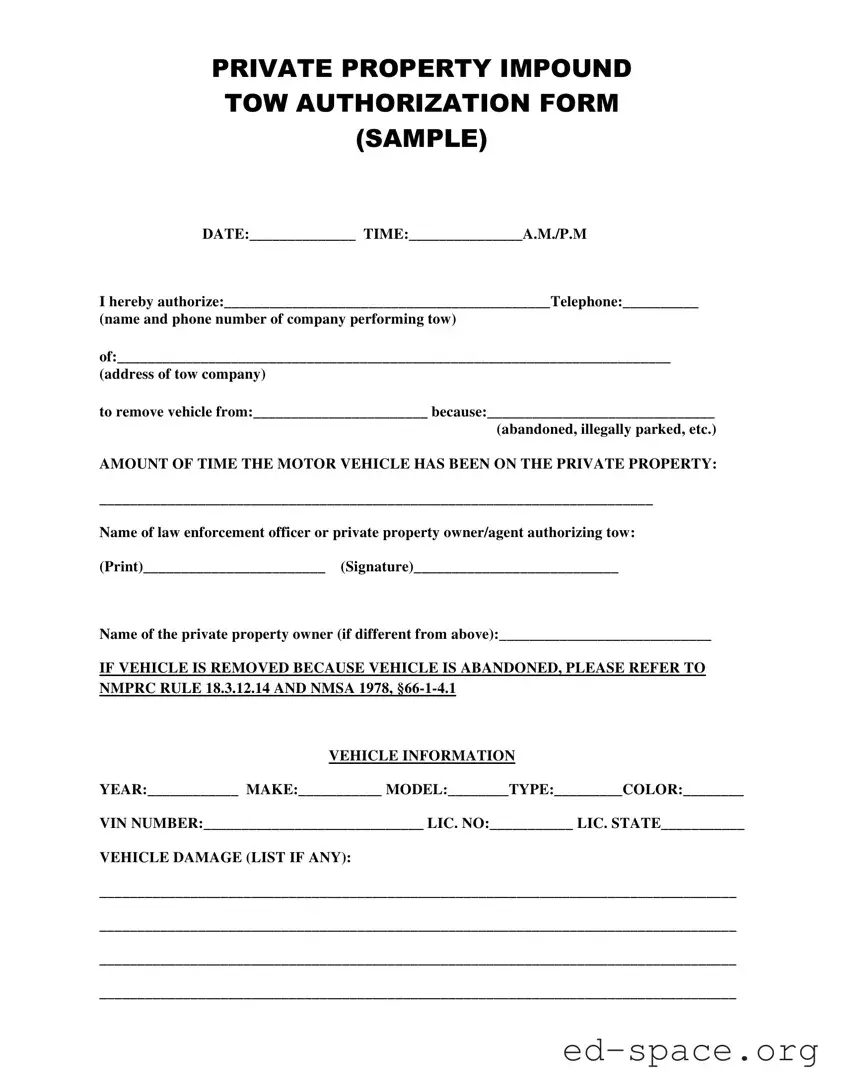
The Tow Authorization form serves as a crucial document for property owners and tow companies, facilitating the legal removal of vehicles from private property. This form outlines essential details, including the date and time of authorization, the name and contact information of the towing company, and the specific address from which the vehicle will be towed. It requires the property owner or their agent to specify the reason for the tow, such as abandonment or illegal parking, providing clarity and justification for the action. Additionally, the form prompts the individual authorizing the tow to indicate how long the vehicle has been on the property, which can be important for compliance with local regulations. The document also captures vital vehicle information, including year, make, model, color, VIN number, and license plate details, ensuring that the correct vehicle is identified and removed. If the vehicle is deemed abandoned, references to specific regulations, such as NMPRC Rule 18.3.12.14 and NMSA 1978, §66-1-4.1, are included to guide the process. Overall, this form is a key tool in managing private property and maintaining order, protecting the rights of property owners while adhering to legal standards.

| Fact Name | Description |
|---|---|
| Date and Time | The form requires the date and time of the tow authorization, ensuring proper documentation of the event. |
| Tow Company Information | Details about the towing company, including name and contact information, must be provided to ensure accountability. |
| Reason for Tow | The form mandates a clear reason for the vehicle's removal, such as being abandoned or illegally parked, which helps clarify the situation. |
| Law Enforcement or Agent Authorization | Signature and printed name of the authorizing law enforcement officer or property owner/agent are essential for legal validation of the tow. |
| Governing Law | If the vehicle is deemed abandoned, the form references NMPRC Rule 18.3.12.14 and NMSA 1978, §66-1-4.1, which govern the towing of abandoned vehicles in New Mexico. |
Completing the Tow Authorization form is a straightforward process. This form allows you to officially authorize a towing company to remove a vehicle from your property. To ensure everything is filled out correctly, follow the steps outlined below.
What is a Tow Authorization form?
A Tow Authorization form is a document that allows a towing company to remove a vehicle from private property. It includes details about the vehicle, the reason for the tow, and the authorization from the property owner or agent.
Who can authorize a tow?
The property owner or an authorized agent can authorize a tow. This person must sign the form and provide their name and contact information. If the vehicle is abandoned, specific rules may apply.
What information is required on the form?
The form requires the date, time, towing company details, vehicle information (year, make, model, type, color, VIN, and license plate number), the reason for the tow, and the name and signature of the authorizing individual.
What should I do if my vehicle is towed?
If your vehicle has been towed, contact the towing company listed on the Tow Authorization form. They can provide information about where your vehicle is located and any fees that may be due for its release.
How long can a vehicle be on private property before it can be towed?
The amount of time a vehicle can remain on private property before being towed varies by state and local laws. The Tow Authorization form should indicate how long the vehicle has been on the property, which is essential for compliance with these regulations.
What if the vehicle is damaged during the tow?
The Tow Authorization form includes a section to note any pre-existing vehicle damage. If damage occurs during towing, the towing company may be liable, depending on the circumstances and local laws. Always document any damage and report it to the towing company immediately.
Can I contest a tow?
You may contest a tow if you believe it was unjustified. Gather evidence, such as photographs and witness statements, and contact the property owner or the towing company to discuss your concerns. Legal options may also be available depending on local laws.
What happens if I do not retrieve my vehicle?
If you do not retrieve your vehicle within a specified time frame, the towing company may have the right to sell or dispose of it. Fees will continue to accrue, so it is best to act promptly to avoid additional costs.
Are there specific laws governing towing in my area?
Yes, towing regulations vary by state and municipality. It is important to familiarize yourself with local laws regarding towing, especially concerning abandoned vehicles, notification requirements, and towing fees.
Incomplete Information: Failing to fill out all required fields can lead to delays or rejections of the authorization. Ensure every section, from the date to the vehicle details, is completed.
Incorrect Contact Information: Providing an incorrect phone number for the towing company can create confusion. Double-check that the name and phone number are accurate.
Ambiguous Vehicle Location: Not specifying the exact location from which the vehicle is being towed can lead to misunderstandings. Clearly state the address to avoid complications.
Vague Reason for Tow: Writing a general reason, such as "illegally parked," without additional context may not suffice. Be specific about the circumstances surrounding the tow.
Missing Authorizing Signature: Omitting the signature of the law enforcement officer or property owner can invalidate the authorization. Always ensure that signatures are present.
Neglecting Vehicle Details: Leaving out critical vehicle information, such as the VIN or license plate number, can complicate the towing process. Fill in all vehicle details thoroughly.
Ignoring Damage Reporting: Failing to note any existing vehicle damage can lead to disputes later. Document any damage clearly on the form.
Not Following Local Regulations: Overlooking local laws regarding towing can result in legal issues. Familiarize yourself with relevant regulations before completing the form.
Inconsistent Dates and Times: Providing conflicting information about the date and time of the tow can raise questions. Ensure consistency throughout the form.
Forgetting Additional Signatures: If the property owner is different from the authorizing agent, neglecting to include their signature can create problems. Make sure all necessary parties sign the document.
The Tow Authorization form is often accompanied by several other documents that help clarify the towing process and protect the rights of all parties involved. Below is a list of commonly used forms and documents that may accompany the Tow Authorization form.
These documents collectively ensure that the towing process is handled legally and transparently. Each plays a vital role in protecting the rights of vehicle owners and property owners alike.
The Tow Authorization form shares similarities with several other important documents related to vehicle towing and property management. Understanding these similarities can help clarify their functions and uses. Here’s a list of documents that are comparable:
When filling out the Tow Authorization form, it’s essential to approach the task with care. Here’s a list of things you should and shouldn’t do to ensure a smooth process.
Understanding the Tow Authorization form is crucial for both property owners and vehicle owners. However, several misconceptions can lead to confusion. Here are seven common misconceptions:
This form is required for any vehicle that needs to be towed from private property, not just abandoned ones. It can also be used for illegally parked vehicles.
Written authorization is essential. The form serves as legal documentation that protects both the property owner and the towing company.
The tow company must follow the terms outlined in the Tow Authorization form. Towing without proper authorization may lead to legal issues.
Fees for towing must comply with local laws and regulations. Property owners should be aware of the limits on towing charges.
Each state may have different requirements and rules regarding towing. It is important to be familiar with local laws.
Vehicle owners can contest a tow if they believe it was unjustified. They should review the Tow Authorization form and local laws to understand their rights.
While a signature from a law enforcement officer is not always necessary, having one can provide additional legitimacy and support for the towing process.
Filling out and using the Tow Authorization form requires attention to detail and adherence to specific guidelines. Here are key takeaways to consider:
Following these guidelines will help ensure that the towing process is conducted smoothly and legally.