Homepage Blank Texas Writ Mandamus PDF Form
Content Overview

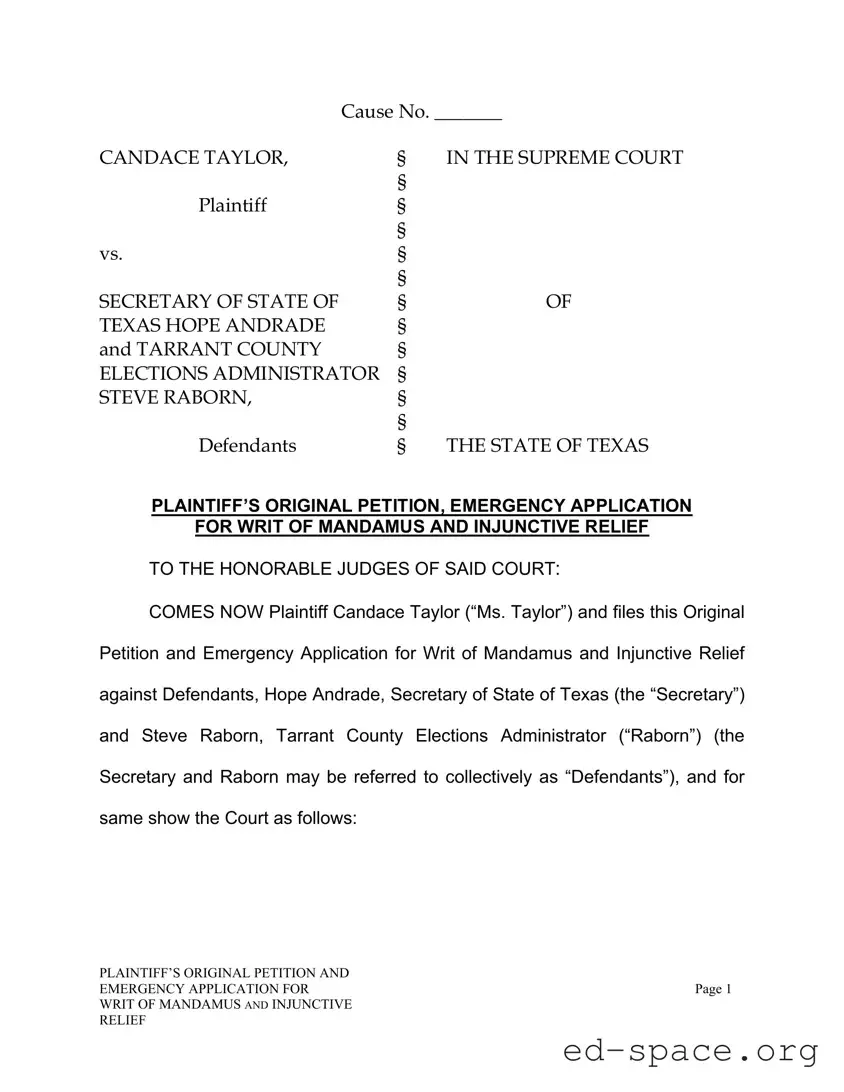
The Texas Writ of Mandamus form serves as a critical legal document used to compel a government official or agency to perform a duty that is required by law. This form is often utilized in urgent situations where a party seeks immediate relief, especially in election-related matters. In this context, the form is structured to include essential components such as the cause number, parties involved, and a clear statement of jurisdiction. The plaintiff, in this case, is Candace Taylor, who has filed an original petition against the Secretary of State of Texas and the Tarrant County Elections Administrator. The document outlines the facts surrounding the case, including the urgency of the situation due to impending election deadlines. Additionally, it requests an expedited hearing, emphasizing the need for a timely resolution. The form also details the qualifications of the plaintiff and the circumstances that led to the necessity of this writ, including the tragic passing of a primary candidate, which created a vacancy. Overall, the Texas Writ of Mandamus form is designed to facilitate swift judicial intervention in matters where public interest and electoral integrity are at stake.


Document Preview

PLAINTIFF’S ORIGINAL PETITION AND
EMERGENCY APPLICATION FOR Page 1
WRIT OF MANDAMUS AND INJUNCTIVE
RELIEF
Cause No. _______
CANDACE TAYLOR, § IN THE SUPREME COURT
§
Plaintiff §
§
vs. §
§
SECRETARY OF STATE OF § OF
TEXAS HOPE ANDRADE §
and TARRANT COUNTY §
ELECTIONS ADMINISTRATOR §
STEVE RABORN, §
§
Defendants § THE STATE OF TEXAS
PLAINTIFF’S ORIGINAL PETITION, EMERGENCY APPLICATION
FOR WRIT OF MANDAMUS AND INJUNCTIVE RELIEF
TO THE HONORABLE JUDGES OF SAID COURT:
COMES NOW Plaintiff Candace Taylor (“Ms. Taylor”) and files this Original
Petition and Emergency Application for Writ of Mandamus and Injunctive Relief
against Defendants, Hope Andrade, Secretary of State of Texas (the “Secretary”)
and Steve Raborn, Tarrant County Elections Administrator (“Raborn”) (the
Secretary and Raborn may be referred to collectively as “Defendants”), and for
same show the Court as follows:
PLAINTIFF’S ORIGINAL PETITION AND
EMERGENCY APPLICATION FOR Page 2
WRIT OF MANDAMUS AND INJUNCTIVE
RELIEF
I.
JURISDICTION AND VENUE; SERVICE OF PROCESS
This Court has jurisdiction pursuant to T
EXAS ELECTION CODE §§ 273.061
and 273.081. The Secretary of State of Texas may be served with process at
1100 Congress, Capitol Bldg., Room 1E.8, Austin, Texas 78701. Steve Raborn,
Tarrant County Elections Administrator, may be served with process at 2700
Premier Street, Fort Worth 76111.
II.
REQUEST FOR EXPEDITED HEARING
Because of the upcoming deadlines relating to candidacy for the upcoming
general election, scheduled for November 2, 2010, the necessity of resolving the
issues that are the subject of this Petition is urgent, and Plaintiff requests that the
Court set this matter for hearing on an expedited basis. The deadline for
submitting a candidate’s name for inclusion on the ballot is August 20, 2010,
which Plaintiff Candace Taylor has already done, as evidenced by the letter from
the Secretary of State, rejecting Ms. Taylor’s application, which is attached to this
Petition as Exhibit A
. The deadline for certifying the ballot is on or about August
24, 2010, a date after which Defendant's will argue adding a candidate to the
ballot for the 432nd District Court will be moot.
PLAINTIFF’S ORIGINAL PETITION AND
EMERGENCY APPLICATION FOR Page 3
WRIT OF MANDAMUS AND INJUNCTIVE
RELIEF
III.
FACTUAL BACKGROUND
1. Plaintiff Candace Taylor is an attorney licensed to practice law in the
State of Texas, having been granted her law license in 1996. Ms. Taylor meets
all of the qualifications for a candidate for public office pursuant to Section
141.001 of the T
EXAS ELECTION CODE.
2. In 2009, a new criminal district court was created in Tarrant County,
Texas. This was the 432
nd
District Court, and the initial Judge of the court was
Ruben Gonzalez, who was appointed by Governor Rick Perry in accordance with
Texas law governing the filling of judicial posts in newly created courts between
elections. Judge Gonzalez’s term is set to expire, and the position will be filled
by the winning candidate in the general election this coming November.
3. In March 2010, the Republican and Democratic Parties each held
primary elections to determine the parties’ respective choices for candidates to
be placed on the ballot for the general election scheduled for November 2, 2010
(hereinafter, the “General Election”). Ms. Taylor was aware that the Republican
nominee for the 432
nd
District Court was Tom Zachry, whom Ms. Taylor believed
was a highly qualified candidate, and that Mr. Zachry would win the primary
election against Judge Gonzalez. Ms. Taylor, and the Democratic Party
generally, were satisfied that Mr. Zachry would be an excellent judge, which was
PLAINTIFF’S ORIGINAL PETITION AND
EMERGENCY APPLICATION FOR Page 4
WRIT OF MANDAMUS AND INJUNCTIVE
RELIEF
an important reason why the Democratic Party chose not to run a candidate in
the primary elections for the 432
nd
District Court.
4. Mr. Zachry did, in fact, defeat Judge Gonzalez in the primary, and
was to have been the Republican candidate for the judgeship for the 432
nd
Court
in the General Election. The Democrats and Ms. Taylor, not wanting to run a
candidate against Mr. Zachry, were content for Mr. Zachry to run unopposed in
the general election.
5. Unfortunately, Mr. Zachry was killed in a tragic boating accident
shortly after the primary election. On March 19, 2010, Mr. Zachry’s boat
capsized on Aquilla Lake, and Mr. Zachry was subsequently pronounced dead.
Mr. Zachry’s death created a vacancy in the nominees for judge of the
432
nd
District Court in the November General Election. As Mr. Zachry was to
have been unopposed, his passing left no candidate for the position.
6. As a further result of Mr. Zachry’s untimely death, Plaintiff Candace
Taylor (and Democratic Party officials of Tarrant County) now faces the prospect
of having the Republican Party offer a replacement for Mr. Zachry. In fact, the
Republican Party has named Judge Ruben Gonzalez – the very candidate whom
Mr. Zachry defeated in the March primary - as the replacement for Mr. Zachry.
Neither Ms. Taylor nor Democratic Party officials finds Judge Gonzalez to be a
satisfactory replacement nominee, and do not believe Judge Gonzalez is the
best candidate to hold the position of Judge of the 432
nd
District Court.
PLAINTIFF’S ORIGINAL PETITION AND
EMERGENCY APPLICATION FOR Page 5
WRIT OF MANDAMUS AND INJUNCTIVE
RELIEF
Accordingly, Ms. Taylor has been requested by the Democratic Party to run
against Judge Gonzalez in the General Election, and Ms. Taylor has been
named by the Democratic Party of Tarrant County as a replacement candidate
due to the death of Tom Zachry.
7. On July 19, 2010, the Tarrant County Democratic Party Executive
Committee, a quorum being present, nominated Candace Taylor as the
Democratic Party for the office of 432nd District Court. Tarrant County
Democratic Party Chairman Steve Maxwell immediately certified the nomination
and forwarded Candace Taylor's nomination to the Texas Secretary of State.
Ms. Taylor’s name was submitted to the Texas Secretary of State in accordance
with Texas law and procedure. See Tex. Elec. Code §143.037. A copy of a
letter from Mr. Stephen C. Maxwell, Tarrant County Democratic Party Chair, to
the Secretary is attached hereto as Exhibit A
. The Secretary, however, has
rejected Ms. Taylor as a candidate, stating that she is not qualified to run in the
General Election against Judge Gonzalez for the sole reason that Ms. Taylor was
not selected as a candidate by the Democratic Party in its March primary
elections. A copy of an August 3, 2010 letter from the Secretary to Mr. Maxwell,
denying certification of Ms. Taylor as a nominee, is attached hereto as Exhibit B
.
8. Plaintiff Candace Taylor believes the Secretary of State’s position on
this issue is unfounded, and therefore brings this action seeking an order from
this Court that Candace Taylor be placed on the ballot as a judicial candidate for
PLAINTIFF’S ORIGINAL PETITION AND
EMERGENCY APPLICATION FOR Page 6
WRIT OF MANDAMUS AND INJUNCTIVE
RELIEF
the 432
nd
District Court in the General Election scheduled to be held in the State
of Texas on November 2, 2010.
IV.
ARGUMENT AND LEGAL AUTHORITIES
9. The Secretary relies on Sections 145.035 and 145.036 of the Texas
Election Code (the “Code”) as the basis for denying Ms. Taylor a place on the
General Election ballot. Section 145.036(a) of the Code states as follows:
(a) Except as provided by Subsection (b), if a candidate's name is to
be omitted from the ballot under Section 145.035, the political party's
state, district, county, or precinct executive committee, as
appropriate for the particular office, may nominate a replacement
candidate to fill the vacancy in the nomination.
Subsection (b) establishes the conditions whereby a committee may select
a replacement nominee who has withdrawn due to a catastrophic illness, and is
therefore inapplicable to the situation at hand.
10. The Secretary contends that, because Ms Taylor was not a
candidate for the 432
nd
judicial post in the Democratic Party’s primary election,
Ms. Taylor may not now be listed as a candidate for the position on the General
Election ballot. The Secretary’s position is that, for candidates who withdraw
because of death, the replacement process requires that any replacement
nominee must be one who was a candidate in a party’s primary (or at least that
the party must have listed a candidate for the position in its primary election).
PLAINTIFF’S ORIGINAL PETITION AND
EMERGENCY APPLICATION FOR Page 7
WRIT OF MANDAMUS AND INJUNCTIVE
RELIEF
The Secretary’s Position Violates the Texas Constitution
11. Article 5, Section 28 of the Texas Constitution states that, in the
event of a vacancy in the office of judge of a district court, any such vacancy will
be filled by the Governor of Texas, and the appointee shall serve until “the next
succeeding General Election….” T
EX. CONST. ART. 5, SEC. 28. At the General
Election, “…the voters shall fill the vacancy for the unexpired term.” Id.
12. Under the circumstances of this case, the “vacancy” occurred
only because a new court was created, and the Governor properly appointed a
judge – Judge Gonzalez – to serve until the next General Election.
13. The Texas Constitution, however, requires that at the next
General Election, it is the voters who decide who will serve as judge. The voters
are not even being given that opportunity in this case and, in fact, if the
Secretary’s position were to be sustained, the voters would be allowed to select
only one major party candidate whom voters (those who voted in the Republican
primary) have already rejected as a candidate!
1
The inequity of such a situation
is obvious, fundamentally flawed, and violates the precepts of our State’s
Constitution.
14. Furthermore, the Texas Election Code, as applied by the Texas
Secretary of State, violates Candace Taylor’s right to Equal Protection, Candace
1
Judge Gonzalez lost the primary election by some 20 points.
PLAINTIFF’S ORIGINAL PETITION AND
EMERGENCY APPLICATION FOR Page 8
WRIT OF MANDAMUS AND INJUNCTIVE
RELIEF
Taylor's First Amendment Right to be a candidate, and the voters of Tarrant
County's rights to vote, as protected by the Texas Constitution. There is no
rational basis or compelling interest under the Texas Equal Protection Clause to
allow the Republican Party to nominate a candidate while not allowing the
Democratic Party to nominate a candidate after the death of the Republican
nominee. Candace Taylor had no desire to run when Tom Zachary was a
candidate; only upon Mr. Zachry’s death did Ms. Taylor agree to run for the
432nd District Court. There is no rational basis or compelling interest under the
Equal Protection Clause to deny voters the right to choose between two
candidates for the 432nd District Court after the death of Tom Zachary.
Statutes Must Be Strictly Construed in Favor of Ballot Access
15. Any constitutional or statutory provision which restricts the right
to hold office must be strictly construed against ineligibility. Texas Democratic
Party v. Benkiser, 459 F.3d 582, 590 (5
th
Cir. 2006); Wentworth v. Meyer, 839
S.W.2d 766-67 (Tex. 1992). The Texas Supreme Court has consistently held
that political candidates’ access to the ballot shall be given precedence over
“rigid adherence to statutory deadlines, when a candidate is deprived of a place
on the ballot through no fault of the candidate’s.” See Bird v. Rothstein, 930
S.W.2d 586, 588 (Tex. 1996); Davis v. Taylor, 930 S.W.2d 581, 583 (Tex. 1996).
Laws must be construed broadly in favor of eligibility in the interest of access to
PLAINTIFF’S ORIGINAL PETITION AND
EMERGENCY APPLICATION FOR Page 9
WRIT OF MANDAMUS AND INJUNCTIVE
RELIEF
the ballot. See Pilcher v. Rains, 853 F.2d 334, 336 (5
th
Cir. 1988); Davis, 930
S.W.2d at 583.
Strict Adherence to Code Deadlines Inapplicable in Unusual
Situations
16. Moreover, the Texas Supreme Court has explicitly held that
“withdrawal and replacement deadlines in the Election Code are not intended to
apply to unusual situations when there is not a reasonable opportunity to comply
with a statutorily set deadline.” Slagle v. Hannah, 837 S.W.2d 100, 102 (Tex.
1992). Nor is it unprecedented for a candidate to be placed on a general election
ballot by a process other than primary election, where circumstances prevented
the candidate from running in the primary. See In re Dupont, 142 S.W.3d 528
(Tex. App. – Fort Worth 2004, orig. proceeding). In Dupont, a vacancy occurred
too late for nominees to be selected by voters in a primary election; therefore, the
Parker County Republican Party selected a nominee by a meeting of the Party’s
Executive Committee. Id. at 529-30.
17. The Secretary nevertheless has opted for a construction of Code
§145.036 that would prevent access to the ballot by Ms. Taylor, despite the lack
of any concrete basis for such an interpretation. As reflected in the Secretary’s
August 3
rd
letter, the Secretary relies upon a single phrase – emphasized in the
letter – as the basis for denying Ms. Taylor’s nomination. The portion of the
statute at issue states:
PLAINTIFF’S ORIGINAL PETITION AND
EMERGENCY APPLICATION FOR Page 10
WRIT OF MANDAMUS AND INJUNCTIVE
RELIEF
Except as provided by Subsection (b), if a candidate’s name is to be
omitted from the ballot under Section 145.035, the political party’s
state, district
or precinct executive committee….may nominate a replacement candidate….”
(emphasis taken from Secretary of State’s August 3, 2010 letter).
18. The Secretary, however, ignores the unusual circumstances of
this case. At the time the primary elections were held, Ms. Taylor (and
Democratic Party representatives) was confident that Mr. Zachry would defeat
Judge Gonzalez in the primary election, and that Mr. Zachry would be an
excellent judge for the 432
nd
District Court. Accordingly, Ms. Taylor, content with
Mr. Zachry as a nominee for the judgeship, with the blessing of the Democratic
Party, did not run in the primary. Candace Taylor's nomination is proper and not
prohibited by the terms of section 145.036 of the Texas Election Code.
19. Obviously, circumstances changed with Mr. Zachry’s tragic
death. Neither Ms. Taylor nor the Democratic Party is satisfied that Judge
Gonzalez – who lost the primary election to Mr. Zachry – will serve at the same
level as Mr. Zachry would have. As such, both Ms. Taylor and the Democratic
Party are compelled to offer voters another selection for the judgeship, someone
other than a candidate who was rejected by primary voters in March 2010.
20. This is precisely the type of “unusual situation” to which the
Texas Supreme Court referred in holding that Election Code withdrawal and
replacement deadlines must not be construed in such a way as to prevent

Form Specifications

Fact Name Fact Description
Governing Law The Texas Writ of Mandamus is governed by the Texas Election Code, specifically §§ 273.061 and 273.081.
Purpose The writ is used to compel a public official to perform a duty they are legally obligated to fulfill.
Parties Involved The parties typically include a plaintiff seeking relief and defendants who are public officials or agencies.
Filing Requirements The petition must include a clear statement of the facts and the specific relief sought.
Emergency Application In urgent cases, an emergency application can be filed to expedite the hearing process.
Service of Process Defendants must be properly served at their designated addresses to ensure the court has jurisdiction.
Deadline for Submission Timely filing is crucial, especially when deadlines for elections are involved.
Judicial Review The court reviews the petition to determine if the plaintiff is entitled to the requested relief.
Potential Outcomes The court may grant or deny the writ, or it may order further proceedings based on the merits of the case.
Importance of Compliance Compliance with the Texas Election Code is essential for candidates seeking to be placed on the ballot.

Texas Writ Mandamus: Usage Guidelines

Filling out the Texas Writ Mandamus form requires careful attention to detail. After completing the form, you will submit it to the appropriate court, and the next steps will depend on the court's schedule and procedures.

  1. Begin by entering the Cause No. at the top of the form. This number will be assigned by the court once your case is filed.
  2. In the section labeled Plaintiff, write your name, in this case, "Candace Taylor."
  3. Under Defendants, list the names of the parties you are filing against: "Secretary of State of Texas Hope Andrade" and "Tarrant County Elections Administrator Steve Raborn."
  4. In the Jurisdiction and Venue; Service of Process section, confirm the court's jurisdiction and provide the addresses for the defendants. For the Secretary, use "1100 Congress, Capitol Bldg., Room 1E.8, Austin, Texas 78701." For the Elections Administrator, use "2700 Premier Street, Fort Worth 76111."
  5. In the Request for Expedited Hearing section, explain the urgency of your situation and request a hearing date, emphasizing any deadlines relevant to the upcoming election.
  6. In the Factual Background section, provide a clear and concise summary of the facts leading to your petition. Include your qualifications and the circumstances surrounding the election.
  7. Attach any necessary documents as exhibits, such as letters from the Secretary of State or any other relevant correspondence.
  8. Finally, sign and date the form where indicated, confirming that the information you provided is true and correct.

Your Questions, Answered

What is a Writ of Mandamus in Texas?

A Writ of Mandamus is a court order that compels a government official or agency to perform a duty that is required by law. In Texas, this legal tool is often used when someone believes that a public official has failed to fulfill their obligations, particularly in matters related to elections. It serves as a means to ensure that the law is followed and that rights are protected.

Who can file for a Writ of Mandamus?

Any individual or entity that believes they have been wronged by a government action or inaction can file for a Writ of Mandamus. This includes candidates who have been denied a place on the ballot or individuals seeking to challenge the decisions of election officials. In the context of the Texas Writ Mandamus form, the plaintiff, like Candace Taylor, is typically someone who has a specific legal interest in the outcome of an election-related decision.

What are the grounds for filing a Writ of Mandamus?

To successfully file for a Writ of Mandamus, the petitioner must demonstrate that there is a clear legal duty that the official has failed to perform. In the case of election matters, this might involve showing that a candidate meets all qualifications but has been improperly denied a place on the ballot. The petitioner must also show that there are no other adequate legal remedies available, meaning that this is the only way to resolve the issue.

How does the process of filing a Writ of Mandamus work?

The process begins by preparing a petition that outlines the facts of the case and the legal basis for the request. This petition must be filed with the appropriate court, along with any necessary supporting documents. In many cases, as seen in the Texas Writ Mandamus form, a request for an expedited hearing is included due to the urgency of election deadlines. After the petition is filed, the court will review the case and may schedule a hearing to consider the arguments from both sides.

What happens if the court grants the Writ of Mandamus?

If the court grants the Writ of Mandamus, it will issue an order directing the government official to take the required action. For instance, in the context of the Texas Writ Mandamus form, if the court finds that Candace Taylor should be on the ballot, it would order the Secretary of State to include her name. This decision can significantly impact the election process and the candidates involved.

Are there deadlines associated with filing a Writ of Mandamus?

Yes, there are often strict deadlines when it comes to filing a Writ of Mandamus, especially in election cases. Candidates must be aware of critical dates, such as the deadlines for submitting names for the ballot or certifying candidates. In the example of Candace Taylor, the urgency was heightened by the upcoming general election, prompting her to request an expedited hearing to resolve the matter quickly.

What is the role of the Texas Secretary of State in this process?

The Texas Secretary of State plays a crucial role in overseeing elections and ensuring compliance with election laws. When a candidate submits their application to be placed on the ballot, it is the Secretary's responsibility to review the qualifications and make a determination. If a candidate is denied, as Candace Taylor was, they may seek a Writ of Mandamus to challenge that decision and compel the Secretary to act differently.

Can a Writ of Mandamus be appealed?

Generally, a Writ of Mandamus is considered an extraordinary remedy, and decisions made by the court can be difficult to appeal. However, if a party believes that the court made an error in its ruling, they may have limited options for appeal. It is essential to consult legal counsel to understand the specific circumstances and the potential for appealing a Writ of Mandamus decision.

Common mistakes

  1. Incomplete Information: Many individuals fail to provide all necessary details on the Texas Writ Mandamus form. This can include missing names, addresses, or case numbers. Each piece of information is crucial for the court to process the request efficiently.

  2. Improper Formatting: Some people neglect to follow the required formatting guidelines. The form must be filled out clearly and legibly. Handwritten submissions can be difficult to read, which may lead to delays or rejections.

  3. Failure to Attach Supporting Documents: It is common for applicants to overlook the importance of including necessary exhibits. Supporting documents, such as letters or previous court orders, should be attached to strengthen the case.

  4. Ignoring Deadlines: Many applicants miss critical deadlines when submitting their petitions. Understanding the timeline for filing is essential, especially in urgent cases related to elections or other time-sensitive matters.

Documents used along the form

The Texas Writ of Mandamus is a legal tool used to compel a government official or entity to perform a duty they are legally obligated to fulfill. When pursuing this writ, several other forms and documents are often utilized to support the case. Below is a list of these documents, each accompanied by a brief description.

  • Original Petition: This document initiates the lawsuit and outlines the plaintiff's claims, legal basis for the writ, and the relief sought from the court.
  • Exhibits: Supporting documents attached to the petition that provide evidence or context for the claims made, such as letters, notices, or other relevant correspondence.
  • Affidavit: A sworn statement by the plaintiff or a witness that provides factual support for the claims in the petition, often used to establish urgency or specific circumstances surrounding the case.
  • Notice of Hearing: A formal notification to all parties involved about the date and time of the court hearing regarding the writ, ensuring that all parties have an opportunity to present their case.
  • Motion for Expedited Hearing: A request to the court to prioritize the case due to its urgent nature, often accompanied by a detailed explanation of why immediate action is necessary.
  • Service of Process Documents: These documents confirm that the defendants have been formally notified of the lawsuit and include proof of delivery to the parties involved.
  • Response from Defendants: The formal reply submitted by the defendants, addressing the claims made in the original petition and outlining their position on the matter.
  • Proposed Order: A draft of the order the plaintiff wishes the court to issue if the writ is granted, detailing the specific actions the court should require of the defendants.
  • Certificate of Conference: A document that verifies whether the parties have conferred about the motion or petition, usually required to demonstrate compliance with local court rules.

Utilizing these documents effectively can enhance the chances of success when seeking a writ of mandamus in Texas. Each form serves a specific purpose and contributes to the overall strategy of the case, ensuring that all necessary legal protocols are followed.

Similar forms

The Texas Writ of Mandamus form shares similarities with several other legal documents. Each serves a specific purpose within the legal framework. Below are eight documents that are similar to the Texas Writ of Mandamus form, along with a brief explanation of how they are alike:

  • Petition for Writ of Certiorari: This document requests a higher court to review the decision of a lower court. Like the Writ of Mandamus, it seeks to compel action, typically involving a legal question that needs resolution.
  • Emergency Motion for Temporary Restraining Order: This motion seeks immediate relief from a court to prevent harm before a full hearing can take place. Both documents aim to address urgent issues requiring swift judicial intervention.
  • Application for Injunctive Relief: Similar to a Writ of Mandamus, this application requests the court to order a party to do or refrain from doing specific acts. Both aim to protect rights or prevent harm through court orders.
  • Complaint: A complaint initiates a lawsuit and outlines the plaintiff's claims. While a Writ of Mandamus is a specific request for action, both documents serve to inform the court of grievances and seek judicial remedies.
  • Motion to Compel: This motion requests the court to order a party to comply with discovery requests or other legal obligations. Like the Writ of Mandamus, it seeks to enforce compliance with legal duties.
  • Notice of Appeal: This document informs the court of a party's intention to appeal a decision. Both documents involve seeking higher court intervention, although the Writ of Mandamus addresses immediate compliance rather than appellate review.
  • Petition for Declaratory Judgment: This petition asks the court to clarify legal rights or obligations. Similar to a Writ of Mandamus, it seeks judicial clarification on a matter of law or fact.
  • Motion for Summary Judgment: This motion requests the court to rule in favor of one party based on undisputed facts. Both documents aim to expedite legal processes and resolve disputes efficiently.

Dos and Don'ts

When filling out the Texas Writ Mandamus form, there are important guidelines to follow. Here are five things you should and shouldn’t do:

  • Do ensure all information is accurate and complete. Double-check names, addresses, and dates.
  • Don’t leave any sections blank. If a section doesn’t apply, write “N/A” to indicate it has been considered.
  • Do attach all necessary documents, such as supporting letters or evidence, to strengthen your case.
  • Don’t use complex language or legal jargon. Keep your statements clear and straightforward.
  • Do follow the submission guidelines carefully, including deadlines and filing locations.

By adhering to these tips, you can help ensure your application is processed smoothly and effectively.

Misconceptions

Understanding the Texas Writ of Mandamus form can be challenging. Here are some common misconceptions that may arise:

  • It's only for attorneys. Many believe that only licensed attorneys can file a Writ of Mandamus. In reality, any individual with standing can file this petition, though legal representation can be beneficial.
  • It guarantees a favorable outcome. Some think that filing a Writ of Mandamus ensures that the court will grant their request. However, the court will only grant the writ if it finds that the petitioner has met specific legal criteria.
  • It can be used for any type of case. A common misconception is that a Writ of Mandamus can be used in any situation. In truth, it is typically reserved for cases where there is no other adequate remedy available.
  • It's a quick process. Many assume that a Writ of Mandamus will result in a swift resolution. However, the timeline can vary significantly based on the complexity of the case and the court's schedule.
  • Only appellate courts handle writs. Some people think that only appellate courts can issue a Writ of Mandamus. In fact, trial courts can also issue these writs under certain circumstances.
  • It's the same as an appeal. A Writ of Mandamus is often confused with an appeal. While both seek to challenge a court's decision, a writ is more about compelling action rather than reviewing a decision.
  • You can't request a hearing. Some believe that once a Writ of Mandamus is filed, a hearing is not possible. In reality, petitioners can request an expedited hearing if the situation demands urgent attention.
  • It's only applicable in election cases. While the Writ of Mandamus is frequently used in election-related matters, it is applicable in various legal contexts where there is a need to compel a public official to act.

Addressing these misconceptions can empower individuals to navigate the legal system more effectively. Understanding the true nature and limitations of a Writ of Mandamus is essential for anyone considering this legal option.

Key takeaways

Filling out and using the Texas Writ of Mandamus form requires careful attention to detail and understanding of the process. Here are seven key takeaways to consider:

  • Understand the Purpose: A Writ of Mandamus is a court order compelling a government official or agency to perform a duty they are legally obligated to complete.
  • Identify the Correct Court: Ensure that you file the petition in the appropriate court. In Texas, this is typically the Supreme Court or the Court of Appeals, depending on the circumstances.
  • Provide Jurisdiction Details: Clearly state the jurisdiction under which the court has authority to hear the case, referencing relevant Texas Election Code sections.
  • Include Service of Process Information: Specify how and where the defendants can be served. This includes providing addresses for all parties involved.
  • Request Expedited Hearing: If time is of the essence, request an expedited hearing to address urgent matters, especially related to election deadlines.
  • Attach Supporting Documents: Include all necessary exhibits that support your claims, such as letters or communications that demonstrate the basis for your petition.
  • Clarify the Relief Sought: Clearly outline what you are asking the court to do, such as placing your name on the ballot or reversing a decision made by an election official.

Following these guidelines can help ensure that the Writ of Mandamus is properly filled out and effectively used in the Texas judicial system.