Homepage Blank Texas W 14 PDF Form
Content Overview

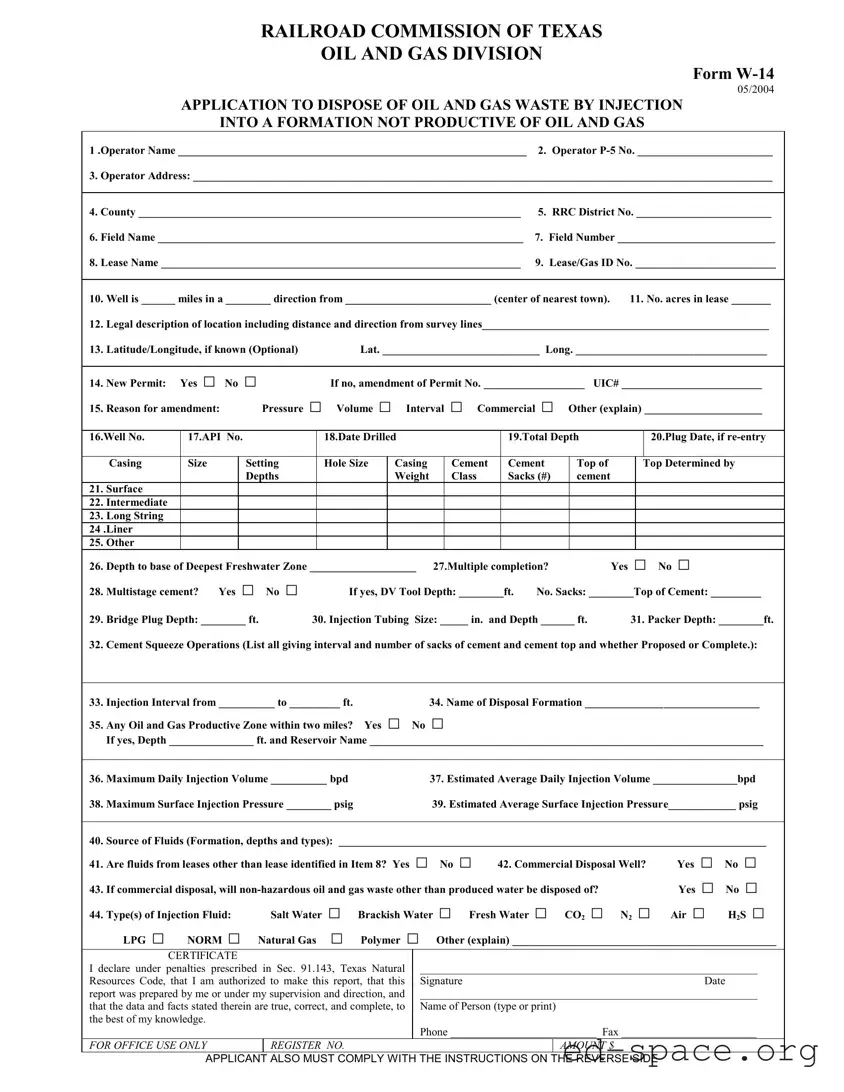
The Texas W-14 form is a crucial document for operators seeking to dispose of oil and gas waste through injection into formations that are not productive of oil and gas. This application, managed by the Railroad Commission of Texas, requires detailed information about the operator, the specific well, and the disposal process. Key aspects include the operator's name and address, the location of the well, and the type of waste to be injected. The form also asks for technical details such as the well's total depth, casing sizes, and the maximum daily injection volume. Additionally, operators must indicate whether the disposal well is new or an amendment of an existing permit, and provide reasons for any amendments. Compliance with environmental regulations is essential, as applicants must attach a letter from the Texas Commission on Environmental Quality confirming that the disposal will not endanger usable quality water. Moreover, notification to affected persons and publication in local newspapers are required steps in the application process. By thoroughly completing the W-14 form, operators can ensure they meet the necessary requirements for safe and responsible waste disposal in Texas.

Document Preview

RAILROAD COMMISSION OF TEXAS
OIL AND GAS DIVISION
Form W-14
05/2004
APPLICATION TO DISPOSE OF OIL AND GAS WASTE BY INJECTION
INTO A FORMATION NOT PRODUCTIVE OF OIL AND GAS
1 .Operator Name ______________________________________________________________ 2. Operator P-5 No. ________________________
3. Operator Address: _______________________________________________________________________________________________________
4. County ____________________________________________________________________ 5. RRC District No. ________________________
6. Field Name _________________________________________________________________ 7. Field Number ____________________________
8. Lease Name ________________________________________________________________ 9. Lease/Gas ID No. _________________________
10. Well is ______ miles in a ________ direction from __________________________ (center of nearest town). 11. No. acres in lease _______
12. Legal description of location including distance and direction from survey lines___________________________________________________
13. Latitude/Longitude, if known (Optional) Lat. ____________________________ Long. __________________________________
14. New Permit: Yes Ƒ No Ƒ If no, amendment of Permit No. __________________ UIC# _________________________
15. Reason for amendment: Pressure Ƒ Volume Ƒ Interval Ƒ Commercial Ƒ Other (explain) _____________________
16.Well No. 17.API No. 18.Date Drilled 19.Total Depth 20.Plug Date, if re-entry
Casing Size Setting
Depths
Hole Size Casing
Weight
Cement
Class
Cement
Sacks (#)
Top of
cement
Top Determined by
21. Surface
22. Intermediate
23. Long String
24 .Liner
25. Other
26. Depth to base of Deepest Freshwater Zone ___________________ 27.Multiple completion? Yes Ƒ No Ƒ
28. Multistage cement? Yes Ƒ No Ƒ If yes, DV Tool Depth: ________ft. No. Sacks: ________Top of Cement: _________
29. Bridge Plug Depth: ________ ft. 30. Injection Tubing Size: _____ in. and Depth ______ ft. 31. Packer Depth: ________ft.
32. Cement Squeeze Operations (List all giving interval and number of sacks of cement and cement top and whether Proposed or Complete.):
33. Injection Interval from __________ to _________ ft. 34. Name of Disposal Formation _______________________________
35. Any Oil and Gas Productive Zone within two miles? Yes Ƒ No Ƒ
If yes, Depth _______________ ft. and Reservoir Name ______________________________________________________________________
36. Maximum Daily Injection Volume __________ bpd 37. Estimated Average Daily Injection Volume _______________bpd
38. Maximum Surface Injection Pressure ________ psig 39. Estimated Average Surface Injection Pressure____________ psig
40. Source of Fluids (Formation, depths and types): ____________________________________________________________________________
41. Are fluids from leases other than lease identified in Item 8? Yes Ƒ No Ƒ 42. Commercial Disposal Well? Yes Ƒ No Ƒ
43. If commercial disposal, will non-hazardous oil and gas waste other than produced water be disposed of? Yes Ƒ No Ƒ
44. Type(s) of Injection Fluid: Salt Water Ƒ Brackish Water Ƒ Fresh Water Ƒ CO
2
Ƒ N
2
Ƒ Air Ƒ H
2
S Ƒ
LPG Ƒ NORM Ƒ Natural Gas Ƒ Polymer Ƒ Other (explain) _______________________________________________
CERTIFICATE
I declare under penalties prescribed in Sec. 91.143, Texas Natural
Resources Code, that I am authorized to make this report, that this
report was prepared by me or under my supervision and direction, and
that the data and facts stated therein are true, correct, and complete, to
the best of my knowledge.
____________________________________________________________
Signature Date
____________________________________________________________
Name of Person (type or print)
Phone __________________________ Fax ________________________
FOR OFFICE USE ONLY REGISTER NO. AMOUNT $
APPLICANT ALSO MUST COMPLY WITH THE INSTRUCTIONS ON THE REVERSE SIDE
05/2004
FORM W-14 INSTRUCTIONS
1. File the original application, including all attachments, with Environmental Services, Railroad Commission of Texas,
P.O. Box 12967, Austin, Texas 78711-2967. File one copy of the application and all attachments with the
appropriate district office.
2. Include with the original application a non-refundable fee of $100 payable to the Railroad Commission of Texas.
Submit an additional $150 fee for each request for an exception to Statewide Rule 9(9) relating to Special
Equipment.
3. Provide the current field name (Item 6) and field number (Item 7) designated in Commission records for an existing
well. If the application is for a new well, provide the nearest producing field name and number.
4. Check in Item 14 the appropriate box for a new permit or an amendment of an existing permit. If an amendment,
check the applicable boxes in Item 15 to indicate the reason for amendment and provide a brief explanation if “other”
is checked.
5. If the application is for a new permit, attach a complete electrical log of the well or the log of a nearby well.
6. Attach a letter from the Texas Commission on Environmental Quality (TCEQ) or its predecessor or successor
agency stating that the well will not endanger usable quality water strata and that the formation or stratum to be used
for disposal does not contain usable quality water. To obtain the TCEQ letter, submit two copies of the Form W-14, a
plat with surveys marked, and a representative electrical log to TCEQ, MC 151, P.O. Box 13087, Austin, Texas
78711-3087. NOTE: If the application is for an amendment, a new TCEQ letter is required only if the amendment is
for a change in the disposal interval.
7. Attach a map showing the location of all wells of public record within one-half (1/2) mile radius of the proposed
disposal well. On the map show each Commission-designated operator of each well within one-half (1/2) mile of the
proposed disposal well. NOTE: For a commercial disposal well application, the map shall also show the ownership
of the proposed disposal well tract and the surface tracts that adjoin the proposed disposal well tract.
8. Attach a table of all wells of public record that penetrate the disposal interval and that are within one-quarter (1/4)
mile radius of the proposed disposal well. The table shall include the well identification, date drilled, depth, current
status, and the plugging dates of those wells that are plugged. Identify any wells that appear to be or that you may
know are unplugged or improperly plugged and penetrate the proposed injection interval. Alternatively, an applicant
may request a variance under Rule 9(7)(B). NOTE: If the application is for an amendment, a table of wells within a
one-quarter (1/4) mile radius is required only if the current permit was issued before April 1, 1982, or if the
amendment is for a shallower disposal depth.
9. Attach a list of the names and mailing or physical addresses of affected persons who were notified of the application
and when the notification was mailed or delivered. Include a signed statement attesting to the notification of the
listed affected persons. Notice shall be provided by sending or delivering a copy of the front and back of the
application to the surface owner of record of the surface tract where the well is located, each Commission-
designated operator of any well located within one-half (1/2) mile of the proposed well, the county clerk, and the city
clerk, or other city official, if the proposed well is located within municipal boundaries. In addition, notice of a
commercial disposal well also shall be provided to surface owners of record of each surface tract that adjoins the
surface tract where the proposed well will be located. NOTE: If the application is for an amendment, notification of
the county clerk and the city clerk are required only if the amendment is for disposal interval or for commercial
status.
10. Attach an affidavit of publication signed by the publisher that the notice of publication has been published in a
newspaper of general circulation in the county where the disposal well will be located. Attach a newspaper clipping
of the published notice. If the application is for a commercial disposal well, that fact must be stated in the published
notice. NOTE: If the application is for an amendment, notification by publication is required only if the amendment is
for disposal interval or for commercial status.
11. Attach any other technical information that you believe will facilitate the review of the application. Such information
may include a cement bond log, a cementing record, or a well bore sketch.
Additional information is available in the Underground Injection Control Manual, which is available on the Railroad
Commission’s website: www.rrc.state.tx.us
No public hearing will be held on this application unless an affected person or local government protests the application,
or the Commission administratively denies the application. Any protest shall be in writing and contain (1) the name,
mailing address, and phone number of the person making the protest; and (2) a brief description of how the protestant
would be adversely affected by the activity sought to be permitted. If the Commission or its delegate determines that a
valid protest has been received, or that a public hearing is in the public interest, a hearing will be held upon written
request by the applicant. The permit may be administratively issued in a minimum of 15 days after receipt of the
application, published notice, or notification of affected persons, whichever is later, if no protest is received.

Form Specifications

Fact Name Description
Purpose The Texas W-14 form is used to apply for the disposal of oil and gas waste by injection into a formation that is not productive of oil and gas.
Governing Law This form is governed by the Texas Natural Resources Code, specifically Section 91.143.
Submission Requirements Applicants must submit the original form along with a non-refundable fee of $100 to the Railroad Commission of Texas.
Notification Applicants must notify affected persons and provide a signed statement confirming the notification.
Public Hearing A public hearing may be held if a valid protest is received regarding the application.
Amendments If applying for an amendment, a new TCEQ letter is required only if the amendment changes the disposal interval.

Texas W 14: Usage Guidelines

Filling out the Texas W-14 form is a crucial step in the application process for disposing of oil and gas waste. It requires careful attention to detail to ensure all necessary information is accurately provided. Following the steps outlined below will help facilitate the completion of the form.

  1. Begin by entering the Operator Name in the designated space.
  2. Fill in the Operator P-5 Number in the next field.
  3. Provide the Operator Address, ensuring to include all relevant details.
  4. Indicate the County where the operation will take place.
  5. Enter the RRC District Number.
  6. Specify the Field Name associated with the application.
  7. Input the Field Number as recorded in Commission records.
  8. Complete the Lease Name section.
  9. Fill in the Lease/Gas ID Number.
  10. State the distance in miles and direction from the nearest town in Item 10.
  11. Indicate the number of acres in the lease.
  12. Provide the legal description of the location, including distance and direction from survey lines.
  13. If known, fill in the Latitude and Longitude coordinates.
  14. Check the appropriate box for New Permit or Amendment in Item 14.
  15. If amending, include the Permit Number and UIC#.
  16. Explain the reason for the amendment in Item 15.
  17. Fill in the details regarding the well, including Well Number, API Number, Date Drilled, Total Depth, and Plug Date.
  18. Provide details on casing, including size, setting hole size, and cement information.
  19. Indicate the depth to the base of the deepest freshwater zone.
  20. Answer whether there is multiple completion or multistage cement.
  21. Specify the Injection Tubing Size and Depth.
  22. Detail any cement squeeze operations.
  23. Provide the Injection Interval information.
  24. State the name of the Disposal Formation.
  25. Indicate if there is any oil and gas productive zone within two miles.
  26. Fill in the Maximum Daily Injection Volume and Estimated Average Daily Injection Volume.
  27. Provide the Maximum Surface Injection Pressure and Estimated Average Surface Injection Pressure.
  28. Detail the Source of Fluids.
  29. Indicate whether fluids are from leases other than the identified lease.
  30. Specify if it is a Commercial Disposal Well.
  31. List the types of injection fluids.
  32. Sign and date the certificate section, providing the name of the person preparing the report and their contact information.

Once the form is completed, it is essential to gather additional documents as specified in the instructions. These documents may include a non-refundable fee, maps, letters from regulatory agencies, and notifications to affected persons. Following these steps will help ensure that the application is complete and ready for submission to the appropriate authorities.

Your Questions, Answered

What is the Texas W-14 form used for?

The Texas W-14 form is an application submitted to the Railroad Commission of Texas for the disposal of oil and gas waste by injection into a formation that is not productive of oil and gas. This form is crucial for operators seeking to manage waste in compliance with state regulations, ensuring that the disposal process does not harm the environment or public health.

Who needs to fill out the Texas W-14 form?

Operators of oil and gas wells in Texas who wish to dispose of waste through injection must complete the Texas W-14 form. This includes both new permit applications and amendments to existing permits. Operators must provide detailed information about the well, the type of waste, and the disposal formation.

What information is required on the Texas W-14 form?

The form requires various pieces of information, including the operator's name, address, and P-5 number. It also asks for details about the well, such as its location, depth, and the type of waste being disposed of. Additionally, operators must indicate whether the application is for a new permit or an amendment and provide justification for any amendments. Other required information includes injection volume, pressure, and the source of fluids.

What fees are associated with the Texas W-14 form?

There is a non-refundable fee of $100 that must accompany the original application. If the application includes a request for an exception to Statewide Rule 9(9), an additional fee of $150 is required. These fees help cover the administrative costs associated with processing the application.

What attachments are necessary when submitting the Texas W-14 form?

Applicants must include several attachments, such as a letter from the Texas Commission on Environmental Quality (TCEQ) confirming that the disposal will not endanger usable quality water. A map showing the location of nearby wells and a table of wells that penetrate the disposal interval are also required. Additionally, an affidavit of publication and notification records for affected persons must be submitted.

How long does it take to process the Texas W-14 application?

The Railroad Commission may issue a permit administratively within 15 days after receiving the application, provided no protests are received. If a protest is filed or if a public hearing is deemed necessary, the process may take longer. The timeline can vary depending on the complexity of the application and any issues raised during the review.

What happens if someone protests the application?

If an affected person or local government protests the application, the Commission will consider the protest. A valid protest must include the protestor's contact information and a description of how they would be adversely affected. If the Commission finds the protest valid or if it is in the public interest, a public hearing will be scheduled to discuss the application further.

Common mistakes

  1. Incomplete Operator Information: Failing to provide the full operator name, P-5 number, or address can lead to delays. All sections must be filled out accurately.

  2. Incorrect Field Information: Providing an incorrect field name or field number can result in the application being rejected. It is crucial to verify this information against Commission records.

  3. Missing Required Attachments: Not including necessary documents, such as the TCEQ letter or maps, can halt the review process. Ensure all required attachments are included with the application.

  4. Improper Fee Submission: Submitting the wrong fee amount or failing to include the fee altogether will cause the application to be incomplete. Double-check the fee requirements before submission.

  5. Failure to Specify Injection Details: Omitting critical information about the injection interval, maximum daily injection volume, or injection pressure can lead to confusion. Provide all relevant details clearly.

  6. Neglecting Notification Requirements: Not notifying affected persons or failing to provide proof of notification can result in issues later. Keep a record of notifications sent and include it with the application.

  7. Ignoring Legal Descriptions: Providing an unclear or incomplete legal description of the well location can cause complications. Be precise and thorough in this section.

  8. Incorrect Signature or Date: Submitting the application without the proper signature or date can render it invalid. Ensure the certificate is signed and dated correctly.

Documents used along the form

When applying for the Texas W-14 form, there are several other forms and documents that may be required or helpful in the process. These documents provide necessary information and support your application for disposing of oil and gas waste. Below is a list of commonly used forms and documents that accompany the Texas W-14 form.

  • Form P-5: This form is the Operator's Certificate of Compliance. It provides information about the operator's qualifications and ensures they are in good standing with the Railroad Commission of Texas.
  • TCEQ Letter: A letter from the Texas Commission on Environmental Quality is essential. It confirms that the proposed disposal well will not harm usable quality water and that the formation used for disposal is suitable.
  • Well Logs: These logs detail the geological formations encountered while drilling. They help assess the suitability of the site for injection and are crucial for new permit applications.
  • Map of Nearby Wells: A map showing all wells within a half-mile radius of the proposed disposal site is required. This helps to identify potential conflicts or issues with existing operations.
  • Notification List: A list of affected persons who have been notified about the application must be included. This demonstrates compliance with notification requirements and community engagement.
  • Affidavit of Publication: This document verifies that a notice regarding the application has been published in a local newspaper. It is an important step in ensuring public awareness of the proposed well.
  • Technical Information: Additional technical documents, such as cement bond logs or well bore sketches, can support your application. They provide further details on the well's construction and integrity.
  • Variance Request (if applicable): If you are seeking a variance under Rule 9(7)(B), a separate request must be submitted. This is relevant for certain amendments or exceptions to standard rules.
  • Environmental Assessments: Depending on the specifics of the application, an environmental assessment may be required. This document evaluates the potential environmental impacts of the proposed disposal activities.
  • Payment Receipt: A receipt showing payment of the required fees must accompany the application. This ensures that all financial obligations are met prior to processing the application.

Each of these documents plays a vital role in the application process for the Texas W-14 form. Ensuring that all necessary forms are completed and submitted accurately can help facilitate a smoother review process. Always check for the most current requirements and guidelines to ensure compliance.

Similar forms

The Texas W-14 form is an important document for the disposal of oil and gas waste. It has similarities with several other forms related to oil and gas operations. Below is a list of documents that share characteristics with the Texas W-14 form:

  • Texas W-1 Form: This form is used for the application to drill a new well. Like the W-14, it requires detailed information about the operator and the well's location.
  • Texas W-2 Form: This form serves as a report of oil and gas production. It also includes information about the operator and the well, similar to the W-14.
  • Texas W-3 Form: Used for reporting the completion of a well, it contains details about the well's depth and production, paralleling the information required in the W-14.
  • Texas W-4 Form: This is a form for the application to plug a well. It requires operator information and well location, akin to the W-14.
  • Texas W-5 Form: This form is for the application to transfer a well. It involves the same operator and well location details as the W-14.
  • Texas W-6 Form: This form is used to report the status of a well. It gathers similar information about the operator and the well's operational status, like the W-14.
  • Texas W-7 Form: This form is for the application to amend an existing permit. It shares the amendment process outlined in the W-14.
  • Texas W-8 Form: This form is used for the application for a new permit to inject fluids. It parallels the W-14 in terms of the injection process and required information.
  • Texas W-9 Form: This is a form for reporting the status of a disposal well. It includes similar details about the operator and injection activities as found in the W-14.

Each of these forms shares the core requirement of providing detailed operator and well information, ensuring compliance with Texas regulations.

Dos and Don'ts

When filling out the Texas W-14 form, it is essential to follow specific guidelines to ensure your application is processed smoothly. Here are six things you should and shouldn't do:

  • Do provide accurate and complete information in all sections of the form.
  • Do include the required fees with your application to avoid delays.
  • Do attach all necessary documentation, such as maps and letters from the TCEQ.
  • Do check the appropriate boxes for new permits or amendments to ensure clarity.
  • Don't leave any sections blank; incomplete forms may be rejected.
  • Don't forget to notify affected persons and provide proof of notification as required.

Following these guidelines will help you navigate the application process more effectively.

Misconceptions

Here are six misconceptions about the Texas W-14 form, along with clarifications for each:

  • The Texas W-14 form is only for new permits. Many believe this form is exclusively for new applications. In reality, it can also be used to amend existing permits.
  • All injection wells require a separate TCEQ letter. Some think that every application necessitates a new letter from the Texas Commission on Environmental Quality. However, a new letter is only needed if the amendment involves a change in the disposal interval.
  • Only large companies need to file the W-14 form. It's a common misconception that only major operators must submit this form. In truth, any operator planning to dispose of oil and gas waste must complete it, regardless of size.
  • Once submitted, the application is automatically approved. Many assume that submitting the W-14 form guarantees approval. The application must undergo review, and approval is contingent upon compliance with all regulations and the absence of protests.
  • Notification of affected persons is optional. Some individuals believe they can skip notifying affected parties. This is incorrect; notifying all relevant parties is a mandatory step in the application process.
  • The form does not require a fee. It's a misconception that filing the W-14 form is free. A non-refundable fee of $100 is required, along with additional fees for exceptions to specific rules.

Key takeaways

Here are some key takeaways for filling out and using the Texas W-14 form:

  • Understand the Purpose: The Texas W-14 form is used to apply for the disposal of oil and gas waste through injection into formations that do not produce oil or gas.
  • Operator Information: Ensure that you provide complete and accurate information about the operator, including name, address, and P-5 number.
  • Application Fees: A non-refundable fee of $100 is required when submitting the application. Additional fees may apply for exceptions.
  • Field Information: Include the current field name and field number as recorded by the Railroad Commission. If applying for a new well, provide information about the nearest producing field.
  • Permits: Indicate whether you are applying for a new permit or amending an existing one. Provide reasons for any amendments.
  • TCEQ Letter: Attach a letter from the Texas Commission on Environmental Quality confirming that the disposal will not endanger usable water strata.
  • Map Requirements: Include a map showing all wells within a half-mile radius of the proposed disposal well, along with their operators.
  • Notification Process: Notify affected persons about the application, including surface owners and local officials. Document this notification.
  • Publication of Notice: Publish a notice in a local newspaper. This is necessary for commercial disposal wells and certain amendments.
  • Technical Information: Attach any additional technical information that may help in the review of the application, such as cement logs or well bore sketches.

Following these guidelines can help ensure a smoother application process and compliance with the necessary regulations.