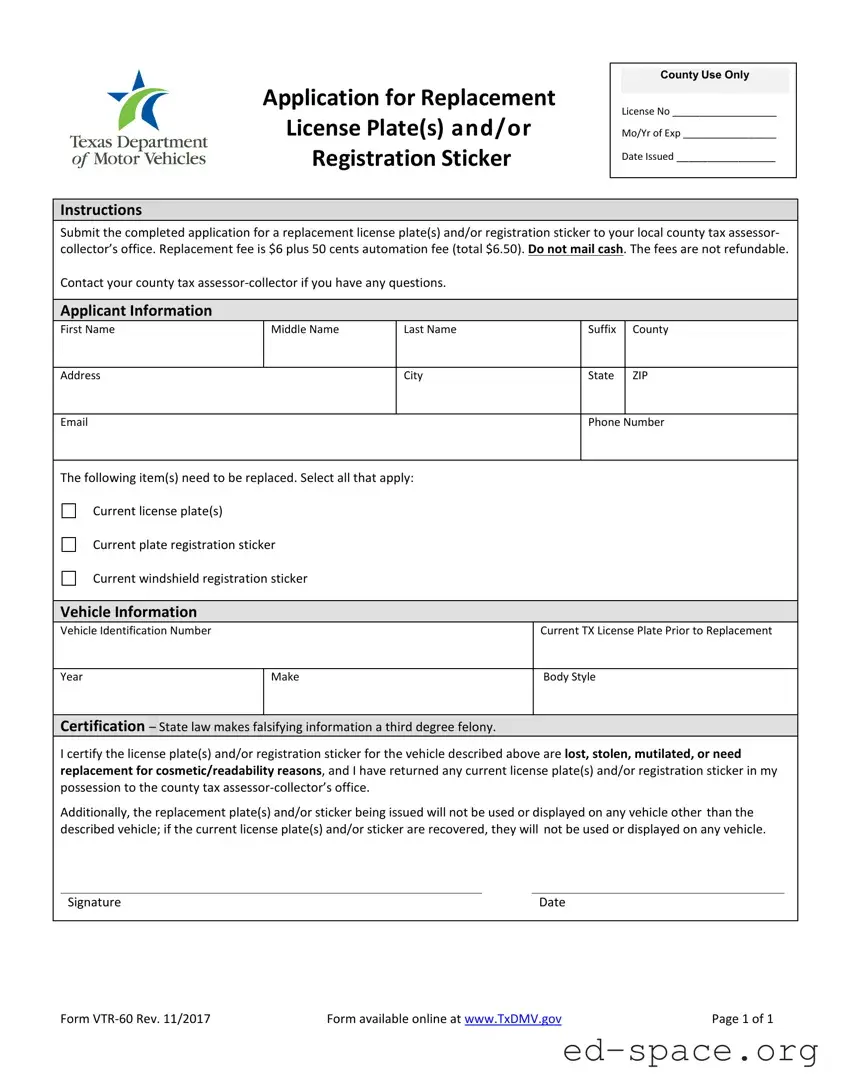
The Texas VTR-60 form serves a crucial purpose for vehicle owners in the state who find themselves in need of replacement license plates or registration stickers. This application is essential for those who may have lost, had stolen, or damaged their current plates or stickers. To initiate the process, applicants must submit the completed form to their local county tax assessor-collector’s office. A nominal fee of $6.50, which includes a $6 replacement fee and a 50-cent automation fee, is required, although it is important to note that cash should not be mailed, and fees are non-refundable. The form requires detailed applicant information, including the name, address, and contact details, as well as specific vehicle information such as the Vehicle Identification Number (VIN) and the current Texas license plate number. Additionally, applicants must certify that the items needing replacement are indeed lost, stolen, or damaged, and they must affirm that any current plates or stickers in their possession have been returned. This certification underscores the seriousness of providing accurate information, as falsifying details can lead to significant legal repercussions. Understanding the requirements and process of the VTR-60 form can help streamline the replacement procedure and ensure compliance with state regulations.
| Fact Name | Details |
|---|---|
| Form Purpose | The Texas VTR-60 form is used to apply for replacement license plates and/or registration stickers. |
| Governing Law | This form is governed by Texas Transportation Code, Chapter 504. |
| Submission Location | Completed applications must be submitted to the local county tax assessor-collector's office. |
| Replacement Fee | The total fee for a replacement is $6.50, which includes a $6 replacement fee and a 50-cent automation fee. |
| Payment Instructions | Cash should not be mailed with the application. Fees are non-refundable. |
| Applicant Information | The form requires the applicant's first name, last name, address, email, and phone number. |
| Certification Requirement | Applicants must certify that the information provided is accurate and that any current plates or stickers have been returned. |
| Online Availability | The form is available online at www.TxDMV.gov for convenience. |
Completing the Texas VTR-60 form is a straightforward process that requires careful attention to detail. Once the form is filled out, it must be submitted to your local county tax assessor-collector’s office. A fee will be assessed for the replacement, and it is important to ensure that all information is accurate before submission.
What is the Texas VTR 60 form?
The Texas VTR 60 form is an application used to request replacement license plates and/or registration stickers for vehicles in Texas. This form is necessary when a license plate or sticker is lost, stolen, mutilated, or needs to be replaced for cosmetic or readability reasons.
Where do I submit the completed VTR 60 form?
You must submit the completed VTR 60 form to your local county tax assessor-collector’s office. This is where the processing of your request will take place.
What is the fee for replacing license plates or registration stickers?
The total fee for replacing license plates or registration stickers is $6.50. This includes a $6 replacement fee and a 50-cent automation fee. It is important to note that these fees are non-refundable.
Can I pay the fee by mail?
No, you should not mail cash. When submitting your application, it is best to check with your local county tax assessor-collector’s office for their accepted payment methods.
What information do I need to provide on the VTR 60 form?
You will need to provide personal information such as your first name, last name, address, email, phone number, and county. Additionally, you will need to supply vehicle information, including the Vehicle Identification Number (VIN), current Texas license plate number, and details about the vehicle’s year, make, and body style.
What should I do if I recover my lost license plate or sticker after applying for a replacement?
If you recover your lost license plate or registration sticker after applying for a replacement, you must not use or display it on any vehicle. Instead, return it to the county tax assessor-collector’s office.
Is it a crime to provide false information on the VTR 60 form?
Yes, providing false information on the VTR 60 form is considered a third-degree felony under state law. It is crucial to ensure that all information provided is accurate and truthful.
What happens if I do not return my current license plate or sticker when applying for a replacement?
When applying for a replacement, you must certify that you have returned any current license plate(s) or registration sticker(s) in your possession. Failure to do so may result in complications with your application or potential legal consequences.
How can I contact my county tax assessor-collector if I have questions?
You can contact your local county tax assessor-collector’s office directly for any questions regarding the VTR 60 form or the replacement process. Check your county's official website for contact information and office hours.
Where can I find the VTR 60 form online?
The VTR 60 form is available online at the Texas Department of Motor Vehicles (TxDMV) website, www.TxDMV.gov. You can download and print the form from there for your convenience.
Incomplete Applicant Information: Many individuals forget to fill out all required fields, such as the first name, last name, or address. Omitting any of these details can delay the processing of the application.
Incorrect Vehicle Identification Number (VIN): The VIN is crucial for identifying the vehicle. Double-checking this number is essential; a simple typo can lead to significant issues.
Failure to Select All Applicable Items: Applicants often neglect to indicate which items need replacement. Ensure that you check all relevant boxes for license plates and registration stickers.
Not Submitting the Form to the Correct Office: Sending the application to the wrong county tax assessor-collector’s office can result in unnecessary delays. Verify that you are addressing it correctly.
Ignoring the Fee Structure: Some applicants fail to include the proper payment. Remember, the total fee is $6.50. Cash should not be mailed, and fees are non-refundable.
Inaccurate Certification Statement: Misunderstanding the certification statement can lead to legal issues. Make sure you accurately certify the reason for replacement and acknowledge that you will not use recovered plates or stickers on other vehicles.
Missing Signature and Date: A common oversight is neglecting to sign and date the form. Without this, the application cannot be processed.
The Texas VTR-60 form is used for applying for replacement license plates and registration stickers. Several other documents and forms may accompany this application to ensure proper processing and compliance with state regulations. Below is a list of commonly used forms related to vehicle registration in Texas.
These forms play a crucial role in the vehicle registration process in Texas. Each serves a specific purpose and helps ensure that vehicle ownership and registration are accurately maintained.
The Texas VTR-60 form is used for applying for replacement license plates and registration stickers. It shares similarities with other documents related to vehicle registration and ownership. Here are four documents that are comparable:
When filling out the Texas VTR-60 form for replacement license plates or registration stickers, there are important guidelines to follow. Below are four things you should and shouldn't do to ensure a smooth process.
Following these guidelines can help prevent delays and ensure that your application is processed efficiently. If you have any questions, reach out to your local county tax assessor-collector's office for assistance.
Understanding the Texas VTR 60 form is crucial for anyone needing to replace their license plates or registration stickers. However, several misconceptions can lead to confusion. Here are five common misunderstandings about this form:
Many people believe they can complete the VTR 60 form online and submit it electronically. In reality, this form must be submitted in person to your local county tax assessor-collector’s office.
Some individuals think that replacing their license plates or registration stickers is free. However, a replacement fee of $6 plus an additional 50 cents for automation is required, totaling $6.50.
It is a common belief that cash can be mailed with the application. This is not allowed. Payments should be made in person, and cash should never be sent through the mail.
Some applicants assume that if they change their mind, they can get their money back. Unfortunately, the fees paid for replacement license plates or stickers are non-refundable.
People often think the VTR 60 form is only necessary for lost or stolen license plates or stickers. In fact, it can also be used for items that are mutilated or need replacement for cosmetic reasons.
Being aware of these misconceptions can help streamline the process of replacing your license plates or registration stickers in Texas. Always refer to official sources or your local tax office for the most accurate information.
Filling out the Texas VTR-60 form is an important step for anyone needing a replacement license plate or registration sticker. Here are some key takeaways to keep in mind:
By following these guidelines, you can navigate the replacement process smoothly and efficiently.