Homepage Blank Texas Vtr 262 PDF Form
Content Overview

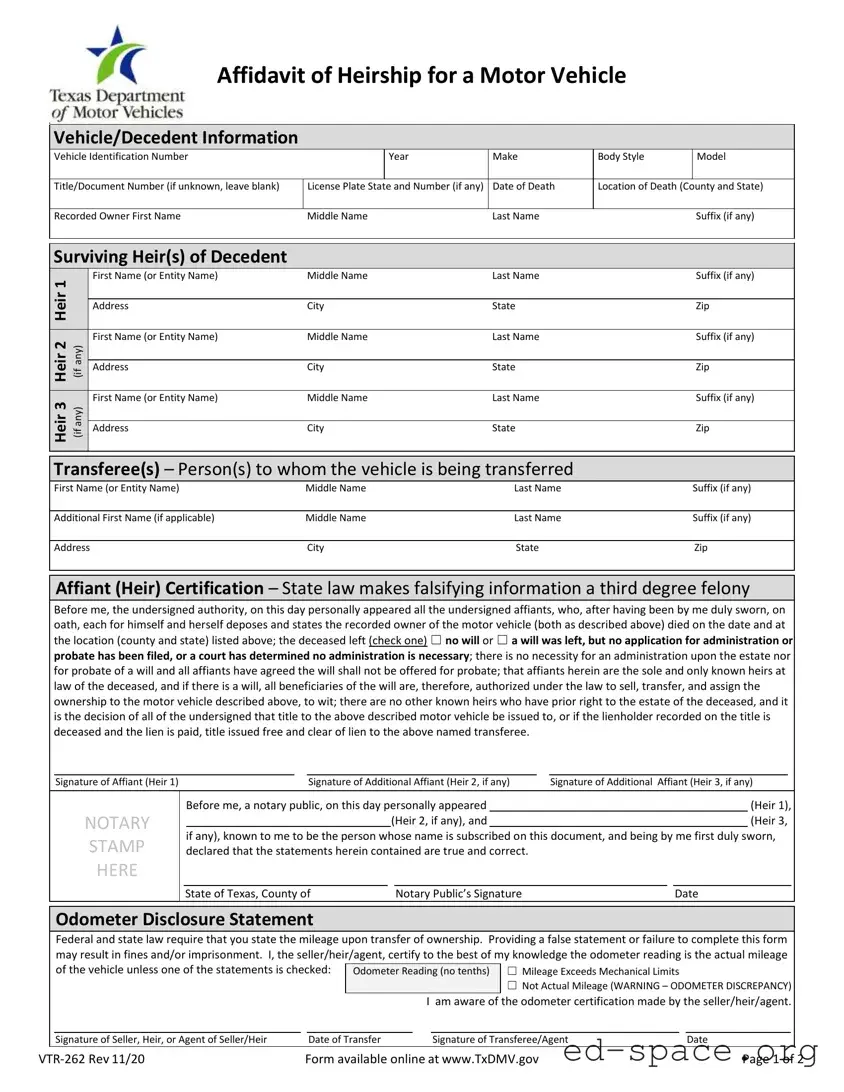
The Texas VTR 262 form, known as the Affidavit of Heirship for a Motor Vehicle, serves a crucial role in the transfer of vehicle ownership following the death of the registered owner. This form is particularly important when there is no need for formal probate proceedings, allowing heirs to claim ownership of the vehicle without the complexities of court involvement. Key components of the form include detailed sections for vehicle information—such as the Vehicle Identification Number (VIN), make, and model—as well as personal details of the deceased and the surviving heirs. The form requires signatures from the heirs, affirming their status as the rightful successors, and must be notarized to validate the claims made. Additionally, it includes an Odometer Disclosure Statement, which ensures compliance with federal and state laws regarding mileage reporting during ownership transfer. The VTR 262 form streamlines the process for heirs, making it easier to manage the transfer of a vehicle while adhering to legal requirements.

Document Preview

Affidavit of Heirship for a Motor Vehicle
Vehicle/Decedent Information
Vehicle Identification Number
Year
Make
Body Style
Model
Title/Document Number (if unknown, leave blank)
License Plate State and Number (if any)
Date of Death
Recorded Owner First Name
Middle Name
Last Name
Suffix (if any)
Surviving Heir(s) of Decedent
Heir 1
First Name (or Entity Name)
Middle Name
Last Name
Suffix (if any)
Address
City
State
Zip
Heir 2
(if any)
First Name (or Entity Name)
Middle Name
Last Name
Suffix (if any)
Address
City
State
Zip
Heir 3
(if any)
First Name (or Entity Name)
Middle Name
Last Name
Suffix (if any)
Address
City
State
Zip
Transferee(s) Person(s) to whom the vehicle is being transferred
First Name (or Entity Name)
Middle Name
Last Name
Suffix (if any)
Additional First Name (if applicable)
Middle Name
Last Name
Suffix (if any)
Address
City
State
Zip
Affiant (Heir) Certification State law makes falsifying information a third degree felony
Before me, the undersigned authority, on this day personally appeared all the undersigned affiants, who, after having been by me duly sworn, on
oath, each for himself and herself deposes and states the recorded owner of the motor vehicle (both as described above) died on the date and at
the location (county and state) listed above; the deceased left (check one) no will or a will was left, but
no application for administration or
probate has been filed, or a court has determined no administration is necessary; there is no necessity for an administration upon the estate nor
for probate of a will and all affiants have agreed the will shall not be offered for probate; that affiants herein are the sole and only known heirs at
law of the deceased, and if there is a will, all beneficiaries of the will are, therefore, authorized under the law to sell, transfer, and assign the
ownership to the motor vehicle described above, to wit; there are no other known heirs who have prior right to the estate of the deceased, and it
is the decision of all of the undersigned that title to the above described motor vehicle be issued to, or if the lienholder recorded on the title is
deceased and the lien is paid, title issued free and clear of lien to the above named transferee.
Signature of Affiant (Heir 1)
Signature of Additional Affiant (Heir 2, if any)
Signature of Additional Affiant (Heir 3, if any)
NOTARY
STAMP
HERE
Before me, a notary public, on this day personally appeared (Heir 1),
(Heir 2, if any), and (Heir 3,
if any), known to me to be the person whose name is subscribed on this document, and being by me first duly sworn,
declared that the statements herein contained are true and correct.
State of Texas, County of
Notary Public’s Signature
Date
Odometer Disclosure Statement
Federal and state law require that you state the mileage upon transfer of ownership. Providing a false statement or failure to complete this form
may result in fines and/or imprisonment. I, the seller/heir/agent, certify to the best of my knowledge the odometer reading is the actual mileage
of the vehicle unless one of the statements is checked:
Odometer Reading (no tenths)
Mileage Exceeds Mechanical Limits
Not Actual Mileage (WARNING ODOMETER DISCREPANCY)
I am aware of the odometer certification made by the seller/heir/agent.
Signature of Seller, Heir, or Agent of Seller/Heir
Date of Transfer
Signature of Transferee/Agent
Date
VTR-262 Rev 11/20 Form available online at www.TxDMV.gov Page 1 of 2
Affidavit of Heirship for a Motor Vehicle
Information
The section is for informational purposes only. Affiant(s) must obtain their own legal advice if required.
If the estate has been probated, the executor or administrator may assign the title provided a certified copy of the
probate proceedings, Letters Testamentary, or Letters of Administration is attached. In this situation, this form is not
required. Otherwise, the procedures in the “Instructions” section below must be met to transfer ownership.
If there has been no administration on the estate, and no administration is necessary, the heirs may complete this form,
and no further documentation is required.
If an heirship affidavit is used when a court has determined no administration is necessary, the affiant(s) must attach the
original or certified copy of the court document indicating no administration of the will is necessary and the portions of
the will that specify the will is in the deceased owner’s name and indicates the name(s) of the heir(s).
If all heirs cannot appear before one notary public on the same date, or there are more than three heirs, additional
copies of this form must be completed. If additional copies of this form are completed, all copies must be submitted by
the transferee (or purchaser) with the title application at the time of application to a county tax assessor-collector’s
office.
If one of the heirs is a surviving spouse, that heir is the only heir needing to complete this form unless there are surviving
children of the decedent with a parent who is other than the surviving spouse in which case all surviving children must
also complete this form.
If there is no surviving spouse, all children of the decedent (if any) must sign as affiants.
If the decedent left neither a spouse nor children, consult legal counsel as to who are the “heirs at law.”
Children
Children born to or legally adopted by the decedent qualify for this procedure as “children” of the decedent.
A guardian must sign for any surviving minor children of the decedent and attach Letters of Guardianship.
Instructions
1. Complete the “Vehicle/Decedent Information” section on page 1. All fields are required unless indicated otherwise.
2. The heir(s) (up to three) must complete the “Surviving Heir(s) of Decedent” section on page 1. Refer to the
“Information” section above for additional information. If there are more than three heirs, additional completed forms
are necessary.
3. Complete the “Transferee(s)” section to indicate to whom the vehicle is being transferred. An heir may also be listed as
a transferee.
4. Complete the “Affiant (Heir) Certification” section by marking the appropriate selection as to the will. The preceding
three sections of the form must be completed prior to completion of this section. Each heir (up to three) must sign this
form before a notary. All signatures must be notarized. This section may not be completed by execution of a power of
attorney.
5. The “Odometer Disclosure Statement” section must be completed by an heir (or any agent of an heir) and the purchaser
of the motor vehicle if the vehicle is subject to odometer disclosure. This section may be completed after the
notarization has been completed. Only one seller/heir is required to execute the odometer disclosure statement.
6. The following documentation is required in order for a title transfer to be processed by the county tax assessor-
collector’s office in the name of the title applicant(s):
Application for Texas Title and/or Registration (Form 130-U);
Affidavit of Heirship for a Motor Vehicle (Form VTR-262);
If a court has determined no administration is necessary:
Original or certified copy of the court document indicating no administration of the will is necessary; and
The portions of the will specifying the will is in the decedent’s name and indicating the heir(s);
Title and/or registration verification if the vehicle was last titled out of state;
Release of Lien (if a lien is recorded on the title record); and
A copy of current proof of liability insurance in the applicant’s name (if applying for registration).
Note: Errors that have been lined through and corrected require a statement of fact. Erasures and significant alterations
may require a new form to be completed.
VTR-262 Rev 11/20 Form available online at www.TxDMV.gov Page 2 of 2

Form Specifications

Fact Name Details
Form Purpose The VTR-262 form is used to transfer ownership of a motor vehicle from a deceased owner to their heirs.
Governing Law This form is governed by Texas state law, specifically the Texas Probate Code.
Required Information Essential details include the vehicle identification number, the decedent's name, and the date of death.
Heir Certification Affiants must certify that they are the sole heirs and that no administration is necessary for the estate.
Notarization Requirement All signatures on the form must be notarized to validate the document.
Odometer Disclosure The form includes a section for disclosing the vehicle's odometer reading at the time of transfer.
Additional Heirs If there are more than three heirs, additional copies of the form must be completed and submitted.
Spousal Rights If a surviving spouse exists, they are the only heir required to complete the form unless there are children from another relationship.
Documentation Needed To process the title transfer, additional documents such as proof of insurance and court documents may be required.
Form Availability The VTR-262 form is available online at the Texas Department of Motor Vehicles website.

Texas Vtr 262: Usage Guidelines

Filling out the Texas VTR-262 form is a crucial step in transferring ownership of a motor vehicle after the recorded owner's death. It's important to ensure that all information is accurate and complete to avoid delays in the transfer process. Follow these steps carefully to fill out the form correctly.

  1. Begin with the “Vehicle/Decedent Information” section. Fill in all required fields, including the Vehicle Identification Number, year, make, title/document number, license plate state and number, and the date of death.
  2. In the “Surviving Heir(s) of Decedent” section, provide the names and addresses of up to three heirs. Ensure that you include their first name, middle name, last name, and complete address.
  3. Complete the “Transferee(s)” section. This is where you indicate the person or entity to whom the vehicle is being transferred. Include their names and addresses as necessary.
  4. In the “Affiant (Heir) Certification” section, select whether the decedent left a will or not. Each heir must sign this section in front of a notary public. Ensure all signatures are notarized.
  5. Fill out the “Odometer Disclosure Statement” section. This must be completed by either an heir or their agent. Only one seller/heir needs to sign this part, and it can be done after notarization.
  6. Gather the required documentation for the title transfer. This includes the Application for Texas Title and/or Registration (Form 130-U), the completed VTR-262 form, and any court documents if applicable.

Your Questions, Answered

What is the Texas VTR 262 form?

The Texas VTR 262 form, also known as the Affidavit of Heirship for a Motor Vehicle, is a legal document used to transfer ownership of a vehicle from a deceased owner to their heirs. This form is necessary when there has been no administration of the estate and the heirs wish to claim the vehicle title without going through probate.

Who needs to fill out the VTR 262 form?

The form must be completed by the surviving heirs of the deceased vehicle owner. If there are more than three heirs, additional copies of the form are required. In cases where a surviving spouse exists, that spouse may be the only heir who needs to complete the form, unless there are surviving children from a different parent.

What information is required on the form?

The VTR 262 form requires specific details, including the vehicle's identification number, year, make, and title number. It also asks for the recorded owner's name, date of death, and the names and addresses of the surviving heirs. Additionally, the form includes sections for the transferee's information and an odometer disclosure statement.

Is notarization required for the VTR 262 form?

Yes, the signatures of the heirs must be notarized. Each heir who completes the form must sign in front of a notary public to validate the document. This step is crucial to ensure the authenticity of the information provided.

What if the deceased left a will?

If the deceased left a will, but no application for administration or probate has been filed, the heirs can still use the VTR 262 form. However, they must indicate this on the form and may need to provide a copy of the will along with the affidavit.

What documentation is needed to process the title transfer?

To process the title transfer, you will need to submit several documents, including the completed VTR 262 form, an Application for Texas Title and/or Registration (Form 130-U), and, if applicable, a certified copy of any court documents indicating that no administration is necessary. Additionally, proof of liability insurance and any lien release documents may be required.

Can the form be completed if all heirs cannot be present at the same time?

If all heirs cannot appear before a notary on the same day, additional copies of the form must be filled out. Each copy must be submitted together with the title application to the county tax assessor-collector’s office.

What should I do if the decedent had no spouse or children?

In cases where the deceased left no spouse or children, it is advisable to consult legal counsel to determine who qualifies as the "heirs at law." This can help ensure that the correct individuals are listed on the form.

What happens if there are errors on the form?

If there are any errors on the VTR 262 form, they should be corrected by lining through the mistake and providing a statement of fact explaining the correction. Significant alterations or erasures may require you to complete a new form to avoid complications in processing.

Where can I obtain the Texas VTR 262 form?

The Texas VTR 262 form is available online at the Texas Department of Motor Vehicles website. It is important to ensure you are using the most current version of the form to avoid any issues during the title transfer process.

Common mistakes

  1. Failing to provide the Vehicle Identification Number (VIN). This number is crucial for identifying the vehicle and must be accurate.

  2. Leaving the Title/Document Number blank. If this information is unknown, it should be clearly indicated, rather than omitted.

  3. Not including all surviving heirs. Each heir must be listed in the appropriate section, and if there are more than three, additional forms are necessary.

  4. Incorrectly marking the status of the will. It is essential to check either that no will was left or that a will exists but no administration is necessary.

  5. Forgetting to complete the Odometer Disclosure Statement. This section is mandatory and must reflect accurate mileage.

  6. Not obtaining notarization for all signatures. Each heir's signature must be notarized, which is a critical step in the process.

  7. Neglecting to attach required documents, such as the court document indicating no administration is necessary, if applicable.

  8. Making significant alterations or corrections. Any changes should be minimal, and major corrections may require a new form.

Documents used along the form

The Texas VTR 262 form, known as the Affidavit of Heirship for a Motor Vehicle, is a crucial document used to transfer ownership of a vehicle when the recorded owner has passed away. However, several other forms and documents are often required in conjunction with the VTR 262 to ensure a smooth transfer of title. Below is a list of these important documents, each serving a specific purpose in the process.

  • Application for Texas Title and/or Registration (Form 130-U): This form is essential for anyone seeking to obtain a new title or register a vehicle in Texas. It collects necessary details about the vehicle and the new owner.
  • Odometer Disclosure Statement: Required by federal and state law, this statement certifies the mileage on the vehicle at the time of sale. It is crucial to prevent odometer fraud and must be completed accurately.
  • Court Document Indicating No Administration Necessary: If a court has determined that no administration of the will is necessary, this document must be provided. It confirms that the estate can be settled without formal probate.
  • Will or Portions of the Will: If the decedent left a will, the relevant sections must be submitted. This includes identifying the heirs and confirming the ownership of the vehicle.
  • Release of Lien: If there is an outstanding lien on the vehicle, a release of lien must be obtained from the lienholder. This document ensures that the new owner receives clear title.
  • Proof of Liability Insurance: Before registering the vehicle, the new owner must provide proof of current liability insurance in their name. This is a requirement for registration in Texas.
  • Letters Testamentary or Letters of Administration: If the estate has been probated, these letters authorize the executor or administrator to act on behalf of the estate. They must be attached if applicable.

Each of these documents plays a vital role in the process of transferring vehicle ownership after the death of the owner. It is essential to gather all necessary forms to avoid delays and ensure compliance with Texas law. Failing to provide the required documentation can lead to complications in the transfer process, so attention to detail is crucial.

Similar forms

  • Application for Texas Title and/or Registration (Form 130-U) - This document is required to apply for a new title or registration for a vehicle. Similar to the VTR-262, it is essential for transferring ownership of a vehicle after the death of the owner.
  • Affidavit of Heirship for Real Property - Like the VTR-262, this affidavit establishes the heirs of a deceased person for the purpose of transferring real property. Both documents serve to clarify ownership and facilitate the transfer process.
  • Probate Application - This document is filed to initiate the probate process when a decedent has left a will. While the VTR-262 is used when no probate is necessary, both aim to establish rightful ownership of the decedent's assets.
  • Bill of Sale - A bill of sale serves as proof of the sale of a vehicle. Similar to the VTR-262, it documents the transfer of ownership, although it does not address the circumstances of the seller's death.
  • Odometer Disclosure Statement - This form is often included with the VTR-262. It certifies the mileage of the vehicle at the time of transfer, ensuring compliance with federal and state laws regarding odometer readings.
  • Release of Lien - This document is necessary when a vehicle has an outstanding lien. It is similar to the VTR-262 in that it must be submitted during the title transfer process to ensure clear ownership.
  • Letters Testamentary - Issued by a probate court, these letters authorize an executor to act on behalf of a deceased person's estate. While the VTR-262 is used when no probate is necessary, both documents facilitate the transfer of property following a death.

Dos and Don'ts

When filling out the Texas VTR 262 form, there are important guidelines to follow. Here’s a list of things you should and shouldn’t do:

  • Do ensure all required fields are completed. Missing information can delay the processing of your application.
  • Do have all heirs sign the form in front of a notary. Each signature must be notarized to validate the document.
  • Do attach any necessary documents. This may include court documents if applicable, or proof of insurance for registration.
  • Do double-check the vehicle identification number (VIN). An incorrect VIN can lead to issues with the title transfer.
  • Don’t leave any fields blank unless specified. Each section is important for the transfer process.
  • Don’t forget to complete the odometer disclosure statement. This is required by law and must be filled out accurately.
  • Don’t use white-out or make significant alterations. Errors should be corrected with a statement of fact; otherwise, a new form may be needed.
  • Don’t submit the form without reviewing it thoroughly. A careful review can help catch any mistakes before submission.

Misconceptions

  • Misconception 1: The VTR 262 form can only be used if there is a will.

    This is incorrect. The VTR 262 form is applicable whether the deceased left a will or not. If there is no will, heirs can still complete the form to transfer the vehicle title.

  • Misconception 2: All heirs must be present to sign the form.

    While it is ideal for all heirs to be present, if they cannot appear before a notary on the same date, additional copies of the form can be completed. Each heir can sign separately, and all copies must be submitted together.

  • Misconception 3: The VTR 262 form does not require notarization.

    This is false. Each heir's signature must be notarized for the form to be valid. Notarization ensures the authenticity of the signatures and the information provided.

  • Misconception 4: The form can be completed without any additional documentation.

    In many cases, additional documentation is required. For example, if a court has determined no administration is necessary, a certified copy of that court document must accompany the VTR 262 form for the title transfer to be processed.

Key takeaways

  • The Texas VTR-262 form is used to transfer ownership of a motor vehicle when the recorded owner has passed away.

  • Complete all required fields in the Vehicle/Decedent Information section, including the Vehicle Identification Number (VIN) and the decedent's details.

  • Identify all surviving heirs in the Surviving Heir(s) of Decedent section. Up to three heirs can be listed on a single form.

  • When transferring the vehicle, indicate the Transferee(s) who will receive ownership. This can include one of the heirs.

  • Signatures of all heirs must be notarized in the Affiant (Heir) Certification section. This step is crucial for the form's validity.

  • Complete the Odometer Disclosure Statement to provide accurate mileage information at the time of transfer. Only one seller/heir is required to sign this section.

  • Gather all necessary documents for title transfer, including the VTR-262 form, proof of insurance, and any court documents if applicable.