Homepage Blank Texas Visitation Enforcement PDF Form
Content Overview

The Texas Visitation Enforcement form is an essential tool for parents seeking to uphold their court-ordered visitation rights. Designed for those who face challenges in exercising their visitation, this kit provides a comprehensive set of documents to facilitate the enforcement of existing court orders. It includes a sample demand letter that serves as a reminder to the other parent about the legal implications of violating the order. Additionally, the kit outlines what constitutes a denial of visitation and offers a visitation journal for documenting incidents of denied access. The form guides users through a structured process, detailing seven critical steps from initial preparation to the court hearing. Each step is clearly defined, ensuring that parents understand their responsibilities and the necessary actions to take. The kit also contains specific motions and orders that can be filed with the court, including a motion for enforcement and an order to appear, which compel the other parent to attend court if they fail to comply. This resource not only empowers parents to advocate for their rights but also emphasizes the importance of thorough documentation and adherence to legal procedures in the pursuit of fair access to their children.

Document Preview

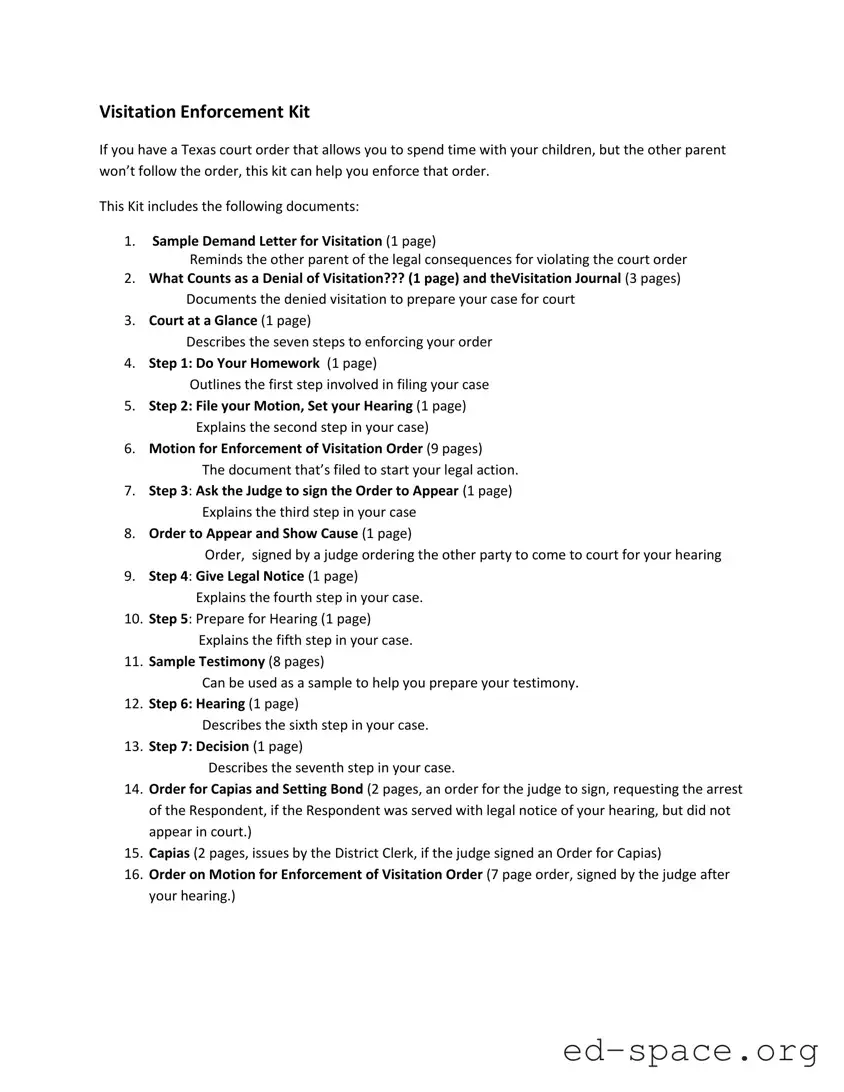
Visitation Enforcement Kit
If you have a Texas court order that allows you to spend time with your children, but the other parent
wo’t follow the order, this kit ca help you eforce that order.
This Kit includes the following documents:
1. Sample Demand Letter for Visitation (1 page)
Reminds the other parent of the legal consequences for violating the court order
2. What Counts as a Denial of Visitation??? (1 page) and theVisitation Journal (3 pages)
Documents the denied visitation to prepare your case for court
3. Court at a Glance (1 page)
Describes the seven steps to enforcing your order
4. Step 1: Do Your Homework (1 page)
Outlines the first step involved in filing your case
5. Step 2: File your Motion, Set your Hearing (1 page)
Explains the second step in your case)
6. Motion for Enforcement of Visitation Order (9 pages)
The docuet that’s filed to start your legal action.
7. Step 3: Ask the Judge to sign the Order to Appear (1 page)
Explains the third step in your case
8. Order to Appear and Show Cause (1 page)
Order, signed by a judge ordering the other party to come to court for your hearing
9. Step 4: Give Legal Notice (1 page)
Explains the fourth step in your case.
10. Step 5: Prepare for Hearing (1 page)
Explains the fifth step in your case.
11. Sample Testimony (8 pages)
Can be used as a sample to help you prepare your testimony.
12. Step 6: Hearing (1 page)
Describes the sixth step in your case.
13. Step 7: Decision (1 page)
Describes the seventh step in your case.
14. Order for Capias and Setting Bond (2 pages, an order for the judge to sign, requesting the arrest
of the Respondent, if the Respondent was served with legal notice of your hearing, but did not
appear in court.)
15. Capias (2 pages, issues by the District Clerk, if the judge signed an Order for Capias)
16. Order on Motion for Enforcement of Visitation Order (7 page order, signed by the judge after
your hearing.)
[DATE]
[Custodial Parent]
[Custodial Parent’s Address]
Re: Notice to Exercise Court-Ordered Possession and Access (Visitation)
Dear
[Custodial Parent]:
I plan to see our
[children / child], according to the court-ordered possession and
access (visitation) schedule, as written in the most recent court order which was signed
by the judge in our case in Cause No. ______ (cause number).
I will be at
[your residence at 6:00 pm]
OR
[the school where our [children /child] is enrolled, when school is dismissed]
OR
[Other fill in the time and place where your visitation is ordered to take place. ]
on [the date designated in the court order for you to take possession]
to exercise my rights to see our
[children / child].
You should have our [children / child ]ready for my visitation as provided for in the
court order.
I will return our
[children / child] to you as required by the court order.
I intend to continue exercising my possession and access (visitation) rights according to
the court ordered schedule from now on.
Interfering with my court-ordered access and visitation rights could result in a contempt
action being filed against you. Failure to pay child support is not a justification or defense
to a charge of contempt for interference with court-ordered visitation rights. If a court
finds you in contempt for denying me court-ordered access to our
[children / child] the
court may sentence you to jail time, and order you to pay a fine, attorney’s fees and
court costs. It would be best for everyone, especially our
[children / child], to avoid
such litigation.
Sincerely,
[Your Name]
[Your Address]
[Your Telephone]
WHAT COUNTS AS A DENIAL OF VISITATION???
To enforce your visitation order and ask the court to hold the other parent in contempt, you must follow very specific
rules when you try to exercise your visitation.
You are not technically denied visitation unless you actually appear in person at the pick-up location listed in your court
order, even if the other parent has already told you that she will not be there or that she will not be giving you your
child.
By not producing the child at the pick-up location at a certain date and time, the other parent is violating the court
order. However, that parent cannot be required to testify against herself in court, so you have to be able to testify
that you were there and she was not.
Step 1: Look at your court order, or at your Visitation Calendar if one has been
prepared for you. Find the next exact date and time that you are supposed to
pick up your child.
Step 2: Arrive at the pick-up location at the exact date and
time you are supposed to be there. Give yourself plenty
of time to get there. If you are early, wait a few minutes.
Step 3: Knock on the door. Wait. Knock on the door again. You must give some
indication that you are there and are ready to pick up your child.
Step 4: Try to obtain evidence that you were at the right location
at the right date and time. You can take a witness with you to
observe what happened. You can go to a nearby convenience
store or fast food restaurant and buy a drink or a pack of gum,
and keep the receipt showing you were in the area at a certain
date and time. Some police departments may be willing to file
a report for you.
Step 5: Immediately write down what happened in your visitation
journal. Write down the date, time, and place where you tried to pick
up your child. If you have a witness, write down his or her name. If you
have a receipt or other evidence, keep it safe.
APRIL 11
th
6 pm pick up son at
his mother’s house
Visitation Journal, Texas Law Help, POLL, April 15, 2011
page 1 of 3
VISITATION JOURNAL (Use this journal to document your attempts to exercise your court
ordered visitation. An accurate and complete Visitation Journal can help you explain your case to
the court.)
My name is: _____________________________________________________.
I am the child’s □father. □mother. □______________________________.
(other, please print your relationship to the child.)
My child’s name is/ My children’s names are:
Child’s Name
Child’s Birthday (month, day, and year)
The child/ren live(s) with (print name of person child/ren live with):
_____________________________________________________________________.
I have court orders allowing me to see my child/ren on specific days and at specific
times. My court order states a specific location for me to pick up my children.
(If you do not have a court order, or your order does not include specific days and times for your visitation, or if your order
does not include a specific location for you to exchange your child/ren with the other parent, you will need to go back to
court to get an order that includes these things, before a court can enforce your order.)
I have tried to see my children, according to my court order, but the child’s other parent
did not allow me to see the child/ren.
This journal records the times I tried to see my child/ren, according to the court ordered
schedule. I tried to see my child/ren on the following dates, but was not allowed to.
(Complete the charts with information about when you tried to see your child/ren, according to your court
schedule, but were not allowed to. You can copy and add additional charts, if you need to.)
Date
Month: ______ Day: _______ Year: ________
Day (check one.)
□Monday □Tuesday □Wednesday □Thursday
□Friday □Saturday □Sunday
Time
______:______ □am □pm
Place
(ex. Mother’s residence,
McDonald’s, etc.)
Address
Street Address:
__________________________________________________________
City, State:
Witnesses
(List names of people
who were there when
you tried to see your
child/ren.)
What happened?
(no one home, wouldn’t
let me see child/ren, etc)
Visitation Journal, Texas Law Help, POLL, April 15, 2011
page 2 of 3
Date
Month: ______ Day: _______ Year: ________
Day (check one.)
□Monday □Tuesday □Wednesday □Thursday
□Friday □Saturday □Sunday
Time
______:______ □am □pm
Place
(ex. Mother’s residence,
McDonald’s, etc.)
Address
Street Address:
__________________________________________________________
City, State:
Witnesses
(List names of people
who were there when
you tried to see your
child/ren.)
What happened?
(no one home, wouldn’t
let me see child/ren, etc)
Date
Month: ______ Day: _______ Year: ________
Day (check one.)
□Monday □Tuesday □Wednesday □Thursday
□Friday □Saturday □Sunday
Time
______:______ □am □pm
Place
(ex. Mother’s residence,
McDonald’s, etc.)
Address
Street Address:
__________________________________________________________
City, State:
Witnesses
(List names of people
who were there when
you tried to see your
child/ren.)
What happened?
(no one home, wouldn’t
let me see child/ren, etc)
Visitation Journal, Texas Law Help, POLL, April 15, 2011
page 3 of 3
Date
Month: ______ Day: _______ Year: ________
Day (check one.)
□Monday □Tuesday □Wednesday □Thursday
□Friday □Saturday □Sunday
Time
______:______ □am □pm
Place
(ex. Mother’s residence,
McDonald’s, etc.)
Address
Street Address:
__________________________________________________________
City, State:
Witnesses
(List names of people
who were there when
you tried to see your
child/ren.)
What happened?
(no one home, wouldn’t
let me see child/ren, etc)
Date
Month: ______ Day: _______ Year: ________
Day (check one.)
□Monday □Tuesday □Wednesday □Thursday
□Friday □Saturday □Sunday
Time
______:______ □am □pm
Place
(ex. Mother’s residence,
McDonald’s, etc.)
Address
Street Address:
__________________________________________________________
City, State:
Witnesses
(List names of people
who were there when
you tried to see your
child/ren.)
What happened?
(no one home, wouldn’t
let me see child/ren, etc)
Court at a Glance, Visitation Enforcement, Texas Law Help, POLL, April 15, 2011
Court at a Glance, Enforcement Kit
There are basically 7 steps in enforcement cases.
Step 1: Do your Homework.
Step 2: File your Motion, and set your hearing
Step 3: Ask the Judge to sign the Order to Appear
Step 4: Give Legal Notice
Tell the other party what you want.
(Process server or Post Office does this for you.)
Step 5: Prepare for Hearing
More homework.
Step 6: Hearing
Ask the judge for what you want, and explain why you should get it.
Step 6: Decision
The Judge decides whether or not you should get what you asked for.
You give the judge an Order to sign.
The order needs to say exactly what the judge decided.
Court at a Glance, Visitation Enforcement, Texas Law Help, POLL, April 15, 2011
Step 1: Do your Homework
For “tep Oe, you’ll need the following:
Civil Case Information Sheet you’ll get this fro the District Clerk’s office.
Motion for Enforcement of Visitation Order
1. Civil Case Information Sheet get this when you are at the District Clerk’s Office.
Complete it.
Make a copy for your records. (The District Clerk will keep the original.)
2. Motion for Enforcement of Possession or Access
Read through the Motion for Enforcement of Visitation Order and Order to Appear very
carefully. Fill in your case information in the blank spaces. Check only those boxes that
apply i your case. If you’re ot sure what to put i the laks, talk to a lawyer.
Sign the last page of the Motion for Enforcement of Possession or Access, in front of a
notary.
Make a copy for yourself and for every party in your case (The District Clerk will keep
the original.)
3. Filing Fee
Be prepared to pay a filing fee to the clerk when you file your papers.
Call the District Clerk to fid out how uch you’ll hae to pay.
If you ca’t afford to pay, you ca file a Affidavit of Inability to Pay Costs, which asks
the court to waive the filing fees.
You can get this form from the this wesite’s
www.TexasLawHelp.org ) alphabetical list
of forms
4. Learn how to set the hearing, and have the judge sign your Order to Appear
Call the judge’s court coordiator,
_________________________________________________________(name), at
_________________________________________________________ (phone).
Eplai that you’re filig a Motion to Enforce, and you need know :
1. What the procedure is to get the judge to sign the Order to Appear, and
2. What the procedure is to set the motion for a hearing.
Write the instructions down here:
______________________________________________________________________________
______________________________________________________________________________
______________________________________________________________________________
______________________________________________________________________________
Court at a Glance, Visitation Enforcement, Texas Law Help, POLL, April 15, 2011
STEPS 2 - 4 will be completed the same day
and at the courthouse
Step 2: File your Motion, and set your hearing
For Step Two, you’ll eed the followig:
Civil Case Information Sheet get this fro the District Clerk’s Office
Motion for Enforcement of Visitation Order
A check or money order for your filing fee (or the Affidavit of Inability to Pay Costs)
1. File your papers with the District Clerk’s Office in the county where you got the order
that you’re trying to enforce.
Take your documents (and your copies) to the District Clerk’s Office.
Tell the clerk you’re there to file a Motio to Eforce, ad had the clerk all of your
documents. (Place the original on top, and the copies of each document behind the
original.)
The clerk will file stap your papers, otig the date whe you filed your Motio.
The clerk will give you your copies, but will keep the original for the court’s file.
Make sure to keep a copy of everything for yourself.
2. Set the Hearing
Follow the Court Coordinator’s istructios to set a hearing to have your motion
heard. (You should have written them in Step One: Do your Homework.)
Be sure to set your case at least 20 days from the date you file your motion. This
will give you enough time to give the other parties legal notice. The parties must
hae at least  days’ otice for a cotept hearig.
1 of 9
Motion for Enforcement of Visitation, Texas Law Help, POLL, April 15, 2011
In the interest of (List children):
1 Name:
2 Name:
3 Name:
4 Name:
Cause No:
In the __________ District County Court of:
County, Te
MOTION FOR ENFORCEMENT OF VISITATION ORDER
1. DISCOVERY LEVEL
Discovery should be conducted under Level 2 of Rule 190 of the Texas Rules of Civil
Procedure. [Discovery is a procedure that can be used by parties in a lawsuit to find out information about
the other party.]
2. PARTIES
Petitioner [You]
I am the Movant.
My name is ___________________________________________________________.
[PRINT your full name]
I live at __________________________________________________________
[address].
I am the child/ren’s [CHECK one.]
mother. father. ______________________________ .
I am the child/ren’s [CHECK one.]
Joint Managing Conservator. Possessory Conservator.
Respondent
The child lives with the Respondent. The Respondent in this case is the child’s:
mother. father. ______________________________ .
Respondent is the child/ren’s [CHECK one.]
Joint Managing Conservator. Possessory Conservator
The Respondent’s name is:
______________________________________________________________________.
[PRINT Respondent’s full name]

Form Specifications

Fact Name Description
Purpose The Texas Visitation Enforcement form helps custodial parents enforce court-ordered visitation rights.
Components This kit includes several documents, such as demand letters, a visitation journal, and court procedures.
Sample Demand Letter A one-page document reminding the other parent of the consequences of violating visitation orders.
Visitation Journal This journal allows parents to document denied visitation attempts, which is crucial for court cases.
Steps for Enforcement The kit outlines seven steps to follow when enforcing visitation orders, ensuring clarity in the process.
Legal Notice Requirement Parents must provide legal notice to the other party before a hearing can take place.
Contempt of Court If the other parent denies visitation, they may be held in contempt of court, which can lead to penalties.
Documentation Importance Accurate documentation of visitation attempts is essential for establishing a case in court.
Texas Family Code The enforcement of visitation rights is governed by the Texas Family Code, specifically sections relating to child custody and visitation.
Sample Testimony The kit includes a sample testimony to help parents prepare for court hearings related to visitation enforcement.

Texas Visitation Enforcement: Usage Guidelines

Filling out the Texas Visitation Enforcement form requires attention to detail and accurate documentation of your visitation attempts. After completing the form, you will be prepared to present your case to the court, should enforcement become necessary.

  1. Gather necessary information, including your court order, child’s details, and visitation schedule.
  2. Complete the top section of the form with your name, address, and contact information.
  3. Indicate your relationship to the child or children involved.
  4. List the names and birthdates of your child or children.
  5. Document the name of the person with whom the child or children reside.
  6. Detail the specific days and times you are allowed to visit your child or children according to the court order.
  7. Fill in the visitation journal section with attempts to see your child or children, including dates, times, and locations.
  8. For each attempt, include a description of what occurred, such as whether you were denied access.
  9. Record any witnesses present during your visitation attempts.
  10. Keep copies of any receipts or evidence that support your visitation attempts.
  11. Review the completed form for accuracy before submission.

Your Questions, Answered

What is the Texas Visitation Enforcement form?

The Texas Visitation Enforcement form is a legal document used by a parent to enforce a court order regarding visitation with their children. If the other parent is not following the visitation schedule set by the court, this form can help initiate legal action to ensure compliance. It is part of a comprehensive kit that includes various documents to assist in the enforcement process.

What documents are included in the Visitation Enforcement Kit?

The Visitation Enforcement Kit contains several essential documents, including a sample demand letter for visitation, a visitation journal, and various steps to take when enforcing your order. It outlines the legal process, from filing a motion to preparing for a hearing, and includes templates for testimony and notices that must be provided to the other parent.

How do I document denied visitation?

To document denied visitation, you should maintain a visitation journal. This journal will record the dates and times you attempted to exercise your visitation rights. Include details such as the location, witnesses present, and any evidence, like receipts, that show you were at the designated pick-up location. This documentation will be crucial if you need to present your case in court.

What constitutes a denial of visitation?

A denial of visitation occurs when the other parent fails to produce the child at the agreed-upon time and place, as stated in the court order. Even if the other parent informs you beforehand that they will not be there, you must still appear at the designated location to establish that visitation was denied. Your presence is necessary to support your claim in court.

What steps should I take if my visitation is denied?

If your visitation is denied, first, document your attempt in your visitation journal. Include the date, time, and location of your visit, as well as any witnesses. Next, follow the steps outlined in the enforcement kit, which may include filing a motion with the court and requesting a hearing. Ensure you adhere to all legal requirements to strengthen your case.

Can I take legal action if the other parent refuses visitation?

Yes, you can take legal action if the other parent refuses to comply with the court-ordered visitation. The enforcement kit provides the necessary forms and guidance to file a motion for enforcement. If the court finds the other parent in contempt for denying visitation, they may face penalties, including fines or even jail time.

Is there a risk of jail time for the other parent if they violate the visitation order?

Yes, if the court finds the other parent in contempt for violating the visitation order, they may face jail time, fines, and be ordered to pay attorney’s fees and court costs. It is important to remember that the goal is to ensure compliance and maintain the best interests of the children involved. Avoiding litigation is preferable, but taking action may be necessary to uphold your rights.

Common mistakes

  1. Incomplete Information: One common mistake is failing to fill out all required fields on the form. Each section is designed to gather specific information. If any part is left blank, it can delay the process or even lead to a rejection of your form.

  2. Incorrect Dates: Entering the wrong dates for visitation can create confusion. It's crucial to double-check the dates mentioned in your court order and ensure they match what you write on the form.

  3. Not Documenting Evidence: Many people forget to include evidence of their visitation attempts. Without documentation, such as a visitation journal or receipts, it becomes challenging to prove that visitation was denied.

  4. Ignoring Specific Instructions: Each step in the enforcement process has specific instructions. Overlooking these can lead to missteps. For example, not providing proper legal notice to the other parent can undermine your case.

  5. Failure to Seek Legal Advice: Some individuals think they can handle the process without consulting a legal expert. However, navigating the legal system can be complex. Seeking advice can help you avoid pitfalls and ensure your rights are protected.

Documents used along the form

When dealing with visitation enforcement in Texas, several forms and documents are commonly used alongside the Texas Visitation Enforcement form. Each document plays a crucial role in ensuring that the court order is upheld and that both parents understand their rights and responsibilities. Here’s a brief overview of these essential documents.

  • Sample Demand Letter for Visitation: This letter serves as a reminder to the other parent about the legal consequences of violating the court-ordered visitation schedule.
  • What Counts as a Denial of Visitation? This document outlines the specific actions that constitute a denial of visitation, helping parents understand how to properly enforce their rights.
  • Visitation Journal: This journal is used to record attempts to exercise visitation rights, providing a detailed account that may be necessary for court proceedings.
  • Court at a Glance: This one-page guide summarizes the steps involved in enforcing a visitation order, giving parents a clear pathway to follow.
  • Step 1: Do Your Homework: This document explains the initial preparations needed before filing a case to enforce visitation rights.
  • Step 2: File Your Motion, Set Your Hearing: This outlines the process of filing a motion and scheduling a hearing, which are critical steps in the enforcement process.
  • Motion for Enforcement of Visitation Order: This is the formal document filed to initiate legal action against the other parent for non-compliance with the visitation order.
  • Order to Appear and Show Cause: Signed by a judge, this order requires the other parent to appear in court and explain why they have not complied with the visitation order.
  • Order on Motion for Enforcement of Visitation Order: This is the judge's ruling following a hearing, which details the outcome of the enforcement motion.

Understanding these documents can empower parents to navigate the complexities of visitation enforcement more effectively. Each form contributes to building a strong case and ensuring that the best interests of the children are prioritized throughout the process.

Similar forms

The Texas Visitation Enforcement form shares similarities with several other legal documents related to family law and visitation rights. Below are four documents that are comparable, along with explanations of their similarities:

  • Demand Letter for Visitation: This document serves as a formal request to the other parent to comply with the visitation schedule. Like the Texas Visitation Enforcement form, it emphasizes the legal implications of failing to adhere to a court order, helping to establish a record of attempts to enforce visitation rights.
  • Visitation Journal: The Visitation Journal is used to document instances of denied visitation. Similar to the Texas Visitation Enforcement form, it provides a structured way to collect evidence of non-compliance with visitation orders, which can be crucial for court proceedings.
  • Motion for Enforcement of Visitation Order: This is a legal request made to the court to enforce an existing visitation order. Like the Texas Visitation Enforcement form, it initiates legal action when one parent fails to comply with the visitation terms set by the court, outlining the necessary steps to seek enforcement.
  • Order to Appear and Show Cause: This document is issued by the court to compel the other parent to explain why they have not followed the visitation order. Similar to the Texas Visitation Enforcement form, it is a formal legal mechanism aimed at ensuring compliance with court-ordered visitation rights.

Dos and Don'ts

When filling out the Texas Visitation Enforcement form, it's essential to be diligent and precise. Here are some important dos and don'ts to keep in mind:

  • Do carefully read your court order before proceeding. Understanding the specifics of your visitation rights is crucial.
  • Do document every attempt to see your child, including dates, times, and locations. This information will be vital for your case.
  • Do keep copies of all correspondence related to your visitation, including letters or notices sent to the other parent.
  • Do seek legal advice if you are unsure about any part of the process. Having clarity can help you avoid mistakes.
  • Don't assume that verbal agreements or promises from the other parent will suffice. Always follow the court order.
  • Don't forget to provide evidence of your visitation attempts. Witnesses, receipts, and your visitation journal are essential.
  • Don't delay in filing your enforcement motion if the other parent continues to deny you access. Timeliness can impact your case.
  • Don't engage in confrontations during visitation exchanges. Keeping interactions civil is best for everyone involved.

Misconceptions

  • Misconception 1: The Texas Visitation Enforcement form can be used without a court order.
  • This form is designed specifically for individuals who already have a court order that outlines visitation rights. Without such an order, the form cannot be effectively utilized.

  • Misconception 2: You can enforce visitation rights without appearing at the designated pickup location.
  • To establish that visitation was denied, you must physically show up at the agreed-upon location. Simply being informed that the other parent will not comply is insufficient for enforcement.

  • Misconception 3: The form guarantees immediate enforcement of visitation rights.
  • While the form initiates the enforcement process, it does not guarantee immediate compliance. Legal proceedings can take time, and outcomes depend on various factors.

  • Misconception 4: Denial of visitation can be justified by failure to pay child support.
  • Failure to pay child support does not serve as a valid defense against denying visitation rights. Courts typically do not allow one issue to justify the violation of another.

  • Misconception 5: You do not need to document denied visitation attempts.
  • Documentation is crucial. Keeping a detailed visitation journal helps build your case and provides evidence of your attempts to exercise your visitation rights.

  • Misconception 6: The other parent must testify against themselves in court.
  • The other parent cannot be compelled to testify against themselves. Therefore, it is essential to gather evidence and witness accounts to support your claims.

  • Misconception 7: You can skip steps in the enforcement process.
  • Each step in the enforcement process is important. Skipping steps may weaken your case and hinder your ability to enforce visitation rights effectively.

  • Misconception 8: The enforcement form is only for custodial parents.
  • Both custodial and non-custodial parents can use the form to enforce visitation rights. The key is having a court order that specifies those rights.

  • Misconception 9: The court will automatically favor the custodial parent.
  • Courts aim to act in the best interest of the child, regardless of which parent is custodial. They will consider evidence and circumstances presented during the enforcement process.

  • Misconception 10: You can file for contempt without following the proper procedures.
  • To file for contempt, specific legal procedures must be followed. Failing to adhere to these procedures can result in dismissal of your case or unfavorable outcomes.

Key takeaways

  • To enforce a visitation order in Texas, it is essential to document every attempt to exercise visitation rights. Use the Visitation Journal to record dates, times, and locations of each visit.

  • Before filing a motion for enforcement, ensure that you have physically appeared at the designated pick-up location. This is crucial to prove that you were denied visitation.

  • Understand the legal implications of denying visitation. If the other parent fails to comply with the court order, they may face serious consequences, including contempt charges.

  • Follow the outlined steps in the Visitation Enforcement Kit carefully. Each step is designed to guide you through the process of enforcing your visitation rights effectively.