Homepage Blank Texas Tdlr Bar PDF Form
Content Overview

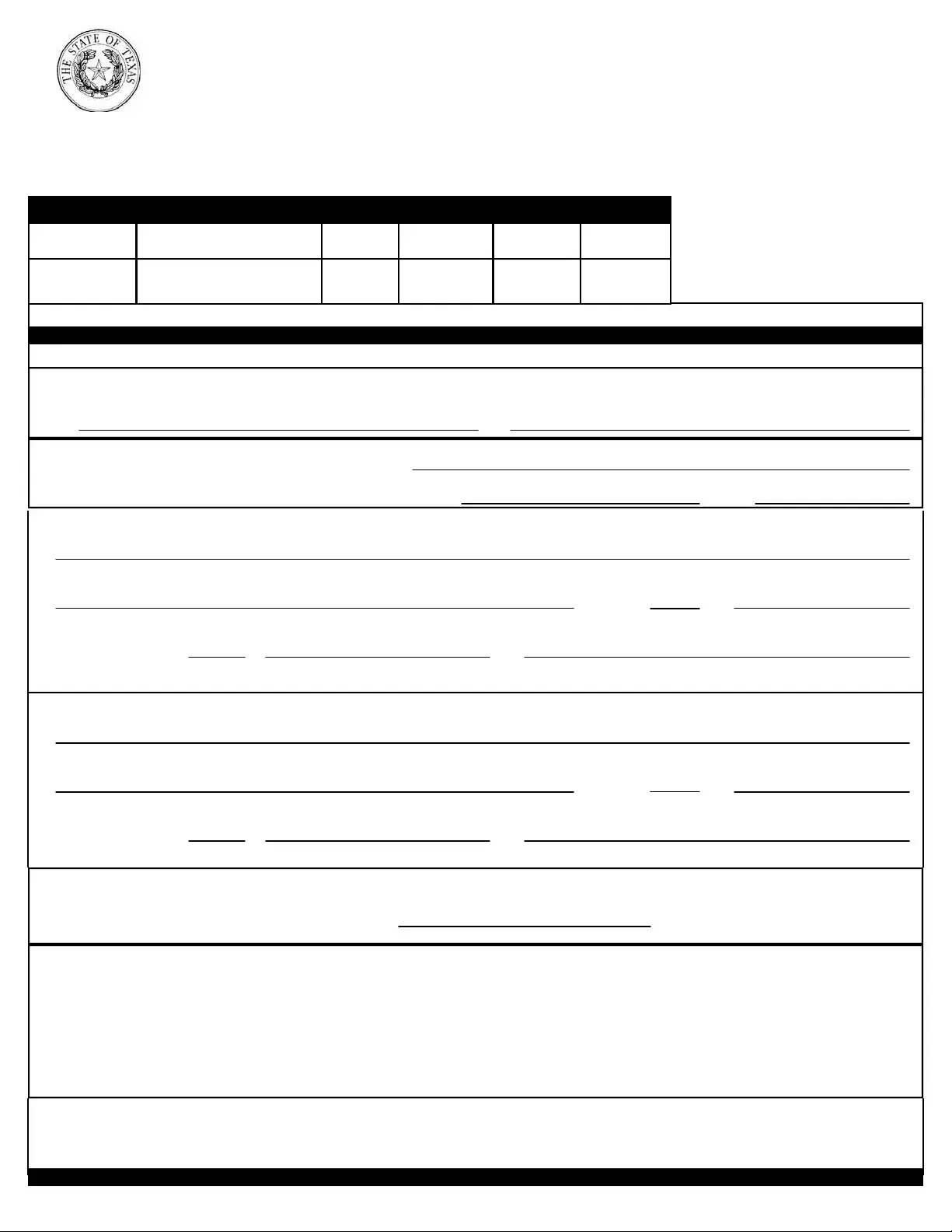
The Texas TDLR Bar form is an essential document for anyone looking to establish a barber shop in the state. This application must be completed accurately to obtain a Texas Barber Shop Permit, which is governed by the Texas Occupations Code, Chapter 1601. The form requires applicants to provide key information, such as the shop name, opening date, and business hours. Additionally, it asks for the shop's mailing and physical addresses, as well as contact information, ensuring that all correspondence can be handled smoothly. Applicants must also disclose ownership details, including any individuals with 25% or more ownership in the business. This section helps the Texas Department of Licensing and Regulation (TDLR) maintain transparency and accountability. Furthermore, the form includes a statement of compliance, where applicants affirm their commitment to adhere to all relevant regulations and standards. Completing the TDLR Bar form accurately is crucial, as providing false information can lead to serious consequences, including the revocation of the license. As you navigate this process, understanding the requirements and implications of the TDLR Bar form is vital for a successful barber shop operation in Texas.
Document Preview

TEXAS DEPARTM EN T OF LI CEN SI N G AN D REGULATI ON
P.O. Box 1 2 1 5 7 - Aust in, Tex as 7 8 7 1 1 - 2 1 5 7
(8 0 0 ) 8 0 3 - 9 2 0 2 - ( 5 1 2 ) 4 6 3 - 6 5 9 9 - FAX ( 5 1 2 ) 4 7 5 - 2 8 7 1
w w w .tdlr.texas.gov - cs.ba r be rs@tdlr.texas.gov
APPLICATI ON FOR:
Texas Barber Shop Perm it
PURSUANT TO OCCUPATI ONS CODE, CHAPTER 1601
TD LR BAR ( r e v 0 8/ 2 0 1 3)
TH I S FORM CON SI STS OF 2 PAGES.
This docum ent is available on the TDLR website at w ww.tdlr.texas.gov/ barbers/ barberform s.htm
DO N OT W RI TE ABOVE TH I S LI N E
Pe r m it #
N OTE: ALL I NFORMATI ON MUST BE TYPED OR PRI NTED I N I NK.
4 . Shops M ailing Addr ess and Con tact I nform ation : ( USED FOR ALL CORRESPONDENCE)
Num ber, Street and Apar t m ent No. - OR - P.O. Box Num ber
Cit y St at e Zip Code Country
Area Code
( )
Phone Num ber
FAX Num ber:
( )
Area Code
Phone Num ber E- mail Address ( johndoe@aol.com for exam ple)
1 . Shop N am e ( List t w o choice s) :
A. B.
2 . Ope ning Dat e ( Change of Ow ner Dat e) :
3 . N orm al Busine ss D ays a nd H ours Ope n: Days: Hours:
5 . Shops Ph ysica l Addr ess:
Num ber, Street and Suit e No.
Cit y St at e Zip Code Country
Area Code
( )
Phone Num ber
FAX Num ber:
( )
Area Code
Phone Num ber E- mail Address ( johndoe@aol.com for exam ple)
6 . I s t h is shop a licen sed Cosm e tology Salon a s w e ll: ( cir cle one) Ye s N o
I f YES” list t he Cosm et ology Salon License Num ber :
7 . Or ganiza t ion Type : ( cir cle one )
Sole Proprietorship Cor porat ion Lim it ed Pa rtnership
Lim it ed Li
abilit y Com pany Lim it ed Lia bility Pa rt ner ship
FEE RECEI PT N UM BER
EVEN T
CODE
FEE
AM OUN T
PMT.
AM OUN T
MON EY
TYPE
License
Fee
$60.00
DO N OT W RI TE I N TH E FEE AREA I MM ED I ATELY BELOW
Cit y St at e Zip Code Country Phone Num ber
( )
Area Code
Num ber, Street and Apar t m ent No. - OR - P.O. Box Num ber
FAX Num ber:
Phone Num ber
E- m ail Address ( j ohndoe@aol.com for exam ple)
( )
Area Code
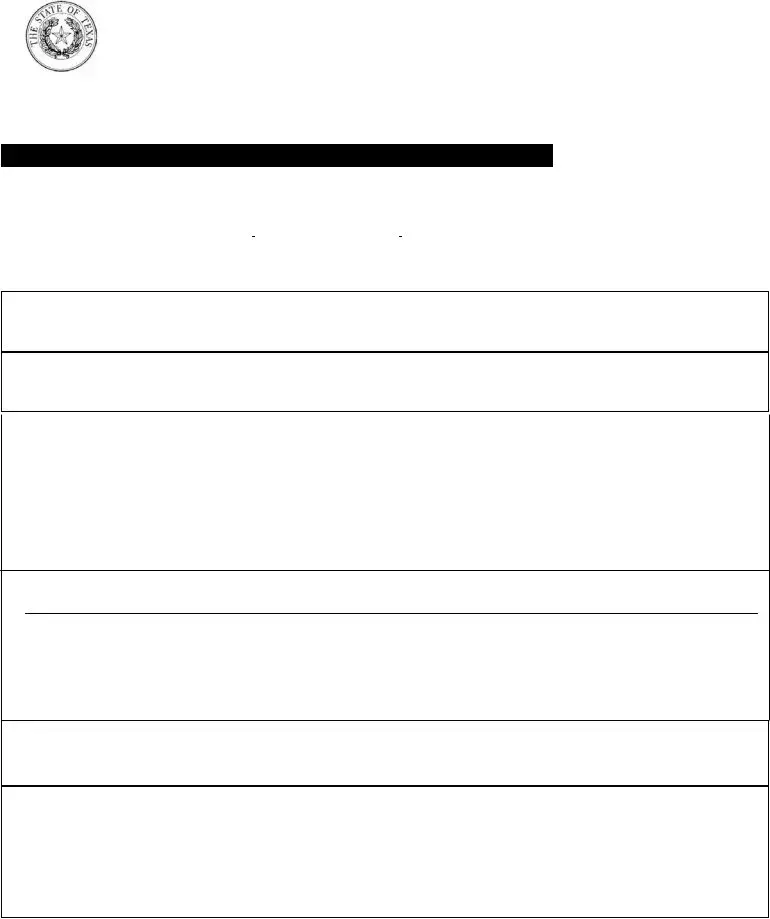
STATEM EN T OF APPLI CAN T( S)
Fe der
al I D N o. or Ow ner Social Securit y N o.* :
M ailing Address a nd Cont a ct I nform ation:
9 . Addit i
onal Ow ne r I nfor m a tion, Mailing Addr ess and Con tact I nform ation:
(if necessary)
N am e :
Fede ra l I D N o. or Ow ner Social Secu rity N o.* :
M ailing Address a nd Cont a ct I nform ation:
8 . Business N a m e ( Ow ne r N am e, if Sole Propr ie t or ship) :
%
Ownership Percent age
____________________ %
I cer tify t hat I w ill com
ply w it h all a pplica ble provisions of t he Tex as Occupa tion s Code, Cha pt ers 5 1 , 1 6 0 1 a nd
1 6 0 3 ; 1 6 TX Adm in. Code, Cha pt er 6 0 ; a nd, t he Ba rber Adm inist ra tive Rule s, 1 6 TX Adm in . Code, Cha pt er 8 2 .
I a lso ce rt ify t hat I w ill not ope n for busine ss un til I ha ve m et a ll r equ ir em e nt s for openin g a Bar ber shop an d
have r eceive d m y Ba rber shop lice nse .
I un de rst and t ha t pr ovidin g false inform a tion on t his a pplicat ion m a y r esult in re voca tion of t he licen se I am
re que st ing a nd t he im posit ion of a dm inist ra tiv e pe na lt ies.
* N ot e: I f you ha ve a Socia l Secur it y N u m be r ( SSN) , Se ction 2 3 1 .3 0 2 of t h e Tex a s Fam ily Cod e REQUI RES all applica n t s t o disclose t he ir SSN
w h en filing a n a pplicat ion . The SSN t ha t is prov ide d is con fide n t ia l a nd is re quire d t o e nforce Child Support or de rs.
Num ber, Street and Apar t m ent No. - OR - P.O. Box Num ber
Cit y
St at e Zip Code
Country
Phone Num ber
( )
Area Code
FAX Num ber:
Phone Num ber
E- m ail Address ( j ohndoe@aol.com for exam ple)
( )
Area Code
BELOW , LI ST ALL OW N ERS TH AT H AVE 2 5 % OR M ORE OW N ERSH I P OF TH E BUSI N ESS. YOU M AY
ATTACH ADDI TI ON AL PAGES I F N ECESSARY.
Dat e Signed Signature of Owner or Corporate Officer
Dat e Signed Signature of Owner or Corporat e Officer
P.O. Box 12157 Austin, Texas 78711 (512 )463-6599 (800)803-9202 FAX (512)463-2951
Email Address: cs.barbers@tdlr.texas.gov Internet Address: www.tdlr.texas.gov
REQUIREMENTS FOR ALL BARBER & SPECIALTY SHOPS
Shop and Shop Conditions:
1. Exterior Sign using the word “Barber Shop”, “Barber Salon”, or any phrase containing the
word Barber.
2. Barbershops may display a Barber Pole. However, if displayed the pole shall be red and
white, with the optional blue.
3. Floors made of non-porous, easily washable, material in areas where chemicals are mixed
and where water may splash. Anti-slip or plastic floor coverings may be used for safety
reasons.
4. Floors, ceilings, shelves, furniture, furnishings, and fixtures clean and in good repair
(no cracks).
5. Plumbing fixtures, including toilets and wash basins, kept clean and in good repair.
6. One sink or wash basin for every three barber chairs or stations.
7. Hot and cold running water within the areas where work is being done and supplies
dispensed.
8. Container of liquid disinfectant at each work station used by a barber or specialty licensee.
9. Food and drinks not prepared or sold in shop for client consumption.
10. Adequate ventilation to exhaust any chemicals or strong odors from the public area and to
provide fresh air.
11. Not used for living or sleeping quarters.
12. Autoclave, dry heat sterilizer, or ultraviolet sanitizer, if manicure or pedicure services are
provided in the shop.
13. No animals allowed except for those providing assistance to individuals.
14. Separated by a solid wall and separate door from restaurant or food preparation area.
15. Separate entrance if attached to a residence. Any door between shop and residence must be
closed during business hours.
16. Not used for any purpose that would tend to make the premises unsanitary, unsafe, or
endanger the health and safety of the public.
Revised 02/2012
TEXAS DEPARTMENT OF LICENSING AND REGULATION
Austin Headquarters: E.O. Thompson State Office Building · 920 Colorado · Austin, Texas 78701
Required Posters, Forms, and Lists:
1. Sanitation Rules posted.
2. Consumer Complaint Sign (“regulated by”) posted.
3. List of all licensees and permits of all employees and independent contractors (booth renters).
Restroom Requirements:
1. One restroom in or near shop; no chemicals stored in the restroom.
Other Requirements:
1. A shop that employs both barbers and cosmetologists must have a Dual Shop Permit or both
a barber shop permit and a cosmetology salon license.
2. Barber poles may be displayed only by shops that have a valid Barber Shop or Dual Shop
Permit. (Barber shops are not required to display a barber pole).
3. Only a licensed barber may shave a beard or mustache, or use a razor to outline the hair, or
shave the back of the neck.
4. Shops must be in compliance with all local ordinances and requirements (example: fire
codes/occupancy).
5. Licensees may not use or possess any of the following substances or products in performing
barbering services.
a. Methyl Methacrylate Liquid Monomers (also known as, MMA).
b. Razor-type callus corn shavers intended to cut growths of skin such as corns and calluses
(example: credo blades).
c. Alum or other astringents in stick or lump form. Powder or liquid is permissible.
d. Fumigants such as Formalin (formaldehyde tablets).
United States Food and Drug Administration (FDA) – Related
1. Licensees shall not use any product in providing a service authorized under the Act that is
banned or deemed to be poisonous or unsafe by the FDA or other local, state, or federal
governmental agencies responsible for making such determinations.
2. Possession or storage on licensed premises of any item banned or deemed to be poisonous or
unsafe by the FDA or other governmental agency shall be considered prima facie evidence of
its use.
3. For the purpose of performing services authorized under the Act, no licensee shall buy, sell,
use, or apply to any person liquid monomeric methyl methacrylate (MMA), a chemical
banned for use in nail services by the FDA.
Revised 02/2012
Austin Headquarters: E.O. Thompson State Office Building · 920 Colorado · Austin, Texas 78701
Texas Department of Licensing & Regulation
Barber Program
Health & Safety Rules
The following health and safety (sanitation) rules must be posted in all barber and
barber specialty shops (Chapter 1601.452, Texas Occupations Code), barber
schools (Chapter 1601.552, Texas Occupations Code), and dual barber and beauty
shops (Chapter 1603.205, Texas Occupations Code).
Please make copies of these health and sanitation rules as needed, or copies may be
downloaded from the TDLR website at the following internet address:
www.tdlr.texas.gov/barbers/barbers.htm
For more information or to request copies by mail, e-mail or by telephone, please
contact:
Barber Program
Texas Department of Licensing & Regulation
PO Box 12157
Austin, TX 78711
800/803-9202
512/463-6599
512/463-2951 (fax)
E-mail requests to:
cs.barbers@tdlr.texas.gov
customer.service@tdlr.texas.gov
Revised 08-2013
82.100. Health and Safety Definitions. (Rule effective March 1, 2006, 31 TexReg 1297; amended effective August 1, 2006, 31
TexReg 5947; amended effective January 1, 2008, 32 TexReg 9966; amended effective February 1, 2012, 37 TexReg 319)
The following words and terms, when used in this chapter, shall have the following meanings, unless the
context clearly indicates otherwise.
(1) Chlorine bl
each solutions--A chemical used to destroy bacteria and to disinfect
implements and non-porous surfaces; solution should be mixed fresh at least once per
day. As used in this chapter, chlorine bleach solutions fall into three categories based on
concentration and exposure time:
(A) Low level disinfection (100 - 200 ppm)--Add two teaspoons household (
5.25%)
bleach to one gallon water. Soak 10 minutes minimum.
(B) High level disinfection (1,000 ppm)--Add one-third (
1/3) cup household (5.25%)
bleach to one gallon water. Soak 20 minutes minimum.
(C) Blood and body fluid cleanup and disinfection (5,000 ppm)--Add one-and-three-
quarters (1 ¾) cups household (5.25%) bleach to one gallon water. Also referred
to as 10% bleach solution.
(2) Clean or cle
ansing--Washing with liquid soap and water, detergent, antiseptics, or other
adequate methods to remove all visible debris or residue. Cleansing is not disinfection.
(3) Disinfect or
disinfection--The use of chemicals to destroy pathogens on implements and
other non-porous surfaces to render an item safe for handling, use, and disposal.
(4) Disinfectant-
-In this chapter, one of the following department-approved chemicals:
(A) an EPA-registered bactericidal, fungicidal, and
virucidal disinfectant used in
accordance with the manufacturer’s instructions;
(B) a chlorine bleach solution used in accordance with this chapter; or
(C) an Isopropyl alcohol used at a concentration of at least 70% and ethyl alcohol
used at a concentration of
at least 90%.
(5) EPA-regist
ered bactericidal, fungicidal, and virucidal disinfectant--When used
according to manufacturer’s instructions, a chemical that is a low-level disinfectant used
to destroy bacteria and to disinfect implements and non-porous surfaces.
(6) Isopropyl or Ethyl alcoh
ol--Isopropyl alcohol used at a concentration of at least 70%
and ethyl alcohol used at a concentration of at least 90% are chemicals that are a low-
level disinfectant used to destroy bacteria and to disinfect implements.
(7) Multi-use items-
-Items constructed of hard materials with smooth surfaces such as
metal, glass, or plastic typically for use on more than one client. The term includes but is
not limited to such items as clippers, scissors, combs, nippers, and some nails files.
(8) Single-use items--Porous item
s made or constructed of cloth, wood, or other absorbent
materials having rough surfaces usually intended for single use including but not limited
to such items as tissues, orangewood sticks, cotton balls, some buffer blocks, and gauze.
(9) Sterili
ze or sterilization--To eliminate all forms of bacteria or other microorganisms by
use of an autoclave, or dry heat sterilizer.
Revised 02-2012
(10) Sanitize or sanitization--To reduce the number of microorganisms to a safe level by use
of an ultraviolet sanitizer.
82.101. Health and Safety Standards--Department-Approved Disinfectants
. (Rule effective March 1, 2006, 31
TexReg 1297; amended effective August 1, 2006, 31 TexReg 5947)
(a) EPA-registered bactericidal, fungicidal, and virucidal disinfectants shall be used as follows:
(1) Implements and surfaces shall first be thoroughly cleaned of all
visible debris prior to
disinfection. EPA-registered bactericidal, fungicidal, and virucidal disinfectants become
inactivated and ineffective when visibly contaminated with debris, hair, dirt and
particulates.
(2) Some disinfectants may be sprayed on the instruments, tools, or equipment to be
disinfected.
(3) Disinfectants in which implements are to be imm
ersed shall be prepared fresh daily or
more often if solution becomes diluted or soiled.
(4) In all cases the disinfectant shall be used in accordance
with the manufacturers’
recommendation or other guidance in this rule.
(5) These chemicals are harsh and may affect the long term use of scissors and other sharp
objects. Therefore, the De
partment recommends leaving items in solution in accordance
with the manufacturers’ recommendation for effective disinfection.
(b) Chlorine bleach solutions shall be used as follows:
(1) Chlorine bleach at the appropriate concentration is an eff
ective disinfectant for all
purposes in a salon.
(2) Chlorine bleach solutions shall be mixed daily.
(3) Chlorine bleach shall be kept in a closed covered container and not
exposed to sunlight.
(4) Chlorine bleach may affect the long-term use of scissors and other sharp objects so the
Depart
ment does not recommend leaving items in bleach solution beyond 2 minutes for
effective disinfection (5 minutes if disinfecting for blood contamination).
(5) Chlorine bleach vapors might react with vapors from other chemicals. Therefore chlorine
bleach shall not be
placed or stored near other chemicals used in salons (i.e. acrylic
monomers, alcohol, or other disinfecting products) or near flame.
(6) Used or soiled chlorine bleach solution shall be properly disposed of each day.
(c) Isopropyl or Ethyl alcohols shall be used as follows:
(1) isopropyl alcohol at a concentration of at least 70%
and ethyl alcohol at a concentration
of at least 90% are low-level disinfectants.
(2) Alcohol shall not be used to clean and disinfect blood or body fluid.
(3) All alcohol shall be kept in a covered container. A
lcohol deteriorates in some plastics,
metals and rubber items.
(4) Alcohol may affect the long-term use of scissors and other sharp objects.
Revised 02-2012
(5) The Department recommends leaving items in alcohol in accordance with the
manufacturer’s recommendation for effective disinfection. When using alcohol on
surfaces other than non-porous materials, the time of contact shall be between 1 to 3
minutes after proper cleaning that removed all visible debris.
(6) Alcohol may be sprayed onto porous or absorbent surfaces after cleaning, with contact
time on the s
urface of the item for at least 1 minute, provided the porous items have not
contacted broken or unhealthy skin or nails.
82.102. Health and Safety Standards--General Requirements.
(Rule effective March 1, 2006, 31 TexReg 1297;
amended effective August 1, 2006, 31 TexReg 5947)
(a) All barber establishments and licensees shall utilize clean and disinfected equipment, tools,
implements, and supplies in accordance with this Chapter, and shall employ good hygiene habits
while providing barbering services.
(b) A licensee may not perform services on a client if the licensee has
reason to believe the client has
a contagious condition such as head lice, nits, ringworm; or inflamed, infected, broken, raised or
swollen skin or nail tissue; or an open wound or sore in the area to be serviced.
(c) Multi-use equipment, implements, tools or materials
not addressed in this chapter shall be cleaned
and disinfected before use on each client. Except as otherwise provided in this chapter, chairs
and dryers do not need to be disinfected prior to use for each client.
(d) Single-use equipment, implements, tools or porous items not addressed in this rule shall be
discarded afte
r use on a single client.
(e) Electrical equipment that cannot be immersed in liquid shall be wiped clean and disinfected prior
to each use on a client.
(f) All clean and disinfected implements and materials when not in use shall be st
ored in a clean, dry,
debris-free environment including but not limited to drawers, cases, tool belts, rolling trays, or
hung from hooks. They must be stored separate from soiled implements and materials.
Ultraviolet electrical sanitizers are permissible for use as a dry storage container. Non-barber
related supplies must be stored in separate drawers or locations.
(g) A container of liquid disinfectant shall be located at each barber
chair or station in a barber
establishment to be used to disinfect combs, brushes, scissors or other equipment which may be
safely immersed in a liquid disinfectant.
(h) Shampoo bowls and manicure tables shall be disinfected prior to
use for each client.
(i) Floors in barber establishments shall be thoroughl
y cleaned each day. All hair cuttings shall be
removed as soon as practicable.
(j) All trash containers must be emptied daily and kept
clean by washing or using plastic liners.
(k) Hand washing facilities, including hot and cold r
unning water must be provided for employees.
(l) Clean towels shall be used on each client. Towels m
ust be washed in hot water and chlorine
bleach.
(m) Soiled towels shall be removed after use on each clie
nt and deposited in a suitable receptacle.
Revised 02-2012
(n) Each barber establishment shall keep all products used in the conduct of their business properly
labeled in compliance with OSHA requirements.
(o) Haircutting capes and shampoo capes shall be kept clean. A clean (one-use) cape shall be used
for each client, or a sanitary neck strip or towel shall be used to keep capes from coming into
direct contact with the client’s neck.
82.103. Health and Safety Standards--Hair Cutting, Styling, Treatment and Shaving Services. (Rule
effective March 1, 2006, 31 TexReg 1297)
(a) Barbers shall wash their hands with soap and water, or use a liquid hand sanitizer, prior to
performing any services on a client.
(b) All equipment, implements, tools and materials shall be proper
ly cleaned and disinfected in
accordance with this rule prior to servicing each client.
(c) After each client, all non-disposable implements sh
all be cleaned and sprayed with either an EPA
-registered bactericidal, fungicidal, and virucidal disinfectant, or isopropyl alcohol, ethyl alcohol,
or a high-level disinfection chlorine bleach solution. Equipment, implements, tools and materials
to be cleaned and disinfected include but are not limited to combs and picks, haircutting shears,
thinning shears/texturizers, razors, edgers, guards, clippers, and perm rods.
(d) At the end of each day of use, the above item
s, along with any other tools, such as sectioning
clips, brushes, comb and picks shall be cleaned by manually scrubbing with soap and water or
adequate methods, and then disinfected by one of the following methods:
(1) Complete immersion in an EPA-registered bactericidal,
fungicidal, and virucidal
disinfectant in accordance with manufacturer’s instructions.
(2) Complete immersion in isopropyl alcohol or ethyl alcohol;
(3) Complete immersion in a high-level dis
infection chlorine bleach solution.
82.104. Health and Safety Standards--Facial Services. (Rule effective March 1, 2006, 31 TexReg 1297; amended effective
August 1, 2006, 31 TexReg 5947; amended effective February 1, 2012, 37 TexReg 319)
(a) Barbers and barber technicians shall wash their hands with soap and water, or use a liquid hand
sanitizer, prior to performing any services on a client. Gloves shall be worn during any type of
extraction.
(b) Equipment, implements, tools and materials shall b
e properly cleaned and disinfected prior to
servicing each client in accordance to this rule.
(c) Facial chairs and beds, including headrest for each, shall be c
leaned and disinfected prior to
providing service to each client. The chair or bed shall be made of or covered in a non-porous
material that can be disinfected.
(d) After each client, multiple use implements such as
metal tweezers and comedone extractors shall
be cleaned and disinfected.
(e) The following implements are single-use items and s
hall be discarded in a trash receptacle after
use: cotton pads, cotton balls, gauze, wooden applicators, disposable gloves, tissues, disposable
wipes, lancets, fabric strips and other items used for a similar purpose as one or more of the items
listed above.
Revised 02-2012
(f) The following items that are used during services shall be replaced with clean items for each
client: disposable and terry cloth towels, hair caps, headbands, brushes, gowns, makeup brushes,
spatulas that contact skin or products from multi-use containers, sponges and other items used for
a similar purpose as any one of the items listed above.
(g) Items subject to possible cross contamination such
as creams, cosmetics, astringents, lotions,
removers, waxes, moisturizers, masks and oils shall be used in a manner so as not to contaminate
the remaining product. Applicators shall not be re-dipped in product. Permitted procedures to
avoid cross contamination are:
(1) Disposing of the remaining product before beginning
services on each client; or
(2) Using a single-use disposable implement to apply
product and disposing of such
implement after use; or
(3) Using an applicator bottle to apply the product.
82.105.
Health and Safety Standards--Waxing Services.
(Rule effective March 1, 2006, 31 TexReg 1297)
(a) Barbers and barber technicians shall clean the areas of the client’s body on which the service is to
be administered. Barbers and barber technicians may perform waxing services only on the face
and/or neck of a client.
(b) Barbers and barber technicians shall wash their hands with soap and water, or use a liquid
hand
sanitizer, prior to performing any services on a client.
(c) Barbers and barber technicians performing waxing services shall dispose of after each use all wax
that has been in contact with a client’s skin. Wax may not be reused under any circumstances.
(d) All wax pots shall be cleaned and disinfected in accordance with manufacturer’s
reco
mmendations. No applicators shall be left standing in the wax at any time.
82.106. Health and Safety Standards--Manicure and Pedicure Services. (Rule effective March 1, 2006, 31
TexReg 1297; amended effective August 1, 2006, 31 TexReg 5947; amended effective October 11, 2007, 32 TexReg 7048; amended
effective February 1, 2012, 37 TexReg 319)
(a) Barbers and barber manicurists shall clean their hands with soap and water or a hand sanitizer
prior to performing any services.
(b) Barbers and barber manicurists shall clean the areas o
f the client’s body on which the service is to
be administered.
(c) All
metal manicure and pedicure tools shall be properly cleaned, disinfected and sterilized or sanitized
after e
ach service, in accordance with this chapter, regardless of the tool’s multiuse for only a sin-
gle client or for multiple clients.
(d) After each client, the following implements shall be cleaned, disinfected, and sterilized or
sanitized in a
ccordance with the rule: metal pusher and files, cuticle nipper and scissors, metal
tweezers, finger and toe nail clippers and electric drill bits.
(e) The following implements are single-use items
and shall be discarded after use: orangewood
sticks, cotton balls, nail wipes and disposable towels.
Revised 02-2012

Form Specifications

Fact Name Detail
Governing Law The Texas TDLR Barber Form is governed by the Texas Occupations Code, Chapter 1601.
Application Purpose This form is used to apply for a Texas Barber Shop Permit.
Fee Requirement The application fee for a Barber Shop Permit is $60.00.
Contact Information For inquiries, applicants can reach TDLR at (800) 803-9202 or via email at [email protected].
Physical Address Requirement Applicants must provide the physical address of the barber shop, including street number and city.
Owner Disclosure Owners with 25% or more ownership must be listed, along with their Federal ID or Social Security number.
Sanitation Rules Health and safety rules must be posted in all barber shops as per Chapter 1601.452 of the Texas Occupations Code.
Restroom Requirement Shops must have at least one restroom, with no chemicals stored inside.
Business Type Applicants must indicate the type of business organization, such as Sole Proprietorship or Limited Liability Company.
Compliance Certification Applicants must certify compliance with all applicable provisions of the Texas Occupations Code and related rules.

Texas Tdlr Bar: Usage Guidelines

Completing the Texas TDLR Bar form requires careful attention to detail. Each section must be filled out accurately to ensure that your application is processed smoothly. After submitting the form, you can expect to receive further instructions or updates regarding your application status from the Texas Department of Licensing and Regulation.

  1. Shop Name: Enter two choices for your shop name in the designated fields.
  2. Opening Date: Provide the date when the shop will open or the date of ownership change.
  3. Normal Business Days and Hours: Specify the days and hours your shop will be open for business.
  4. Shop’s Mailing Address: Fill in the complete mailing address, including street, city, state, zip code, and contact information.
  5. Shop’s Physical Address: Enter the physical address where the shop operates, along with contact details.
  6. Cosmetology Salon License: Indicate whether the shop is also a licensed cosmetology salon by circling 'Yes' or 'No'. If 'Yes', include the license number.
  7. Organization Type: Circle the appropriate type of organization: Sole Proprietorship, Limited Liability Company, Corporation, Limited Partnership, or Limited Liability Partnership.
  8. Owners with 25% or More Ownership: List all owners, including their ownership percentage and federal ID or Social Security number. Provide mailing addresses and contact information for each owner.
  9. Additional Owner Information: If necessary, include information for any additional owners using the same format as above.
  10. Statement of Applicant(s): Read and certify compliance with the applicable provisions by signing and dating the form.

Your Questions, Answered

What is the Texas TDLR Bar form?

The Texas TDLR Bar form is an application used to obtain a Barber Shop Permit from the Texas Department of Licensing and Regulation (TDLR). This permit is essential for anyone looking to legally operate a barber shop in Texas. The form collects information about the shop, its owners, and compliance with state regulations.

How do I fill out the Texas TDLR Bar form?

To fill out the form, you need to provide specific details such as the shop name, opening date, business hours, and contact information. Make sure to type or print all information clearly in ink. It's important to list all owners with 25% or more ownership and provide their contact details. You should also indicate whether the shop is a licensed cosmetology salon.

What is the fee for the Barber Shop Permit?

The application fee for a Texas Barber Shop Permit is $60. This fee must be submitted with your application, and you should not write in the fee area of the form. Keep your payment receipt for your records.

What happens after I submit the form?

Once you submit the form, the TDLR will review your application. If everything is in order and you meet all requirements, you will receive your Barber Shop Permit. It's important to wait until you have received your permit before opening your shop.

What are the requirements for operating a barber shop in Texas?

There are several requirements for operating a barber shop, including maintaining a clean and safe environment, having proper signage, and ensuring that plumbing fixtures are in good repair. Additionally, you must have a sink for every three barber chairs and provide adequate ventilation. Specific sanitation rules also need to be followed, and certain chemicals are prohibited.

Do I need to post any signs in my barber shop?

Yes, you are required to post certain signs in your barber shop. This includes sanitation rules and a consumer complaint sign that states the shop is regulated by TDLR. Having these signs visible helps inform customers about their rights and the standards your shop adheres to.

Can I operate a barber shop from my home?

Operating a barber shop from your home is possible, but there are specific requirements you must meet. For instance, the shop must have a separate entrance from the residence, and any door connecting the two must remain closed during business hours. You must also comply with local zoning laws and health regulations.

What should I do if I have questions about the form or the application process?

If you have questions regarding the Texas TDLR Bar form or the application process, you can reach out directly to the TDLR Barber Program. They can be contacted via phone at (800) 803-9202 or (512) 463-6599. You can also send an email to [email protected] for assistance.

What are the consequences of providing false information on the application?

Providing false information on the Texas TDLR Bar form can lead to serious consequences, including the revocation of your license and potential administrative penalties. It's crucial to ensure that all information submitted is accurate and truthful to avoid any legal issues.

Common mistakes

  1. Failing to provide complete shop names. Applicants must list two choices for the shop name, yet many only provide one.

  2. Neglecting to specify the opening date. This is crucial for determining compliance with regulations.

  3. Inaccurately listing business days and hours. This information must reflect actual operating hours to avoid confusion.

  4. Omitting contact information for the shop. Complete mailing addresses and phone numbers are essential for correspondence.

  5. Providing incorrect ownership percentages. All owners with 25% or more ownership must be listed with accurate percentages.

  6. Failing to disclose if the shop is also a licensed cosmetology salon. This information is necessary for proper licensing.

  7. Not signing the application. Both owners or corporate officers must provide their signatures to validate the application.

  8. Ignoring the Social Security Number requirement. Applicants must disclose their SSN as mandated by Texas law.

Documents used along the form

When applying for a Texas Barber Shop Permit using the Texas TDLR Bar form, there are several other documents that may also be required or beneficial to have on hand. These documents help ensure compliance with state regulations and facilitate a smoother application process. Below is a list of commonly used forms and documents.

  • Cosmetology Salon License: If the barber shop also operates as a cosmetology salon, a separate cosmetology salon license is required. This license ensures that the establishment meets the health and safety standards specific to cosmetology services.
  • Employer Identification Number (EIN): This federal tax identification number is necessary for businesses, including barber shops, to report taxes and hire employees. Obtaining an EIN from the IRS is a crucial step in setting up a business.
  • Proof of Business Registration: Depending on the business structure (e.g., LLC, corporation), proof of registration with the Texas Secretary of State may be needed. This document verifies that the business is legally recognized and authorized to operate in Texas.
  • Health and Safety Inspection Report: Before opening, barber shops must pass a health and safety inspection. This report confirms compliance with sanitation and safety regulations, which are essential for protecting clients and staff.

Having these documents readily available can streamline the application process for your Texas Barber Shop Permit. Ensuring compliance with all necessary regulations not only helps in obtaining the permit but also sets a solid foundation for a successful business.

Similar forms

  • Texas Cosmetology Salon License Application: Similar to the TDLR Barber form, this application requires details about the salon, including ownership information and compliance with state regulations. Both forms ensure that the establishment meets the necessary legal standards for operation.
  • Texas Massage Therapy License Application: This document shares the need for personal and business information, as well as compliance with health and safety regulations. Just like the barber form, it emphasizes the importance of maintaining a clean and safe environment for clients.
  • Texas Nail Salon License Application: This application also requires business ownership details and health compliance. Both forms focus on the safety and sanitation standards necessary for providing services to the public.
  • Texas Tattoo Studio License Application: Like the TDLR Barber form, this application requires information about the business and its owners. Both documents ensure that studios adhere to local and state health regulations to protect client safety.
  • Texas Pool and Spa License Application: This form, similar to the TDLR Barber form, requires information about the business and compliance with safety regulations. Both emphasize maintaining a safe environment for public use.
  • Texas Food Establishment Permit Application: This document requires similar ownership and contact information, as well as compliance with health standards. Both forms are designed to ensure that businesses operate safely and legally.
  • Texas Child Care License Application: This application shares a focus on the safety and well-being of clients. It requires detailed information about the facility and its operators, just like the TDLR Barber form emphasizes compliance with applicable laws.

Dos and Don'ts

When filling out the Texas TDLR Bar form, it's essential to follow specific guidelines to ensure your application is processed smoothly. Here are four things you should do and should not do:

  • Do type or print all information clearly in ink. This ensures that your details are legible and reduces the chance of errors.
  • Don't write in the fee area. This space is designated for official use only, and any markings here could lead to delays.
  • Do provide accurate contact information, including your mailing address and phone number. This allows the TDLR to reach you if there are any questions about your application.
  • Don't leave any required fields blank. Incomplete applications may be returned, which can prolong the process of obtaining your permit.

By adhering to these guidelines, you can help ensure that your application for a Texas Barber Shop Permit is processed efficiently and without unnecessary complications.

Misconceptions

Understanding the Texas TDLR Barber form is essential for anyone looking to operate a barber shop in Texas. However, several misconceptions can lead to confusion. Here’s a breakdown of some common myths surrounding this important form.

  1. All barber shops need a separate cosmetology license. Many believe that if they offer both barber and cosmetology services, they must obtain a separate cosmetology license. In reality, a Dual Shop Permit suffices for shops employing both barbers and cosmetologists.
  2. Filling out the form by hand is acceptable. Some applicants think they can fill out the form by hand. However, the TDLR requires all information to be typed or printed in ink to ensure clarity and legibility.
  3. The application fee is refundable. A common misconception is that the $60 application fee can be refunded if the application is denied. Unfortunately, this fee is non-refundable regardless of the outcome.
  4. Only the owner needs to sign the application. Many applicants believe that only one signature is necessary. However, if there are multiple owners, each must sign the application to validate it.
  5. Barber poles are mandatory for barber shops. Some think that displaying a barber pole is a requirement. While it is allowed and can enhance visibility, it is not mandatory for all barber shops.
  6. All information provided is public. There’s a belief that all details in the application are public records. While some information may be accessible, personal identifiers like Social Security numbers are kept confidential.
  7. There are no penalties for providing false information. Some applicants underestimate the seriousness of the application. Providing false information can lead to severe penalties, including license revocation.
  8. Once submitted, the application cannot be modified. Many think that after submission, no changes can be made. In fact, applicants can update their information if necessary, but it’s best to do so before approval.
  9. Health and safety rules are optional. Some believe that adhering to health and safety rules is not mandatory. In truth, these rules are crucial and must be posted in all barber shops to comply with state regulations.
  10. The physical address of the shop can be a P.O. Box. Many think that a P.O. Box is sufficient for the physical address. However, the TDLR requires a physical address for the shop where services are provided.

By understanding these misconceptions, potential barber shop owners can better navigate the application process and ensure compliance with Texas regulations.

Key takeaways

Key Takeaways for Filling Out the Texas TDLR Barber Form:

  • Ensure all information is typed or printed clearly in ink.
  • Provide two choices for the shop name in the designated section.
  • Include the opening date and normal business hours accurately.
  • Use the shop’s mailing address for all correspondence; this is crucial for communication.
  • List all owners with 25% or more ownership, including their federal ID or Social Security number.
  • Verify compliance with local ordinances, including health and safety regulations, before submission.
  • Submit the form along with the required fee of $60 to avoid delays in processing.