Homepage Blank Texas Subpoena PDF Form
Content Overview

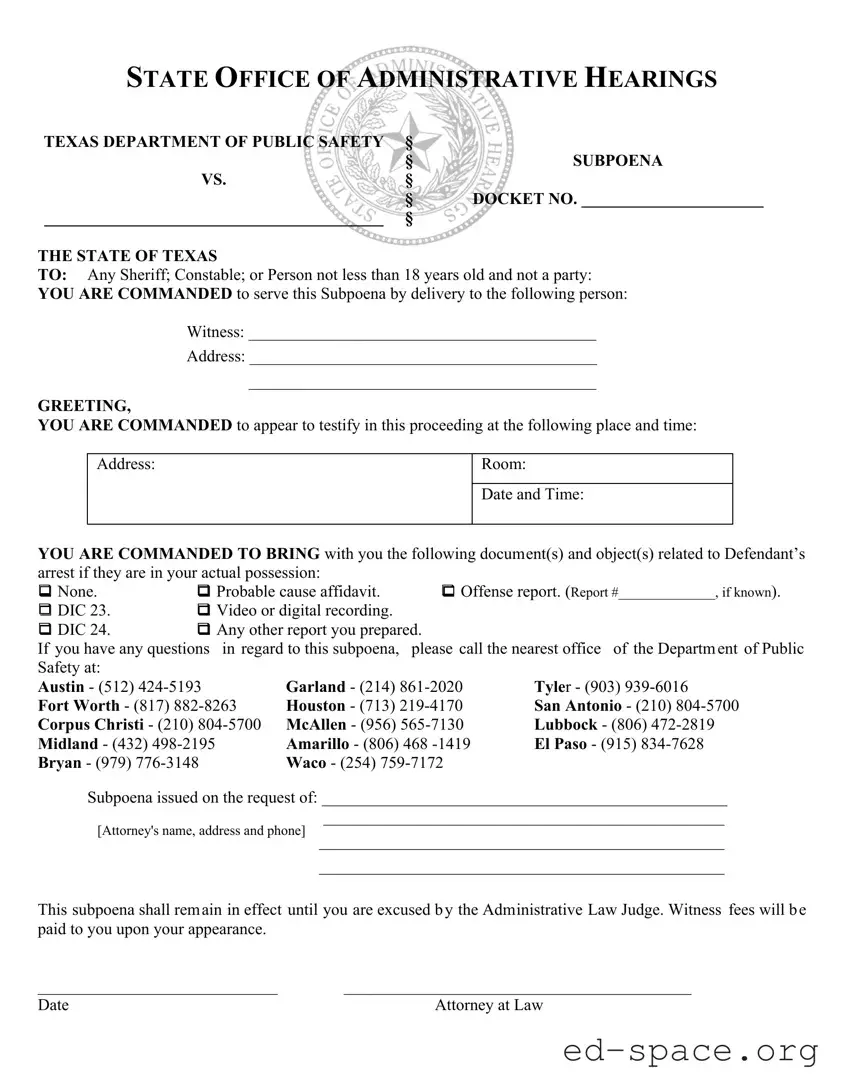
The Texas Subpoena form serves as a critical tool in the legal process, allowing the state to compel witnesses to appear and provide testimony in administrative hearings. This form is issued by the State Office of Administrative Hearings and is directed to any sheriff, constable, or an individual who is at least 18 years old and not a party to the case. It outlines the specific details required for service, including the name and address of the witness, the time and location where their testimony is needed, and any documents or evidence they must bring along. The subpoena also includes a section for the attorney's information who requested the issuance, ensuring accountability and clarity in communication. Notably, it emphasizes that witness fees will be paid upon appearance, reinforcing the importance of participation in the legal process. Additionally, the form contains sections for the return of service and acceptance of service, which document the completion of the subpoena's requirements. Understanding the structure and purpose of the Texas Subpoena form is essential for anyone involved in administrative hearings, as it ensures that all parties are informed and prepared for the proceedings ahead.

Document Preview

STATE OFFICE OF ADMINISTRATIVE HEARINGS
TEXAS DEPARTMENT OF PUBLIC SAFETY
VS.
_________________________________________
§
§
§
§
§
SUBPOENA
DOCKET NO. ______________________
THE STATE OF TEXAS
TO: Any Sheriff; Constable; or Person not less than 18 years old and not a party:
YOU ARE COMMANDED to serve this Subpoena by delivery to the following person:
Witness: __________________________________________
Address: __________________________________________
__________________________________________
GREETING,
YOU ARE COMMANDED to appear to testify in this proceeding at the following place and time:
Address:
Room:
Date and Time:
YOU ARE COMMANDED TO BRING with you the following document(s) and object(s) related to Defendant’s
arrest if they are in your actual possession:
None.
DIC 23.
DIC 24.
Probable cause affidavit.
Video or digital recording.
Any other report you prepared.
Offense report. (Report #______________, if known).
If you have any questions in regard to this subpoena, please call the nearest office of the Department of Public
Safety at:
Austin - (512) 424-5193 Garland - (214) 861-2020 Tyler - (903) 939-6016
Fort Worth - (817) 882-8263 Houston - (713) 219-4170 San Antonio - (210) 804-5700
Corpus Christi - (210) 804-5700 McAllen - (956) 565-7130 Lubbock - (806) 472-2819
Midland - (432) 498-2195 Amarillo - (806) 468 -1419 El Paso - (915) 834-7628
Bryan - (979) 776-3148 Waco - (254) 759-7172
Subpoena issued on the request of: _________________________________________________
_________________________________________________
_________________________________________________
[Attorney's name, address and phone]
_________________________________________________
This subpoena shall rem ain in effect until you are excused by the Administrative Law Judge. Witness fees will be
paid to you upon your appearance.
_____________________________ __________________________________________
Date Attorney at Law
RETURN TO
THE STATE OFFICE OF ADMINISTRATIVE HEARINGS
___________________________________________________________________________________________
Defendant Name:______________________________ SOAH Docket No.: ______________________________
Date of Hearing:____________________ Officer/Witness Name: _____________________________________
[This
Information must be completed]
___________________________________________________________________________________________
CERTIFICATE OF SERVICE
___________________________________________________________________________________________
I received this subpoena for service on ____________________________ at _____________ (A.M.) (P.M.).
I executed this subpoena by de livering a copy to _________________________________________________ in
person at ______________________________________________ on ___________________ at ________
(A.M.) (P.M.).
Any and all fees and costs incurred for service of this subpoena were submitted to the requesting Party for payment.
Date: ______________________________________
I declare the foregoing is true and correct:
Signed: ____________________________________
Name: _____________________________________
Address: ___________________________________
___________________________________________
___________________________________________
Copies to: (1) Texas Department of Public Safety
(2) Defendant or Attorney
___________________________________________________________________________________________
ACCEPTANCE OF SERVICE
___________________________________________________________________________________________
I acknowledge that I received and accep ted service of this S ubpoena at __________________________________
on _________________ at ___________(A.M.) (P.M.). I further understand my legal obligation to appear at
the hearing.
____________________________________________ ______________________________________
Date Witness signature

Form Specifications

Fact Name Description
Issuing Authority The Texas Subpoena form is issued by the State Office of Administrative Hearings.
Applicable Law This form is governed by the Texas Government Code, Chapter 2001, which outlines the procedures for administrative hearings.
Service Requirements Subpoenas must be served by a sheriff, constable, or any person over 18 who is not a party to the case.
Witness Command The subpoena commands the witness to appear and testify at a specified date and time.
Documents Required Witnesses may be required to bring specific documents, such as offense reports or video recordings, related to the case.
Contact Information The form includes contact numbers for various Texas Department of Public Safety offices for any questions regarding the subpoena.
Witness Fees Witnesses are entitled to receive fees upon their appearance at the hearing.
Certificate of Service A certificate of service must be completed to confirm that the subpoena was delivered to the witness.
Acceptance of Service The witness must acknowledge receipt of the subpoena and their obligation to appear at the hearing.

Texas Subpoena: Usage Guidelines

Filling out the Texas Subpoena form requires careful attention to detail to ensure that all necessary information is accurately provided. Once completed, the form will need to be served to the designated witness, who is required to appear at the specified hearing. Below are the steps to effectively fill out the form.

  1. Identify the Docket Number: Locate the space labeled "Docket No." at the top of the form and write in the appropriate docket number for the case.
  2. Enter the Witness Information: In the section labeled "Witness," fill in the name of the person who is being subpoenaed. Include their address in the designated area below.
  3. Specify the Appearance Details: Fill out the address, room, date, and time where the witness is required to appear. Make sure this information is clear and accurate.
  4. List Required Documents: Indicate any documents or objects that the witness must bring with them. If none are required, write "None." If specific reports or recordings are needed, include the details as instructed.
  5. Provide Issuer Information: In the section for the attorney's name, address, and phone number, enter the details of the attorney requesting the subpoena. Ensure that all contact information is correct.
  6. Sign and Date: The attorney must sign and date the form at the bottom where indicated. This confirms the issuance of the subpoena.
  7. Complete the Certificate of Service: If applicable, fill out the certificate of service section. This includes the date the subpoena was received for service and details of how it was delivered to the witness.
  8. Acceptance of Service: If the witness acknowledges receipt of the subpoena, they should fill out the acceptance of service section, including their signature and the date.

After completing these steps, the form will be ready for submission. Ensure that copies are made for all relevant parties, including the Texas Department of Public Safety and the defendant or their attorney. This process is essential to uphold the legal requirements of the hearing.

Your Questions, Answered

What is a Texas Subpoena form?

A Texas Subpoena form is a legal document that orders an individual to appear in court or produce evidence in a legal proceeding. It is typically issued by an attorney or a court and is used to gather testimony or documents relevant to a case. The subpoena outlines what is required from the recipient and provides details about the hearing or trial.

Who can serve a Texas Subpoena?

A Texas Subpoena can be served by any sheriff, constable, or person who is at least 18 years old and not a party to the case. This means that the individual serving the subpoena should have no direct involvement in the legal matter at hand.

What should I do if I receive a Texas Subpoena?

If you receive a Texas Subpoena, it is important to read it carefully. Take note of the date, time, and location where you are required to appear. If the subpoena requests documents, make sure you gather the necessary materials. If you have questions or concerns, contact the issuing attorney or the appropriate office of the Department of Public Safety.

Can I ignore a Texas Subpoena?

Ignoring a Texas Subpoena is not advisable. Failing to comply can lead to legal consequences, including fines or other penalties. If you believe the subpoena is unjust or if you cannot attend, it is best to seek legal advice to understand your options.

What happens if I cannot attend the hearing?

If you cannot attend the hearing as specified in the subpoena, you should notify the issuing attorney as soon as possible. You may need to provide a valid reason for your absence. In some cases, the court may allow you to reschedule or provide alternative arrangements.

Will I be paid for my appearance as a witness?

Yes, if you appear as a witness in response to a Texas Subpoena, you are entitled to witness fees. These fees will be paid to you upon your appearance at the hearing. The amount may vary, so it’s good to confirm with the issuing attorney beforehand.

What information do I need to provide when serving a Texas Subpoena?

When serving a Texas Subpoena, you must provide details such as the name and address of the witness, the date and time of the hearing, and any documents that the witness is required to bring. Accurate completion of this information is crucial for the subpoena to be valid.

What if I have questions about the subpoena?

If you have questions about the Texas Subpoena, you should reach out to the nearest office of the Department of Public Safety or the attorney who issued the subpoena. Contact information is usually provided on the subpoena itself, making it easy to get the answers you need.

How long does a Texas Subpoena remain in effect?

A Texas Subpoena remains in effect until you are excused by the Administrative Law Judge. This means you are legally obligated to comply with the subpoena until you receive confirmation that your appearance is no longer required.

What should I do if I believe the subpoena is invalid?

If you believe the Texas Subpoena is invalid or improperly issued, it is important to consult with a legal professional. They can help you understand your rights and may assist you in filing a motion to quash the subpoena if necessary.

Common mistakes

  1. Incomplete Information: Failing to fill out all required fields, such as the witness name and address, can lead to delays or invalidation of the subpoena.

  2. Incorrect Dates: Entering the wrong date or time for the hearing can cause confusion and may result in the witness not appearing.

  3. Missing Documents: Not specifying the documents or objects the witness is required to bring can result in an incomplete presentation of evidence.

  4. Improper Service: Delivering the subpoena to the wrong person or location can invalidate the service and affect the hearing.

  5. Failure to Sign: Not signing the subpoena or the certificate of service can lead to questions about its authenticity.

  6. Ignoring Witness Fees: Forgetting to mention or arrange for witness fees can discourage compliance and lead to a lack of cooperation.

  7. Incorrect Docket Number: Using an incorrect or missing docket number can create issues in tracking the case and may cause administrative errors.

  8. Not Providing Contact Information: Omitting the attorney's contact details can hinder communication and lead to misunderstandings regarding the subpoena.

  9. Ignoring Local Rules: Each jurisdiction may have specific rules regarding subpoenas. Not adhering to these can invalidate the subpoena.

  10. Failure to Verify Information: Not double-checking the accuracy of the information provided can result in significant complications during the hearing.

Documents used along the form

The Texas Subpoena form is a crucial legal document used to compel a witness to appear in court or provide evidence. Alongside this form, several other documents are commonly utilized to ensure the smooth functioning of legal proceedings. Below is a list of these documents, each serving a specific purpose in the legal process.

  • Affidavit of Service: This document serves as proof that the subpoena has been delivered to the intended recipient. It includes details about when and how the service was completed, ensuring that the court has a record of the delivery.
  • Notice of Hearing: This document informs parties involved in a legal case about the date, time, and location of the upcoming hearing. It ensures that all parties are aware of the proceedings and can prepare accordingly.
  • Motion to Quash: If a recipient believes that the subpoena is invalid or overly burdensome, they may file a motion to quash. This document requests the court to nullify the subpoena, providing reasons for the request.
  • Subpoena Duces Tecum: This specific type of subpoena commands an individual to produce documents or evidence at a legal proceeding. It is often used when the testimony alone is insufficient, and physical evidence is required.
  • Certificate of Compliance: This document is used to confirm that all necessary parties have been notified and that the subpoena has been complied with. It serves as a record that the legal requirements have been met.

Each of these documents plays a vital role in the legal process, ensuring that all parties are informed and that the proceedings adhere to legal standards. Understanding these forms can help individuals navigate the complexities of the legal system more effectively.

Similar forms

  • Subpoena Duces Tecum: Similar to the Texas Subpoena, this document commands an individual to produce documents or evidence for a legal proceeding. It emphasizes the requirement to bring specific items, just like the Texas form.
  • Notice to Produce: This document requests a party to provide certain documents relevant to a case. It shares the same purpose of gathering information for legal proceedings, focusing on the necessity of specific materials.
  • Summons: A summons notifies a person that they are required to appear in court. While it doesn’t typically request documents, it serves the essential function of compelling attendance, similar to the Texas Subpoena.
  • Deposition Notice: This document informs a witness about an upcoming deposition. Like the Texas Subpoena, it mandates attendance but usually occurs outside of court, focusing on witness testimony.
  • Interrogatories: These are written questions sent to a party in a lawsuit, requiring them to respond under oath. While they do not compel physical attendance, they aim to gather information, paralleling the purpose of the Texas Subpoena.
  • Request for Admissions: This document asks a party to admit or deny specific statements. It seeks clarity and information in a case, akin to how the Texas Subpoena seeks testimony and documents.
  • Court Order: A court order can compel a person to do something, such as appear in court or produce documents. It has a similar authoritative tone and purpose as the Texas Subpoena, enforcing compliance.
  • Writ of Mandamus: This is a court order directing a lower court or government official to perform a duty. While more formal, it shares the element of compelling action, much like the Texas Subpoena.
  • Notice of Hearing: This document informs parties of a scheduled hearing. While it doesn’t require document production, it serves to notify individuals of their obligation to appear, similar to the Texas Subpoena.
  • Administrative Subpoena: Used by government agencies, this document compels the production of documents or testimony. It functions similarly to the Texas Subpoena, focusing on compliance with legal processes.

Dos and Don'ts

When filling out the Texas Subpoena form, it’s important to keep a few key points in mind. Here are some things you should and shouldn't do:

  • Do ensure all names and addresses are filled out accurately.
  • Do double-check the date and time for the appearance.
  • Do include all required documents that need to be brought to the hearing.
  • Do keep a copy of the completed subpoena for your records.
  • Don't leave any sections blank unless instructed.
  • Don't forget to sign and date the form before submission.
  • Don't ignore the instructions for service of the subpoena.
  • Don't submit the form late; ensure timely delivery.

Misconceptions

  • Subpoenas are only for criminal cases. Many people believe that subpoenas are exclusively used in criminal proceedings. In reality, they can also be issued in civil cases, administrative hearings, and other legal contexts.
  • A subpoena guarantees that the witness will be paid. While witnesses may receive fees for their time, payment is not automatic. The subpoena itself does mention that witness fees will be paid, but the specifics can vary based on the circumstances and jurisdiction.
  • You can ignore a subpoena if you don't want to testify. Ignoring a subpoena is not advisable. Failing to comply can lead to legal consequences, including contempt of court. It’s important to take a subpoena seriously.
  • Subpoenas can be issued by anyone. This is a common misconception. Only authorized individuals, such as attorneys or certain government officials, can issue subpoenas. It’s not a free-for-all.
  • Once served, a subpoena cannot be challenged. This is incorrect. A recipient can challenge a subpoena in court if they believe it is unreasonable or seeks irrelevant information. There are legal avenues to contest its validity.
  • Subpoenas must always be served in person. While personal service is common, subpoenas can also be served by mail or other means, depending on the rules of the jurisdiction. Understanding the specific requirements is crucial.
  • All subpoenas require the recipient to bring documents. Not all subpoenas demand documents. Some may only require a witness to appear and testify. The requirements will be clearly outlined in the subpoena itself.
  • Subpoenas are only valid for a specific time. While a subpoena will have a date and time for appearance, it remains in effect until the witness is excused by the judge. This can lead to confusion about its duration.

Key takeaways

Filling out and using the Texas Subpoena form is an important process. Here are some key takeaways to keep in mind:

  • Understand the Purpose: A subpoena is a legal document that orders a person to appear in court or produce evidence.
  • Eligibility: The subpoena can be served by a sheriff, constable, or any person who is at least 18 years old and not involved in the case.
  • Complete the Form: Ensure that all required fields, such as the witness's name and address, are filled out accurately.
  • Specify the Details: Clearly indicate the date, time, and location where the witness must appear.
  • List Required Documents: If applicable, specify any documents or evidence that the witness must bring with them.
  • Contact Information: Include a contact number for the Department of Public Safety in case of questions or concerns.
  • Witness Fees: Inform the witness that they will receive payment for their appearance, as required by law.
  • Certificate of Service: The person serving the subpoena must complete this section to confirm delivery.
  • Acceptance of Service: The witness should sign to acknowledge they have received the subpoena and understand their obligation to appear.
  • Keep Copies: Make sure to keep copies of the subpoena for your records and provide necessary copies to relevant parties.

By following these guidelines, you can ensure that the subpoena process runs smoothly and effectively. It is essential to treat all parties involved with respect and understanding throughout this legal procedure.