Homepage Blank Texas St 2 PDF Form
Content Overview

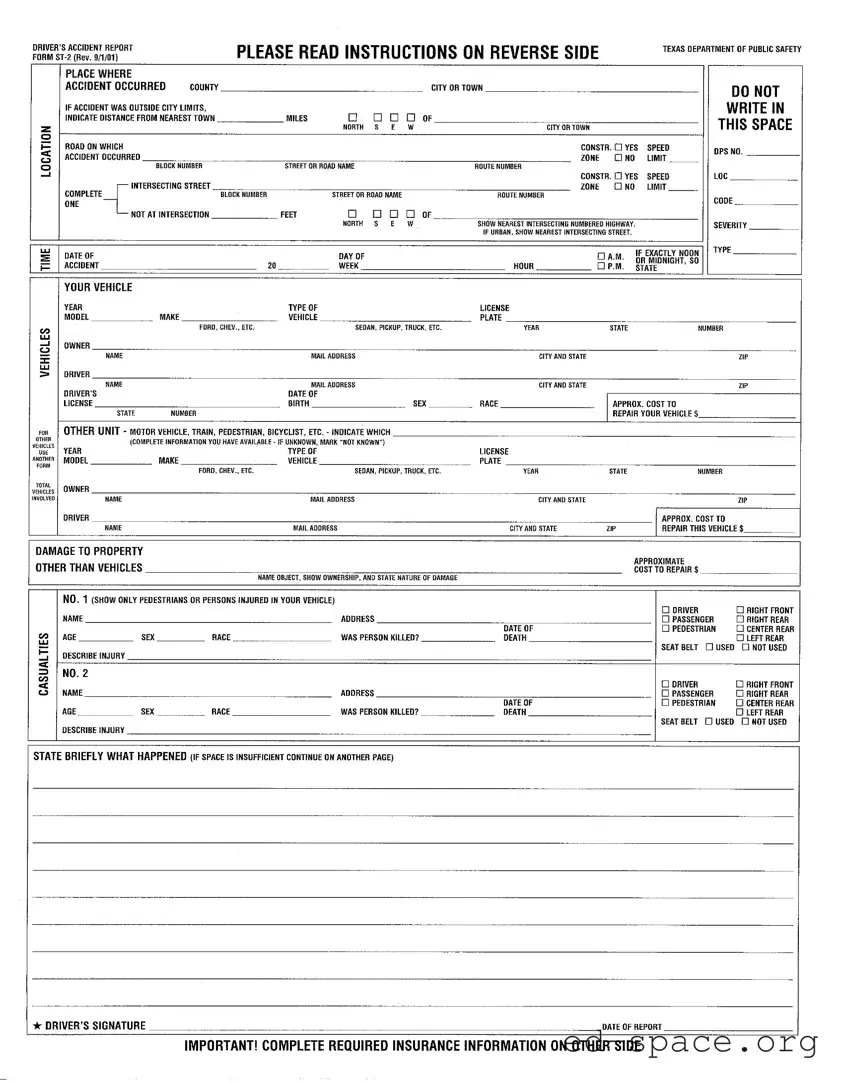
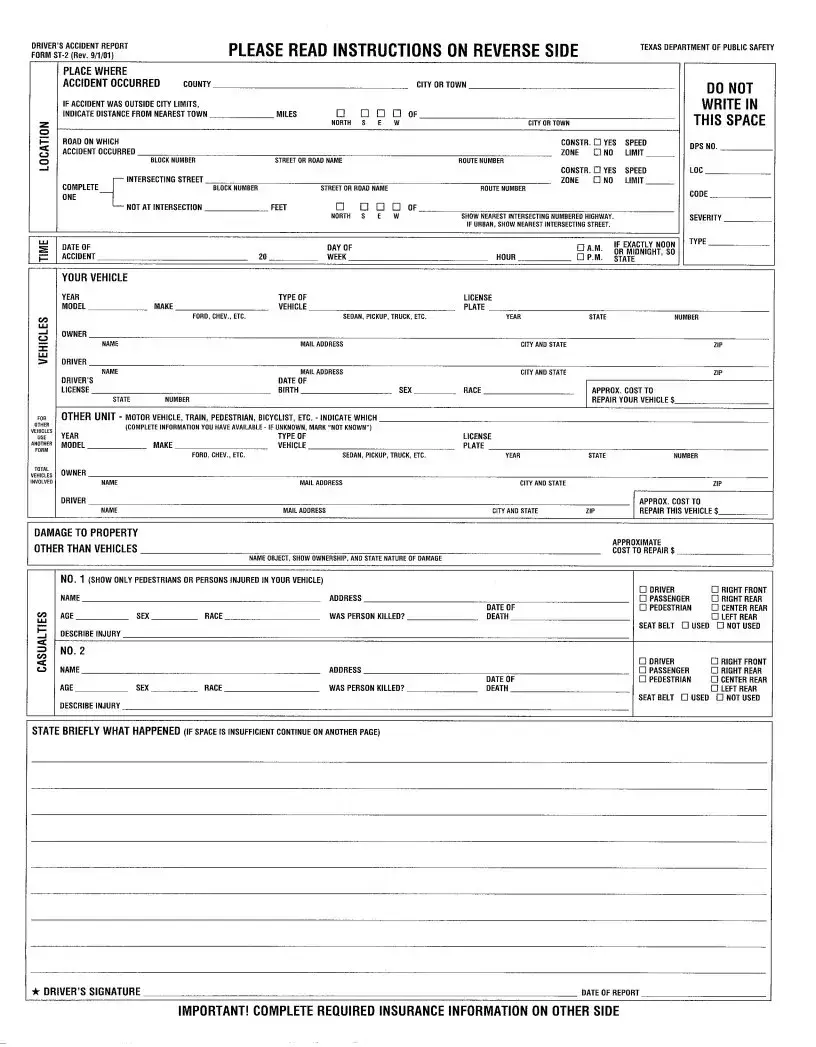
The Texas St 2 form, officially known as the Driver’s Accident Report Form, serves a crucial purpose for individuals involved in motor vehicle accidents within the state. This form is required when an accident results in injury, death, or property damage exceeding $1,000 and is not investigated by law enforcement. It captures essential details such as the location of the accident, the parties involved, and the extent of damages. Completing this form accurately is vital for ensuring that all necessary information is documented and submitted within the stipulated ten-day timeframe. The form includes sections for the driver’s personal information, vehicle details, and specifics about any injuries or damages incurred. Additionally, it requires a narrative description of the incident to provide context for the accident. Properly filling out the Texas St 2 form helps facilitate the processing of claims and ensures compliance with state regulations. Understanding its components and the instructions provided can significantly ease the burden during a stressful time following an accident.
Document Preview

Form Specifications

Fact Name Fact Description
Form Title The form is titled "Driver’s Accident Report Form ST-2."
Revision Date This version of the form was revised on September 1, 2001.
Governing Law The form is governed by the Texas Motor Vehicle Safety-Responsibility Act, specifically Texas Transportation Code §601.004.
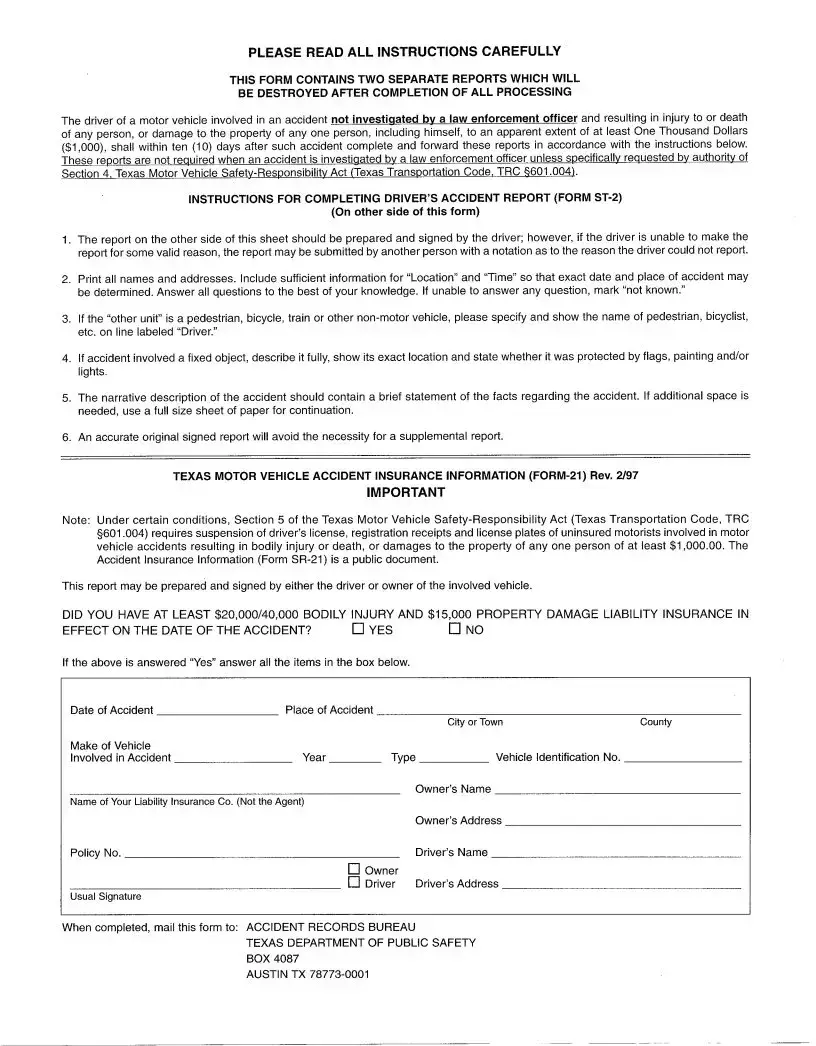
Filing Deadline Drivers must complete and submit this report within ten days of the accident.
Accident Threshold The report is required if the accident resulted in injury, death, or property damage exceeding $1,000.
Report Requirement Reports are not needed when a law enforcement officer investigates the accident, unless specifically requested.
Submission Method The driver or an authorized person may submit the report if the driver is unable to do so.
Insurance Information Completing the report requires providing insurance information, including liability coverage details.
Accident Description A narrative description of the accident must be included, detailing the facts surrounding the incident.

Texas St 2: Usage Guidelines

Filling out the Texas St 2 form is an important step after being involved in a motor vehicle accident. This form collects necessary information about the accident and the parties involved. It is essential to provide accurate details to ensure proper processing.

  1. Begin by entering the place where the accident occurred. Specify the county and city or town.
  2. If the accident was outside city limits, indicate the distance from the nearest town.
  3. Fill in the road on which the accident occurred, including the street or road name and route number.
  4. Complete the section for construction and speed zone information, marking yes or no as applicable.
  5. Provide the date and time of the accident, including the day of the week and whether it was A.M. or P.M.
  6. Enter details about your vehicle, including year, make, model, and license plate number.
  7. Fill out your personal information, including name, address, and date of birth.
  8. Indicate the approximate cost to repair your vehicle.
  9. If there were other vehicles involved, fill out their information using another form.
  10. For each additional unit involved (like a pedestrian or cyclist), provide their details, including name, age, and whether they were injured.
  11. In the section for property damage, describe the object and provide the approximate cost to repair it.
  12. Provide a brief narrative of what happened during the accident. If more space is needed, continue on another page.
  13. Finally, sign and date the form to confirm the information is accurate.

Once the form is complete, it should be mailed to the address provided at the bottom of the form. This ensures that the necessary authorities receive the report for processing.

Your Questions, Answered

What is the Texas St 2 form?

The Texas St 2 form, also known as the Driver’s Accident Report Form, is used to report motor vehicle accidents that result in injury, death, or property damage exceeding $1,000. This form is necessary when an accident is not investigated by law enforcement. It helps ensure that all relevant details about the accident are documented for insurance and legal purposes.

When do I need to complete the Texas St 2 form?

You must complete the Texas St 2 form within ten days of an accident if it resulted in injury, death, or property damage of at least $1,000 and was not investigated by a law enforcement officer. If the accident was investigated, you typically do not need to submit this form unless specifically requested.

Who should fill out the Texas St 2 form?

The driver involved in the accident should fill out the form. However, if the driver is unable to do so for a valid reason, another person can complete it on their behalf. In such cases, it’s important to include a note explaining why the driver could not report the accident.

What information do I need to provide on the form?

When filling out the Texas St 2 form, you need to provide detailed information about the accident, including the date, time, and location. You should also include information about all vehicles involved, the drivers, and any injuries sustained. If there were pedestrians or other non-motor vehicles involved, that information should be noted as well.

What happens if I don’t submit the Texas St 2 form?

If you fail to submit the Texas St 2 form when required, you may face penalties, including suspension of your driver's license and vehicle registration. It’s crucial to comply with the reporting requirements to avoid potential legal and financial consequences.

Where do I send the completed Texas St 2 form?

Once you have completed the Texas St 2 form, mail it to the Accident Records Bureau at the Texas Department of Public Safety. The address is: Box 4087, Austin, TX 78773-0001. Make sure to keep a copy for your records before sending it off.

Common mistakes

  1. Failing to provide complete information about the location of the accident. It's crucial to include the county, city, and any specific details like distance from the nearest town. Incomplete information can lead to delays in processing.

  2. Not answering all questions accurately. If unsure about a particular detail, marking it as “not known” is preferable to leaving it blank. Every piece of information contributes to a clearer understanding of the incident.

  3. Neglecting to include details about other units involved. If a pedestrian, bicycle, or train was part of the accident, it’s essential to specify this. Providing complete information ensures that all parties are accounted for in the report.

  4. Overlooking the requirement for a signature. The report must be signed by the driver, or if they are unable, by another person with a valid reason noted. An unsigned report may be deemed invalid and could lead to complications.

Documents used along the form

When involved in a motor vehicle accident in Texas, several forms and documents may accompany the Driver’s Accident Report Form ST-2. Each of these documents serves a specific purpose and can be crucial for processing claims or complying with state regulations. Below is a list of some of the commonly used forms that you might encounter.

  • Texas Motor Vehicle Accident Insurance Information (Form SR-21): This form provides essential insurance details about the involved vehicles. It confirms whether the drivers had the required liability insurance at the time of the accident.
  • Texas Peace Officer’s Crash Report (Form CR-3): This report is completed by law enforcement officers who investigate an accident. It includes details about the accident scene, involved parties, and any citations issued.
  • Notice of Accident (Form 4): This form notifies the Texas Department of Public Safety about an accident that occurred. It is often used when the accident does not involve law enforcement.
  • Claim Form: Insurance companies typically require this form to initiate a claim. It gathers information about the accident and the parties involved to process the claim effectively.
  • Medical Records Release Form: If there are injuries, this form allows medical providers to share patient information with insurance companies or legal representatives, facilitating the claims process.
  • Property Damage Claim Form: This document is used to claim damages to property resulting from the accident. It details the extent of the damage and the estimated repair costs.
  • Witness Statement Form: If there are witnesses to the accident, this form collects their accounts of what happened. It can be vital in establishing liability.
  • Subrogation Form: This form is used by insurance companies to recover costs from the party at fault after they have paid for damages or injuries.
  • Release of Liability Form: This document is often signed to release one party from future claims related to the accident, usually in exchange for compensation.
  • Accident Reconstruction Report: In more complex cases, experts may prepare this report to analyze the accident scene and provide insights into how the accident occurred.

Understanding these forms can make navigating the aftermath of an accident smoother. Each document plays a role in ensuring that all parties involved are held accountable and that claims are processed efficiently. Being prepared with the right paperwork can help you manage the situation more effectively.

Similar forms

The Texas St 2 form, known as the Driver’s Accident Report, is a crucial document for reporting vehicle accidents in Texas. It shares similarities with several other documents used in accident reporting and insurance claims. Here’s a look at four documents that are akin to the Texas St 2 form, highlighting how they relate to it:

  • Form SR-21 (Accident Insurance Information): This form is also required in the event of a motor vehicle accident. Like the Texas St 2, it gathers essential information about the accident, including details about the vehicles involved and the insurance coverage of the driver. Both forms aim to ensure that proper information is recorded for legal and insurance purposes.
  • Form CR-3 (Texas Peace Officer's Crash Report): This is the official report generated by law enforcement when they investigate an accident. While the Texas St 2 form is completed by the driver, the CR-3 is filled out by officers. Both documents serve to document the details of an accident but from different perspectives—one from the driver’s point of view and the other from law enforcement.
  • Form TR-1 (Texas Vehicle Accident Report): Similar to the Texas St 2, the TR-1 is another form used to report accidents. It collects information about the parties involved, the circumstances of the accident, and damages incurred. The main difference lies in the specific use cases and requirements for submission, but both aim to provide a comprehensive account of the incident.
  • Form 10-200 (Insurance Claim Form): This form is utilized when filing an insurance claim after an accident. It requires similar information as the Texas St 2, such as details of the accident and damages. Both documents facilitate the claims process, ensuring that all relevant information is captured to assist in resolving claims efficiently.

Understanding these forms and their similarities can help streamline the process of reporting accidents and filing claims, making it easier for everyone involved to navigate the aftermath of a vehicle incident.

Dos and Don'ts

Filling out the Texas St 2 form can seem daunting, but with careful attention, it can be a straightforward process. Here’s a guide on what to do and what to avoid to ensure your report is completed accurately and efficiently.

  • Do read all instructions thoroughly before starting. Understanding the requirements will help you fill out the form correctly.
  • Do provide clear and legible information. Use block letters to ensure that your details are easy to read.
  • Do include all relevant details about the accident, such as the location, time, and parties involved. This will help in processing your report.
  • Do sign and date the form. An unsigned report may lead to delays in processing.
  • Don't leave any sections blank. If you don't know the answer, write "not known" instead of skipping it.
  • Don't provide vague descriptions. Be specific about the accident's circumstances to avoid confusion.
  • Don't forget to include insurance information. This is crucial for processing your report and any potential claims.
  • Don't submit the form late. Make sure it is sent within ten days of the accident to comply with legal requirements.

By following these guidelines, you can navigate the Texas St 2 form with confidence, ensuring that your report is both accurate and complete. Remember, the goal is to provide a clear account of the accident to facilitate any necessary follow-up actions.

Misconceptions

When it comes to the Texas St 2 form, there are several misconceptions that can lead to confusion. Understanding the truth behind these myths can help you navigate the process more smoothly. Here are seven common misconceptions:

  • It's only for serious accidents. Many people believe the form is only necessary for major accidents. In reality, it's required for any accident resulting in damage over $1,000, regardless of severity.
  • Only law enforcement can file this report. While law enforcement may file a report, the driver involved in the accident is also responsible for completing the Texas St 2 form if no officer investigates.
  • Filing is optional if no one is injured. This is not true. If property damage exceeds $1,000, the form must be completed and submitted, even if no injuries occurred.
  • It must be submitted immediately. While timely submission is important, you actually have ten days from the date of the accident to file the report.
  • Only the driver can complete the form. If the driver is unable to report for a valid reason, another person may submit the form on their behalf, provided they note the reason for the driver’s absence.
  • All questions must be answered. If you don’t know the answer to a question, it’s acceptable to mark it as “not known.” It’s better to provide incomplete information than to guess.
  • It's the same as a police report. The Texas St 2 form is not a police report. It is a separate document that serves a different purpose and is completed by the driver.

Understanding these misconceptions can save you time and stress when dealing with the Texas St 2 form. Always ensure you have the correct information and submit it as required to avoid any complications.

Key takeaways

When filling out and using the Texas St 2 form, it is essential to keep several key points in mind. These takeaways will help ensure that the report is completed accurately and submitted correctly.

  • Timeliness is Crucial: The report must be completed and submitted within ten days of the accident if it resulted in injury or property damage exceeding $1,000.
  • Accurate Information: Provide complete and accurate details regarding the accident location, time, and the vehicles involved. This includes information about the driver, vehicle make and model, and any damage incurred.
  • Use Clear Descriptions: In the narrative section, describe the accident clearly and concisely. If additional space is needed, continue on a separate sheet of paper.
  • Insurance Information: Ensure that all required insurance information is filled out. This is necessary for compliance with Texas laws regarding motor vehicle accidents.
  • Signature Requirement: The report should be signed by the driver. If the driver is unable to sign due to valid reasons, another person may submit the report, but they must note the reason for the driver's absence.

Following these guidelines can facilitate a smoother process in the aftermath of an accident. It is important to approach this task with care and attention to detail.