Homepage Blank Texas Small Claims PDF Form
Content Overview

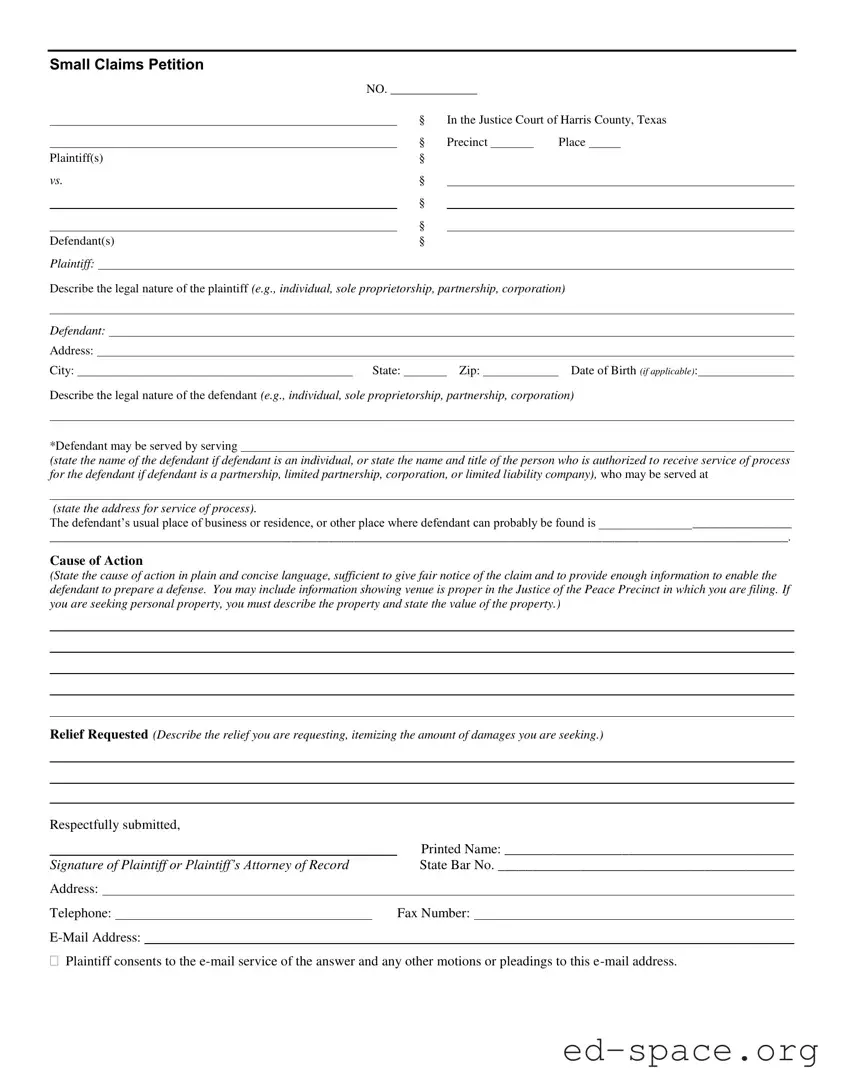
The Texas Small Claims form is a crucial document for individuals seeking to resolve disputes in a straightforward and efficient manner. This form is utilized in the Justice Court of Harris County, Texas, and it serves as the starting point for filing a small claims case. It requires the plaintiff to provide essential information, including their legal status—whether they are an individual, a sole proprietorship, a partnership, or a corporation. Similarly, details about the defendant must be included, such as their address and legal nature. The form also specifies how the defendant can be served, which is vital for ensuring that the legal process is followed correctly. Additionally, the plaintiff must clearly state the cause of action, outlining the nature of the claim in a way that allows the defendant to understand and prepare a defense. This section should include any relevant details that establish the jurisdiction of the court. Furthermore, the relief requested must be articulated, detailing the damages sought. Completing this form accurately is essential for the case to proceed smoothly. The document concludes with spaces for the plaintiff's signature and contact information, ensuring that all parties are properly notified throughout the legal process.

Document Preview

Small Claims Petition
NO. ______________
§ In the Justice Court of Harris County, Texas
§ Precinct Place
Plaintiff(s) §
vs. §
§
§
Defendant(s) §
Plaintiff:
Describe the legal nature of the plaintiff (e.g., individual, sole proprietorship, partnership, corporation)
Defendant:
Address:
City: State: Zip: Date of Birth (if applicable):
Describe the legal nature of the defendant (e.g., individual, sole proprietorship, partnership, corporation)
*Defendant may be served by serving
(state the name of the defendant if defendant is an individual, or state the name and title of the person who is authorized to receive service of process
for the defendant if defendant is a partnership, limited partnership, corporation, or limited liability company), who may be served at
(state the address for service of process).
The defendant’s usual place of business or residence, or other place where defendant can probably be found is _______________________________
_______________________________________________________________________________________________________________________.
Cause of Action
(State the cause of action in plain and concise language, sufficient to give fair notice of the claim and to provide enough information to enable the
defendant to prepare a defense. You may include information showing venue is proper in the Justice of the Peace Precinct in which you are filing. If
you are seeking personal property, you must describe the property and state the value of the property.)
Relief Requested (Describe the relief you are requesting, itemizing the amount of damages you are seeking.)
Respectfully submitted,
Printed Name: __________________________________________
Signature of Plaintiff or Plaintiff’s Attorney of Record State Bar No. ___________________________________________
Address:
Telephone: Fax Number:
E-Mail Address:
Plaintiff consents to the e-mail service of the answer and any other motions or pleadings to this e-mail address.

Form Specifications

Fact Name Description
Governing Law The Texas Small Claims form is governed by the Texas Government Code, Chapter 27, which outlines the procedures for small claims in Justice Courts.
Filing Jurisdiction Small claims cases must be filed in the Justice Court of the precinct where the defendant resides or where the incident occurred.
Parties Involved The form requires identification of both the plaintiff and defendant, including their legal nature (individual, corporation, etc.) and addresses.
Service of Process Defendants can be served at their residence, place of business, or an authorized representative's address, ensuring they receive notice of the claim.
Cause of Action The petitioner must clearly state the cause of action, providing enough detail to inform the defendant of the nature of the claim and the basis for the court's jurisdiction.
Relief Requested Petitioners must specify the relief they are seeking, including a detailed breakdown of any damages claimed.
Consent for E-mail Service By signing the form, plaintiffs can consent to receive service of process via email, streamlining communication and court proceedings.

Texas Small Claims: Usage Guidelines

Filling out the Texas Small Claims form is a straightforward process that requires careful attention to detail. Once completed, this form will be submitted to the appropriate court, and it is essential to ensure all information is accurate. Here are the steps to fill out the form correctly:

  1. Begin by entering the Small Claims Petition Number at the top of the form.
  2. Fill in the Justice Court information, including the County (Harris County) and Precinct Place.
  3. In the Plaintiff(s) section, provide your name and describe your legal nature (e.g., individual, corporation).
  4. In the Defendant(s) section, enter the defendant's name, address, city, state, and zip code.
  5. If applicable, include the defendant's Date of Birth.
  6. Describe the legal nature of the defendant (e.g., individual, corporation).
  7. State the name of the person authorized to receive service of process for the defendant.
  8. Provide the address where the defendant can be served.
  9. Describe the defendant’s usual place of business or residence.
  10. In the Cause of Action section, clearly state your claim in plain language. Include details that show why the court has jurisdiction.
  11. If you are claiming personal property, describe the property and state its value.
  12. In the Relief Requested section, itemize the damages you are seeking.
  13. Sign the form in the Signature of Plaintiff or Plaintiff’s Attorney of Record section.
  14. Print your name and include your State Bar Number if you are an attorney.
  15. Fill out your address, telephone number, fax number, and email address.
  16. If you consent to e-mail service, check the box provided.

Your Questions, Answered

What is the Texas Small Claims form used for?

The Texas Small Claims form is designed for individuals or businesses to file a lawsuit in a Justice Court for claims typically involving amounts up to $20,000. This form allows you to present your case, detailing the nature of your claim and the relief you are seeking. It’s a straightforward way to resolve disputes without needing extensive legal knowledge or representation.

How do I fill out the Texas Small Claims form?

To fill out the form, start by identifying yourself as the plaintiff and providing your contact information. Next, include details about the defendant, such as their name, address, and legal nature (individual, corporation, etc.). Clearly state the cause of action—this means explaining what happened and why you believe you are owed money or relief. Finally, itemize the damages you are requesting. Make sure to keep your language clear and concise to help the court understand your claim.

Where do I file the Texas Small Claims form?

You should file the Texas Small Claims form in the Justice Court located in the precinct where the defendant lives or where the dispute occurred. Check with your local court for specific filing procedures, as they may vary. Once you file, the court will assign a case number and set a date for your hearing.

What happens after I file the Texas Small Claims form?

After filing, the court will notify the defendant of the lawsuit, allowing them to prepare their defense. You will receive a court date, where both parties can present their cases. It’s important to gather any evidence, such as documents or witnesses, that support your claim. Remember, the goal is to clearly communicate your side of the story to the judge.

Common mistakes

  1. Neglecting to Clearly Identify the Parties: It is crucial to accurately describe both the plaintiff and defendant. Failing to specify whether they are individuals, businesses, or other legal entities can lead to confusion and delays in the process.

  2. Inaccurate or Incomplete Addresses: Providing a complete and correct address for the defendant is essential. Missing details can hinder the ability to serve legal documents properly.

  3. Vague Cause of Action: The cause of action must be stated in clear and concise language. Being too vague or using legal jargon can prevent the defendant from understanding the claim and preparing an appropriate defense.

  4. Omitting the Relief Requested: It is important to clearly outline what you are asking for in terms of damages or other relief. Without this information, the court may not fully understand the purpose of the claim.

  5. Forgetting to Sign the Form: A signature is required for the petition to be valid. Submitting an unsigned form can lead to immediate dismissal of the case.

  6. Ignoring the Filing Fees: Be aware of any required filing fees. Not including the appropriate payment can result in the court rejecting the petition.

Documents used along the form

When filing a small claims case in Texas, several other forms and documents may be necessary to support your claim. Each of these documents serves a specific purpose in the legal process, ensuring that all parties are properly informed and that the case is handled efficiently. Below is a list of commonly used forms alongside the Texas Small Claims form.

  • Affidavit of Service: This document confirms that the defendant has been properly served with the small claims petition. It includes details about how and when the service was completed.
  • Statement of Claim: This form outlines the specifics of the claim, including the facts of the case and the legal basis for the claim. It provides a clear narrative for the court.
  • Notice of Hearing: This document informs all parties involved about the date, time, and location of the hearing. It ensures that everyone has the opportunity to attend and present their case.
  • Request for Production of Documents: This form allows one party to request specific documents from the other party that are relevant to the case. This can help gather evidence to support the claim.
  • Interrogatories: These are written questions that one party sends to the other, which must be answered under oath. They help clarify issues and gather more information about the case.
  • Motion to Compel: If one party fails to respond to requests for documents or interrogatories, this motion asks the court to order compliance. It is a way to enforce discovery rules.
  • Counterclaim: If the defendant believes they have a claim against the plaintiff, they may file a counterclaim. This document outlines the defendant's own claims against the plaintiff.
  • Judgment Form: After a hearing, the court may issue a judgment form that outlines the decision made regarding the case, including any damages awarded.
  • Appeal Notice: If either party wishes to appeal the court’s decision, they must file an appeal notice. This document outlines the intent to challenge the ruling in a higher court.

Understanding these additional forms can help streamline the small claims process. Each document plays a crucial role in ensuring that the case is presented clearly and that all parties are adequately informed. Being prepared with the right paperwork can significantly impact the outcome of your case.

Similar forms

  • Complaint Form: Similar to the Texas Small Claims form, a complaint form initiates a legal action by outlining the plaintiff's claims against the defendant. Both documents require details about the parties involved and the nature of the dispute.
  • Summons: A summons informs the defendant of the legal action and requires them to respond. Like the Small Claims form, it includes the names of the parties and the court where the case is filed.
  • Notice of Claim: This document notifies the defendant of the plaintiff's intention to seek relief. It shares similarities with the Small Claims form in that it provides a concise description of the claim and the relief sought.
  • Petition for Damages: A petition for damages outlines the plaintiff's request for compensation due to harm or loss. Both this petition and the Small Claims form require a clear statement of the cause of action and the damages sought.
  • Statement of Claim: This document details the reasons for the lawsuit and the relief requested. It is similar to the Small Claims form in its requirement for clarity and specificity regarding the claim.
  • Counterclaim: A counterclaim is filed by a defendant against the plaintiff in response to the original claim. Like the Small Claims form, it requires the defendant to provide a clear description of their claims and the relief they seek.
  • Affidavit of Service: This document confirms that legal papers have been properly delivered to the defendant. It shares common elements with the Small Claims form, as both require accurate identification of the parties and the service details.

Dos and Don'ts

When filling out the Texas Small Claims form, it is essential to be careful and thorough. Here are some important dos and don’ts to keep in mind:

  • Do provide accurate information about both the plaintiff and the defendant. This includes names, addresses, and legal nature.
  • Do clearly state the cause of action. Use plain language to explain your claim and ensure it is understandable.
  • Do itemize the relief you are requesting. Specify the amount of damages and any other relief sought.
  • Do include the defendant’s address for service of process. This helps ensure that the defendant receives all necessary documents.
  • Don't use vague language. Avoid terms that may confuse the reader or leave room for misinterpretation.
  • Don't forget to sign the form. An unsigned petition may be rejected or delayed.

By following these guidelines, you can help ensure that your small claims petition is properly submitted and processed.

Misconceptions

Misconceptions about the Texas Small Claims form can lead to confusion and errors in filing. Here are four common misunderstandings:

  • The form is only for individuals. Many believe that only individuals can file a small claims petition. In reality, businesses such as sole proprietorships, partnerships, and corporations can also file claims using this form.
  • All claims must be filed in person. Some think that filing a claim requires a physical appearance at the courthouse. However, in many cases, you can submit the form online or by mail, depending on the local court's rules.
  • Detailed legal language is necessary. There is a misconception that the cause of action must be described using complex legal terms. In fact, the form encourages clear and simple language that provides enough information for the defendant to understand the claim.
  • Only monetary damages can be requested. Many assume that the relief requested must always involve money. However, you can also seek non-monetary relief, such as the return of personal property, as long as it is clearly described in the petition.

Key takeaways

When filling out the Texas Small Claims form, keep these key takeaways in mind:

  • Understand the Basics: Know who the plaintiff and defendant are. Clearly identify their legal nature, such as individual or corporation.
  • Provide Accurate Information: Fill in the address, city, state, and zip code for both the plaintiff and defendant. This information is crucial for proper service.
  • Service of Process: Specify how the defendant will be served. This includes the name of the person authorized to receive documents if the defendant is a business entity.
  • Clearly State Your Claim: Describe the cause of action in simple terms. Make sure it’s clear enough for the defendant to understand the claim against them.
  • Detail the Relief Requested: Itemize the damages you are seeking. This helps the court understand what you want to achieve from the case.
  • Sign and Print Your Name: Ensure that you sign the form and print your name clearly. This adds authenticity to your submission.
  • Consider E-Mail Service: If you consent to e-mail service for any responses or motions, include your e-mail address on the form.

By following these guidelines, you can effectively complete the Texas Small Claims form and prepare for your case.