Homepage Blank Texas Sales Tax Exemption Certificate PDF Form
Content Overview

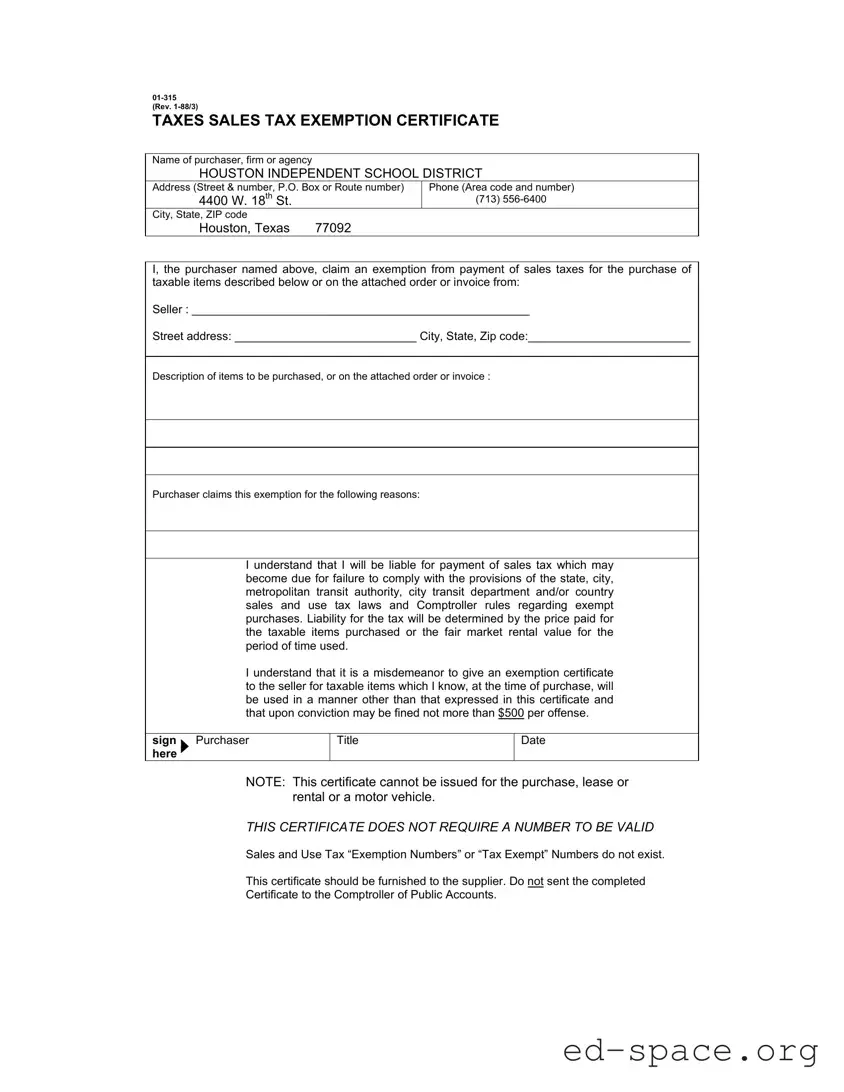
The Texas Sales Tax Exemption Certificate form is a crucial document for certain purchasers who seek to avoid paying sales tax on specific items. This form, identified as 01-315, allows entities such as schools, government agencies, and non-profit organizations to claim an exemption when making eligible purchases. Key details required on the form include the name of the purchaser, their address, and contact information. Additionally, it necessitates the seller's information and a description of the items being purchased. The purchaser must also provide a reason for the exemption claim, affirming their understanding of the legal responsibilities that accompany this exemption. Notably, the form emphasizes that it cannot be used for the purchase, lease, or rental of motor vehicles. Importantly, this certificate does not require a number to be valid, as “Exemption Numbers” do not exist in this context. Instead, it should be presented to the supplier, and there is no need to submit it to the Comptroller of Public Accounts.
Document Preview

01-315
(Rev. 1-88/3)
TAXES SALES TAX EXEMPTION CERTIFICATE
Name of purchaser, firm or agency
HOUSTON INDEPENDENT SCHOOL DISTRICT
Address (Street & number, P.O. Box or Route number)
4400 W. 18
th
St.
Phone (Area code and number)
(713) 556-6400
City, State, ZIP code
Houston, Texas 77092
I, the purchaser named above, claim an exemption from payment of sales taxes for the purchase of
taxable items described below or on the attached order or invoice from:
Seller : ____________________________________________________
Street address: ____________________________ City, State, Zip code:_________________________
Description of items to be purchased, or on the attached order or invoice :
Purchaser claims this exemption for the following reasons:
I understand that I will be liable for payment of sales tax which may
become due for failure to comply with the provisions of the state, city,
metropolitan transit authority, city transit department and/or country
sales and use tax laws and Comptroller rules regarding exempt
purchases. Liability for the tax will be determined by the price paid for
the taxable items purchased or the fair market rental value for the
period of time used.
I understand that it is a misdemeanor to give an exemption certificate
to the seller for taxable items which I know, at the time of purchase, will
be used in a manner other than that expressed in this certificate and
that upon conviction may be fined not more than $500
per offense.
sign Purchaser
here
Title Date
NOTE: This certificate cannot be issued for the purchase, lease or
rental or a motor vehicle.
THIS CERTIFICATE DOES NOT REQUIRE A NUMBER TO BE VALID
Sales and Use Tax “Exemption Numbers” or “Tax Exempt” Numbers do not exist.
This certificate should be furnished to the supplier. Do not
sent the completed
Certificate to the Comptroller of Public Accounts.

Form Specifications

Fact Name Fact Description
Form Number The Texas Sales Tax Exemption Certificate is designated as form number 01-315.
Revision Date This form was last revised in January 1988.
Governing Law The use of this certificate is governed by Texas Tax Code, Chapter 151.
Eligible Purchasers Entities such as schools, government agencies, and certain nonprofit organizations can use this certificate.
Exemption Reasons The purchaser must specify the reason for claiming the exemption on the form.
Liability for Tax If the exemption is misused, the purchaser is liable for the unpaid sales tax.
Misdemeanor Penalty Providing a false exemption certificate can result in a misdemeanor charge and fines up to $500.
No Exemption Number This certificate does not require an exemption number to be valid.
Submission Guidelines The completed certificate should be given to the seller, not sent to the Comptroller of Public Accounts.
Restrictions This certificate cannot be used for the purchase, lease, or rental of a motor vehicle.

Texas Sales Tax Exemption Certificate: Usage Guidelines

Completing the Texas Sales Tax Exemption Certificate form is straightforward. This certificate allows certain purchasers to claim an exemption from sales tax for specific purchases. Follow the steps below to fill out the form correctly.

  1. Begin by entering the name of the purchaser, firm, or agency in the designated space.
  2. Next, fill in the address with the street number, P.O. Box, or route number.
  3. Provide a phone number with the area code.
  4. Fill in the city, state, and ZIP code where the purchaser is located.
  5. In the section for the seller's information, write the seller's name.
  6. Complete the street address, city, and ZIP code of the seller.
  7. Describe the items to be purchased or refer to the attached order or invoice.
  8. State the reason for claiming the exemption.
  9. Sign the form as the purchaser, and include your title and date of signing.

Once you have filled out the form, provide it to the supplier. Remember, do not send the completed certificate to the Comptroller of Public Accounts. Keep a copy for your records, if needed.

Your Questions, Answered

What is the Texas Sales Tax Exemption Certificate form used for?

The Texas Sales Tax Exemption Certificate form allows eligible purchasers, such as schools or non-profit organizations, to claim an exemption from sales tax on specific purchases. This certificate is presented to sellers to confirm that the buyer is exempt from paying sales tax for the items listed on the form. It is important to accurately complete this form to ensure compliance with state tax laws.

Who can use the Texas Sales Tax Exemption Certificate?

The certificate can be used by certain entities, such as government agencies, schools, and non-profit organizations. For example, the Houston Independent School District can utilize this form to make tax-exempt purchases. However, it is essential to note that the certificate cannot be used for the purchase, lease, or rental of motor vehicles.

How should the Texas Sales Tax Exemption Certificate be completed?

To complete the certificate, fill in the purchaser's name, address, and phone number. Specify the seller’s information, including their address. Clearly describe the items being purchased or attach an order or invoice. The purchaser must also indicate the reason for claiming the exemption. Finally, the purchaser must sign and date the form. Remember, this certificate does not require a number to be valid.

What are the consequences of misusing the Texas Sales Tax Exemption Certificate?

Misusing the certificate can lead to serious consequences. If a purchaser provides the exemption certificate for items they know will not be used as stated, they may face legal repercussions. This is considered a misdemeanor and can result in a fine of up to $500 per offense. It's crucial to use the certificate only for eligible purchases to avoid any liabilities.

Common mistakes

  1. Incorrectly Filling Out the Purchaser's Information: Many people forget to include the full name of the purchaser, firm, or agency. This can lead to confusion and may invalidate the exemption.

  2. Missing or Incorrect Address: Providing an incomplete or incorrect address can create issues. Ensure that the street address, city, state, and ZIP code are all accurate.

  3. Not Specifying the Seller's Information: Failing to list the seller's name and address is a common mistake. This information is crucial for the exemption to be valid.

  4. Omitting Item Descriptions: It's essential to describe the items being purchased. Leaving this section blank or providing vague descriptions can lead to complications.

  5. Ignoring the Reason for Exemption: You must clearly state the reason for claiming the exemption. Not doing so can result in the exemption being denied.

  6. Failing to Sign and Date the Certificate: A signature and date are required for the certificate to be valid. Forgetting this step can render the entire document useless.

Documents used along the form

The Texas Sales Tax Exemption Certificate is an essential document for entities seeking to make tax-exempt purchases. However, several other forms and documents often accompany this certificate to ensure compliance with state tax laws and to provide clarity in transactions. Below is a list of these documents, along with a brief description of each.

  • Texas Resale Certificate: This document allows businesses to purchase goods tax-free with the intent of reselling them. It confirms that the purchaser is a retailer and will not use the items for personal consumption.
  • Form 01-339 - Texas Sales Tax Exemption Certificate for Educational Institutions: Specifically designed for educational institutions, this form verifies their status and allows them to claim exemptions on purchases related to their educational activities.
  • Form 01-330 - Texas Sales Tax Exemption Certificate for Nonprofit Organizations: Nonprofit organizations can use this certificate to purchase goods without paying sales tax, provided the items are used for their exempt purposes.
  • Purchase Order: This document outlines the details of a purchase transaction, including the items being bought, quantities, and agreed prices. It serves as a formal agreement between the buyer and seller.
  • Invoice: An invoice is a bill sent by the seller to the buyer, detailing the products or services provided, their costs, and payment terms. It is often used alongside the exemption certificate to validate tax-exempt purchases.
  • Exemption Affidavit: This sworn statement may be required by some sellers to confirm that the buyer qualifies for a tax exemption, providing additional legal backing for the exemption claim.
  • Sales Tax Permit: Businesses must obtain this permit from the state to collect sales tax. It can be helpful in verifying that the purchaser is authorized to make tax-exempt purchases.
  • Tax Exempt Status Letter: This letter, often issued by the IRS or a state tax authority, confirms an organization's tax-exempt status and may be requested by sellers to support the exemption claim.

Understanding these documents can streamline the purchasing process and help ensure compliance with Texas sales tax regulations. By having the right forms on hand, businesses and organizations can avoid unnecessary tax liabilities and focus on their core activities.

Similar forms

The Texas Sales Tax Exemption Certificate form is similar to several other documents used for tax exemption purposes across various states and contexts. Here are nine documents that share similarities:

  • California Resale Certificate - This document allows businesses in California to purchase goods without paying sales tax, provided those goods are intended for resale.
  • New York Exempt Organization Certificate - Used by non-profit organizations in New York, this certificate exempts them from sales tax on purchases related to their charitable activities.
  • Florida Sales Tax Exemption Certificate - This form is issued to exempt certain entities, such as government agencies and non-profits, from paying sales tax in Florida.
  • Illinois Sales Tax Exemption Certificate - Similar to Texas, this certificate allows eligible purchasers in Illinois to claim exemption from sales tax for specific purchases.
  • Pennsylvania Exempt Use Certificate - This document is used in Pennsylvania to exempt certain purchases from sales tax, particularly for manufacturing and industrial purposes.
  • Virginia Sales and Use Tax Exemption Certificate - This certificate allows qualifying organizations in Virginia to make tax-exempt purchases for specific purposes.
  • Ohio Sales Tax Exemption Certificate - This document is used by exempt organizations in Ohio to purchase items without incurring sales tax.
  • Georgia Sales Tax Exemption Certificate - This form is issued to certain entities in Georgia, allowing them to make tax-exempt purchases for specific uses.
  • Michigan Sales and Use Tax Exemption Certificate - Similar to Texas, this certificate allows qualifying purchasers in Michigan to claim exemption from sales tax for eligible items.

Dos and Don'ts

When filling out the Texas Sales Tax Exemption Certificate form, it’s crucial to follow the guidelines carefully. Here are some important do's and don'ts:

  • Do provide the correct name of the purchaser, firm, or agency.
  • Do include the full address, including street number, city, state, and ZIP code.
  • Do specify the seller’s name and address accurately.
  • Do describe the items to be purchased clearly.
  • Don't use this certificate for purchasing a motor vehicle.
  • Don't leave any sections blank; complete all required fields.
  • Don't submit the certificate to the Comptroller of Public Accounts.
  • Don't provide false information or use the certificate if you know the items will be used differently.

Following these guidelines will help ensure that your exemption certificate is valid and properly processed. Take the time to review your entries before submission.

Misconceptions

Understanding the Texas Sales Tax Exemption Certificate is crucial for anyone involved in purchasing goods exempt from sales tax. However, several misconceptions can lead to confusion and potential legal issues. Here are six common misconceptions:

  • Exemption certificates are only for certain types of buyers. Many believe that only specific organizations, like non-profits or government entities, can use these certificates. In reality, any qualifying purchaser can claim an exemption if they meet the criteria.
  • Sales tax exemption certificates require a special number. Some think that a unique exemption number is necessary for the certificate to be valid. However, this is not true. The Texas Sales Tax Exemption Certificate does not require a number to be valid.
  • The certificate must be submitted to the Comptroller's office. There is a common belief that completed certificates need to be sent to the Comptroller of Public Accounts. In fact, the certificate should be given directly to the supplier and not submitted to any government office.
  • All purchases made with the certificate are tax-exempt. Many assume that once they present the certificate, all purchases will be exempt. This is misleading. The exemption only applies to items specified in the certificate and for the reasons stated.
  • Using the certificate for non-qualifying items is harmless. Some individuals think that using the exemption certificate for items not covered by the exemption is a minor issue. This is a serious misconception. Misuse can result in fines and penalties, including a misdemeanor charge.
  • The certificate can be used for vehicle purchases. There is a belief that the exemption certificate can be applied to motor vehicle purchases. This is incorrect. The certificate explicitly states that it cannot be used for the purchase, lease, or rental of a motor vehicle.

Awareness of these misconceptions can help individuals and organizations navigate the complexities of sales tax exemptions more effectively. It is essential to understand the rules and comply with them to avoid potential liabilities.

Key takeaways

  • To claim a sales tax exemption in Texas, individuals or organizations must fill out the Texas Sales Tax Exemption Certificate form accurately. This includes providing the name of the purchaser, address, and contact information.

  • The certificate must specify the items being purchased and the reason for the exemption. This ensures clarity and compliance with tax regulations.

  • It is essential to remember that this certificate is not valid for the purchase, lease, or rental of a motor vehicle. Understanding these limitations helps avoid potential legal issues.

  • Once completed, the certificate should be given to the seller. It is important to note that there is no need to send it to the Texas Comptroller of Public Accounts for validation.