Homepage Blank Texas Reg 200 PDF Form
Content Overview

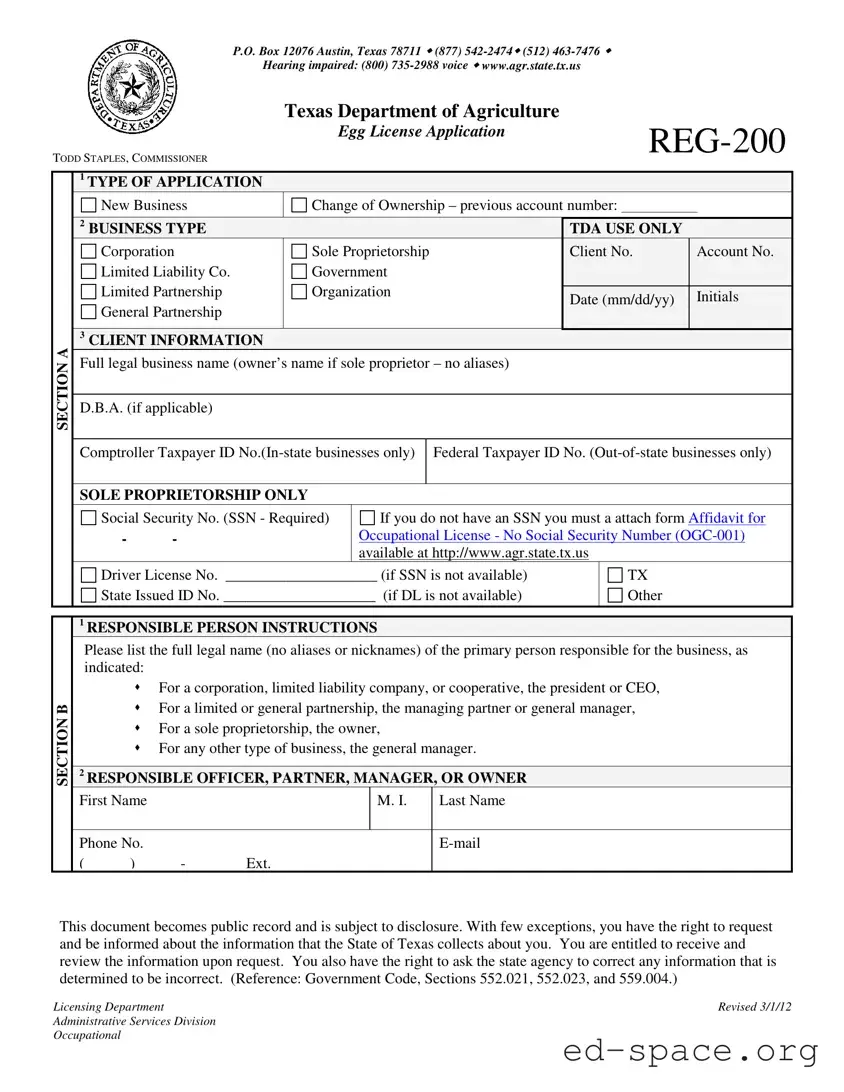
The Texas Reg 200 form is a crucial document for anyone looking to obtain an egg license in Texas, serving as the official application submitted to the Texas Department of Agriculture. This form is designed for various types of businesses, including corporations, sole proprietorships, and partnerships, and it requires detailed information about the applicant's business structure and ownership. Key sections include the type of application—whether it’s a new business or a change of ownership—and the classification of the business, such as dealer-wholesaler or processor. Applicants must provide their legal business name, taxpayer identification numbers, and contact information for responsible parties. Additionally, there are specific requirements for out-of-state applicants, who must designate a resident agent in Texas. The form also outlines fee structures based on estimated weekly volumes of egg sales, ensuring that the licensing process is tailored to the scale of operations. It is essential to complete the form accurately, as any misrepresentation could lead to denial or revocation of the license. Timely submission of the form, along with the required fees, is vital to avoid delays in processing and to maintain compliance with state regulations.
Document Preview

P.O. Box 12076 Austin, Texas 78711
(877) 542-2474
(512) 463-7476
Hearing impaired: (800) 735-2988 voice
www.agr.state.tx.us
This document becomes public record and is subject to disclosure. With few exceptions, you have the right to request
and be informed about the information that the State of Texas collects about you. You are entitled to receive and
review the information upon request. You also have the right to ask the state agency to correct any information that is
determined to be incorrect. (Reference: Government Code, Sections 552.021, 552.023, and 559.004.)
Licensing Department Revised 3/1/12
Administrative Services Division
Occupational
T
ODD
S
TAPLES
, C
OMMISSIONER
Texas Department of Agriculture
Egg License Application
1
TYPE OF APPLICATION
New Business Change of Ownership – previous account number:
2
BUSINESS TYPE TDA USE ONLY
Client No.
Account No.
Corporation
Limited Liability Co.
Limited Partnership
General Partnership
Sole Proprietorship
Government
Organization
Date (mm/dd/yy)
Initials
3
CLIENT INFORMATION
Full legal business name (owner’s name if sole proprietor – no aliases)
D.B.A. (if applicable)
Comptroller Taxpayer ID No.(In-state businesses only)
Federal Taxpayer ID No. (Out-of-state businesses only)
SOLE PROPRIETORSHIP ONLY
Social Security No. (SSN - Required)
- -
If you do not have an SSN you must a attach form Affidavit for
Occupational License - No Social Security Number (OGC-001)
available at http://www.agr.state.tx.us
SECTION A
Driver License No. ____________________ (if SSN is not available)
State Issued ID No. ____________________ (if DL is not available)
TX
Other
1
RESPONSIBLE PERSON INSTRUCTIONS
Please list the full legal name (no aliases or nicknames) of the primary person responsible for the business, as
indicated:
 For a corporation, limited liability company, or cooperative, the president or CEO,
 For a limited or general partnership, the managing partner or general manager,
 For a sole proprietorship, the owner,
 For any other type of business, the general manager.
2
RESPONSIBLE OFFICER, PARTNER, MANAGER, OR OWNER
First Name
M. I.
Last Name
SECTION B
Phone No.
(
-
Ext.
E-mail
REG
-
200
REG-200 Egg License Application Page 2 of 4
Legal Business Name ______________________________
Licensing Department Revised 3/1/12
Administrative Services Division
Occupational
1
PERSON TO CONTACT FOR LICENSE-RELATED MATTERS
First Name
M. I.
Last Name
Primary Phone
( ) - Ext.
Secondary Phone (optional)
( ) - Ext.
Fax (optional)
( ) - Ext.
E-mail Address
***Important Note*** I understand that my email address is required for the Texas Department of Agriculture to keep me
informed of critical information, including licensing and regulatory updates; renewal invoices; and other important
communications. Failure to provide an email address may result in my not receiving time-sensitive information that could
affect my compliance with state regulations, thereby, resulting in monetary penalties.
2
MAILING ADDRESS
Address
SECTION C
City
State
Zip
1
FACILITY INFORMATION
Facility Name
2
PHYSICAL ADDRESS OF LOCATION OF LICENSEE, LICENSED ACTIVITIES OR EQUIPMENT
Address (No P.O. Box)
City
State
Zip
County
SECTION D
Directions to Physical Location if address above is difficult to find
3
RESPONSIBLE PERSON MAILING ADDRESS
Address
City
State
Zip
SEC. B (CONT’D.)
Web Address of Business (optional)
REG-200 Egg License Application Page 3 of 4
Legal Business Name ______________________________
Licensing Department Revised 3/1/12
Administrative Services Division
Occupational
1
OUT-OF-STATE APPLICANTS ONLY
An applicant for an Egg license whose principal place of business is situated outside the State of Texas must
appoint and designate a resident citizen of Texas as said applicant’s resident agent within Texas. This information
is REQUIRED if the address provided in Section C is out of state.
Who do you wish to designate as resident agent? The Texas Secretary of State Other (list below)
Resident Agent Name
Resident Agent Address
SECTION E
City
Zip
Business Phone
( ) -
1
BUSINESS CLASSIFICATION
SEC. F
Dealer-Wholesaler – Complete Section G, #1
Processor – Complete Section G, #2
Broker ($420) – Please skip to Section H
Retailers selling eggs directly to consumers are not
required to obtain a license.
1
DEALER-WHOLESALER CLASS
Are you a packer? Yes No
If yes, please provide USDA Plant No. (if applicable) ________________________
Estimated Average Weekly Volume (check only one)
Class 1 ($20) – 1 case (30 dozen eggs) or more, but less than 10 cases
Class 2 ($40) – 10 cases or more, but less than 50 cases
Class 3 ($60) – 50 cases or more, but less than 100 cases
Class 4 ($100) – 100 cases or more, but less than 200 cases
Class 5 ($180) – 200 cases or more, but less than 500 cases
Class 6 ($270) – 500 cases or more, but less than 1,000 cases
Class 7 ($360) – 1,000 cases or more, but less than 1,500 cases
Class 8 ($720) – 1,500 cases or more, but less than 3,000 cases
Class 9 ($900) – 3,000 cases or more, but less than 4,500 cases
Class 10 ($1200) – 4,500 cases or more, but less than 7,000 cases
Class 11 ($1800) – 7,000 cases or more, but less than 10,000 cases
Class 12 ($2400) – 10,000 cases or more
2
PROCESSOR CLASS
SECTION G
Estimated Average Weekly Volume (check only one)
Class 1 ($60) – Less than 250 cases per week
Class 2 ($120) – 250 cases or more, but less than 600 cases
Class 3 ($210) – 600 cases or more, but less than 1,500 cases
Class 4 ($420) – 1,500 cases or more
REG-200 Egg License Application Page 4 of 4
Legal Business Name ______________________________
Licensing Department Revised 3/1/12
Administrative Services Division
Occupational
1
PAYMENT
Please see instructions for applicable fees.
REGISTRATION IS NOT VALID UNTIL APPROVED BY TDA.
Method of Payment (payable to Texas Department of Agriculture)
Check # Cashier’s Check # Money Order #
Amount remitted
$
Mail to: Texas Department of Agriculture
P.O. Box 12076, Austin, TX 78711-2076
SECTION H
TDA USE ONLY
Receipt No. Date Receipt Issued
1
SIGNATURE
The applicant, by and through their personal or agent's signature below (1) certifies that all information provided in
connection with this application at any time is true and correct to the best of the applicant's knowledge; (2)
acknowledges that any misrepresentation or false statement made by the applicant, or an authorized agent of the
applicant, in connection with this application, whether intentional or not, will constitute grounds for denial,
revocation, or non-renewal of any license issued pursuant to this application and/or assessment of monetary
administrative penalties; and (3) if applying as an individual, further acknowledges that this application may be
denied and that any license issued pursuant to this application may be suspended, revoked, or denied renewal due
to delinquency in payment of a guaranteed student loan and that any license issued pursuant to this application may
be suspended or denied renewal for failure to pay child support. If signed by an agent (including employee) of the
applicant, the person signing certifies that he or she is authorized to make the preceding certifications on behalf of
the applicant.
Applicant Name
Title
SECTION I
Applicant Signature Date / /
month day year
1
CHECKLIST
Please use this checklist to ensure you are sending all of the necessary information and documents.
Egg License Application
Fee (see instructions for assistance with calculating the correct fee.)
SECTION J
Please note that an incomplete application may result in processing delays.

Form Specifications

Fact Name Details
Purpose of Form The Texas REG-200 form is used to apply for an Egg License through the Texas Department of Agriculture.
Governing Law This form is governed by the Texas Agriculture Code, Chapter 12, which regulates the licensing of egg producers and distributors.
Public Disclosure Information submitted on the REG-200 form becomes public record and may be disclosed, as outlined in Government Code Sections 552.021, 552.023, and 559.004.
Application Types Applicants can select from various types of applications, including New Business or Change of Ownership, indicating their specific needs on the form.

Texas Reg 200: Usage Guidelines

Completing the Texas Reg 200 form is essential for individuals or businesses seeking to apply for an egg license in Texas. The process involves providing detailed information about the applicant, the business, and the specific licensing requirements. Following these steps will help ensure that the application is filled out accurately and completely.

  1. Begin by indicating the type of application in Section A. Choose either "New Business" or "Change of Ownership" and provide the previous account number if applicable.
  2. In Section B, select the business type from the options provided: Corporation, Sole Proprietorship, Limited Liability Company, Government, Limited Partnership, or General Partnership.
  3. Fill out the client information in Section C. Enter the full legal business name, "Doing Business As" (D.B.A.) if applicable, and the appropriate Taxpayer ID numbers. If you are a sole proprietor, include your Social Security Number or the driver's license number if the SSN is not available.
  4. List the responsible person in Section D. This should be the full legal name of the primary contact for the business, along with their phone number and email address.
  5. Provide the mailing address for the responsible person in Section D. Include the street address, city, state, and zip code.
  6. In Section E, enter the facility information. Provide the facility name and the physical address where licensed activities will take place, ensuring to avoid using a P.O. Box.
  7. If applicable, designate a resident agent in Section F for out-of-state applicants. Include the name and address of the resident agent.
  8. Complete Section G based on the business classification. Specify whether you are a Dealer-Wholesaler or Processor and provide the estimated average weekly volume by checking the appropriate box.
  9. In Section H, select the payment method and enter the amount remitted. Ensure that the payment is made out to the Texas Department of Agriculture.
  10. Sign and date the application in Section I, certifying that all information is true and correct to the best of your knowledge.
  11. Finally, use the checklist in Section J to confirm that all necessary information and documents are included before submitting the application.

Your Questions, Answered

What is the Texas Reg 200 form used for?

The Texas Reg 200 form is an application for an Egg License issued by the Texas Department of Agriculture. This license is necessary for businesses involved in the egg industry, including dealers, wholesalers, and processors. It ensures that these businesses comply with state regulations regarding the sale and distribution of eggs.

Who needs to fill out the Texas Reg 200 form?

What information is required on the form?

How is the licensing fee determined?

What happens after submitting the Texas Reg 200 form?

Common mistakes

  1. Incomplete Client Information: Many applicants forget to provide complete information about their business, such as the full legal business name and taxpayer identification numbers. Ensure all required fields are filled out accurately.

  2. Incorrect Type of Business: Applicants often misclassify their business type, which can lead to delays. Double-check that you have selected the correct category, whether it be a corporation, sole proprietorship, or another type.

  3. Missing Email Address: Failure to include an email address is a common oversight. This information is crucial for receiving important updates and communications from the Texas Department of Agriculture.

  4. Signature Issues: Some applicants neglect to sign the application or provide an unauthorized signature. Make sure the application is signed by the appropriate person and that the date is included.

  5. Payment Errors: Errors in payment methods or amounts are frequent mistakes. Verify that the payment is made according to the instructions and that the correct fee is submitted.

Documents used along the form

The Texas Reg 200 form, used for applying for an Egg License, often accompanies several other important documents. Each of these documents serves a specific purpose in the licensing process and helps ensure compliance with state regulations.

  • Affidavit for Occupational License - No Social Security Number (OGC-001): This form is required for applicants who do not possess a Social Security Number. It provides an alternative means of identification for the application process.
  • Texas Secretary of State Appointment of Resident Agent Form: Out-of-state applicants must designate a resident agent in Texas. This form officially appoints a representative who can receive legal documents on behalf of the business.
  • Business Entity Formation Documents: Corporations, limited liability companies, and partnerships must submit their formation documents. These include articles of incorporation or organization, which verify the legal status of the business entity.
  • Tax Identification Number (TIN) Verification: This document confirms the business's federal and state tax identification numbers. It is essential for tax purposes and compliance with state regulations.
  • Payment Method Documentation: Applicants must provide proof of payment for the licensing fee. This can include a check, cashier’s check, or money order, which ensures that the application is processed without delays.
  • Checklist for Egg License Application: This checklist helps applicants ensure that all necessary documents are included with their submission. It serves as a guide to avoid incomplete applications that could delay processing.
  • Compliance and Regulatory Updates Acknowledgment: Applicants must acknowledge their understanding of the importance of receiving updates from the Texas Department of Agriculture. This document ensures they are informed about licensing requirements and compliance issues.

These documents collectively support the application process for an Egg License in Texas. Ensuring that all forms are correctly completed and submitted can significantly enhance the likelihood of a smooth approval process.

Similar forms

  • Texas Business License Application - Similar to the Texas Reg 200 form, this document requires information about the business structure, ownership, and contact details. Both forms aim to ensure compliance with state regulations.
  • Texas Sales Tax Permit Application - This form also collects business and owner information. It is essential for businesses selling taxable goods or services, just as the Reg 200 is crucial for egg-related businesses.
  • Texas Food Establishment Permit Application - Like the Reg 200, this application requires details about the business, including ownership and location. It ensures that food businesses meet health and safety standards.
  • Texas Alcoholic Beverage License Application - This document shares similarities in that it requires specific business information and is necessary for compliance with state laws regarding the sale of alcohol.
  • Texas Occupational License Application - Both forms require the applicant's information and business details. They serve to regulate specific industries and ensure businesses operate within legal parameters.
  • Texas Nonprofit Organization Registration - This form also demands detailed information about the organization and its leadership. It ensures that nonprofits comply with state regulations for operation.
  • Texas LLC Formation Certificate - Similar to the Reg 200, this document requires information about the business structure and ownership. It is necessary for establishing a limited liability company in Texas.
  • Texas Corporation Formation Certificate - This form also gathers essential business and owner information. It is required for forming a corporation, ensuring compliance with state business laws.
  • Texas Partnership Registration Form - Like the Reg 200, this document collects information about the partners and the business structure, ensuring that partnerships comply with state regulations.
  • Texas Assumed Name Certificate - This form, similar to the Reg 200, requires the business name and owner details. It is necessary for businesses operating under a name different from their legal name.

Dos and Don'ts

When filling out the Texas Reg 200 form, there are several important considerations to keep in mind. Here are five things you should and shouldn't do:

  • Do provide the full legal name of the business or owner without using aliases.
  • Do ensure that all required sections are completed accurately, including contact information and business type.
  • Do include an email address to receive important updates regarding licensing and compliance.
  • Do check for any required attachments, such as the Affidavit for Occupational License if applicable.
  • Do review the application for completeness before submission to avoid delays.
  • Don't skip any sections that apply to your business type; incomplete forms may lead to processing delays.
  • Don't use a P.O. Box for the physical address; a street address is required.
  • Don't forget to sign the application, as an unsigned form may be considered invalid.
  • Don't provide false information; misrepresentation can lead to denial or revocation of the license.
  • Don't ignore the payment instructions; ensure that the correct fee is included with the application.

Misconceptions

Understanding the Texas Reg 200 form can be challenging due to various misconceptions. Here are nine common misunderstandings about this important document:

  • It’s only for new businesses. Many believe the Texas Reg 200 form is exclusively for new businesses. In reality, it also accommodates changes in ownership and other updates.
  • Only large businesses need to apply. Some think that only large corporations require an egg license. However, any business involved in egg distribution must complete this form, regardless of size.
  • Retailers don’t need a license at all. While it’s true that retailers selling eggs directly to consumers do not need a license, many are unaware of the specific exemptions and requirements that apply to them.
  • Filing the form guarantees approval. Submitting the Texas Reg 200 form does not guarantee that the application will be approved. The Texas Department of Agriculture reviews all applications and may deny them based on various factors.
  • All information is confidential. Many applicants assume that all submitted information is confidential. In fact, the information becomes public record and is subject to disclosure, with few exceptions.
  • Only Texas residents can apply. Out-of-state applicants can also apply for an egg license. They must designate a resident agent in Texas to handle matters related to the license.
  • Payment is not required until approval. Some believe they can wait to make a payment until after their application is approved. However, the application process requires payment upfront, and registration is not valid until approved.
  • Providing an email address is optional. Applicants often think that they can skip the email address section. This is not true; providing an email is essential for receiving important updates and communications from the Texas Department of Agriculture.
  • Once licensed, no further action is needed. Many assume that obtaining a license is a one-time action. However, ongoing compliance with state regulations and timely renewals are necessary to maintain the license.

Being aware of these misconceptions can help streamline the application process and ensure compliance with Texas regulations. It’s always best to verify the requirements and stay informed about any changes that may affect your business.

Key takeaways

  • The Texas Reg 200 form is essential for individuals or businesses seeking an egg license from the Texas Department of Agriculture.

  • Applicants must provide accurate and complete information, including the full legal business name and the type of business entity, such as corporation or sole proprietorship.

  • It is crucial to include the Social Security Number for sole proprietors. If unavailable, an affidavit form must be attached.

  • Designating a responsible person is mandatory. This individual must be the primary contact for business-related matters.

  • Out-of-state applicants need to appoint a resident agent in Texas, ensuring compliance with state regulations.

  • Applicants should be aware of the different business classifications, as fees vary based on the volume of eggs handled.

  • Failure to provide an email address may hinder the receipt of important updates regarding licensing and compliance, leading to potential penalties.

  • Submitting the application does not guarantee approval; it must be reviewed and accepted by the Texas Department of Agriculture.