Homepage Blank Texas Psb 13 PDF Form
Content Overview

The Texas PSB 13 form plays a crucial role in the application process for individuals seeking to become licensed personal protection officers. This form is primarily concerned with the psychological and emotional health of the applicant. It requires a licensed psychologist to conduct a thorough evaluation, which includes the Minnesota Multiphasic Personality Inventory, to assess the individual’s mental fitness for the responsibilities associated with personal protection. Key components of the form include the applicant's personal information, such as name, social security number, and date of birth, along with the psychologist's declaration confirming the individual’s satisfactory emotional health. The form also mandates the psychologist to provide their contact details and license number, ensuring accountability and compliance with Texas regulations. Notably, the declaration is not considered public information and remains valid for one year unless revoked or deemed invalid. This process underscores the importance of mental health in the personal security field, ensuring that only qualified individuals are entrusted with such significant responsibilities.

Document Preview

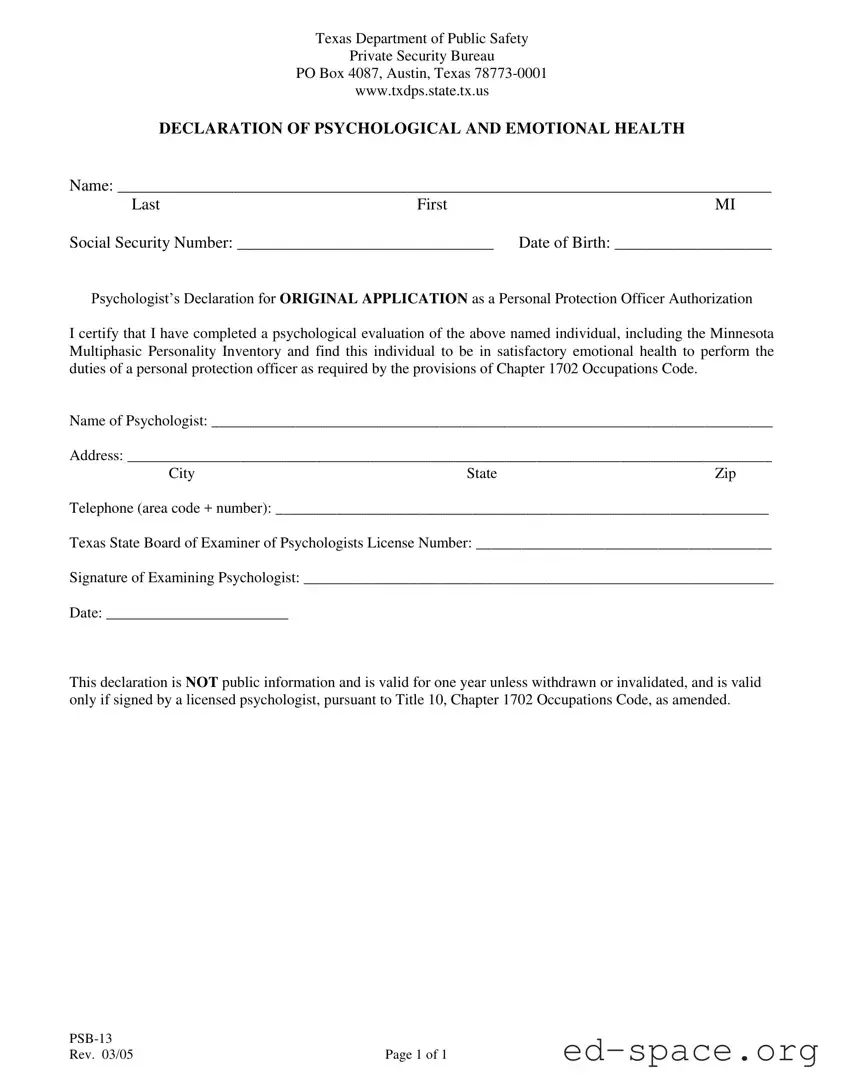
Texas Department of Public Safety
Private Security Bureau
PO Box 4087, Austin, Texas 78773-0001
www.txdps.state.tx.us
PSB-13
Rev. 03/05 Page 1 of 1
DECLARATION OF PSYCHOLOGICAL AND EMOTIONAL HEALTH
Name: _______________________________________________________________________________
Last First MI
Social Security Number: _______________________________ Date of Birth: ___________________
Psychologist’s Declaration for ORIGINAL APPLICATION as a Personal Protection Officer Authorization
I certify that I have completed a psychological evaluation of the above named individual, including the Minnesota
Multiphasic Personality Inventory and find this individual to be in satisfactory emotional health to perform the
duties of a personal protection officer as required by the provisions of Chapter 1702 Occupations Code.
Name of Psychologist: __________________________________________________________________________
Address: _____________________________________________________________________________________
City State Zip
Telephone (area code + number): _________________________________________________________________
Texas State Board of Examiner of Psychologists License Number: _______________________________________
Signature of Examining Psychologist: ______________________________________________________________
Date: ________________________
This declaration is NOT public information and is valid for one year unless withdrawn or invalidated, and is valid
only if signed by a licensed psychologist, pursuant to Title 10, Chapter 1702 Occupations Code, as amended.

Form Specifications

Fact Name Description
Purpose The Texas PSB 13 form is used to certify the psychological and emotional health of individuals applying to be personal protection officers.
Governing Law This form is governed by Title 10, Chapter 1702 of the Texas Occupations Code.
Validity The declaration is valid for one year unless it is withdrawn or invalidated.
Confidentiality The information on the PSB 13 form is not considered public information.
Psychologist Requirement The form must be signed by a licensed psychologist to be valid.

Texas Psb 13: Usage Guidelines

Completing the Texas PSB 13 form requires careful attention to detail. Ensure all information is accurate and legible. Once filled out, this form must be submitted as part of your application process.

  1. Begin by writing your name in the designated space. Include your last name, first name, and middle initial.
  2. Next, enter your Social Security Number in the appropriate field.
  3. Provide your date of birth in the specified format.
  4. In the section for the psychologist’s declaration, the psychologist must complete the evaluation. They will certify your emotional health status.
  5. The psychologist should write their name clearly in the space provided.
  6. Include the psychologist’s address, ensuring to fill in the city, state, and zip code.
  7. Record the psychologist’s telephone number with the area code.
  8. Enter the psychologist’s Texas State Board of Examiner of Psychologists License Number.
  9. The psychologist must sign the form, confirming the evaluation.
  10. Finally, the psychologist should fill in the date of their signature.

Your Questions, Answered

What is the Texas PSB 13 form?

The Texas PSB 13 form is a declaration of psychological and emotional health required for individuals applying to become personal protection officers in Texas. This form is part of the application process to ensure that candidates meet the mental health standards set forth by the Texas Department of Public Safety's Private Security Bureau.

Who needs to complete the PSB 13 form?

Individuals seeking to obtain a license as a personal protection officer must complete the PSB 13 form. This includes those applying for the original license as well as those who may need to renew their licenses, provided that their psychological evaluations are still valid.

What information is required on the PSB 13 form?

The form requires the applicant's name, Social Security number, date of birth, and the psychologist's declaration. The psychologist must provide their name, address, contact information, and license number. Additionally, the psychologist must sign and date the form to validate the evaluation.

What does the psychologist need to evaluate?

The psychologist must conduct a thorough evaluation, which includes administering the Minnesota Multiphasic Personality Inventory (MMPI). This assessment helps determine if the individual is in satisfactory emotional health to perform the duties of a personal protection officer.

How long is the PSB 13 form valid?

The PSB 13 form is valid for one year from the date it is signed by the licensed psychologist. After one year, a new evaluation is necessary to ensure ongoing compliance with mental health standards.

Is the information on the PSB 13 form public?

No, the information provided on the PSB 13 form is not considered public information. This confidentiality helps protect the privacy of individuals undergoing psychological evaluations.

What happens if the psychologist finds the individual unsatisfactory?

If the psychologist determines that the individual does not meet the emotional health requirements, the declaration will not be signed. This means the applicant cannot proceed with the licensing process until they receive a satisfactory evaluation.

Can the PSB 13 form be used for other purposes?

The PSB 13 form is specifically designed for the licensing of personal protection officers. It is not intended for other uses or professions, as the evaluation criteria are tailored to the responsibilities associated with this role.

What should I do if I need to withdraw my application?

If you decide to withdraw your application, it is advisable to notify the Texas Department of Public Safety as soon as possible. Keep in mind that the PSB 13 form becomes invalid if the application is withdrawn or if the evaluation is otherwise invalidated.

Where can I find more information about the PSB 13 form?

For additional information about the PSB 13 form and the licensing process for personal protection officers, you can visit the Texas Department of Public Safety’s website at www.txdps.state.tx.us. This site provides resources and guidance for applicants.

Common mistakes

  1. Failing to provide complete and accurate personal information. It's essential to fill in all fields, including your full name and Social Security number, without any omissions.

  2. Not including the psychologist's signature. The form must be signed by a licensed psychologist to be valid. Without this signature, the application cannot be processed.

  3. Using an unlicensed psychologist. Ensure that the psychologist conducting the evaluation holds a valid license from the Texas State Board of Examiners of Psychologists.

  4. Omitting the license number of the psychologist. This number is crucial for verifying the psychologist’s credentials and must be included on the form.

  5. Not providing the date of the evaluation. The date is important as the declaration is only valid for one year from this date.

  6. Neglecting to indicate the psychologist’s contact information. Including the address and phone number is necessary for any follow-up or verification.

  7. Submitting the form without a psychological evaluation. Ensure that the evaluation, including the Minnesota Multiphasic Personality Inventory, has been completed before submission.

  8. Forgetting to check for errors or typos. Review the entire form carefully to avoid any mistakes that could delay processing.

  9. Ignoring the confidentiality aspect of the declaration. Remember that this information is not public and must be handled appropriately.

Documents used along the form

The Texas PSB 13 form is a crucial document for individuals seeking to become licensed personal protection officers in Texas. Along with this form, several other documents are often required to ensure a comprehensive application process. Below is a list of these forms, each serving a specific purpose in the licensing journey.

  • Texas PSB 14 Form: This form is used to provide a detailed background check on the applicant. It includes personal information, employment history, and criminal history, which helps the licensing authority assess the applicant's suitability for the role of a personal protection officer.
  • Affidavit of Citizenship: This document serves to confirm the applicant's citizenship status. It is essential for verifying that the individual meets the legal requirements to work in the United States and, by extension, in a security capacity.
  • Training Certification: Applicants must submit proof of completing a state-approved training program for personal protection officers. This certification demonstrates that the individual has received the necessary education and skills to perform their duties effectively and safely.
  • Fingerprint Card: A fingerprint card is required for conducting a criminal background check. This document captures the applicant's fingerprints, which are then submitted to law enforcement agencies to ensure there are no disqualifying offenses in the applicant's history.

Each of these documents plays a vital role in the application process for becoming a personal protection officer in Texas. Ensuring that all required forms are accurately completed and submitted can facilitate a smoother and more efficient review by the licensing authority.

Similar forms

The Texas PSB 13 form, used for declaring psychological and emotional health for personal protection officers, shares similarities with several other important documents. Each of these documents serves to verify qualifications or health status in various professional contexts. Here are four documents that are similar:

  • Texas PSB 14 Form: This form is also related to the personal protection officer application process. It focuses on the applicant's criminal history and background check, ensuring that individuals meet the legal standards to serve in this capacity.
  • Texas PSB 15 Form: This document is used to report any incidents or changes in the psychological status of personal protection officers. Like the PSB 13, it emphasizes the importance of mental health in maintaining safety and security standards.
  • Psychological Evaluation Report: Often required for various professional licenses, this report assesses an individual's mental fitness for specific roles. It is similar to the PSB 13 as it also requires the evaluation to be conducted by a licensed psychologist.
  • Health Declaration Form: This form is commonly used in many professions to ensure that employees or applicants are in good health. It parallels the PSB 13 in that it aims to confirm an individual's ability to perform job duties without health-related issues.

Dos and Don'ts

When filling out the Texas PSB 13 form, it's important to pay attention to detail and follow the guidelines carefully. Here are some things you should and shouldn't do:

  • Do ensure that all personal information is accurate and complete. Double-check your name, Social Security number, and date of birth.
  • Do have a licensed psychologist complete the evaluation. This is crucial for the validity of your application.
  • Don't leave any sections blank. Every part of the form must be filled out to avoid delays in processing.
  • Don't forget to sign and date the form. An unsigned form may be rejected, leading to further complications.

By following these guidelines, you can help ensure a smoother application process for your personal protection officer certification.

Misconceptions

The Texas PSB 13 form is often misunderstood. Below is a list of common misconceptions regarding this document.

  • The PSB 13 form is only for new applicants. Many believe that this form is only required for individuals applying for the first time. In reality, it is also necessary for those renewing their personal protection officer licenses.
  • Any mental health professional can complete the form. Some individuals think that any therapist or counselor can sign the PSB 13 form. However, only a licensed psychologist can provide the required evaluation and signature.
  • The evaluation results are public information. There is a misconception that the psychological evaluation results can be accessed by the public. In fact, the declaration is not public information and is kept confidential.
  • The form is valid indefinitely once signed. Some may assume that once the PSB 13 form is signed, it remains valid forever. The truth is that it is only valid for one year unless it is withdrawn or invalidated.
  • Completion of the form guarantees approval. Many individuals believe that submitting the PSB 13 form guarantees their application will be approved. Approval is contingent on meeting all other requirements set forth by the Texas Department of Public Safety.
  • Only the applicant needs to sign the form. It is a common misconception that only the applicant's signature is necessary. The form must also be signed by the examining psychologist to be valid.
  • The Minnesota Multiphasic Personality Inventory is optional. Some may think that the psychological evaluation can be conducted without using the Minnesota Multiphasic Personality Inventory. However, this specific assessment is required as part of the evaluation process.
  • The form can be submitted without a psychologist’s address. Individuals might believe that they can submit the form without providing the psychologist’s address. In reality, the address is a required part of the documentation.
  • All psychological evaluations are the same. There is a misconception that all psychological evaluations for this form are conducted in the same manner. Each evaluation may vary based on the psychologist's approach and the specific needs of the applicant.

Key takeaways

When filling out and using the Texas PSB 13 form, keep these key takeaways in mind:

  • Purpose: The PSB 13 form is used to declare the psychological and emotional health of individuals applying to be personal protection officers.
  • Evaluation Requirement: A psychological evaluation must be conducted by a licensed psychologist, including the Minnesota Multiphasic Personality Inventory.
  • Validity: The declaration is valid for one year unless it is withdrawn or invalidated.
  • Confidentiality: This declaration is not considered public information, ensuring privacy for the individual evaluated.
  • Signature Requirement: The form must be signed by the examining psychologist to be valid.
  • Information Accuracy: Ensure all personal information, such as name and Social Security number, is filled out accurately to avoid delays.
  • Contact Information: Provide complete contact information for the psychologist, including address and phone number.
  • License Number: The psychologist’s Texas State Board of Examiner of Psychologists License Number must be included on the form.
  • Submission: Send the completed form to the Texas Department of Public Safety Private Security Bureau at the specified address.
  • Review Process: After submission, the form will be reviewed as part of the application process for becoming a personal protection officer.