Homepage Blank Texas Premarital Course Certificate PDF Form
Content Overview

When couples decide to take the important step of marriage, preparing for the journey ahead can be as crucial as the ceremony itself. The Texas Premarital Course Certificate form serves as a formal acknowledgment that a couple has completed a premarital education course designed to equip them with essential skills for a successful marriage. This certificate is not merely a piece of paper; it signifies that the couple has engaged in at least six hours of instruction covering vital topics such as conflict management, communication skills, financial responsibilities, and parenting roles. These subjects are critical in fostering a strong foundation for a lasting partnership. Furthermore, the course must be conducted by a qualified professional, whether a licensed counselor, social worker, marriage and family therapist, psychiatrist, psychologist, or a member of the clergy. The form also requires the signature of a notary public, ensuring the authenticity of the certification. By understanding the significance of this certificate, couples can better appreciate the value of the education they receive, ultimately enhancing their marital readiness and the health of their future relationship.


Document Preview

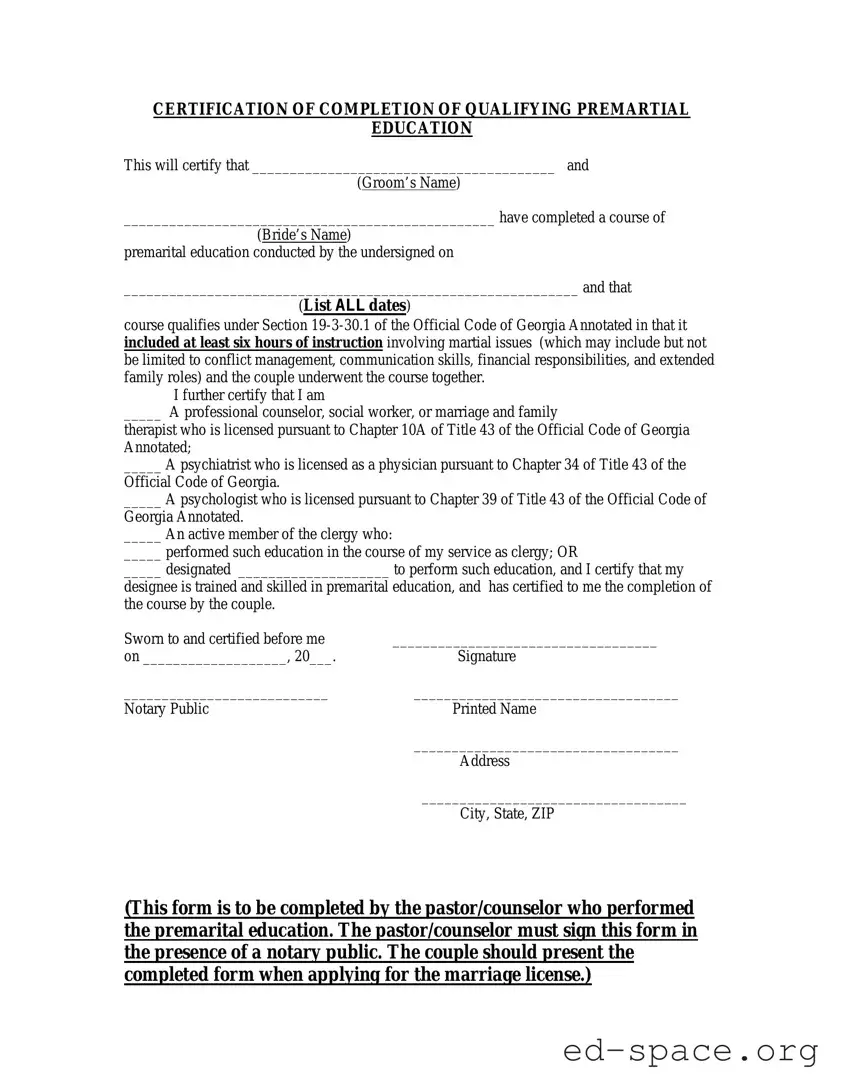
CERTIFICATION OF COMPLETION OF QUALIFYING PREMARTIAL
EDUCATION
This will certify that ________________________________________ and
(Groom’s Name)
_________________________________________________ have completed a course of
(Bride’s Name
)
premarital education conducted by the undersigned on
____________________________________________________________ and that
(
List ALL dates
)
course qualifies under Section 19-3-30.1 of the Official Code of Georgia Annotated in that it
included at least six hours of instruction involving martial issues (which may include but not
be limited to conflict management, communication skills, financial responsibilities, and extended
family roles) and the couple underwent the course together.
I further certify that I am
_____ A professional counselor, social worker, or marriage and family
therapist who is licensed pursuant to Chapter 10A of Title 43 of the Official Code of Georgia
Annotated;
_____ A psychiatrist who is licensed as a physician pursuant to Chapter 34 of Title 43 of the
Official Code of Georgia.
_____ A psychologist who is licensed pursuant to Chapter 39 of Title 43 of the Official Code of
Georgia Annotated.
_____ An active member of the clergy who:
_____ performed such education in the course of my service as clergy; OR
_____ designated ____________________ to perform such education, and I certify that my
designee is trained and skilled in premarital education, and has certified to me the completion of
the course by the couple.
Sworn to and certified before me ___________________________________
on ___________________, 20___. Signature
___________________________ ___________________________________
Notary Public Printed Name
___________________________________
Address
___________________________________
City, State, ZIP
(This form is to be completed by the pastor/counselor who performed
the premarital education. The pastor/counselor must sign this form in
the presence of a notary public. The couple should present the
completed form when applying for the marriage license.)

Form Specifications

Fact Name Description
Governing Law The Texas Premarital Course Certificate is governed by Texas Family Code, Section 2.001.
Course Duration The course must consist of at least six hours of instruction on marital issues.
Topics Covered Instruction may include conflict management, communication skills, financial responsibilities, child and parenting responsibilities, and extended family roles.
Completion Requirement The couple must complete the course together to receive certification.
Instructor Qualifications Instructors must be licensed professionals such as counselors, social workers, marriage and family therapists, psychiatrists, or psychologists.
Clergy Involvement Active members of the clergy can also conduct these courses, provided they are trained in premarital education.
Certification Process Completion of the course is certified by the instructor, who must sign and date the certificate.

Texas Premarital Course Certificate: Usage Guidelines

Completing the Texas Premarital Course Certificate form is a straightforward process that requires attention to detail. Once you have gathered the necessary information, follow these steps to ensure the form is filled out correctly.

  1. Begin by entering the names of both individuals who completed the premarital education course in the designated space.
  2. Next, fill in the date on which the course was completed.
  3. In the section that describes the course, ensure that you note the topics covered, such as conflict management, communication skills, and financial responsibilities.
  4. Identify the professional who conducted the course. This could be a licensed counselor, social worker, psychiatrist, psychologist, or clergy member. Write their name and title clearly.
  5. Confirm that the individual conducting the course is licensed or qualified as stated in the form. Provide any necessary license numbers or credentials if required.
  6. Sign the form in the designated signature area to certify the completion of the course.
  7. Have a notary public witness your signature. They will fill in their information and sign the form to validate it.
  8. Finally, ensure that the printed name, address, city, state, and ZIP code of the notary public are included.

After completing the form, you can submit it as required by your local jurisdiction or keep it for your records. Be sure to check any specific submission guidelines that may apply.

Your Questions, Answered

What is the Texas Premarital Course Certificate?

The Texas Premarital Course Certificate is an official document that certifies a couple has completed a premarital education course. This course typically covers essential topics related to marriage, such as communication skills, conflict management, financial responsibilities, and parenting roles. Completing this course can be beneficial for couples as they prepare for marriage.

Who can provide the premarital education course?

The course must be conducted by a qualified individual. This can include licensed professional counselors, social workers, marriage and family therapists, psychiatrists, psychologists, or active clergy members. These professionals are trained to address the various issues that couples may face in marriage.

How long does the premarital education course need to be?

The course must include at least six hours of instruction. This requirement ensures that couples receive comprehensive education on important marital issues. The time spent in the course allows for meaningful discussions and learning opportunities that can strengthen the couple's relationship.

What topics are typically covered in the premarital course?

Topics generally include conflict management, communication skills, financial responsibilities, child and parenting responsibilities, and the roles of extended family. These subjects are crucial for establishing a strong foundation for a successful marriage. Couples are encouraged to engage actively in discussions about these topics during the course.

Do both partners need to attend the course together?

Yes, both partners must complete the course together. This requirement emphasizes the importance of shared learning and understanding in a relationship. Attending the course as a couple allows for open dialogue and mutual exploration of the topics covered.

How do I obtain the Texas Premarital Course Certificate?

After successfully completing the course, the instructor will provide the Texas Premarital Course Certificate. This certificate serves as proof of your completion and may be required when applying for a marriage license in Texas. Be sure to keep this document in a safe place, as you may need it during the marriage application process.

Is the premarital course certificate required to get a marriage license in Texas?

While the premarital course certificate is not mandatory for obtaining a marriage license in Texas, completing the course can offer benefits. Couples who provide the certificate may qualify for a discount on their marriage license fee. Additionally, the knowledge gained can help couples navigate the challenges of marriage more effectively.

Common mistakes

  1. Incomplete Personal Information: Failing to provide full names of both individuals can lead to delays. Ensure that all fields for names are filled out completely and accurately.

  2. Missing Date of Completion: Not including the date on which the premarital course was completed can invalidate the certificate. Always double-check that the date is clearly noted.

  3. Incorrect Certification Details: The form requires specific information about the instructor's qualifications. Omitting or inaccurately stating the instructor's credentials can result in the form being rejected.

  4. Signature Issues: The absence of required signatures can lead to complications. Ensure that both the instructor and the notary public have signed the document where indicated.

  5. Failure to Include Notary Information: Not providing the notary's printed name and address can render the certificate incomplete. It is crucial to fill out this section accurately to ensure the document is legally valid.

Documents used along the form

When preparing for marriage in Texas, couples often need to complete various forms and documents alongside the Texas Premarital Course Certificate. Each of these documents serves a specific purpose in the marriage preparation process, ensuring that couples are informed and ready for the commitments ahead. Below is a list of commonly used forms that complement the Texas Premarital Course Certificate.

  • Marriage License Application: This form is required to obtain a marriage license in Texas. Couples must provide personal information, including identification and residency details, to legally marry.
  • Affidavit of Informal Marriage: This document is used when couples wish to declare their informal marriage. It outlines the couple's mutual agreement to be married without a formal ceremony.
  • Certificate of Completion of Premarital Education: Similar to the Texas Premarital Course Certificate, this document specifically verifies that a couple has completed an approved premarital education course.
  • Prenuptial Agreement: This legal contract outlines the distribution of assets and responsibilities in the event of divorce or separation. It can help clarify financial expectations before marriage.
  • Consent to Marriage: In certain situations, such as when one partner is underage, this document may be required to obtain permission from a parent or guardian to marry.
  • Notice of Confidential Marriage: This form allows couples to keep their marriage records confidential. It is particularly useful for those seeking privacy regarding their marital status.
  • Change of Name Form: If one partner intends to change their last name after marriage, this form is often required to officially document the name change.
  • Marriage Ceremony Officiant Agreement: This document outlines the responsibilities and expectations of the officiant conducting the marriage ceremony, ensuring clarity on the roles involved.
  • Postnuptial Agreement: Similar to a prenuptial agreement, this document is created after marriage and addresses financial and property matters between spouses.

Each of these documents plays a crucial role in the marriage preparation process. By understanding their purposes and requirements, couples can navigate the legal landscape of marriage more effectively, ensuring a smoother transition into their new life together.

Similar forms

  • Marriage License Application: Similar to the Texas Premarital Course Certificate, a marriage license application requires couples to provide proof of certain qualifications before they can legally marry. Both documents involve a formal process and often require signatures from authorized individuals.
  • Certificate of Completion for Parenting Classes: Like the premarital course certificate, this document certifies that individuals have completed a specific educational program. It often focuses on essential skills for parenting, including communication and conflict resolution, paralleling the skills taught in premarital education.
  • Divorce Mediation Agreement: This document outlines the terms agreed upon during mediation sessions, similar to how the premarital course certificate reflects the couple's commitment to understanding marital issues. Both documents serve as formal acknowledgments of educational processes aimed at fostering healthy relationships.
  • Affidavit of Support for Immigration: This form is required in immigration processes to affirm financial responsibility for a spouse. It shares similarities with the premarital course certificate in that both require a sworn statement and often involve a notary public, emphasizing the legal commitments made by the parties involved.

Dos and Don'ts

When filling out the Texas Premarital Course Certificate form, it is important to follow certain guidelines. Here are some dos and don’ts to keep in mind:

  • Do ensure all names are spelled correctly.
  • Do include the date the course was completed.
  • Do provide accurate information about the instructor’s qualifications.
  • Do confirm that both partners attended the course together.
  • Do sign the form in the designated area.
  • Don’t leave any sections blank unless instructed.
  • Don’t forget to include the notary’s signature if required.
  • Don’t use abbreviations for names or titles.
  • Don’t submit the form without reviewing it for accuracy.

Misconceptions

Misconceptions can often cloud the understanding of important documents like the Texas Premarital Course Certificate form. Here are six common misunderstandings about this form:

  • The certificate guarantees a successful marriage. Many people believe that completing the premarital course will ensure a happy and successful marriage. While the course provides valuable tools and knowledge, the success of a marriage ultimately depends on the couple's commitment and effort.
  • Only religious leaders can conduct the course. It's a common belief that only clergy can provide premarital education. In reality, licensed professionals such as counselors, social workers, and therapists can also conduct these courses.
  • Completion of the course is mandatory for marriage. Some couples think they must complete this course to get married in Texas. While the course offers benefits, it is not a legal requirement for marriage in the state.
  • The course content is the same everywhere. Many assume that premarital courses are uniform across Texas. However, the content can vary significantly depending on the provider, covering different topics and focusing on specific issues relevant to the couple.
  • Online courses are not valid. There is a misconception that only in-person courses are acceptable. In fact, many online premarital courses are recognized and can provide the necessary certification, as long as they meet the state's requirements.
  • Once the course is completed, no further education is needed. Some couples believe that completing the premarital course is the end of their learning journey. In truth, ongoing communication and learning about each other are essential for a lasting relationship.

Key takeaways

Filling out and using the Texas Premarital Course Certificate form is a vital step for couples planning to marry. Here are some key takeaways to keep in mind:

  • Understand the Purpose: This certificate verifies that you and your partner have completed a premarital education course, which can help strengthen your relationship.
  • Course Requirements: Ensure that the course includes at least six hours of instruction covering essential marital topics such as communication and conflict management.
  • Completion Together: Both partners must attend the course together to qualify for the certificate.
  • Qualified Instructors: The course must be conducted by a licensed professional, such as a counselor, psychologist, or clergy member, who meets specific criteria.
  • Accurate Information: Fill out the form carefully, ensuring that all names, dates, and signatures are correct to avoid any issues later.
  • Notarization Required: The certificate must be sworn to and certified before a notary public to be valid.
  • Submission for Marriage License: Present the completed and notarized certificate when applying for your marriage license to benefit from potential discounts or waivers of waiting periods.