Homepage Blank Texas Pre Authorization Request PDF Form
Content Overview

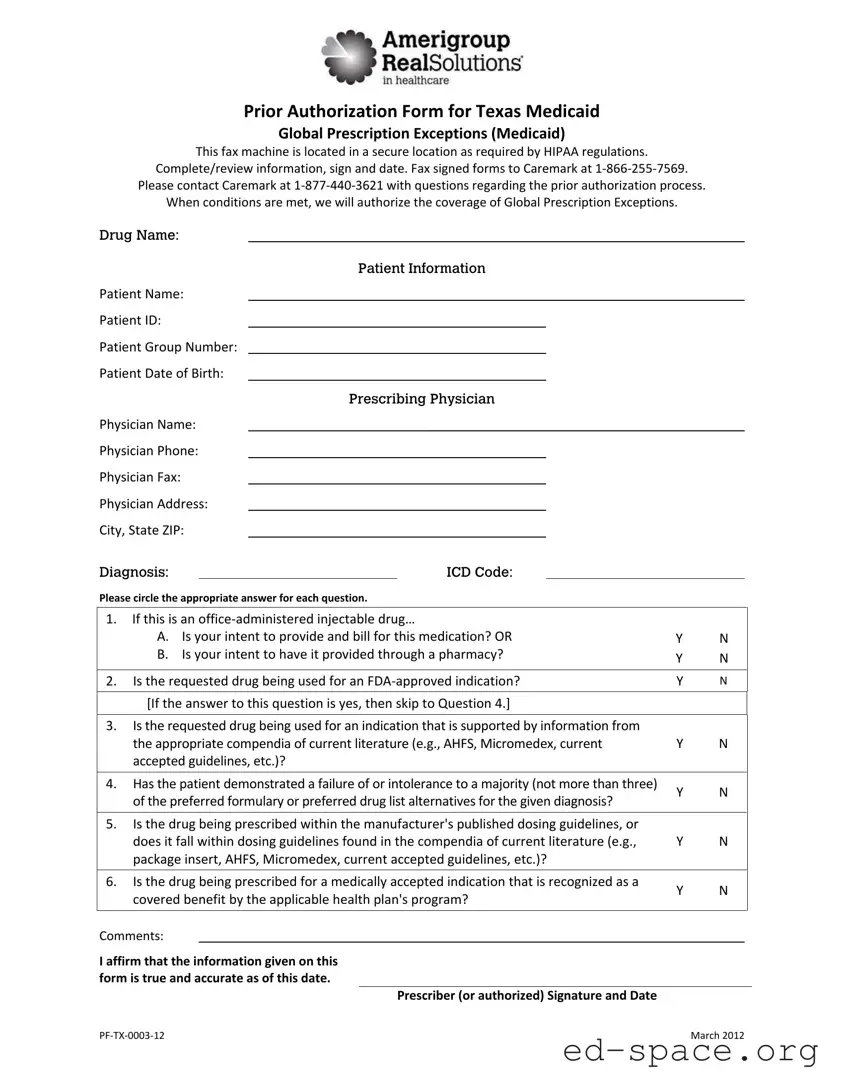
The Texas Pre Authorization Request form plays a crucial role in the Medicaid system, particularly for those seeking coverage for Global Prescription Exceptions. This form streamlines the process for healthcare providers and patients alike, ensuring that necessary medications can be accessed efficiently. It requires detailed information about the patient, including their name, ID, and date of birth, as well as the prescribing physician's contact details. Essential questions guide the prescriber in confirming whether the requested drug is appropriate, such as its FDA-approved status and alignment with established medical guidelines. The form also addresses whether the patient has tried alternative medications and if the prescribed dosage adheres to manufacturer recommendations. Completing this form accurately is vital, as it affirms the authenticity of the provided information and facilitates the authorization process when all conditions are met. Once filled out, the signed form must be faxed to Caremark, with a dedicated contact number available for any inquiries regarding the prior authorization process. Understanding this form can significantly impact patient care and access to necessary treatments.

Document Preview

PFTX000312 March2012
PriorAuthorizationFormforTexasMedicaid
GlobalPrescriptionExceptions(Medicaid)
ThisfaxmachineislocatedinasecurelocationasrequiredbyHIPAAregulations.
Complete/reviewinformation,signanddate.FaxsignedformstoCaremarkat18662557569.
PleasecontactCaremarkat18774403621withquestionsregardingthepriorauthorizationprocess.
Whenconditionsaremet,wewillauthorizethecoverageofGlobalPrescriptionExceptions.
Drug Name: 
Patient Information
PatientName:
PatientID:
PatientGroupNumber:
PatientDateofBirth:
Prescribing Physician
PhysicianName:
PhysicianPhone:
PhysicianFax:
PhysicianAddress:
City,StateZIP:
Diagnosis:
ICD Code:
Pleasecircletheappropriateanswerforeachquestion.
1. Ifthisisanofficeadministeredinjectabledrug…
A. Isyourintenttoprovideandbillforthismedication?OR
B. Isyourintenttohaveitprovidedthroughapharmacy?
Y N
Y N
2. IstherequesteddrugbeingusedforanFDAapprovedindication? Y
N
 [Iftheanswertothisquestionisyes,thenskiptoQuestion4.]
3. Istherequesteddrugbeingusedforanindicationthatissupportedbyinformationfrom
theappropriatecompendiaofcurrentliterature(e.g.,AHFS,Micromedex,current
acceptedguidelines,etc.)?
Y N
4. Hasthepatientdemonstratedafailureoforintolerancetoamajority(notmorethanthree)
ofthepreferredformularyorpreferreddruglistalternativesforthegivendiagnosis?
Y N
5. Isthedrugbeingprescribedwithinthemanufacturer'spublisheddosingguidelines,or
doesitfallwithindosingguidelinesfoundinthecompendiaofcurrentliterature(e.g.,
packageinsert,AHFS,Micromedex,currentacceptedguidelines,etc.)?
Y N
6. Isthedrugbeingprescribedforamedicallyacceptedindicationthatisrecognizedasa
coveredbenefitbytheapplicablehealthplan'sprogram?
Y N
Comments:
Iaffirmthattheinformationgivenonthis
formistrueandaccurateasofthisdate.
Prescriber(orauthorized)SignatureandDate

Form Specifications

Fact Name Description
Form Purpose This form is used to request prior authorization for Global Prescription Exceptions under Texas Medicaid.
Governing Law The form operates under Texas Medicaid regulations and is compliant with HIPAA requirements.
Submission Method Completed forms must be faxed to Caremark at the number 1‐866‐255‐7569.
Contact Information For questions regarding the prior authorization process, individuals can call Caremark at 1‐877‐440‐3621.
Patient Information The form requires essential patient details, including name, ID, group number, and date of birth.
Physician Details Prescribing physician's information, including name, phone, fax, and address, must be provided.
Verification Questions The form includes several questions to verify the medical necessity and appropriateness of the requested drug.

Texas Pre Authorization Request: Usage Guidelines

Filling out the Texas Pre Authorization Request form is a straightforward process that ensures your request for medication coverage is properly submitted. After completing the form, you will need to fax it to Caremark for review. If you have any questions during this process, Caremark's customer service is available to assist you.

  1. Obtain the Texas Pre Authorization Request form.
  2. Fill in the Drug Name at the top of the form.
  3. Provide the Patient Name, Patient ID, and Patient Group Number.
  4. Enter the Patient Date of Birth.
  5. Complete the Physician Name, Physician Phone, Physician Fax, and Physician Address sections.
  6. Fill in the City, State ZIP for the physician's office.
  7. Provide the Prescribing Physician Diagnosis and the ICD Code.
  8. Circle the appropriate answers for each of the six questions regarding the medication's use and indications.
  9. Add any necessary comments in the comments section.
  10. Sign and date the form to affirm that the information is true and accurate.
  11. Fax the signed form to Caremark at 1-866-255-7569.

Once you have submitted the form, Caremark will review it. If all conditions are met, they will authorize the coverage for the requested medication. If you have questions or need further assistance, don't hesitate to reach out to Caremark at 1-877-440-3621.

Your Questions, Answered

What is the Texas Pre Authorization Request form?

The Texas Pre Authorization Request form is a document used to obtain prior authorization for Global Prescription Exceptions under Texas Medicaid. It ensures that the requested medication is covered and meets specific criteria set by the health plan.

How do I submit the Texas Pre Authorization Request form?

Complete the form with accurate information, including patient and physician details. After signing and dating the form, fax it to Caremark at 1-866-255-7569. Ensure that all required fields are filled out to avoid delays.

What information do I need to provide on the form?

You will need to provide the patient's name, ID, date of birth, and the prescribing physician's details. Additionally, include the drug name, diagnosis, ICD code, and answers to specific questions regarding the drug's use and indications.

What should I do if I have questions about the prior authorization process?

If you have questions regarding the prior authorization process, contact Caremark at 1-877-440-3621. They can provide assistance and clarify any concerns you may have.

What happens after I submit the form?

Once the form is submitted, Caremark will review the information provided. If all conditions are met, they will authorize the coverage for the requested medication. You will be notified of the decision.

What if the requested drug is not FDA-approved?

If the requested drug is not being used for an FDA-approved indication, you must provide supporting information from recognized compendia or current literature to justify its use. This is crucial for approval.

What if the patient has not tried preferred alternatives?

It is important to demonstrate that the patient has either failed or shown intolerance to a majority of the preferred formulary alternatives. This information is critical for the approval of the requested drug.

Can I submit the form without all the required information?

No, submitting the form without complete information may result in delays or denial of the authorization request. Ensure all sections are filled out accurately before submission.

Is my information secure when submitting the form?

Yes, the fax machine used for submitting the form is located in a secure location, in compliance with HIPAA regulations. Your information is protected during the submission process.

Common mistakes

  1. Incomplete Patient Information: Failing to provide all necessary details about the patient, such as their full name, date of birth, and Patient ID, can lead to delays in processing the request.

  2. Missing Physician Details: Omitting the prescribing physician's information, including their name, phone number, and address, can result in confusion and hinder communication.

  3. Incorrect Drug Name: Writing the wrong drug name or dosage can cause significant issues. Always double-check to ensure accuracy.

  4. Neglecting to Circle Answers: Not circling “Yes” or “No” for the required questions can render the form incomplete. Each question must be answered clearly.

  5. Skipping Questions: Some individuals may overlook questions that are crucial for determining authorization. Each question is designed to gather specific information.

  6. Failing to Provide Supporting Documentation: When required, additional documentation to support the request, such as previous treatment records, should be included. This can strengthen the case for approval.

  7. Not Reviewing Before Submission: Submitting the form without a final review can lead to unnoticed errors. A quick check can save time and effort later.

  8. Ignoring Signature and Date: Forgetting to sign and date the form is a common mistake that can halt the authorization process. Always remember this crucial step.

  9. Failure to Follow Submission Instructions: Not faxing the form to the correct number or failing to follow the specific submission guidelines can lead to unnecessary delays.

Documents used along the form

The Texas Pre Authorization Request form is a crucial document for obtaining approval for specific medications under Texas Medicaid. However, it is often accompanied by other forms and documents that support the prior authorization process. Below is a list of commonly used documents that may be required alongside the Texas Pre Authorization Request form.

  • Patient Consent Form: This document ensures that the patient understands and agrees to the treatment plan and the sharing of their medical information with relevant parties.
  • Prescription Drug History: A summary of the patient's previous prescriptions, which helps to establish the patient's medication background and any past issues with medications.
  • Clinical Notes: Detailed notes from the prescribing physician that outline the patient's medical history, diagnosis, and the rationale for prescribing the requested medication.
  • Insurance Verification Form: This form confirms the patient's insurance coverage details, ensuring that the requested medication is covered under their plan.
  • ICD-10 Diagnosis Codes: A list of relevant diagnosis codes that correspond to the patient's condition, necessary for the approval process.
  • Drug Utilization Review (DUR) Form: A document that assesses the appropriateness of the prescribed medication based on the patient's health status and medication history.
  • Medication Prior Authorization Criteria: Guidelines that outline the specific criteria that must be met for the medication to be approved, helping to streamline the review process.
  • Appeal Form: If a prior authorization request is denied, this form allows the healthcare provider or patient to formally appeal the decision and provide additional information.

Understanding these forms can facilitate a smoother prior authorization process. Each document plays a significant role in ensuring that the patient's needs are met while complying with regulatory requirements.

Similar forms

The Texas Pre Authorization Request form is similar to several other documents used in healthcare and insurance processes. Each of these forms serves a specific purpose related to obtaining approval for medical services or prescriptions. Here are seven documents that share similarities with the Texas Pre Authorization Request form:

  • Prior Authorization Form for Medicare Part D: This form is used to request approval for certain medications under Medicare Part D. Like the Texas form, it requires patient information, physician details, and specific questions regarding the medication's use and necessity.
  • Prior Authorization Request for Commercial Insurance: This document is submitted to private insurance companies to gain approval for treatments or medications. It also includes patient and physician information, along with clinical questions to justify the request.
  • Medicaid Prior Authorization Request for Durable Medical Equipment (DME): Similar to the Texas form, this document is used to obtain approval for medical equipment. It requires details about the patient’s condition and the necessity of the equipment.
  • Clinical Prior Authorization Form: This form is often used by healthcare providers to request pre-approval for specific clinical services. It includes similar sections for patient and provider information, as well as clinical justification.
  • Pharmacy Benefit Management (PBM) Prior Authorization Form: This document is used to request approval for medications managed by a pharmacy benefit manager. It shares the same structure of patient and physician details and clinical questions.
  • Insurance Pre-Certification Form: This form is required for certain medical procedures or surgeries to ensure coverage. It requires similar information and clinical justification, much like the Texas Pre Authorization Request form.
  • Request for Medical Necessity Documentation: This document is used to provide evidence that a treatment or medication is necessary for a patient’s condition. It often includes similar patient and provider information and requires justification for the request.

Dos and Don'ts

When filling out the Texas Pre Authorization Request form, following certain guidelines can help ensure a smooth process. Here are ten things you should and shouldn't do:

  • Do ensure all required fields are completed accurately.
  • Don't leave any questions unanswered; each section is important.
  • Do double-check the patient's information for correctness.
  • Don't use abbreviations that might confuse the reviewer.
  • Do provide clear and concise answers to the questions.
  • Don't submit the form without a signature and date.
  • Do confirm that the drug being requested has an FDA-approved indication.
  • Don't forget to include any relevant supporting documentation.
  • Do fax the signed form to the correct number: 1‐866‐255‐7569.
  • Don't hesitate to contact Caremark at 1‐877‐440‐3621 if you have questions.

Following these guidelines can help facilitate the prior authorization process and improve the chances of approval for the requested medication.

Misconceptions

Here are five common misconceptions about the Texas Pre Authorization Request form:

  • It is only for injectable drugs. Many believe that this form is exclusively for office-administered injectable medications. In reality, it can be used for any drug that requires prior authorization under Texas Medicaid.
  • All requests will be automatically approved. Some assume that submitting the form guarantees approval. However, coverage is contingent upon meeting specific criteria outlined in the form.
  • Only physicians can submit the form. While the form requires a physician's signature, authorized representatives can also complete and submit it on behalf of the physician.
  • It can be submitted without all required information. Some think they can send the form with incomplete details. Incomplete submissions may lead to delays or denials, so it's crucial to fill out every section accurately.
  • Once submitted, no follow-up is needed. Many believe that after submitting the form, they can simply wait for a response. In fact, it’s advisable to follow up with Caremark to ensure the request is being processed.

Key takeaways

Filling out the Texas Pre Authorization Request form requires careful attention to detail. Below are key takeaways to ensure proper completion and effective use of the form.

  • Secure Submission: The form must be faxed to Caremark at 1-866-255-7569. This fax machine is located in a secure area, adhering to HIPAA regulations.
  • Contact Information: For any questions regarding the prior authorization process, individuals should reach out to Caremark at 1-877-440-3621.
  • Comprehensive Details: It is essential to fill in all required patient and physician information, including the drug name, patient ID, and physician address.
  • Diagnosis and ICD Code: The prescribing physician must provide a diagnosis along with the corresponding ICD code to substantiate the request.
  • Indication Questions: The form includes specific questions regarding the drug's use, including its FDA-approved status and whether the patient has tried preferred alternatives.
  • Affirmation of Accuracy: The prescriber must sign and date the form, affirming that all information provided is accurate as of the submission date.