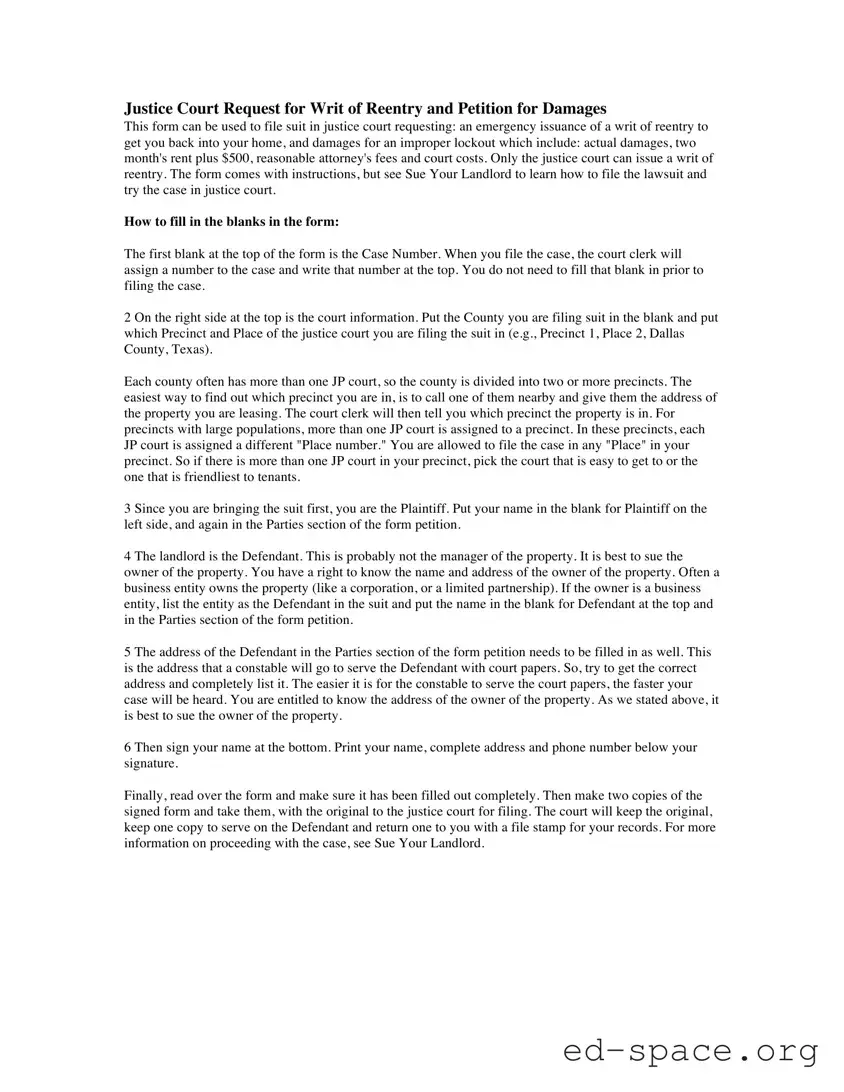
The Texas Plaintiffs Petition form is an essential tool for tenants seeking justice in cases of improper lockouts. This form allows individuals to file a lawsuit in justice court, requesting not only an emergency writ of reentry to regain access to their homes but also damages for any wrongful eviction. The damages sought can include actual losses, two months’ rent plus an additional $500, and reasonable attorney's fees along with court costs. Understanding how to fill out this form correctly is critical. It requires specific information such as the case number, which will be assigned by the court clerk upon filing, and details about the court's jurisdiction, including the county and precinct. Additionally, the form mandates that the plaintiff—typically the tenant—clearly identify themselves and the landlord, who is usually the property owner. This is crucial because the landlord is often a business entity rather than an individual. Accurate information about the defendant's address is necessary to ensure proper service of court documents. Once completed, the form must be signed, and the plaintiff should retain copies for their records. This petition serves as a vital step in protecting tenants' rights and facilitating their access to legal remedies when faced with unlawful eviction practices.



| Fact Name | Description |
|---|---|
| Purpose of the Form | This form is used to request a writ of reentry and damages for an improper lockout from your home. |
| Governing Laws | The form is governed by Sections 92.008 and 92.009 of the Texas Property Code. |
| Filing Location | You must file the petition in the justice court of the county where the property is located. |
| Plaintiff and Defendant | The person filing the suit is the Plaintiff, while the landlord or property owner is the Defendant. |
| Required Information | Complete details such as case number, Plaintiff's name, Defendant's name, and addresses are necessary for the form. |
After completing the Texas Plaintiff's Petition form, the next step involves filing it with the appropriate justice court. This process will initiate the legal proceedings regarding the request for a writ of reentry and damages. Ensure that all information is accurate and complete to avoid delays in your case.
What is the Texas Plaintiffs Petition form used for?
The Texas Plaintiffs Petition form is used to file a lawsuit in justice court. This form allows you to request an emergency writ of reentry to regain access to your home and to seek damages for an improper lockout. Damages can include actual losses, two months' rent plus $500, reasonable attorney's fees, and court costs.
How do I fill out the Case Number section?
You do not need to fill in the Case Number before filing. When you file your petition, the court clerk will assign a number to your case and write it at the top of the form.
What information do I need to provide about the court?
At the top right of the form, you need to provide the county where you are filing your suit. Additionally, include the precinct and place of the justice court. If you are unsure of your precinct, you can call a nearby JP court and provide the address of the property you are leasing. They will help you determine the correct precinct.
Who should I list as the Plaintiff and Defendant?
As the person bringing the lawsuit, you are the Plaintiff. Write your name in the Plaintiff section. The Defendant is typically the landlord, but it is best to sue the property owner directly. If the owner is a business entity, list that entity as the Defendant.
How do I ensure the Defendant receives the court papers?
You need to provide the Defendant's correct address in the Parties section of the form. This address is where a constable will go to serve the court papers. The easier it is for the constable to find the Defendant, the faster your case will move forward.
What should I do after completing the form?
After filling out the form, sign your name at the bottom. Then, print your name, complete address, and phone number below your signature. Make sure to review the form for completeness. You will need to make two copies of the signed form. Take the original and both copies to the justice court for filing.
What happens to the copies of the form I submit?
The court will keep the original form for their records. One copy will be used to serve the Defendant, and the other copy will be returned to you with a file stamp. This stamped copy serves as proof that you filed the petition.
Where can I find more information about proceeding with my case?
For additional guidance on how to proceed with your case, you can refer to the resource titled "Sue Your Landlord." This resource provides helpful information on navigating the legal process in justice court.
What types of relief can I request in my petition?
In your petition, you can request several types of relief. This includes an immediate writ of reentry, two times the monthly rent plus $500, actual damages, court costs, and any other relief that you may be entitled to under the law.
Failing to leave the Case Number blank at the top of the form. This number is assigned by the court clerk after filing.
Not providing accurate court information. Ensure you include the correct County, Precinct, and Place for the justice court.
Incorrectly identifying yourself as the Plaintiff. Make sure your name appears in both the Plaintiff section and the Parties section.
Listing the wrong party as the Defendant. It’s essential to sue the property owner, not just the property manager.
Neglecting to provide a complete and accurate address for the Defendant. This address is crucial for the constable to serve court papers.
Forgetting to sign the form. Your signature is necessary, along with your printed name, address, and phone number.
Not reviewing the form for completeness. Double-check that all sections are filled out before making copies for filing.
Failing to make the required copies. You need to take the original and two copies to the justice court for filing.
The Texas Plaintiffs Petition form is a critical document for individuals seeking legal recourse in a justice court regarding issues such as wrongful eviction. Alongside this form, several other documents are often utilized to support the case and facilitate the legal process. Below is a list of these forms and documents, each accompanied by a brief description.
Utilizing these documents in conjunction with the Texas Plaintiffs Petition form can significantly enhance the effectiveness of a legal claim. Each form plays a distinct role in the litigation process, helping to ensure that the Plaintiff's rights are protected and that the case is presented thoroughly to the court.
The Texas Plaintiffs Petition form shares similarities with several other legal documents. Here are four that are comparable:
Filling out the Texas Plaintiffs Petition form is a crucial step in seeking justice. To ensure your petition is completed correctly and efficiently, here are some important dos and don’ts to keep in mind.
By following these guidelines, you can approach the process with confidence, ensuring that your petition is properly prepared and submitted. Remember, attention to detail is key in legal matters, and taking the time to do it right can make a significant difference in the outcome of your case.
Here are some common misconceptions about the Texas Plaintiffs Petition form:
When filling out and using the Texas Plaintiffs Petition form, there are several important points to keep in mind. These takeaways will help ensure that your petition is completed accurately and effectively.
By following these key takeaways, you can navigate the process of filling out the Texas Plaintiffs Petition form with greater confidence and clarity.