Homepage Blank Texas Petition Eviction PDF Form
Content Overview

The Texas Petition Eviction form serves as a crucial legal document for landlords seeking to regain possession of their property due to non-payment of rent. This form initiates the eviction process by allowing the plaintiff, typically the landlord, to outline the specific grounds for eviction and request a judgment from the court. Essential components of the form include the identification of the parties involved, including the plaintiff and defendant, as well as the precise location of the rental property. The form also addresses whether the plaintiff is seeking a monetary judgment for unpaid rent, detailing the amount owed and the payment period in question. Furthermore, it specifies the grounds for eviction, typically centered on the defendant's failure to adhere to the rental agreement. The plaintiff may also request various forms of relief, including attorney’s fees and post-judgment interest, thereby ensuring that all potential costs associated with the eviction process are accounted for. Lastly, the form includes provisions for the service of citation, ensuring that the defendant is properly notified of the legal action being taken against them. By carefully completing this form, landlords can navigate the complexities of eviction law in Texas with greater clarity and efficiency.
Document Preview

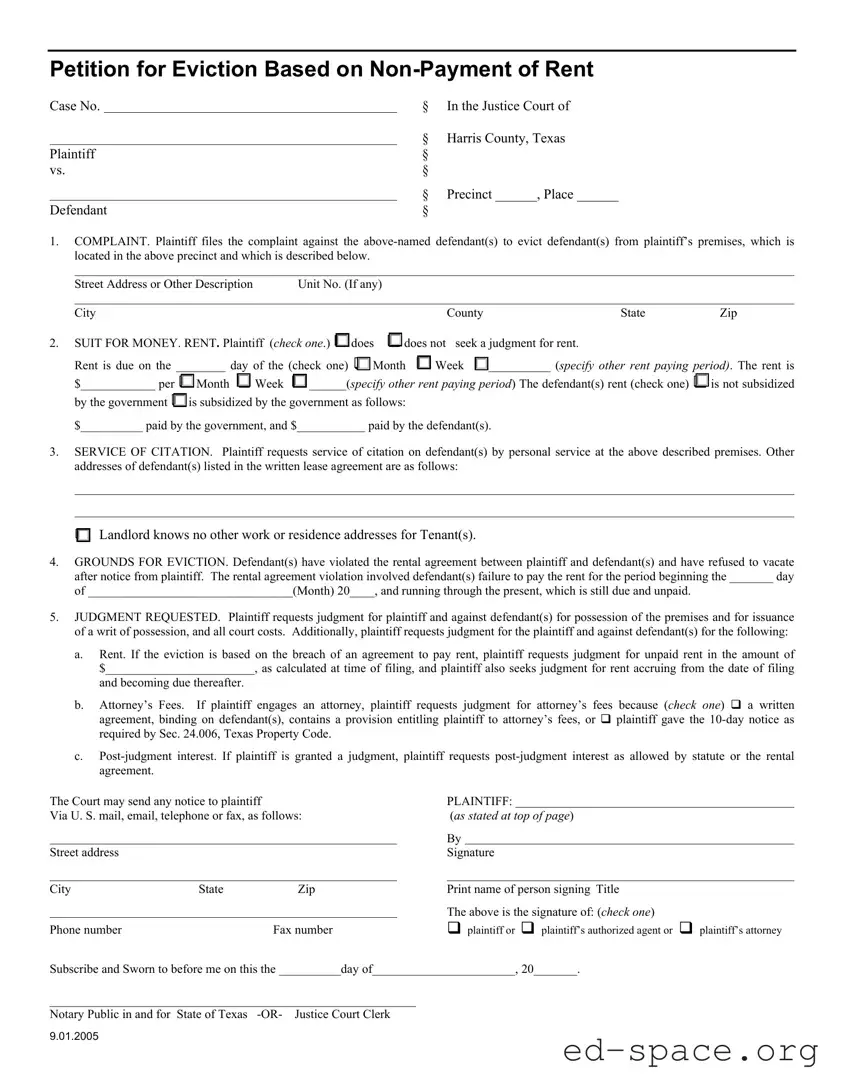
9.01.2005
Petition for Eviction Based on Non-Payment of Rent
Case No. § In the Justice Court of
§ Harris County, Texas
Plaintiff §
vs. §
§ Precinct ______, Place ______
Defendant §
1. COMPLAINT. Plaintiff files the complaint against the above-named defendant(s) to evict defendant(s) from plaintiff’s premises, which is
located in the above precinct and which is described below.
Street Address or Other Description Unit No. (If any)
City County State Zip
2. SUIT FOR MONEY. RENT. Plaintiff (check one.)
does does not seek a judgment for rent.
Rent is due on the ________ day of the (check one)
Month Week __________ (specify other rent paying period). The rent is
$____________ per Month Week ______(specify other rent paying period) The defendant(s) rent (check one) is not subsidized
by the government is subsidized by the government as follows:
$__________ paid by the government, and $___________ paid by the defendant(s).
3. SERVICE OF CITATION. Plaintiff requests service of citation on defendant(s) by personal service at the above described premises. Other
addresses of defendant(s) listed in the written lease agreement are as follows:
Landlord knows no other work or residence addresses for Tenant(s).
4. GROUNDS FOR EVICTION. Defendant(s) have violated the rental agreement between plaintiff and defendant(s) and have refused to vacate
after notice from plaintiff. The rental agreement violation involved defendant(s) failure to pay the rent for the period beginning the _______ day
of _________________________________(Month) 20____, and running through the present, which is still due and unpaid.
5. JUDGMENT REQUESTED. Plaintiff requests judgment for plaintiff and against defendant(s) for possession of the premises and for issuance
of a writ of possession, and all court costs. Additionally, plaintiff requests judgment for the plaintiff and against defendant(s) for the following:
a. Rent. If the eviction is based on the breach of an agreement to pay rent, plaintiff requests judgment for unpaid rent in the amount of
$________________________, as calculated at time of filing, and plaintiff also seeks judgment for rent accruing from the date of filing
and becoming due thereafter.
b. Attorney’s Fees. If plaintiff engages an attorney, plaintiff requests judgment for attorney’s fees because (check one) a written
agreement, binding on defendant(s), contains a provision entitling plaintiff to attorney’s fees, or plaintiff gave the 10-day notice as
required by Sec. 24.006, Texas Property Code.
c. Post-judgment interest. If plaintiff is granted a judgment, plaintiff requests post-judgment interest as allowed by statute or the rental
agreement.
The Court may send any notice to plaintiff PLAINTIFF:
Via U. S. mail, email, telephone or fax, as follows: (as stated at top of page)
By
Street address Signature
City State Zip Print name of person signing Title
The above is the signature of: (check one)
Phone number Fax number
plaintiff or plaintiff’s authorized agent or plaintiff’s attorney
Subscribe and Sworn to before me on this the __________day of_______________________, 20_______.
___________________________________________________________
Notary Public in and for State of Texas -OR- Justice Court Clerk

Form Specifications

Fact Name Description
Purpose of the Form The Texas Petition Eviction form is used by landlords to initiate eviction proceedings against tenants who have failed to pay rent. It outlines the complaint and the basis for eviction.
Governing Law This form is governed by the Texas Property Code, specifically Section 24.005, which details the process for evicting a tenant for non-payment of rent.
Judgment Requests Landlords can request possession of the premises, recovery of unpaid rent, attorney's fees, and post-judgment interest as part of the eviction process.
Service of Citation The form allows landlords to request service of citation on tenants by personal service at the premises, ensuring that tenants are properly notified of the eviction proceedings.

Texas Petition Eviction: Usage Guidelines

Filling out the Texas Petition Eviction form requires careful attention to detail. Each section of the form must be completed accurately to ensure the eviction process proceeds smoothly. After submitting the completed form, the next steps will involve serving the defendant and potentially attending a court hearing.

  1. Case Number: Write the case number at the top of the form, if available.
  2. Precinct and Place: Fill in the precinct and place information in the designated areas.
  3. Plaintiff Information: Enter your name (the plaintiff) in the section provided.
  4. Defendant Information: Write the name of the defendant(s) in the appropriate section.
  5. Complaint Section: Describe the premises from which you are seeking eviction, including the street address, unit number (if applicable), city, county, state, and zip code.
  6. Suit for Money: Indicate whether you seek a judgment for rent by checking the appropriate box. Specify the due date for rent and the amount owed.
  7. Subsidized Rent: State if the rent is subsidized by the government. If so, provide the amounts paid by both the government and the defendant(s).
  8. Service of Citation: Request service of citation on the defendant(s) at the premises and list any other addresses known from the lease agreement.
  9. Grounds for Eviction: Fill in the details regarding the rental agreement violation, including the date rent was due and the period of non-payment.
  10. Judgment Requested: Specify what you are requesting from the court, including possession of the premises, court costs, and any unpaid rent.
  11. Attorney’s Fees: Indicate if you are requesting attorney’s fees and check the appropriate box based on your situation.
  12. Post-Judgment Interest: State whether you are requesting post-judgment interest.
  13. Plaintiff Contact Information: Provide your contact details, including mailing address, phone number, and email address.
  14. Signature: Sign the form, print your name, and indicate your title (if applicable).
  15. Notary Public: Arrange for the form to be notarized or signed by the Justice Court Clerk, as required.

Your Questions, Answered

What is the Texas Petition Eviction form?

The Texas Petition Eviction form is a legal document used by landlords in Texas to initiate the eviction process against tenants who have failed to pay rent. This form outlines the complaint against the tenant, details the rental agreement violations, and specifies the judgment requested by the landlord. It is typically filed in the Justice Court of the appropriate precinct in Harris County, Texas.

Who can file a Texas Petition Eviction form?

Any landlord or property owner who has a valid rental agreement with a tenant can file this form. The landlord must demonstrate that the tenant has violated the terms of the lease, primarily through non-payment of rent. It is essential to ensure that all information is accurate and complete to avoid delays in the eviction process.

What information is required to complete the form?

The form requires specific details, including the names of the plaintiff (landlord) and defendant (tenant), the address of the rental property, the amount of rent due, and the time period for which rent has not been paid. Additionally, if applicable, the form should indicate whether the rent is subsidized by the government. Accurate completion of these sections is crucial for the case to proceed smoothly.

What happens after the form is filed?

Once the Texas Petition Eviction form is filed with the court, a citation will be issued to the tenant. This citation serves as a formal notice of the eviction proceedings and must be delivered to the tenant, typically through personal service. The tenant will then have a specified amount of time to respond to the complaint. If they do not respond or appear in court, the landlord may be granted a default judgment.

Can a landlord seek money judgment for unpaid rent?

Yes, the landlord can request a money judgment for unpaid rent in addition to seeking possession of the property. This request must be clearly stated in the form, including the specific amount of rent owed. If the court rules in favor of the landlord, they may also be entitled to post-judgment interest and attorney’s fees, depending on the circumstances outlined in the rental agreement.

What should a tenant do upon receiving the eviction notice?

Upon receiving the eviction notice, the tenant should review the document carefully. It is important to understand the claims made by the landlord and the timeline for responding. Tenants have the right to contest the eviction in court, and it may be beneficial to seek legal advice to navigate the process effectively. Timely action is crucial to protect their rights.

Is it necessary to have an attorney to file a Texas Petition Eviction form?

No, it is not mandatory to have an attorney to file the Texas Petition Eviction form. However, having legal representation can be advantageous, especially if the case involves complex issues or if the tenant contests the eviction. An attorney can help ensure that the form is filled out correctly and that all legal procedures are followed properly.

Common mistakes

  1. Incomplete Information: Failing to provide all necessary details, such as the full address of the rental property or the correct names of all defendants, can lead to delays or dismissals.

  2. Incorrect Dates: Entering wrong dates for the rent due or the period of non-payment can confuse the court and weaken your case.

  3. Missing Signatures: Forgetting to sign the petition or having an unauthorized person sign can invalidate the document.

  4. Improperly Checking Boxes: Misunderstanding the options available for whether rent is subsidized or if a judgment for rent is being sought can lead to incorrect filings.

  5. Failure to Specify Rent Amount: Not clearly stating the amount of unpaid rent can result in complications during the court proceedings.

  6. Ignoring Additional Claims: Overlooking the request for attorney’s fees or post-judgment interest may mean losing out on potential recoveries.

  7. Not Providing Alternate Addresses: If there are other known addresses for the defendant, failing to list them can hinder the service of citation.

  8. Omitting the Grounds for Eviction: Not clearly stating the reasons for eviction can lead to confusion and may weaken the case.

  9. Inaccurate Contact Information: Providing incorrect contact details for the plaintiff can prevent the court from reaching out for necessary communication.

  10. Neglecting to File Timely: Waiting too long to file the petition can result in missed opportunities to recover possession of the property.

Documents used along the form

The Texas Petition Eviction form is a crucial document in the eviction process, particularly for landlords seeking to reclaim their property due to non-payment of rent. Several other forms and documents often accompany this petition to ensure a comprehensive legal approach. Below is a list of commonly used forms that may be relevant in this context.

  • Notice to Vacate: This document serves as a formal request for the tenant to leave the premises. It typically outlines the reasons for eviction and provides a specified timeframe within which the tenant must vacate. This notice is usually a prerequisite before filing the eviction petition.
  • Service of Citation: This form is used to notify the tenant of the eviction lawsuit. It includes details about the court date and location, ensuring the tenant is informed and has the opportunity to respond to the claims made against them.
  • Affidavit of Service: This document verifies that the tenant was properly served with the eviction notice or citation. It includes details about how and when the service was completed, providing proof that the legal requirements were met.
  • Judgment for Possession: If the court rules in favor of the landlord, this document outlines the court's decision, granting the landlord possession of the property. It may also include details regarding any monetary judgments awarded, such as unpaid rent or legal fees.

These documents work together to facilitate the eviction process, ensuring that both landlords and tenants are aware of their rights and responsibilities. Properly preparing and filing these forms can significantly impact the outcome of an eviction case.

Similar forms

The Texas Petition Eviction form shares similarities with several other legal documents. Here are eight documents that resemble it in purpose and structure:

  • Notice to Quit: This document informs a tenant that they must vacate the premises. Like the eviction petition, it outlines the reason for termination of tenancy, often due to non-payment of rent.
  • Unlawful Detainer Complaint: This is filed in court to seek possession of a property. It details the grounds for eviction, similar to the Texas Petition Eviction form.
  • Lease Agreement: This document outlines the terms of the rental arrangement. It provides context for any disputes that may lead to eviction, just as the eviction form references violations of the lease.
  • Answer to Eviction Suit: This document allows a defendant to respond to the eviction claim. It serves a similar purpose as the eviction petition by addressing the issues raised in the initial complaint.
  • Motion for Summary Judgment: This document requests a court to rule in favor of one party without a trial. It may include similar arguments and evidence as the eviction petition.
  • Affidavit of Service: This document verifies that the eviction notice was delivered to the tenant. It is essential for proving that the tenant was informed, just as the eviction petition requires proof of service.
  • Judgment for Possession: After an eviction case, this document grants the landlord possession of the property. It reflects the outcome sought in the Texas Petition Eviction form.
  • Petition for Rent: This form is used to claim unpaid rent in court. Like the eviction petition, it seeks a legal remedy for financial issues related to the rental agreement.

Dos and Don'ts

When filling out the Texas Petition Eviction form, careful attention to detail is essential. Here are seven important dos and don’ts to keep in mind:

  • Do ensure all sections of the form are completed accurately.
  • Do provide the correct address of the rental property to avoid delays.
  • Do specify whether you are seeking a judgment for unpaid rent.
  • Do double-check the dates for the rent due and the period of non-payment.
  • Don’t leave any sections blank; incomplete forms may be rejected.
  • Don’t forget to sign the form before submitting it.
  • Don’t use legal jargon; keep your language clear and straightforward.

Following these guidelines can help ensure your petition is processed smoothly and efficiently.

Misconceptions

Understanding the Texas Petition Eviction form can be challenging, leading to several misconceptions. Here are seven common misunderstandings about this form:

  • Eviction is automatic once the form is filed. Many believe that simply filing the eviction petition guarantees an immediate eviction. However, the process involves court hearings and legal procedures that must be followed.
  • All evictions are for non-payment of rent. While non-payment is a common reason for eviction, the form can also be used for other violations of the rental agreement, such as property damage or illegal activities.
  • The landlord must provide a reason for eviction. Some think that landlords can evict tenants without justification. In reality, landlords must specify the grounds for eviction in the petition, such as failure to pay rent or violating lease terms.
  • Tenants do not have rights during the eviction process. This misconception overlooks the fact that tenants have the right to contest the eviction in court. They can present their case and defend against the claims made by the landlord.
  • The eviction process is the same in all Texas counties. While the general procedures are similar, there may be variations in local rules and practices. It is essential to be aware of the specific requirements in the county where the eviction is filed.
  • Landlords can change the locks immediately after filing. Many believe that landlords can take matters into their own hands after filing an eviction petition. However, self-help evictions are illegal, and landlords must wait for a court order to regain possession of the property.
  • Once a judgment is made, tenants cannot appeal. Some tenants think that they have no recourse after a judgment is issued. In fact, tenants may have the right to appeal the court's decision under certain circumstances.

By dispelling these misconceptions, individuals can better navigate the eviction process and understand their rights and responsibilities. Knowledge is a powerful tool in ensuring fair treatment in housing matters.

Key takeaways

Filling out and using the Texas Petition Eviction form requires careful attention to detail. Here are key takeaways to consider:

  1. Understand the Purpose: The form is used to initiate eviction proceedings against a tenant for non-payment of rent.
  2. Identify the Parties: Clearly state the names of the plaintiff (landlord) and defendant (tenant) at the top of the form.
  3. Provide Accurate Property Information: Include the complete address of the rental property, ensuring all details are correct.
  4. Specify Rent Details: Indicate whether the rent is due monthly, weekly, or under another arrangement, and specify the amount owed.
  5. Government Subsidies: If applicable, disclose any rent subsidies received by the tenant and the amounts paid by both the government and the tenant.
  6. Grounds for Eviction: Clearly state the reasons for eviction, focusing on the tenant's failure to pay rent and any relevant dates.
  7. Request for Judgment: Specify the type of judgment sought, including possession of the premises and any unpaid rent.
  8. Attorney's Fees: If applicable, indicate whether attorney's fees are being requested and the basis for that request.
  9. Service of Citation: Indicate how you wish to serve the eviction notice to the tenant, typically through personal service at the property.
  10. Final Review: Before submitting the form, ensure all information is complete and accurate to avoid delays in the eviction process.

By following these guidelines, individuals can navigate the eviction process more effectively and with greater confidence.