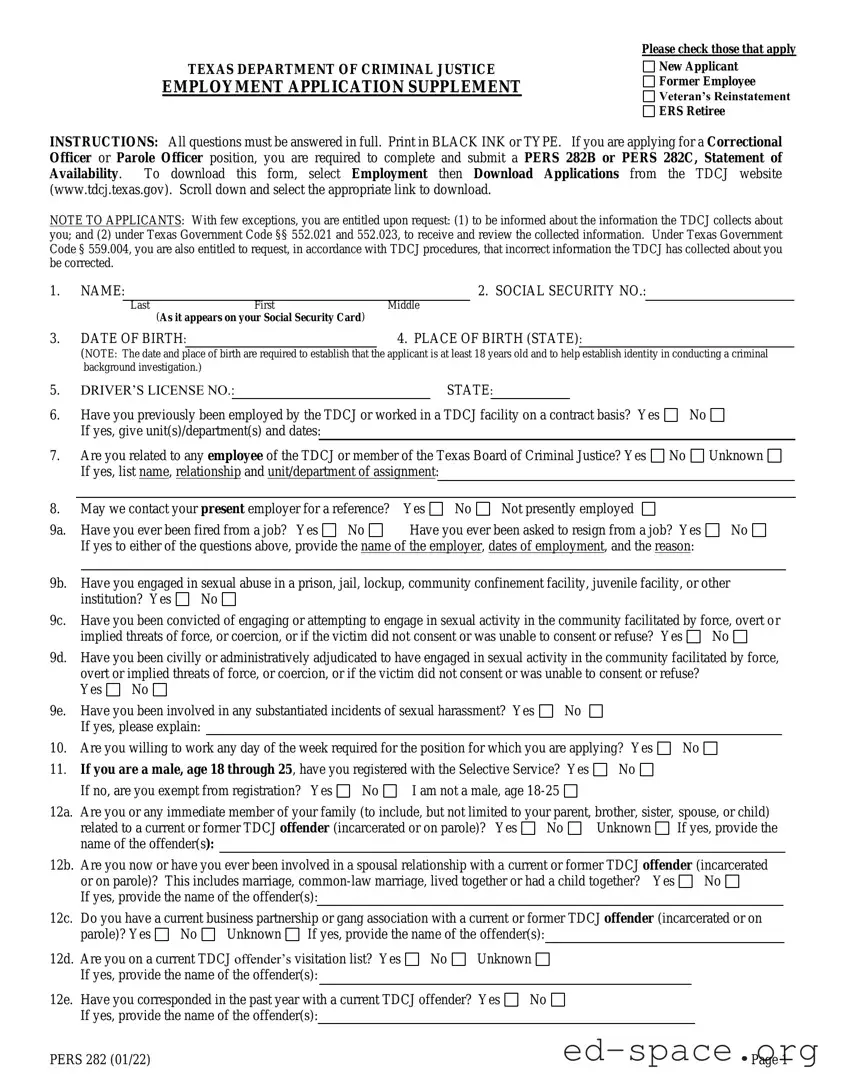
The Texas PERS 282 form serves as a critical component of the employment application process for individuals seeking positions within the Texas Department of Criminal Justice (TDCJ). This form is designed to gather essential information about applicants, including their personal details, employment history, and any potential conflicts of interest. Applicants must indicate their eligibility status, whether they are new applicants, former employees, veterans, or ERS retirees. The form also includes specific questions that assess the applicant's background, particularly regarding any previous employment with TDCJ, criminal history, and relationships with current or former offenders. Notably, those applying for correctional officer or parole officer roles must complete additional sections, such as the PERS 282B or PERS 282C, which delve into their availability and qualifications. Furthermore, the form emphasizes the importance of transparency, requiring applicants to disclose any criminal charges or convictions, as well as any affiliations that might pose a security risk. Understanding the nuances of the PERS 282 form is vital for prospective employees, as it not only sets the stage for their potential employment but also underscores the TDCJ's commitment to maintaining a safe and secure environment for both staff and offenders.




| Fact Name | Details |
|---|---|
| Governing Law | Texas Government Code §§ 552.021, 552.023, and 559.004 govern the collection and review of information by the TDCJ. |
| Application Requirement | All applicants must complete the PERS 282 form in full, using black ink or typing. |
| Additional Forms | Correctional Officer and Parole Officer applicants must submit PERS 282B or PERS 282C, Statement of Availability. |
| Age Requirement | Applicants must be at least 18 years old to be considered for employment. |
| Falsification Consequences | Providing false information on the application can lead to disqualification or termination of employment. |
| Emergency Reporting | Employees may be required to report to work during emergencies, and failure to do so can result in disciplinary action. |
Completing the Texas PERS 282 form is an essential step in the application process for positions within the Texas Department of Criminal Justice. Following the correct procedures will help ensure that your application is processed smoothly and efficiently.
After completing the form, review your responses to ensure accuracy. Submitting all required documents along with the form will facilitate the processing of your application. Be mindful of any specific instructions regarding additional forms that may be necessary based on your answers, particularly if you have connections to TDCJ offenders.
What is the Texas PERS 282 form used for?
The Texas PERS 282 form is an employment application supplement used by the Texas Department of Criminal Justice (TDCJ). It is required for individuals applying for positions within the TDCJ, including Correctional Officers and Parole Officers. The form collects essential personal information, employment history, and background details necessary for the hiring process.
How do I obtain the Texas PERS 282 form?
You can download the Texas PERS 282 form from the TDCJ website. Navigate to the Employment section, then select Download Applications. Scroll down to find the appropriate link for the PERS 282 form. Ensure you have the most recent version for your application.
What should I do if I have a criminal record?
If you have a criminal record, you must disclose this information on the PERS 282 form. You will need to provide details about any convictions, including dates, offenses, and the type of punishment received. It is important to be honest, as failing to disclose this information can result in disqualification from employment.
Are there any specific eligibility requirements for applicants?
What is the purpose of the additional forms mentioned in the PERS 282?
Additional forms, such as the PERS 282A, are required if you have a relationship with a current or former TDCJ offender. These forms provide further information about your relationship and help the TDCJ assess any potential conflicts of interest or security concerns related to your application.
Can I submit my application without all the required documents?
No, your application will not be processed without the required documents. This includes a copy of your driver’s license, Social Security card, educational credentials, and any relevant military discharge paperwork if applicable. Ensure that all documents are photocopies, as originals should not be submitted.
What happens if I provide false information on the PERS 282 form?
Providing false information on the PERS 282 form can lead to serious consequences. It is grounds for refusing employment or terminating your employment if already hired. Accuracy and honesty are crucial when filling out the application.
Is it possible to request corrections to my information after submitting the form?
Yes, under Texas Government Code, you have the right to request corrections to any incorrect information collected by the TDCJ. You must follow the established procedures to request these corrections. It is essential to keep your information up to date, especially if any changes occur after your application is submitted.
Failing to answer all questions completely. Each question on the PERS 282 form must be answered in full. Incomplete responses may lead to delays or disqualification.
Using ink colors other than black. The instructions specify that applicants must print in BLACK INK or type the form. Using other colors may result in the form being rejected.
Not providing accurate information regarding previous employment. If an applicant has previously worked for the TDCJ or in a TDCJ facility, they must list the unit(s)/department(s) and dates of employment.
Neglecting to include required documentation. Applications will not be processed without the necessary documents, such as a copy of the driver’s license and social security card.
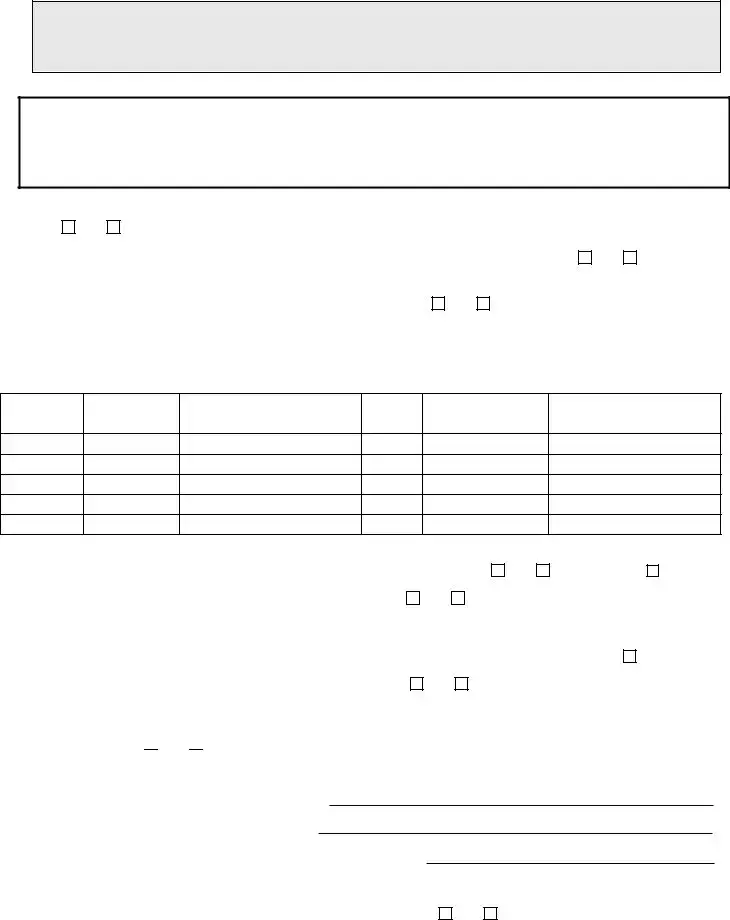
Misunderstanding the question about criminal history. Applicants must disclose any pending criminal charges and past convictions, including those that may not appear on their record.
Failing to disclose relationships with current or former TDCJ offenders. If applicable, this information must be provided, and a PERS 282A form may need to be completed.
Not reviewing the application before submission. It is essential to check for any errors or omissions. Any inaccuracies may be considered falsification, which can lead to disqualification from employment.
The Texas PERS 282 form is an essential document for applicants seeking employment with the Texas Department of Criminal Justice (TDCJ). Alongside this form, several other documents may be required or helpful during the application process. Below is a list of these documents, each accompanied by a brief description.
Being prepared with these documents can streamline the application process and enhance the chances of securing a position with the TDCJ. Ensure that all required materials are complete and accurate to avoid delays in processing your application.
When filling out the Texas PERS 282 form, it’s essential to be thorough and accurate. Here’s a list of things you should and shouldn’t do:
Following these guidelines will help ensure your application is processed smoothly. Take your time and double-check your answers before submitting the form.
This form is also applicable for former employees seeking reinstatement and veterans. It is designed to accommodate various applicant categories, ensuring all relevant information is collected.
All employment history must be disclosed, including any firings or resignations. Transparency is crucial, as failure to disclose this information can lead to disqualification.
A driver's license is still required for identification purposes, regardless of the specific job applied for. It helps establish your identity during the background check.
All applications must include required documents, such as a driver's license and Social Security card. Incomplete applications will not be processed.
While certain convictions may impact eligibility, each application is reviewed on a case-by-case basis. Factors such as the nature of the offense and the time elapsed since the conviction are considered.
Ensure that all questions on the Texas PERS 282 form are answered completely and accurately. Incomplete applications may delay processing.
Use black ink or type your responses. This ensures clarity and readability.
If applying for a Correctional Officer or Parole Officer position, be prepared to submit additional forms, specifically PERS 282B or PERS 282C.
Be aware of your rights regarding the information collected by the TDCJ. You can request to review your collected data and correct any inaccuracies.
Provide your Social Security number and date of birth as they are necessary for identity verification and background checks.
Answer questions about previous employment and any criminal history truthfully. Falsification can lead to disqualification from employment.
If you have personal relationships with TDCJ offenders, you must disclose this information and may need to complete an additional form.
Understand that you are required to report any changes in your eligibility for employment after submitting your application, such as new criminal charges.
Gather all required documents before submission. Applications lacking necessary documentation will not be processed.