Homepage Blank Texas Parking Vtr 214 PDF Form
Content Overview

The Texas Parking VTR 214 form serves as a crucial document for individuals seeking parking privileges due to disabilities. This application allows eligible persons to obtain a parking placard and/or a specialized license plate, which can significantly ease mobility challenges. To apply, individuals must submit the completed form along with proof of eligibility and payment, if applicable, to their local county tax assessor-collector’s office. The form accommodates both permanent and temporary disabilities, with no fee for permanent disability placards, while temporary ones incur a nominal charge. Specific guidelines dictate the number of placards and license plates issued based on individual circumstances. For instance, a person with a permanent disability may receive one set of plates displaying the International Symbol of Access, while those without such plates can apply for up to two placards. The application process requires careful attention to detail, including notarized signatures from licensed medical professionals, ensuring that all information provided is accurate to avoid legal repercussions. Understanding the requirements and procedures outlined in the VTR 214 form is essential for those seeking to enhance their accessibility and mobility within Texas.

Document Preview

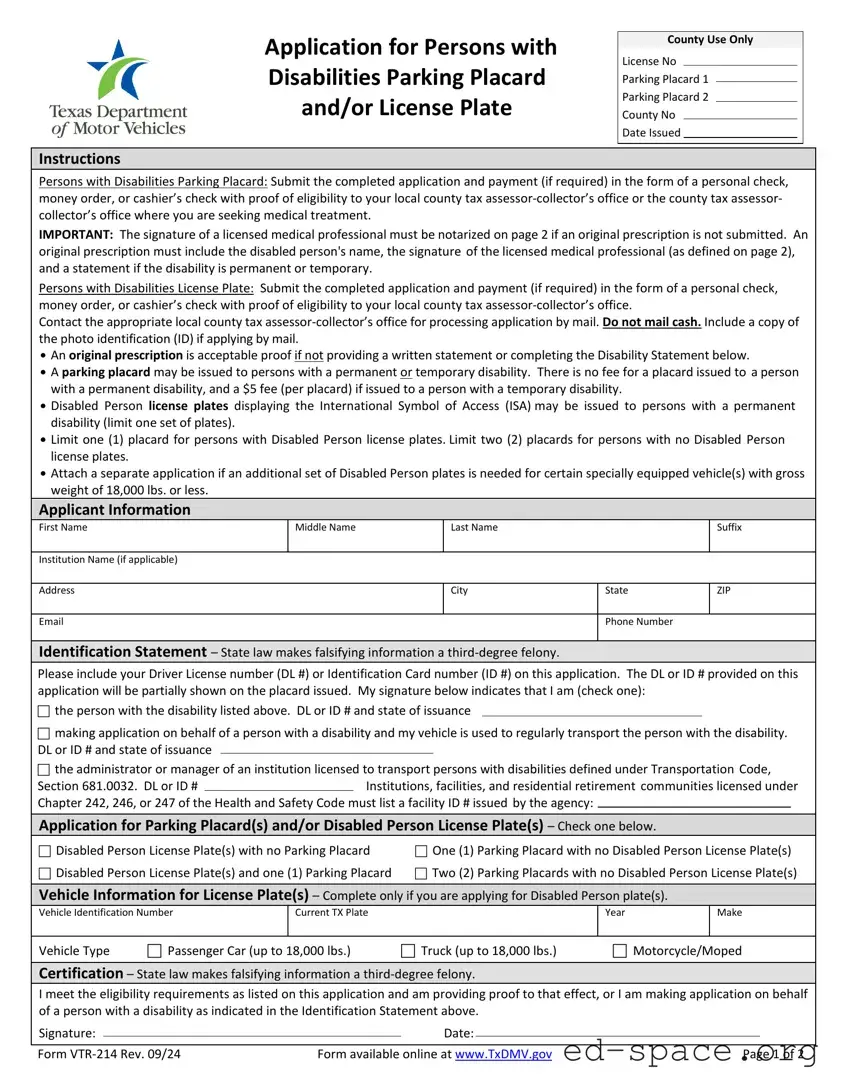
License No
Parking Placard 1
Parking Placard 2
County No
Date Issued
First Name
Middle Name
Last Name
Suffix
Institution Name (if applicable)
Address
City
State
ZIP
Phone Number
Disabled Person License Plate(s) with no Parking Placard One (1) Parking Placard with no Disabled Person License Plate(s)
Disabled Person License Plate(s) and one (1) Parking Placard Two (2) Parking Placards with no Disabled Person License Plate(s)
Vehicle Identification Number
Current TX Plate
Year
Make
Passenger Car (up to 18,000 lbs.) Truck (up to 18,000 lbs.) Motorcycle/Moped
: D
ate:
Application for Persons with
Disabilities Parking Placard
and/or License Plate
County Use Only
Instructions
Persons with Disabilities Parking Placard: Submit the completed application and payment (if required) in the form of a personal check,
money order, or cashier’s check with proof of eligibility to your local county tax assessor-collector’s office or the county tax assessor-
collector’s office where you are seeking medical treatment.
IMPORTANT: The signature of a licensed medical professional must be notarized on page 2 if an original prescription is not submitted. An
original prescription must include the disabled person's name, the signature of the licensed medical professional (as defined on page 2),
and a statement if the disability is permanent or temporary.
Persons with Disabilities License Plate: Submit the completed application and payment (if required) in the form of a personal check,
money order, or cashier’s check with proof of eligibility to your local county tax assessor-collector’s office.
Contact the appropriate local county tax assessor-collector’s office for processing application by mail. Do not mail cash. Include a copy of
the photo identification (ID) if applying by mail.
An original prescription is acceptable proof if not providing a written statement or completing the Disability Statement below.
A parking placard may be issued to persons with a permanent or temporary disability. There is no fee for a placard issued to
a person
with a permanent disability, and a $5 fee (per placard) if issued to a person with a temporary disability.
Disabled Person license plates displaying the International Symbol of Access (ISA) may be issued to persons with a permanent
disability (limit one set of plates).
Limit one (1) placard for persons with Disabled Person license plates. Limit two (2) placards for persons with no Disabled Person
license plates.
Attach a separate application if an additional set of Disabled Person plates is needed for certain specially equipped vehicle(s) with gross
weight of 18,000 lbs. or less.
Applicant Information
Identification Statement State law makes falsifying information a third-degree felony.
Please include your Driver License number (DL #) or Identification Card number (ID #) on this application. The DL or ID # provided on this
application will be partially shown on the placard issued. My signature below indicates that I am (check one):
the person with the disability listed above. DL or ID # and state of issuance
making application on behalf of a person with a disability and my vehicle is used to regularly transport the person with the disability.
DL or ID # and state of issuance
the administrator or manager of an institution licensed to transport persons with disabilities defined under Transportation Code,
Section 681.0032. DL or ID # Institutions, facilities, and residential retirement communities licensed under
Chapter 242, 246, or 247 of the Health and Safety Code must list a facility ID # issued by the agency:
Application for Parking Placard(s) and/or Disabled Person License Plate(s) Check one below.
Vehicle Information for License Plate(s) Complete only if you are applying for Disabled Person plate(s).
Vehicle Type
Certification State law makes falsifying information a third-degree felony.
I meet the eligibility requirements as listed on this application and am providing proof to that effect, or I am making application on behalf
of a person with a disability as indicated in the Identification Statement above.
Signature
Form VTR-214 Rev. 09/24 Form available online at www.TxDMV.gov Page 1 of 2
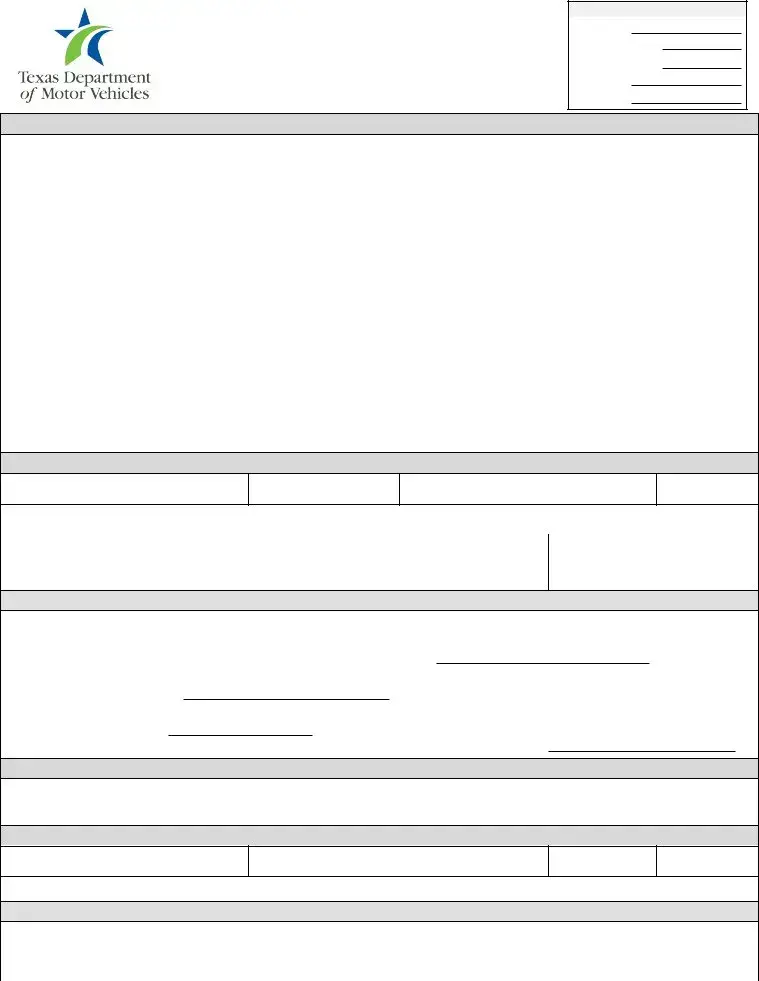
Application for Persons with Disabilities Parking Placard and/or License Plate
Definitions
Transportation Code, Section 681.001(2) defines a disability as a condition in which a person has:
(a) mobility problems that substantially impair the person's ability to ambulate;
(b) visual acuity of 20/200 or less in the better eye with correcting lenses; or
(c) visual acuity of more than 20/200 but with a limited field of vision in which the widest diameter of the visual field subtends an
angle of 20 degrees or less.
Transportation Code, Section 681.001(5) defines a mobility problem as one that substantially impairs a person's ability to ambulate, and
the person:
(a) cannot walk 200 feet without stopping to rest;
(b) cannot walk without the use of or assistance from an assistance device, including a brace, cane, crutch, another person or a
prosthetic device;
(c) cannot ambulate without a wheelchair or similar device;
(d) is restricted by lung disease to the extent that the person's forced respiratory expiratory volume for one second, measured by
spirometry, is less than one liter, or the arterial oxygen tension is less than 60 millimeters of mercury on room air at rest;
(e) uses portable oxygen;
(f) has a cardiac condition to the extent that the person's functional limitations are classified in severity as Class III or Class IV
according to standards set by the American Heart Association;
(g) is severely limited in the ability to walk because of an arthritic, neurological, or orthopedic condition;
(h) has a disorder of the foot that, in the opinion of a physician licensed to practice medicine in this state or in a state adjacent to this
state, limits or impairs the person's ability to walk; or
(i) has another debilitating condition that, in the opinion of a physician licensed to practice medicine in this state or a state adjacent
to this state, or authorized by applicable law to practice medicine in a hospital or other health facility of the Veterans
Administration, limits or impairs the person's ability to walk.
Disability Statement – To be completed by a Licensed Medical Professional.
A Licensed Medical Professional is defined as a physician, podiatrist, optometrist, or qualifying physician's assistant or advanced practice
nurse as defined in Chapter 301, Occupations Code. At least one of the following conditions must be met:
Licensed in Texas, Arkansas, Louisiana, New Mexico, or Oklahoma; or
Must practice medicine in a U.S. military installation based in Texas; or
Must practice medicine in a hospital or health facility of the U.S. Department of Veterans Affairs.
I certify that
has a
permanent
, or
Printed Name of Person with a Disability or Mobility Problem
Printed Name of Licensed Medical Professional Professional License Number Date
temp
orary disability as defined above
.
Signature of Licensed Medical Professional
Mailing Address City State Z
IP
Notary This section is only for placards and must be completed by a notary if an original prescription is not submitted.
, On this date
Date Name
State of
, County of
Notary Public
My commission expires
Date
the above named licensed medical professional
appeared before me so that I could witness his or her signature.
Form VTR-214 Rev. 09/24
Form available online at www.TxDMV.gov Page 2 of 2

Form Specifications

Fact Name Details
Purpose The VTR-214 form is used to apply for a Persons with Disabilities Parking Placard and/or License Plate in Texas.
Governing Laws This form is governed by the Texas Transportation Code, specifically Sections 681.001 and 681.0032.
Application Submission Applicants must submit the completed form and payment, if applicable, to their local county tax assessor-collector’s office.
Payment Details No fee is required for a placard issued to a person with a permanent disability; a $5 fee applies for temporary disabilities.
Identification Requirements Applicants must include a copy of their photo identification when applying by mail.
Medical Professional Signature A licensed medical professional's signature must be notarized if an original prescription is not provided.
Placard Limits One placard is allowed for those with Disabled Person license plates; up to two placards can be issued for those without.
Eligibility Criteria Eligibility includes conditions that substantially impair a person’s ability to walk, as defined in the Transportation Code.
Military Considerations Active duty U.S. military personnel may use an out-of-state Driver License or military ID number on the application.

Texas Parking Vtr 214: Usage Guidelines

Filling out the Texas Parking VTR 214 form is a straightforward process that allows individuals with disabilities to apply for parking placards or license plates. Once completed, the form must be submitted along with any necessary documentation to the appropriate county office. Below are the steps to guide you through the application process.

  1. Obtain the Form: Download the Texas Parking VTR 214 form from the Texas Department of Motor Vehicles website or visit your local county tax assessor-collector’s office to get a physical copy.
  2. Fill Out Applicant Information: Enter your first name, middle name, last name, suffix, institution name (if applicable), address, city, state, ZIP code, email, and phone number.
  3. Identification Statement: Indicate your relationship to the person with a disability by checking the appropriate box. Include your Driver License number (DL #) or Identification Card number (ID #).
  4. Select Application Type: Check one option for the type of application you are submitting: Disabled Person License Plate(s) only, one Parking Placard only, both a Disabled Person License Plate and a Parking Placard, or two Parking Placards only.
  5. Vehicle Information: If applying for a Disabled Person license plate, provide the Vehicle Identification Number (VIN), current Texas plate number, year, make, and type of vehicle.
  6. Certification: Read the certification statement carefully. Sign and date the form to confirm that you meet the eligibility requirements or are applying on behalf of someone who does.
  7. Medical Professional Section: If applicable, have a licensed medical professional complete the disability statement, including their printed name, professional license number, and signature.
  8. Notary Section: If an original prescription is not submitted, ensure the medical professional’s signature is notarized in the designated section.
  9. Prepare for Submission: Gather any required payment (personal check, money order, or cashier’s check), proof of eligibility, and a copy of your photo ID if applying by mail.
  10. Submit the Application: Send the completed form and all accompanying documents to your local county tax assessor-collector’s office or the office where you are seeking medical treatment.

Your Questions, Answered

What is the Texas Parking VTR 214 form used for?

The Texas Parking VTR 214 form serves as an application for obtaining a parking placard and/or license plate for persons with disabilities. This form is crucial for individuals who have mobility impairments or other qualifying disabilities, as it allows them to access designated parking spaces that are closer to their destinations. The form can be submitted to the local county tax assessor-collector's office and is available for both permanent and temporary disabilities.

How do I apply for a parking placard or license plate using the VTR 214 form?

To apply for a parking placard or license plate, you must complete the VTR 214 form and submit it along with the required payment. Payments can be made via personal check, money order, or cashier’s check. If you are applying for a parking placard, include proof of eligibility, which may consist of a medical professional's statement or an original prescription. Applications can be submitted in person or by mail to your local county tax assessor-collector's office. If mailing, do not send cash and ensure to include a copy of your photo identification.

What are the fees associated with the parking placard or license plate?

There is no fee for a parking placard issued to individuals with a permanent disability. However, if the placard is for a temporary disability, a fee of $5 per placard applies. For disabled person license plates, there is typically a fee involved, although the exact amount may vary based on local regulations. It’s advisable to check with your local county tax assessor-collector’s office for specific fee details.

What documentation is required to support my application?

Common mistakes

  1. Incomplete Information: Failing to fill out all required fields can delay the processing of your application. Ensure that every section, including personal details and vehicle information, is fully completed.

  2. Missing Proof of Eligibility: Not attaching the necessary documentation to prove eligibility for the parking placard or license plate is a common error. Always include the required medical documentation or proof of disability.

  3. Incorrect Payment Method: Submitting cash instead of a personal check, money order, or cashier’s check can result in your application being returned. Use only the accepted payment methods as specified.

  4. Signature Issues: Neglecting to have the medical professional's signature notarized when an original prescription is not provided can lead to rejection. Ensure that all signatures are properly completed and notarized where necessary.

  5. Improper Submission: Sending the application to the wrong county tax assessor-collector’s office can cause significant delays. Always verify that you are submitting your application to the correct office based on your location or where you seek medical treatment.

Documents used along the form

The Texas Parking VTR 214 form is essential for individuals seeking a parking placard or license plate designated for persons with disabilities. However, several other forms and documents may be required or beneficial to accompany this application. Below is a list of these documents, each serving a specific purpose in the application process.

  • Proof of Eligibility: This document may include medical records or a letter from a licensed medical professional confirming the applicant's disability. It serves to validate the need for a parking placard or license plate.
  • Medical Prescription: A prescription from a licensed medical professional stating the nature of the disability is necessary if the professional's signature is not notarized. This document must include the applicant's name and whether the disability is permanent or temporary.
  • Photo Identification: A copy of a government-issued photo ID, such as a driver's license or state ID, is required to verify the identity of the applicant. This is especially important for applications submitted by mail.
  • Application for Additional Plates: If the applicant requires more than one set of disabled person license plates, a separate application must be submitted. This document details the specific vehicle(s) for which the additional plates are requested.
  • Notarized Signature Form: If an original prescription is not provided, the signature of the licensed medical professional must be notarized. This form confirms the authenticity of the medical professional's endorsement of the application.
  • Vehicle Registration Documents: Current registration documents for the vehicle(s) for which the disabled person license plate is being requested must be included. This ensures that the vehicle is properly registered in the applicant's name.

Each of these documents plays a crucial role in the application process for a Texas Parking VTR 214 form. Ensuring that all necessary paperwork is completed accurately can help facilitate a smoother application experience for individuals with disabilities seeking the accommodations they require.

Similar forms

  • Texas Application for Disabled Person License Plates (Form VTR-214): This form is similar to the Texas Parking VTR 214 form as it also allows individuals with disabilities to apply for special license plates. Both forms require proof of eligibility and have specific instructions for submission.
  • Texas Application for Disabled Veteran License Plates (Form VTR-421): Like the VTR 214, this form is used to obtain special license plates for veterans with disabilities. It requires documentation proving the veteran's disability and has similar submission processes.
  • Texas Application for Specialty License Plates (Form VTR-846): This form allows applicants to request specialty license plates, including those for disabled individuals. Both forms involve submitting proof of eligibility and payment information.
  • Texas Application for Temporary Disabled Parking Placard (Form VTR-214A): This form is specifically for temporary disabled parking placards, paralleling the VTR 214 in terms of purpose and required documentation.
  • Texas Application for Handicapped Parking Permit (Form VTR-214B): This document serves a similar function as the VTR 214, allowing individuals with disabilities to apply for a parking permit. Both forms require medical certification of the disability.
  • Texas Department of Motor Vehicles (DMV) Registration Application (Form VTR-130): This form is used for vehicle registration but may include options for disabled individuals. Both forms necessitate personal information and vehicle details.
  • Texas Vehicle Title Application (Form 130-U): This form is used for applying for a vehicle title. Similar to the VTR 214, it requires personal information and may involve additional documentation for specific circumstances, such as disabilities.
  • Texas Application for Disabled Person's Identification Card (Form VTR-441): This form allows individuals with disabilities to obtain an ID card. It shares similarities with the VTR 214 in terms of eligibility requirements and the need for medical documentation.

Dos and Don'ts

When filling out the Texas Parking VTR 214 form, it is essential to follow specific guidelines to ensure a smooth application process. Below are six important dos and don'ts to keep in mind.

  • Do provide accurate information throughout the form. Inaccurate details can lead to delays or denial of your application.
  • Do submit the application along with the required payment, if applicable. Acceptable payment methods include personal checks, money orders, or cashier’s checks.
  • Do include proof of eligibility, such as a signed statement from a licensed medical professional, to support your application.
  • Do contact your local county tax assessor-collector’s office for any questions regarding the application process or to confirm submission methods.
  • Don't mail cash. Cash payments are not accepted and can lead to loss of funds.
  • Don't forget to notarize the medical professional's signature if you are not submitting an original prescription. This step is crucial for the application to be valid.

Misconceptions

Here are some common misconceptions about the Texas Parking VTR 214 form:

  • Only permanent disabilities qualify for a parking placard. This is not true. Both permanent and temporary disabilities can qualify for a parking placard. A temporary disability may incur a small fee, while permanent disabilities do not.
  • A medical professional's signature does not need to be notarized. In fact, if you do not submit an original prescription, the signature of a licensed medical professional must be notarized on the form.
  • Cash payments are accepted for application fees. This is incorrect. You should submit your payment in the form of a personal check, money order, or cashier’s check. Cash should never be mailed.
  • Anyone can apply for a parking placard on behalf of a disabled person. Only individuals who regularly transport the person with a disability can apply on their behalf. This ensures that the placard is used appropriately.
  • There is no limit to the number of placards one can receive. There are specific limits. A person with Disabled Person license plates can receive only one placard, while those without can obtain up to two placards.
  • Out-of-state residents cannot apply for a parking placard. This is a misconception. Non-Texas residents seeking medical treatment in Texas can apply and provide their out-of-state or out-of-country identification number.

Key takeaways

  • The Texas Parking VTR 214 form is essential for obtaining a parking placard or disabled person license plate for individuals with disabilities.

  • Applicants must submit the completed form along with proof of eligibility to their local county tax assessor-collector’s office. Payment can be made via personal check, money order, or cashier’s check.

  • For those applying by mail, it is crucial to include a copy of a photo ID. Cash should never be mailed.

  • There is no fee for a parking placard issued to individuals with a permanent disability. However, a $5 fee applies for those with a temporary disability.

  • Each applicant is limited to one placard if they have disabled person license plates and can request up to two placards if they do not.

  • A licensed medical professional must provide a signature on the form. If an original prescription is not submitted, this signature must be notarized.

  • Active duty military members and non-Texas residents seeking medical treatment in Texas can use their out-of-state driver’s license or ID numbers on the application.