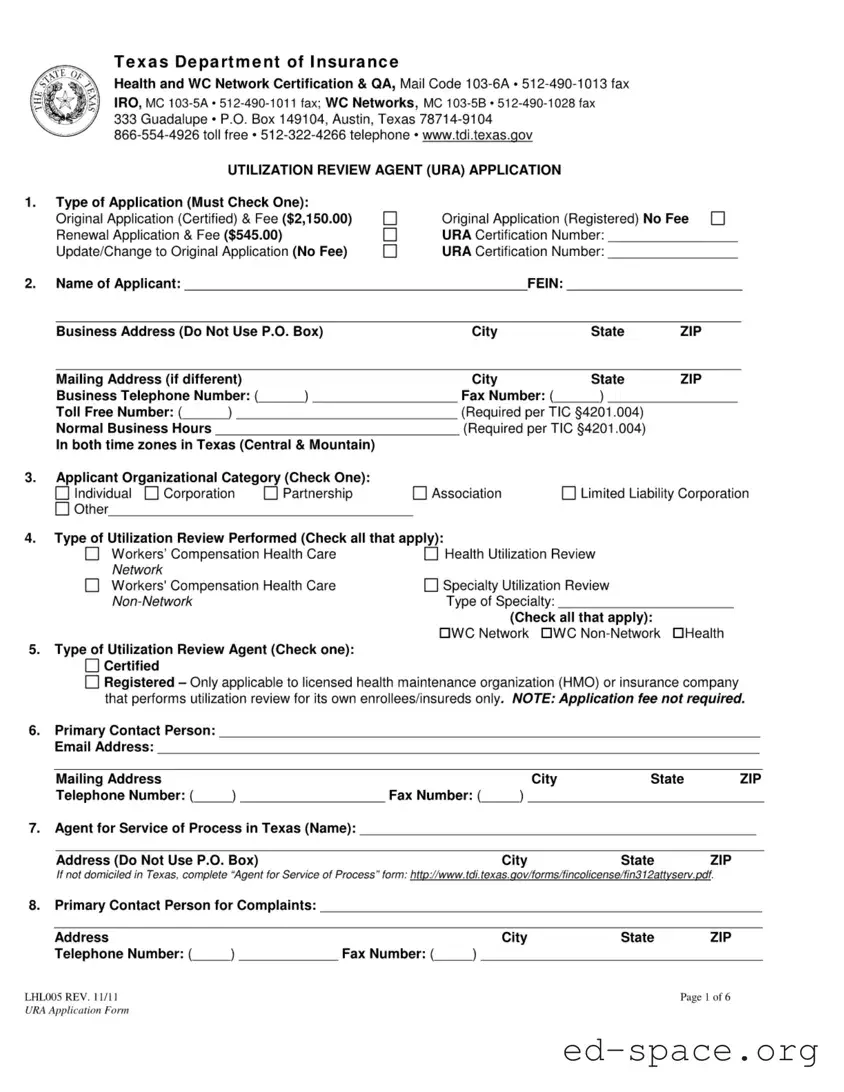
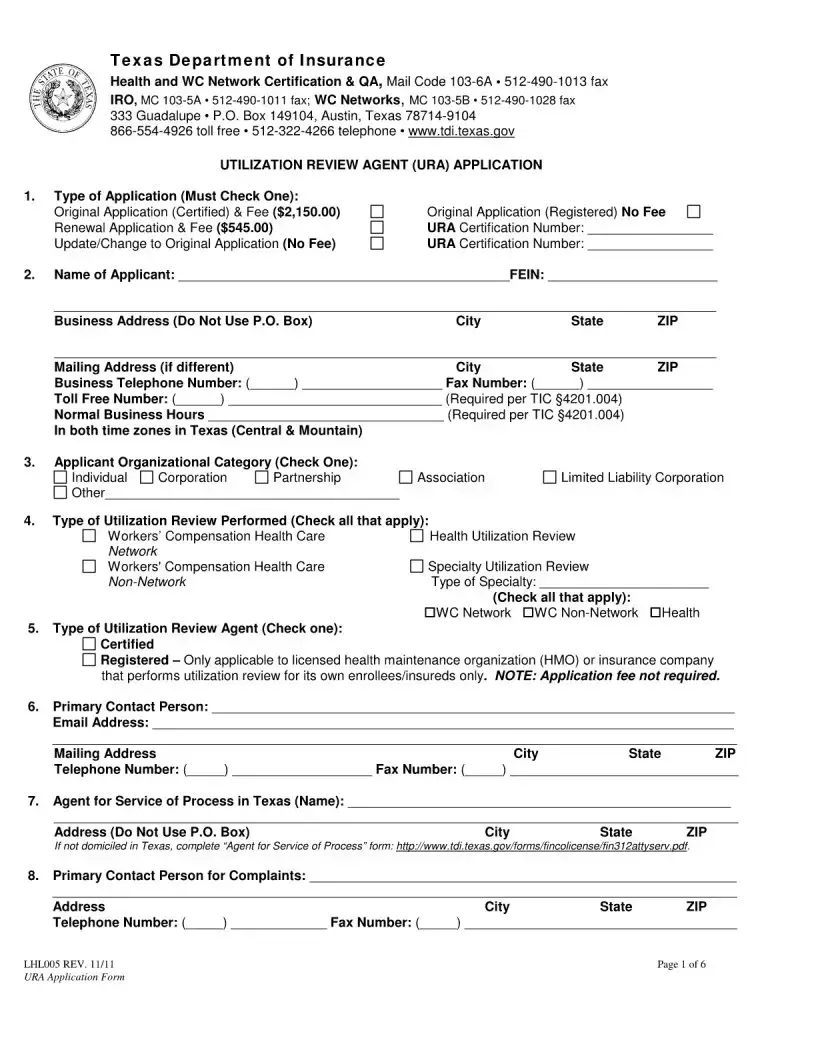
The Texas LHL005 form plays a crucial role in the certification and registration process for Utilization Review Agents (URAs) operating within the state. This application is essential for those seeking to perform utilization review in various healthcare settings, including workers' compensation and health care networks. The form requires applicants to specify the type of application they are submitting, whether it’s an original application, a renewal, or an update. Each option comes with its own associated fees, such as the $2,150 fee for original applications and a $545 fee for renewals. Applicants must provide detailed information about their organization, including business addresses, contact information, and the type of utilization review services they offer. Additionally, the form asks for the primary contact person and an agent for service of process in Texas, ensuring that there is a clear line of communication. The application process also emphasizes the importance of compliance with Texas statutes and rules related to utilization review, making it imperative for applicants to be well-informed about the relevant legal landscape. Completing the LHL005 form accurately is not just a formality; it is a foundational step for URAs to operate legally and effectively in Texas.
| Fact Name | Fact Details |
|---|---|
| Governing Law | The Texas LHL005 form is governed by Texas Insurance Code Chapter 4201 and Chapter 1305. |
| Application Types | There are four application types: Original (Certified), Renewal, Update/Change to Original, and Original (Registered). |
| Application Fees | The fees are $2,150 for an original application and $545 for a renewal application. |
| Contact Information | Applicants must provide a primary contact person’s name, email, and telephone number. |
| Business Address Requirement | Applicants must provide a physical business address and cannot use a P.O. Box. |
| Utilization Review Types | Types of utilization review include Workers’ Compensation Health Care Network and Non-Network. |
| Organizational Categories | Applicants can be individuals, corporations, partnerships, associations, or limited liability corporations. |
| Agent for Service of Process | If not based in Texas, the applicant must designate an agent for service of process in Texas. |
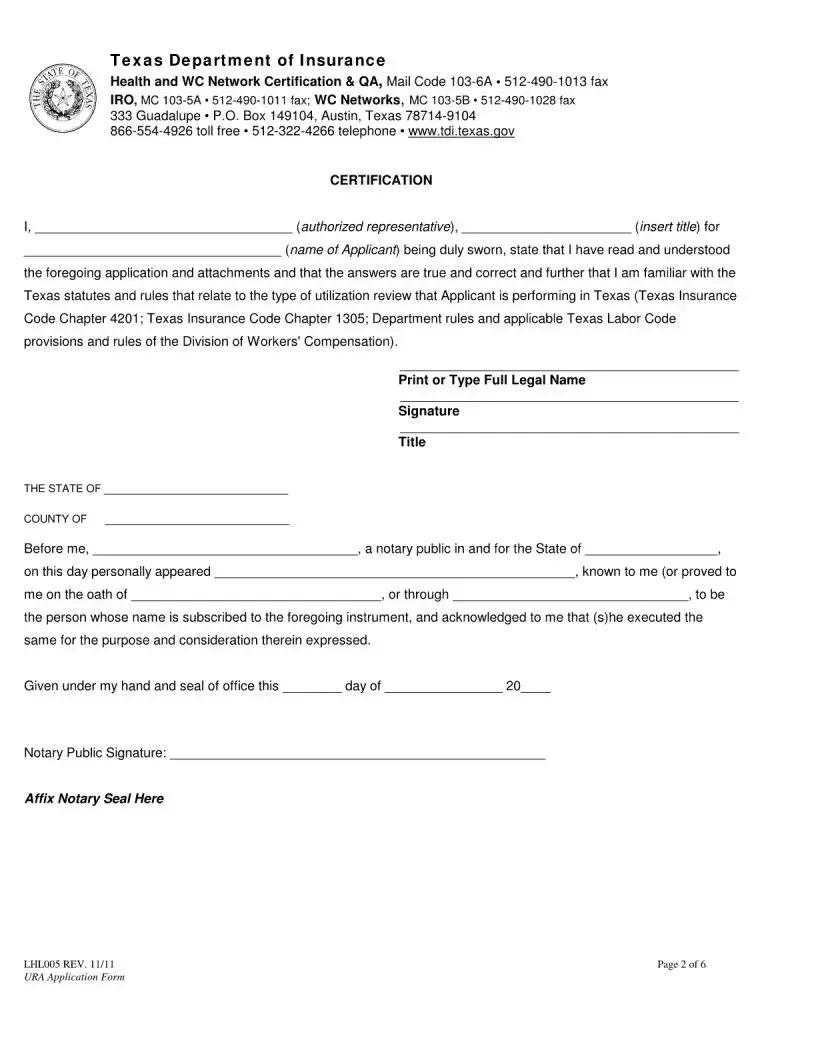
| Notary Requirement | The application must be signed in the presence of a notary public, affirming the accuracy of the information provided. |
Filling out the Texas LHL005 form requires careful attention to detail. Each section must be completed accurately to ensure that the application is processed without delays. Below are the steps to guide you through the process.
What is the Texas LHL005 form?
The Texas LHL005 form is an application for Utilization Review Agents (URAs) in Texas. It is used for obtaining certification, renewing certification, or updating information related to utilization review activities in health care and workers' compensation networks. The form must be submitted to the Texas Department of Insurance along with the appropriate fees and documentation.
Who needs to complete the LHL005 form?
Any individual or organization that intends to perform utilization review in Texas must complete the LHL005 form. This includes corporations, partnerships, associations, and limited liability corporations that provide services related to health care networks or workers' compensation.
What types of applications can be submitted using the LHL005 form?
The LHL005 form allows for several types of applications: original applications for certification, renewal applications, and updates or changes to previously submitted applications. Each type of application has specific requirements and associated fees.
What are the fees associated with the LHL005 form?
The fees for submitting the LHL005 form vary based on the type of application. An original application requires a fee of $2,150. A renewal application costs $545. There is no fee for updates or changes to an existing application or for original applications submitted by registered health maintenance organizations (HMOs) or insurance companies for their own enrollees.
What information is required on the LHL005 form?
The form requires detailed information about the applicant, including the name, business address, organizational category, type of utilization review performed, and contact information. It also requires the applicant to indicate the type of utilization review agent and provide an agent for service of process in Texas.
How often must the LHL005 form be renewed?
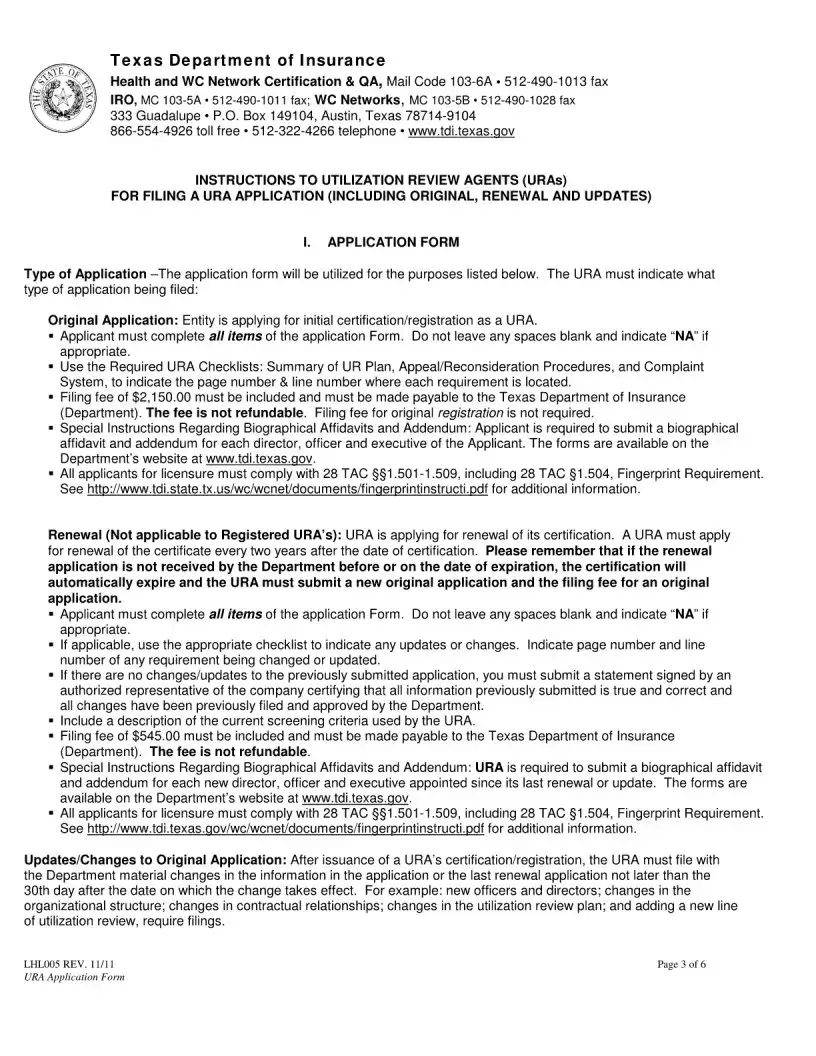
URAs must renew their certification every two years. It is essential to submit the renewal application before the expiration date to avoid automatic expiration of the certification. If the renewal is not submitted on time, a new original application must be filed.
What happens if there are changes after certification?
If there are material changes to the information provided in the LHL005 form after certification, the URA must file an update with the Texas Department of Insurance within 30 days of the change. This includes changes in officers, organizational structure, or utilization review plans.
Where can I find more information about the LHL005 form?
Additional information about the LHL005 form, including filing instructions and requirements, can be found on the Texas Department of Insurance website. You can also contact their office directly for assistance.
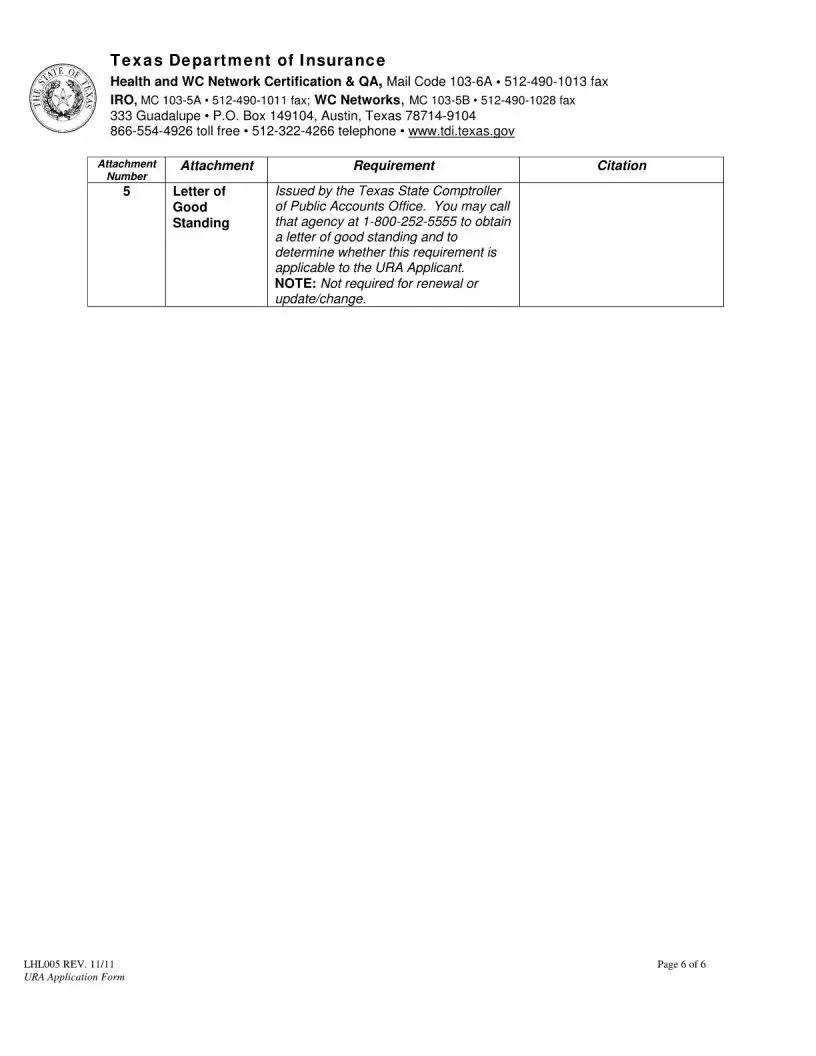
Incompleteness of Information: Many applicants fail to fill out all required fields. Leaving spaces blank can lead to delays or rejections. Always ensure that every section is completed, and use "NA" where applicable.
Incorrect Application Type: Selecting the wrong type of application can cause significant issues. Applicants must carefully check the appropriate box for Original, Renewal, or Update/Change to avoid complications.
Failure to Include Fees: Not submitting the correct filing fee is a common mistake. Each application type has a specific fee associated with it. Ensure that the payment is included and made out to the Texas Department of Insurance.
Neglecting to Update Changes: After receiving certification, applicants often overlook the requirement to file updates for material changes. It is crucial to report changes within 30 days to maintain compliance.
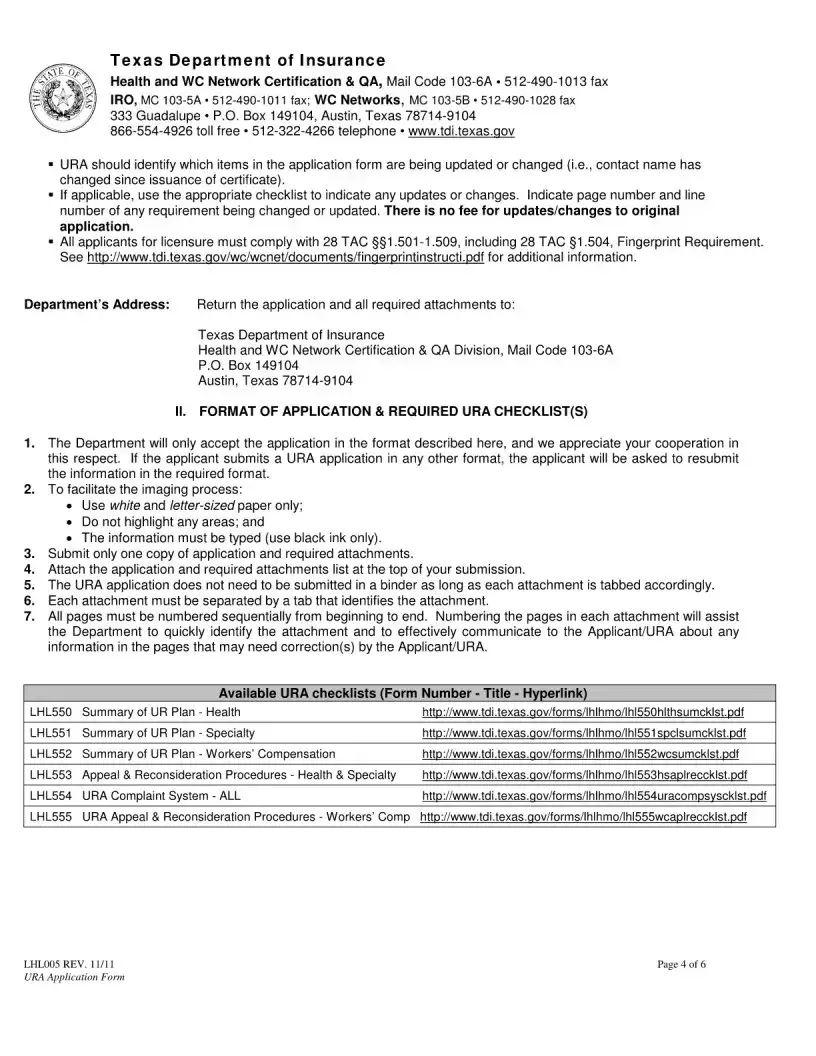
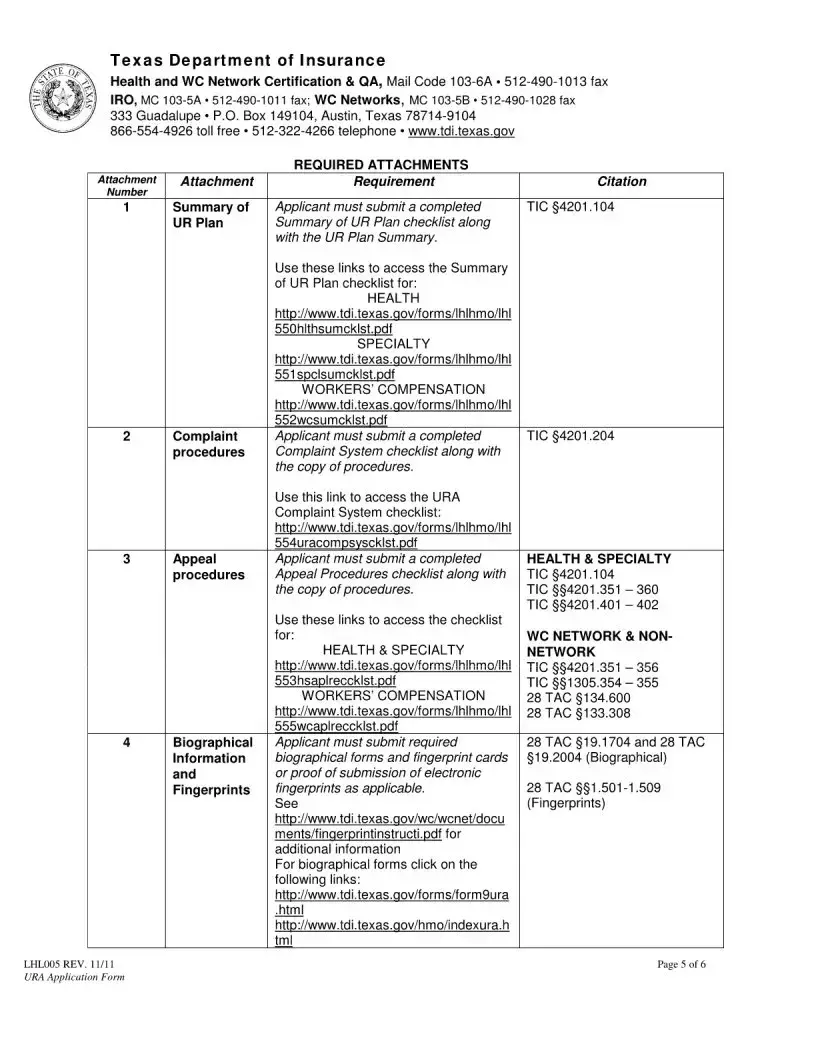
The Texas LHL005 form is an application for utilization review agents (URAs) seeking certification or registration with the Texas Department of Insurance. It serves as a critical document in the regulatory framework governing healthcare services in Texas. Several other forms and documents are often utilized in conjunction with the LHL005 form to ensure compliance with state regulations and to facilitate the application process.
Each of these documents plays a significant role in the application and regulatory process for utilization review agents in Texas. They collectively ensure that URAs operate within the legal framework established by the state, promoting accountability and quality in healthcare services.
The Texas LHL005 form, which serves as an application for Utilization Review Agents (URAs), shares similarities with several other documents used in various regulatory and compliance contexts. Below is a list of six documents that are comparable to the Texas LHL005 form, along with explanations of their similarities.
When filling out the Texas LHL005 form, there are several important guidelines to follow. Here is a list of things you should and shouldn't do:
Understanding the Texas LHL005 form is crucial for those involved in utilization review in the state. However, several misconceptions can lead to confusion. Here are five common misconceptions about the Texas LHL005 form, along with clarifications:
In reality, the application fee varies based on the type of application. For an original application, the fee is $2,150, while a renewal application costs $545. There is no fee for updates or changes to an original application.
This is not true. Any entity, regardless of size, that performs utilization review in Texas must complete and submit the LHL005 form. This includes individuals, partnerships, and associations.
All sections of the LHL005 form must be completed. Leaving spaces blank can lead to delays or rejection of the application. If a section does not apply, it should be marked as "NA."
This is incorrect. Certification must be renewed every two years. Failure to submit a renewal application before the expiration date will result in automatic expiration of the certification, requiring a new original application to be submitted.
The form is applicable to various types of utilization review agents, including those involved in workers' compensation. Both health care networks and non-networks must utilize this form if they perform utilization reviews.
When filling out and using the Texas LHL005 form, there are several important considerations to keep in mind. This application is essential for those seeking certification as a Utilization Review Agent (URA) in Texas. Here are key takeaways to ensure a smooth application process:
By adhering to these key points, applicants can navigate the LHL005 form process more effectively, ensuring compliance and facilitating a smoother certification experience.