Homepage Blank Texas Legal Claim PDF Form
Content Overview

The Texas Legal Claim form serves as a crucial document for individuals seeking to navigate the complexities of legal services in Texas. This form is divided into several parts, each designed to capture essential information that facilitates the processing of claims. The first section gathers participant information, including the member's name, contact details, and subscriber identification, ensuring that the claim is accurately associated with the correct individual. Following this, the form requires client information, particularly if the client is not the member themselves, which is vital for establishing relationships and verifying eligibility. Coverage verification is another critical aspect, allowing participants to confirm their eligibility for legal services before they incur any costs. The form also includes sections for attorney information, detailing the attorney's credentials and billing information, which is necessary for the reimbursement process. Additionally, participants must provide specifics about the services performed, including dates of service and descriptions of the legal work completed. Court-related information, such as the court name and docket number, is also required to ensure that claims are linked to the appropriate legal proceedings. Finally, the submission section outlines the methods for sending the completed form, while signatures from both the member and the attorney affirm the accuracy of the information provided and the necessity of the services rendered. Understanding these components is essential for anyone looking to successfully submit a claim through the Texas Legal Claim form.
Document Preview

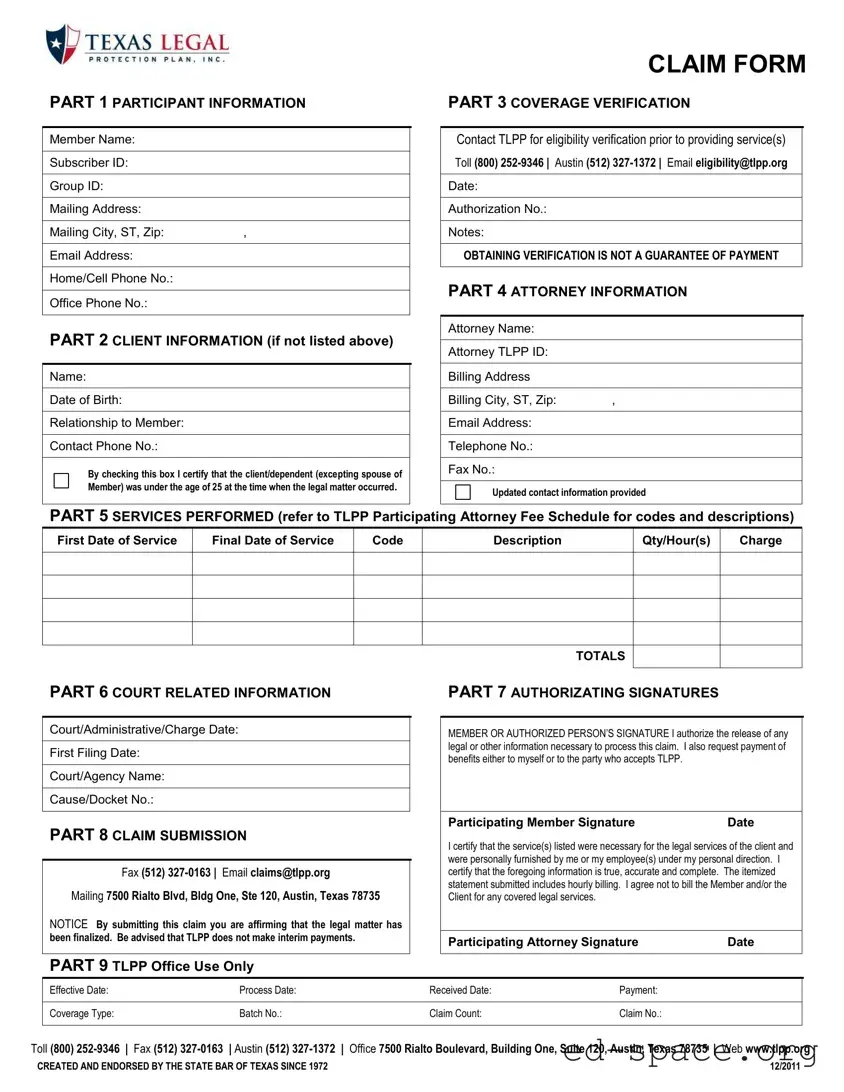
CLAIM FORM
Toll (800) 252-9346 | Fax (512) 327-0163 | Austin (512) 327-1372 | Office 7500 Rialto Boulevard, Building One, Suite 120, Austin, Texas 78735 | Web www.tlpp.org
CREATED AND ENDORSED BY THE STATE BAR OF TEXAS SINCE 1972 12/2011
PART 1 PARTICIPANT INFORMATION
PART 3 COVERAGE VERIFICATION
Member Name:
Contact TLPP for eligibility verification prior to providing service(s)
Subscriber ID:
Toll (800) 252-9346 | Austin (512) 327-1372 | Email [email protected]
Group ID:
Date:
Mailing Address:
Authorization No.:
Mailing City, ST, Zip:
,
Notes:
Email Address:
OBTAINING VERIFICATION IS NOT A GUARANTEE OF PAYMENT
Home/Cell Phone No.:
PART 4 ATTORNEY INFORMATION
Office Phone No.:
PART 2 CLIENT INFORMATION (if not listed above)
Attorney Name:
Attorney TLPP ID:
Name:
Billing Address
Date of Birth:
Billing City, ST, Zip:
Relationship to Member:
Email Address:
Contact Phone No.:
Telephone No.:
By checking this box I certify that the client/dependent (excepting spouse of
Member) was under the age of 25 at the time when the legal matter occurred.
Fax No.:
Updated contact information provided
PART 5 SERVICES PERFORMED (refer to TLPP Participating Attorney Fee Schedule for codes and descriptions)
First Date of Service
Final Date of Service
Code
Description
Qty/Hour(s)
Charge
TOTALS
PART 6 COURT RELATED INFORMATION
PART 7 AUTHORIZATING SIGNATURES
Court/Administrative/Charge Date:
MEMBER OR AUTHORIZED PERSON’S SIGNATURE I authorize the release of any
legal or other information necessary to process this claim. I also request payment of
benefits either to myself or to the party who accepts TLPP.
First Filing Date:
Court/Agency Name:
Cause/Docket No.:
PART 8 CLAIM SUBMISSION
Participating Member Signature
Date
I certify that the service(s) listed were necessary for the legal services of the client and
were personally furnished by me or my employee(s) under my personal direction. I
certify that the foregoing information is true, accurate and complete. The itemized
statement submitted includes hourly billing. I agree not to bill the Member and/or the
Client for any covered legal services.
Fax (512) 327-0163 | Email [email protected]
Mailing 7500 Rialto Blvd, Bldg One, Ste 120, Austin, Texas 78735
NOTICE By submitting this claim you are affirming that the legal matter has
been finalized. Be advised that TLPP does not make interim payments.
Participating Attorney Signature
Date
PART 9 TLPP Office Use Only
Effective Date:
Process Date:
Received Date:
Payment:
Coverage Type:
Batch No.:
Claim Count:
Claim No.:

Form Specifications

Fact Name Description
Participant Information This section requires details about the member, including their name, subscriber ID, group ID, mailing address, email, and phone numbers.
Client Information If the client is not the member, their name, date of birth, relationship to the member, and contact phone number must be provided.
Coverage Verification Eligibility must be verified with TLPP before services are provided. Note that obtaining verification does not guarantee payment.
Attorney Information Details about the attorney, including their name, TLPP ID, billing address, email, and phone numbers, are required in this section.
Submission Guidelines Claims can be submitted via fax, email, or mail. The claim must be finalized, as TLPP does not make interim payments.

Filling out the Texas Legal Claim form is a straightforward process that requires careful attention to detail. Accurate completion of this form is essential for the efficient processing of claims. Below are the steps to fill out the form correctly.

  1. Begin with PART 1: PARTICIPANT INFORMATION. Enter the Member Name, Subscriber ID, Group ID, and Mailing Address, including the city, state, and zip code. Provide the Email Address and both Home/Cell Phone and Office Phone numbers.
  2. Proceed to PART 2: CLIENT INFORMATION. If the client is not the member, enter the client's Name, Date of Birth, Relationship to Member, and Contact Phone Number. Check the box if the client/dependent was under the age of 25 at the time of the legal matter.
  3. In PART 3: COVERAGE VERIFICATION, contact TLPP to verify eligibility before providing services. Record the Date and Authorization Number. Note that obtaining verification does not guarantee payment.
  4. Fill out PART 4: ATTORNEY INFORMATION. Provide the Attorney Name, Attorney TLPP ID, Billing Address, Billing City, State, and Zip Code. Include the Attorney's Email Address, Telephone Number, and Fax Number.
  5. Move to PART 5: SERVICES PERFORMED. Enter the First Date of Service and Final Date of Service. List the Code Description, Quantity/Hours, and Charge. Calculate and enter the total amount.
  6. Complete PART 6: COURT RELATED INFORMATION. Include the Court/Administrative/Charge Date, First Filing Date, Court/Agency Name, and Cause/Docket Number.
  7. In PART 7: AUTHORIZING SIGNATURES, the Member or Authorized Person must sign and date the form, authorizing the release of necessary information to process the claim. The Participating Attorney must also sign and date, certifying the accuracy of the information provided.
  8. Finally, submit the claim as outlined in PART 8: CLAIM SUBMISSION. You can fax it to (512) 327-0163, email it to [email protected], or mail it to the provided address.

Your Questions, Answered

What is the Texas Legal Claim form used for?

The Texas Legal Claim form is designed for individuals seeking reimbursement for legal services provided under the Texas Legal Protection Plan (TLPP). This form collects essential information about the member, the client, the attorney, and the services performed. It ensures that all necessary details are submitted for processing the claim efficiently.

Who should fill out the Texas Legal Claim form?

The form should be completed by the member of the TLPP or an authorized representative. If the legal services were provided to a client or dependent, their information must also be included. It is crucial to provide accurate details, as this will help facilitate the claims process.

What information is required on the form?

The Texas Legal Claim form requires several pieces of information. This includes the member's name, subscriber ID, mailing address, and contact details. Additionally, you need to provide information about the client, such as their name, date of birth, and relationship to the member. Details about the attorney, services performed, court-related information, and signatures are also necessary for processing the claim.

How do I submit the Texas Legal Claim form?

You can submit the completed Texas Legal Claim form in several ways. The form can be faxed to (512) 327-0163 or emailed to [email protected]. Alternatively, you can mail it to the TLPP office at 7500 Rialto Blvd, Building One, Suite 120, Austin, Texas 78735. Be sure to keep a copy of the submitted form for your records.

What happens after I submit the claim?

Once you submit the Texas Legal Claim form, it will be reviewed by the TLPP office. They will verify the eligibility of the claim and process it accordingly. It’s important to note that obtaining verification does not guarantee payment. You will receive updates regarding the status of your claim, including any payment details, once the review is complete.

Common mistakes

  1. Incomplete Participant Information: Many individuals forget to fill out all the required fields in Part 1. Missing information like the Subscriber ID or mailing address can lead to delays in processing the claim.

  2. Incorrect Client Information: When filling out Part 2, some people mistakenly provide incorrect details about the client or dependent. This includes errors in the date of birth or relationship to the member, which can complicate eligibility verification.

  3. Neglecting Coverage Verification: Failing to verify coverage before submitting the claim can result in unexpected denials. It’s crucial to contact TLPP for eligibility verification as outlined in Part 3.

  4. Missing Signatures: In Part 7, some forget to include the necessary signatures. Both the member and the attorney must sign the form to authorize the release of information and confirm the accuracy of the claim.

Documents used along the form

When submitting a Texas Legal Claim form, several other documents may be required or helpful to ensure a smooth process. Here’s a brief overview of these forms and documents.

  • Proof of Eligibility: This document verifies that the member is eligible for coverage under the Texas Legal Plan. It typically includes the member's identification and details about their coverage.
  • Itemized Billing Statement: This statement outlines the specific services provided, their costs, and the time spent on each service. It helps substantiate the claim and ensures accurate payment.
  • Authorization for Release of Information: This form allows the attorney to obtain necessary information from third parties, such as medical providers or other legal entities, to support the claim.
  • Client Consent Form: This document confirms that the client agrees to the legal services provided and understands the terms of representation. It is essential for compliance and transparency.
  • Final Judgment or Settlement Agreement: If applicable, this document outlines the resolution of the legal matter, including any settlements or court judgments. It is crucial for confirming that the case has been finalized.
  • Cover Letter: A cover letter can accompany the claim submission. It should briefly explain the purpose of the submission and list the enclosed documents for clarity.

Having these documents ready can facilitate the claim process and help avoid delays. Always double-check requirements to ensure compliance and completeness.

Similar forms

  • Insurance Claim Form: Similar to the Texas Legal Claim form, an insurance claim form requires detailed information about the claimant, the services provided, and the circumstances surrounding the claim. Both documents aim to facilitate the processing of claims for reimbursement or coverage verification.
  • Medical Claim Form: This document is used to request payment for medical services rendered. Like the Texas Legal Claim form, it includes patient information, details about the services performed, and the provider's information. Both forms require accuracy to ensure proper processing and payment.
  • Workers' Compensation Claim Form: This form is used by employees to report work-related injuries and request benefits. It shares similarities with the Texas Legal Claim form in that it requires participant information, details of the incident, and verification of services rendered. Both forms are crucial for ensuring that claims are processed efficiently.
  • Property Damage Claim Form: Used to report damages to property and request compensation, this form is akin to the Texas Legal Claim form. Both documents require specific details about the incident, the claimant's information, and any relevant documentation to support the claim. They serve the purpose of initiating the claims process.

Dos and Don'ts

When filling out the Texas Legal Claim form, it is important to follow certain guidelines to ensure a smooth process. Here are five things you should and shouldn't do:

  • Do double-check all personal information for accuracy.
  • Don't leave any required fields blank.
  • Do provide a valid email address for communication.
  • Don't submit the claim without verifying coverage first.
  • Do sign and date the form before submission.

Following these steps will help avoid delays and ensure your claim is processed efficiently.

Misconceptions

Understanding the Texas Legal Claim form is crucial for a smooth claims process. However, several misconceptions often arise. Here are six common misunderstandings:

  • Misconception 1: The form guarantees payment.
  • Many believe that submitting the claim form guarantees payment. In reality, obtaining verification of eligibility does not ensure payment will be made.

  • Misconception 2: Only members can submit claims.
  • While members are the primary submitters, authorized individuals can also submit claims on behalf of the member. This includes dependents listed on the form.

  • Misconception 3: Claims can be submitted at any time.
  • Some assume that claims can be submitted whenever they choose. However, the legal matter must be finalized before submission, and interim payments are not made.

  • Misconception 4: All legal services are covered.
  • Not all services fall under the coverage. It is essential to refer to the TLPP Participating Attorney Fee Schedule for details on covered services.

  • Misconception 5: The form is only for court-related claims.
  • While court-related information is a part of the form, it can also be used for administrative claims. The context of the legal matter determines its use.

  • Misconception 6: Signature requirements are flexible.
  • Some think that signatures can be bypassed. In fact, both the member and the attorney must sign the form to validate the claim and authorize the release of necessary information.

Key takeaways

Filling out the Texas Legal Claim form is a crucial step in ensuring that legal services are processed efficiently and accurately. Below are key takeaways to guide individuals through this process.

  • Complete Participant Information: Ensure that all fields in Part 1 are filled out accurately, including the member’s name, subscriber ID, and contact information. This information is essential for proper identification.
  • Client Information: If the client is not the member, provide their details in Part 2. It is important to specify the relationship to the member and confirm that the client was under 25 at the time of the legal matter, if applicable.
  • Verify Coverage: Before providing services, contact TLPP for eligibility verification. This step is crucial as it confirms whether the legal matter is covered, though it does not guarantee payment.
  • Attorney Information: In Part 4, include the attorney’s details, such as their name, TLPP ID, and contact information. This ensures that the claim is associated with the correct legal representative.
  • Document Services Performed: Accurately record the dates of service, codes, and charges in Part 5. Refer to the TLPP Participating Attorney Fee Schedule for guidance on the correct codes and descriptions.
  • Submit the Claim: Claims can be submitted via fax, email, or mail as outlined in Part 8. Be mindful of the submission method, as it may affect the processing time.
  • Signatures Required: Ensure that the member or authorized person signs the claim in Part 7. Both the member and the attorney must certify that the information provided is true and that services were necessary and rendered.

By following these key takeaways, individuals can navigate the Texas Legal Claim form process with greater confidence and clarity. Proper completion and submission of the form can lead to timely processing and resolution of legal matters.