Homepage Blank Texas Law Help PDF Form
Content Overview

The Texas Law Help form is an essential resource for individuals navigating the divorce process in Texas, especially when children are involved. Specifically designed for couples with children under 18 or still in high school, this form set is applicable when there are no existing court orders regarding the children. It's important to note that if there is a family violence protective order that includes child-related provisions, you should still utilize this form set, attaching a copy of the protective order to your Original Petition for Divorce. Before diving into the paperwork, it is highly recommended to read through the guidelines on how to file an uncontested divorce. This ensures you understand the necessary steps and forms, which may include the Original Petition for Divorce, Final Decree of Divorce, and others. You might not need every form listed, and additional documents could be necessary depending on your unique situation. Remember, while these forms are designed for individuals representing themselves, consulting with a lawyer can provide valuable insight tailored to your circumstances.


Document Preview

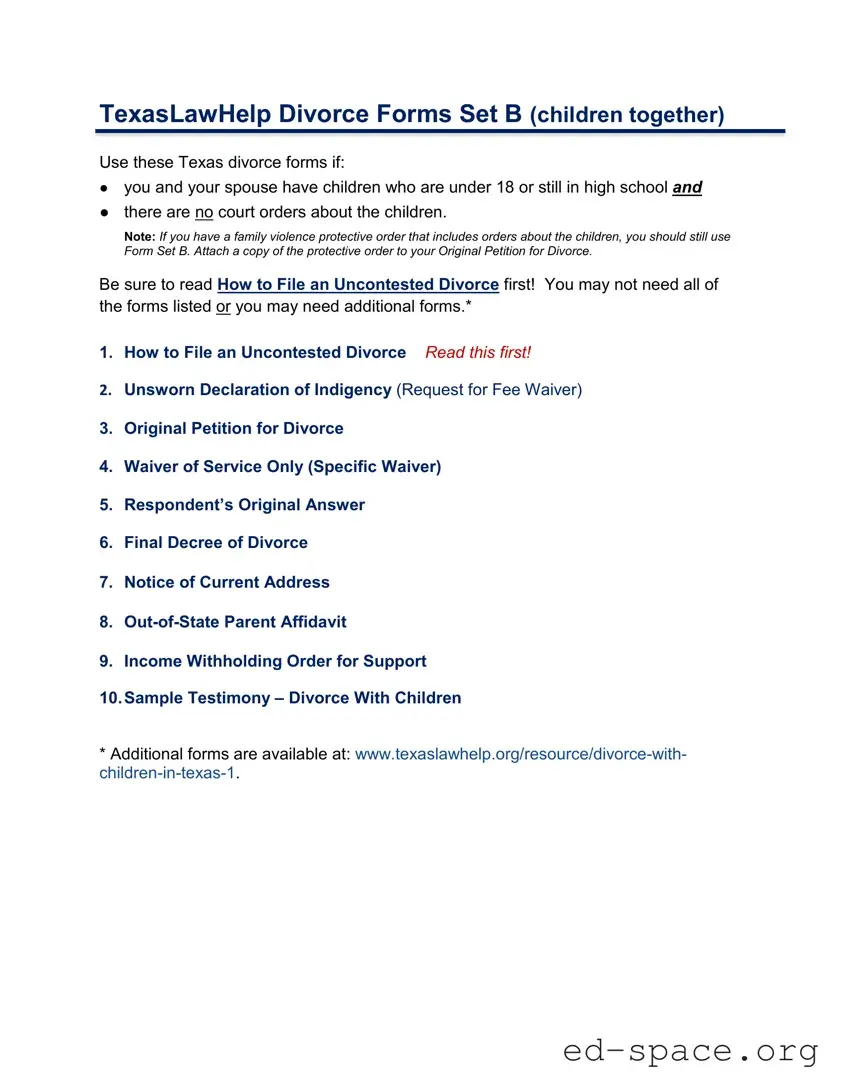
TexasLawHelp Divorce Forms Set B (children together)
Use these Texas divorce forms if:
you and your spouse have children who are under 18 or still in high school and
there are no court orders about the children.
Note: If you have a family violence protective order that includes orders about the children, you should still use
Form Set B. Attach a copy of the protective order to your Original Petition for Divorce.
Be sure to read
How to File an Uncontested Divorce first! You may not need all of
the forms listed or you may need additional forms.*
1. How to File an Uncontested Divorce Read this first!
2. Unsworn Declaration of Indigency (Request for Fee Waiver)
3. Original Petition for Divorce
4. Waiver of Service Only (Specific Waiver)
5. Respondent’s Original Answer
6. Final Decree of Divorce
7. Notice of Current Address
8. Out-of-State Parent Affidavit
9. Income Withholding Order for Support
10. Sample TestimonyDivorce With Children
* Additional forms are available at: www.texaslawhelp.org/resource/divorce-with-
children-in-texas-1.
© TexasLawHelp.org How to File an Uncontested Divorce, July 2014 Page 1 of 13
How to File an Uncontested Divorce
These instructions explain the steps in a simple, uncontested Texas divorce. Use them with the FREE
do-it-yourself divorce forms at
www.TexasLawHelp.org
.
These instructions are written for people who are “pro se.” Pro se means you don’t have a lawyer.
These instructions are not a substitute for the advice and help of a lawyer. It’s a good idea to talk to a
lawyer about your particular situation before filing or responding to a divorce.
Is Your Divorce Uncontested?
Your divorce is uncontested when it is:
agreed you and your spouse agree about all the issues in your case OR
defaultyour spouse is given legal notice of your divorce by Official Service of Process,
Publication or Posting and does not file an Answer or Waiver of Service with the Court
or otherwise appear in the case.
If your divorce is contested, it is best to talk to a lawyer before filing any forms with the Court.
Steps for an Uncontested Texas Divorce
A full description of each step follows. Carefully read all the steps before you begin.
Step 1: Get help if there has been family violence or you feel unsafe.
Step 2: Talk to a lawyer about your particular situation.
Step 3: Determine where to file.
Step 4: Choose a divorce form set at www.TexasLawHelp.org.
Step 5: Fill out the Original Petition for Divorce.
Step 6: File (turn in) your Original Petition for Divorce.
Step 7: Give “legal notice” to your spouse
Step 8: Fill out the Final Decree of Divorce.
Step 9: Wait the required waiting periods.
Step 10: Confirm that your case is uncontested and get ready for court.
Step 11: Go to court to finish your divorce.
© TexasLawHelp.org How to File an Uncontested Divorce, July 2014 Page 2 of 13
Step 1: Get help if there has been violence or you feel unsafe.
It’s not a good idea to do your own divorce, without a lawyer, when there has been family violence.
Family violence includes physical violence and sexual assault. It can also include threats of
violence. You do not need to have called the police or sought medical care to be the victim of
family violence.
If you or your children have been the victim of family violence or if at any time you feel unsafe, get
help by calling the:
o National Domestic Violence Hotline at 1-800-799-SAFE (7233) or
o Texas Family Violence Legal Line at 1-800-374-HOPE (4673)
Step 2: Talk to a lawyer about your particular situation.
Divorce cases can be complicated and your property, your money and your rights as a parent may
be at risk. Even if you decide to represent yourself, you should see a lawyer for legal advice about
your particular situation before filing anything,
It’s really important to talk to a lawyer if:
o you’re afraid for your or your children’s safety, or
o your case is contested, or
o your spouse has a lawyer, or
o you or your spouse has a house, retirement, business, other valuable property or a lot of debt.
Talking to a lawyer now, can save you time and money in the long run.
Need help finding a lawyer? For referral to a lawyer, or if you have a low income to a free
Legal Aid program, call the Lawyer Referral Information Service at 1-800-252-9690. Or, go
to www.TexasLawHelp.org and click on “Find Legal Help.
Just want advice? You can hire a lawyer just to give you advice, review your forms, draft a
document or help you prepare for a hearing. This is called limited scope representation. You
may then be able to handle the other parts of your divorce yourself.
Go to http://texaslawhelp.org/resource/limited-scope-representation?ref=U6Rdg for more
information about limited scope representation.
Do Not Use the TexasLawHelp Divorce Forms if:
o You or your spouse have an ongoing bankruptcy case.
o You want to file specific grounds for divorce, such as cruelty or adultery.
o You want spousal maintenance, referred to as “alimony” in some states.
o You and your spouse have a disabled child.
© TexasLawHelp.org How to File an Uncontested Divorce, July 2014. Page 3 of 13
Step 3: Determine where to file.
You can file for divorce in Texas as long as you or your
spouse has lived:
in Texas for at least the last 6 months, and
in the county where you want to file for divorce
for at least the last 90 days. See Texas Family Code Section 6.301.
Information for Military Families: If you are serving in the armed forces outside of Texas or
other government service outside of Texas or you have accompanied your spouse who is serving
in the armed forces or other government service outside of Texas, you may still file for divorce in
Texas if Texas has been the home state of either you or spouse for at least 6 months and the
county where you plan to file the divorce has been the home county of either spouse for at least
90 days. Time spent away while serving in the armed forces or other government service counts
as time spent in Texas and your home county. See Texas Family Code Section 6.303.
Information for Immigrants: You may file for divorce in Texas even if you do not have legal
status in the United States, as long as you or your spouse has lived in Texas for at least the last 6
months and in the county where you want to file for divorce for at least the last 90 days.
Things to consider
if your children don’t live in Texas or havent lived in Texas very long.
A Texas Court cannot make initial custody and visitation orders about a child unless
:
1) the child has lived in Texas for at least the last 6 months (or since birth), or
2) Texas was the child’s home state and the child has been gone for fewer than 6 months.
See Texas Family Code Section 152.201.
There are a few exceptions to this rule. Talk with a lawyer if this is an issue.
if your spouse lives outside of Texas.
As long as you meet the residency requirements for divorce, you can get divorced in Texas even if
your spouse lives in another state. However, the Court must have personal jurisdiction over
your out-of-state spouse to include orders in your divorce that impose a personal obligation on
your spouse such as ordering your spouse to pay a debt or pay child support.
See Texas Family Code Sections 6.305, 6.308, 102.011 and 102.012.
The Original Petition for Divorce form includes a list of situations that give the Court personal
jurisdiction over an out-of-state spouse. Check any that apply to your case. Talk to a lawyer if
none apply or you have questions about personal jurisdiction.
Residency
Requirements
for Divorce
Things to consider
if your children don’t live in Texas or haven’t lived in Texas very long.
A Texas Court cannot make initial custody and visitation orders about a child unless:
1) the child has lived in Texas for at least the last 6 months (or since birth), or
2) Texas was the child’s home state and the child has been gone for fewer than 6 months.
See Texas Family Code Section 152.201.
There are a few exceptions to this rule. Talk with a lawyer if this is an issue.
if your spouse lives outside of Texas.
As long as you meet the residency requirements for divorce, you can get divorced in Texas even
if your spouse lives in another state. However, the Court must have personal jurisdiction over
your out-of-state spouse to include orders in your divorce that impose a personal obligation on
your spouse — such as ordering your spouse to pay a debt or pay child support.
See Texas Family Code Sections 6.305, 6.308, 102.011 and 102.012.
The Original Petition for Divorce form includes a list of situations that give the Court personal
jurisdiction over an out-of-state spouse. Check any that apply to your case. Talk to a lawyer if
none apply or you have questions about personal jurisdiction.
© TexasLawHelp.org How to File an Uncontested Divorce, July 2014. Page 4 of 13
Step 4: Choose a divorce form set.
Choose one of the following divorce form sets at www.TexasLawHelp.org. Each set includes
multiple forms that you or your spouse will need to fill out and file with (turn in to) the Court. The
forms are described on the following page.
o Texas Supreme Court Divorce Form SET 1 (no children, no real property)
Use these forms if there are:
no minor children and
no real property (house or land).
These forms are approved for use throughout Texas by the Texas Supreme Court.
These forms come with different instructions.
o TexasLawHelp Divorce Form SET A (no children together)
Use these forms if:
you and your spouse do not have children who are under 18 or still in high school.
o TexasLawHelp Divorce Form SET B (children together)
Use these forms if:
you and your spouse have children who are under 18 or still in high school and
there are no court orders regarding the children.
Note: If you have a family violence protective order that includes orders regarding the
children, you should still use SET B.
o TexasLawHelp Divorce Form SET C (children together with final court order)
Use these forms if:
you and your spouse have children together who are under 18 or still in high school and
there is a final court order for custody and support of your children in place and you do not
want to change that order.
Note: Do not use the TexasLawHelp divorce forms if you have a court order but: 1) it does
not include all the children you and your spouse have together, 2) the order is a temporary
order, or 3) you are asking the court to make changes to the order. If one of these
situations applies, ask a lawyer to draft the appropriate forms for your case.
Things to consider
if you and your spouse don’t agree on child support.
If you and your spouse don’t agree on child support, the Office of the Attorney General (OAG)
may be able to help. Although the OAG cannot represent either parent, they can ask the court to
make an order for child support, medical support, custody and visitation.
Once there is a final court order for custody and support of your children, you may use the
TexasLawHelp Divorce SET C for your divorce.
For information about opening a case with the OAG call 1-800-255-8014 or go to their website
at www.oag.state.tx.us/cs.
Things to consider
if you and your spouse don’t agree on child support.
If you and your spouse don’t agree on child support, the Office of the Attorney General (OAG)
may be able to help. Although the OAG cannot represent either parent, they can ask the court to
make an order for child support, medical support, custody and visitation.
Once there is a final court order for custody and support of your children, you may use the
TexasLawHelp Divorce SET C for your divorce.
For information about opening a case with the OAG call 1-800-255-8014 or go to their website at
www.oag.state.tx.us/cs.
© TexasLawHelp.org How to File an Uncontested Divorce, July 2014. Page 5 of 13
Each divorce form set includes a version of the following forms. Additional forms are available
at www.TexasLawHelp.org.
Name of Form
What It Is and How to Use It
Affidavit of
Indigency
If you have a low income, receive government benefits because you have a
low income
or you cannot pay court fees, you may fill out this form to ask the
Court if you can file for divorce without paying the court and filing fees. The
Court may ask you to present evidence of your income and expenses at a
hearing. The Court may or may not decide to let you file without paying.
Original
Petition for
Divorce
One spouse (the Petitioner) fills out and files (turns in) this form at the
courthouse to start the divorce.
It tells the Court and your spouse that you
want a divorce and states what
you want the Court to order in the Final
Decree of Divorce. Note: This form must be turned in first, before the other
spouse signs anything.
Waiver of
Service Only
(Specific
Waiver)
The other spouse (the Respondent) may fill out this form if she or he does
not want to be served by a constable, sheriff, or private process server with a
copy of the Original Petition for Divorce. The Waiver must be signed in front
of a notary at least one day after the Original Petition for Divorce is filed at
the courthouse.
This form allows the judge to finish the divorce as long as
both spouses have signed the Final Decree of Divorce.
Note: The TexasLawHelp Waiver of Service Only (Specific Waiver) form only waives
the right to be formally served with a copy of the Petition. Other Waiver forms may
also waive the right to know anything else about the case. If someone asks you to
sign a Waiver, read it carefully. You may want to sign an Answer instead.
Respondent’s
Original
Answer
This form may be used two ways:
(1) If the divorce is agreed, the other spouse (the Respondent) may fill out
and sign this form instead of the Waiver of Service Only form. The
Respondent’s Original Answer form also
allows the judge to finish the
divorce as long as both spouses have signed the
Final Decree of
Divorce. The Respondent’s Original Answer form does not
need to be
signed in front of a notary.
(2) If the divorce is not agreed, the other sp
ouse (the Respondent) may fill
out and file the Respondent’s Original Answer
form to contest the
divorce.
Final Decree of
Divorce
The Judge signs this form to grant your divorce and make orders regarding
your property, debts and children (if applicable).
Fill it out ahead of time and
bring it with you to the final divorce hearing.
Notice of
Current of
Address
This form must
be filed if you or your spouse moves. It tells the Court your
new address so that the Court can contact you about hearings, etc.
Divorce form Set B (with children together) also includes the following forms.
Out-of-State
Party Affidavit
Fill out and file this form if either spouse lives outside of Texas.
Income
Withholding for
Support Order
The Court signs this form to order an employer to withhold child support from
an employee’s paycheck. Fill it out and bring it with you to the final divorce
hearing if child support will be ordered.
© TexasLawHelp.org How to File an Uncontested Divorce, July 2014. Page 6 of 13
Step 5: Fill out the Original Petition for Divorce.
After you choose a divorce form set, fill out the Original Petition for Divorce form.
You are the Petitioner. Your spouse is the Respondent.
Fill out all
the spaces unless instructed otherwise. Print clearly in blue or black ink.
Note: The Petition asks for your address. Your spouse will get a copy of this form. If you are
concerned about your spouse knowing your address, call the Family Violence Legal Line at 1-
800-374-4673 for free advice.
Fill out the Information on Suit Affecting the Family Relationship form.
Fill out these additional beginning forms only if they apply to your case:
o Affidavit of Indigency only if you can’t pay the filing fee for your divorce. Call the clerk’s
office to learn the fee for your case.
Note: Do not sign this form until you are in front of a notary. Or, if you don’t have the
necessary picture identification to get this form notarized attach a completed
Unsworn
Declaration form. If you receive public benefits (such as foodstamps) attach proof.
o
Exhibit: Out-of-State Party Affidavit only if 1) you are filing a Divorce SET B and 2) you or
your spouse live outside of Texas.
o
Affidavit for Service by Posting or Publication only if you can’t find your spouse after
looking really hard. Read Step 7C for more information.
Make 2 copies of each form you filled out.
Things to consider
if the wife is pregnant.
If the wife is pregnant, you will not be able to finish your divorce until after the child is born.
If the husband is not the biological father, paternity of the child must be established before you
can finish your divorce. Get information about establishing paternity at
www.TexasLawHelp.org.
If the husband is the biological father, orders for custody and support of the child must be included
in the Final Decree of Divorce.
if the wife had a child with another man while married to the husband.
If the wife had a child with another man while married to the husband, paternity of the child must
be established before you can finish your divorce.
This is true even if you have been separated
for a long time. Get information about establishing paternity at
www.TexasLawHelp.org
.
if you need orders right away.
If you need orders right away, you may ask the Court to make temporary orders after notice to
your spouse and a hearing. Temporary orders typically last until the divorce is finished. Talk to a
lawyer if you need temporary orders. Your county law library may also have information about
temporary orders.
If you need a protective order because of family violence call the Texas Family Violence Legal
Line at 1-800-374-HOPE or the National Domestic Violence Hotline at 1-800-799-SAFE.
Things to consider
if the wife is pregnant.
If the wife is pregnant, you will not be able to finish your divorce until after the child is born.
If the husband is not the biological father, paternity of the child must be established before you
can finish your divorce. Get information about establishing paternity at
www.TexasLawHelp.org.
If the husband is
the biological father, orders for custody and support of the child must be
included in the Final Decree of Divorce.
if the wife had a child with another man while married to the husband.
If the wife had a child with another man while married to the husband, paternity of the child must
be established before you can finish your divorce.
This is true even if you have been separated
for a long time. Get information about establishing paternity at www.TexasLawHelp.org.
if you need orders right away.
If you need orders right away, you may ask the Court to make temporary orders after notice to
your spouse and a hearing. Temporary orders typically last until the divorce is finished. Talk to a
lawyer if you need temporary orders.
Your county law library may also have information about
temporary orders.
If you need a protective order because of family violence call the Texas Family Violence Legal
Line at 1-800-374-HOPE or the National Domestic Violence Hotline at 1-800-799-SAFE.
© TexasLawHelp.org How to File an Uncontested Divorce, July 2014. Page 7 of 13
Step 6: File (turn in) your Original Petition for Divorce.
File (turn in) your completed Original Petition for Divorce and
additional beginning forms to the Court either in person or
electronically.
o To file your forms in person, take the original and 2 copies of your
forms to the courthouse and turn them in at the clerk’s office.
You may use the Texas Civil Courts Guide at
www.TexasLawHelp.org
to find the address and phone number for the clerk’s office in the
county where you plan to file your divorce.
o To file your forms electronically go to
http://www.efiletexas.gov.
Pay the filing fee (or file your Affidavit of Indigency form if you cannot afford the fee).
Ask the clerk if there are local rules or procedures you need to know about for your divorce.
The clerk will:
o write your “Cause Number” and “Court Number” at the top of the first page of your Petition.
(You should write these numbers at the top of any document you file in your divorce.)
o “file-stamp” your papers with the date and time.
o ask if you want to have your spouse “served.Served is when your spouse is given legal
notice of your divorce by Official Service of Process or by Posting or Publication.
If your spouse
will agree to sign a Waiver of Service or Answer, you do not
need to have
your spouse served. Follow the instructions set out in Step 7A.
If your spouse
will not agree to sign a Waiver of Service or Answer, you must have your
spouse served by Official Service of Process. Follow the instructions set out in Step 7B.
If you can’t find your spouse, you must have your spouse served by Posting or Publication.
Follow the instructions set out in Step 7C.
Things to consider
if your children get Medicaid or TANF or got it in the past.
You MUST send a file-stamped copy of your Original Petition for Divorce to the Office of the
Attorney General Child Support Division by commercial delivery, fax, email, personal delivery
or through the electronic filing manager if:
1) you and your spouse have children together and
2) the children get Medicaid or TANF or got it in the past.
See Texas Family Code Section 6.301.
Get contact information for the Attorney General child support office in your area at
www.oag.state.tx.us/cs/fieldoffices.php
.
Bring proof of delivery when you go to court.
if you and your spouse don’t agree.
If you and your spouse don’t agree on the terms of your divorce, you may want to consider
mediation. In mediation, an independent person (the mediator) will try to help you reach an
agreement. The divorce process is usually easier when you have an agreement. Be sure to
talk to a lawyer first. A lawyer can help you understand your options and negotiate a fair
agreement.
© TexasLawHelp.org How to File an Uncontested Divorce, July 2014. Page 8 of 13
Step 7: Give “legal notice” to your spouse.
Your spouse has the right to know that you have filed for divorce. You cannot simply tell your
spouse or send your spouse a letter. You must use a legally acceptable way to give your spouse
notice and prove to the Court that you did so.
Here are 3 ways to give legal noticeto your spouse:
7A - Waiver of Service or Answer (Use this way if your divorce is AGREED.)
7B - Official Service of Process (Use this way if your divorce is NOT AGREED.)
7C - Posting or Publication (Use this way if you can’t find your spouse.)
Each way to give legal notice is described below. Choose the way that bests fits your situation.
7A. Waiver of Service or Answer (Use this way if your divorce is AGREED.)
You may give your spouse legal notice by Waiver of Service or Answer if
your spouse agrees to sign the Waiver of Service Only (Specific Waiver)
form or the Respondent’s Original Answer form.
Follow these steps:
1. Mail or hand-deliver to your spouse:
a) a file-stamped copy of your Original Petition for Divorce, and
b) a blank Waiver of Service Only (Specific Waiver) or Respondent’s Original Answer form.
2. If your spouse plans to sign the Waiver of Service Only (Specific Wavier) form, tell him or her
to sign it in front of a notary at least one day after you filed the Petition. Otherwise your
spouse will have to redo it.
3. File the completed Waiver of Service form or Answer form at the courthouse.
TIP:
If your divorce is agreed, your spouse must also sign a completed
Final Decree of Divorce
(Decree) form. It may save you time to fill out the Decree now and send it to your spouse with the
Waiver of Service Only (Specific Waiver)
or Respondent’s Original Answer form. You may also
wait until later in the process to fill-out the Decree.
Warning:
Do not hand-deliver any papers to your spouse if there has been violence during your
relationship, especially if a judge has signed a Protective Order ordering you or your spouse to
stay away from the other. Mail or give legal notice by Official Service of Process instead.
© TexasLawHelp.org How to File an Uncontested Divorce, July 2014. Page 9 of 13
7B. Official Service of Process (Use this way if your divorce is NOT AGREED.)
Official Service of Process is when your spouse is formally given legal notice of your divorce by a
constable, sheriff, private process server or the clerk.
Give legal notice by Official Service of Process if your spouse will not sign the Waiver of Service
or Answer form or you do not want to have personal contact with your spouse.
Follow these steps to give legal notice by Official Service of Process:
1. Tell the clerk where you filed your Petition that you want to have your spouse “served.” The
clerk will print a form called the “Citation” that tells your spouse you have filed for divorce. The
clerk will attach a copy of your Petition to the Citation.
2. Tell the clerk whether you want your spouse served by:
a. personal service (this is the better way), or
b. certified mail return receipt requested.
3. If you choose personal service, send the Citation (with a copy of your Petition attached) to a
constable, sheriff or private process server in the county where your spouse will be served.
4. The constable, sheriff, private process server or clerk will fill out a Return of Service form.
Make sure the Return of Service form is filed at the courthouse.
What is personal service?
Personal service is when a constable,
sheriff or private process server gives your
spouse the divorce paperwork in person.
The constable, sheriff or private process
server then completes a Return of Service
form stating when your spouse was
served. The Return of Service form is
proof to the Court that you gave your
spouse legal notice. Your spouse does not
have to sign anything.
Note: The Return of Service form must be
filed at the courthouse at least 12 days
before your final hearing.
What if my spouse is in jail or prison?
Use personal service if your spouse is in
jail or prison. DO NOT use service by
certified mail because your spouse will not
be able to sign for the letter.
What is service by certified mail?
Service by certified mail is when the clerk (or
constable) sends your spouse the divorce
paperwork by certified mail return receipt
requested. The return receipt (or “green card”)
must be signed by your spouse. Only use this
way if you know that your spouse is the only
person who will sign for the letter when the
post office delivers it. If someone else signs
or your spouse does not sign his or her name
exactly as it is written on your Petition, you will
have to pay another fee and have your
spouse served a different way.
The clerk (or constable) will complete a
Return of Service form stating when your
spouse was served. The Return of Service
form must be filed at the courthouse at least
12 days before your final hearing.
7C - Posting or Publication (Use this way if you can’t find your spouse.)
If you can’t find your spouse, you must give your spouse legal notice by posting or publication
depending on your case. Find forms and instructions for service by posting and publication
at www.TexasLawHelp.org.
Each way is described below.

Form Specifications

Fact Name Details
Target Audience This form is for couples with children under 18 or still in high school and no existing court orders regarding the children.
Family Violence Consideration If there is a family violence protective order, use Form Set B and attach a copy to the Original Petition for Divorce.
Form Set Components Includes 10 forms, such as the Original Petition for Divorce and Final Decree of Divorce.
Filing Instructions Before filing, read "How to File an Uncontested Divorce" to understand the process.
Residency Requirements Either spouse must have lived in Texas for at least 6 months and in the filing county for at least 90 days (Texas Family Code Section 6.301).
Legal Representation It's advisable to consult a lawyer, especially if there are concerns about safety or contested issues.
Pro Se Filing Individuals can represent themselves (pro se), but legal advice is strongly recommended.
Additional Resources For more forms and information, visit www.texaslawhelp.org.
Limitations Do not use these forms if there is an ongoing bankruptcy case or if you want to file specific grounds for divorce.

Texas Law Help: Usage Guidelines

Filling out the Texas Law Help form is an important step in initiating your uncontested divorce process. Follow these steps carefully to ensure you complete the necessary paperwork accurately and efficiently.

  1. Visit www.TexasLawHelp.org to access the divorce form set you need.
  2. Determine if you need TexasLawHelp Divorce Form SET B, which is for couples with children under 18 or still in high school, and without existing court orders regarding the children.
  3. Download the Original Petition for Divorce form and any additional forms listed, such as the Waiver of Service and Final Decree of Divorce.
  4. Fill out the Original Petition for Divorce completely, providing accurate information about you, your spouse, and your children.
  5. If applicable, complete the Unsworn Declaration of Indigency if you need a fee waiver.
  6. Gather any additional documents you may need, such as a copy of a protective order if family violence is involved.
  7. File (turn in) your Original Petition for Divorce at the appropriate court in your county.
  8. Ensure that your spouse receives legal notice of the divorce by following the proper service methods.
  9. Fill out the Final Decree of Divorce after the waiting period has passed.
  10. Confirm that your case remains uncontested and prepare for your court appearance.
  11. Attend the court hearing to finalize your divorce.

After completing these steps, you will be on your way to finalizing your divorce. Make sure to keep copies of all documents for your records and stay informed about any additional requirements that may arise during the process.

Your Questions, Answered

1. What is the Texas Law Help Divorce Form Set B?

The Texas Law Help Divorce Form Set B is designed for couples who have children together and are seeking a divorce. This set is specifically for those whose children are under 18 or still in high school, and where there are no existing court orders regarding the children. If there is a family violence protective order that involves the children, you should still use this form set and attach a copy of the protective order to your Original Petition for Divorce.

2. What should I do before filing for an uncontested divorce?

Before filing, it is important to read the instructions on how to file an uncontested divorce. You should also consider talking to a lawyer, especially if there has been family violence or if you have concerns about your safety. A lawyer can provide valuable advice tailored to your situation and help ensure your rights are protected.

3. What steps are involved in filing for an uncontested divorce in Texas?

Filing for an uncontested divorce involves several steps. First, ensure you are safe and seek help if needed. Next, determine where to file based on residency requirements. Choose the appropriate divorce form set and fill out the Original Petition for Divorce. After filing the petition, you must give legal notice to your spouse. Finally, complete the Final Decree of Divorce and attend court to finalize the divorce.

4. Who should not use the Texas Law Help Divorce Forms?

You should not use these forms if you or your spouse are involved in an ongoing bankruptcy case, if you wish to file for specific grounds for divorce such as cruelty or adultery, or if you want spousal maintenance (alimony). Additionally, if you have a disabled child, it is best to consult a lawyer for the appropriate forms.

5. What if my spouse lives outside of Texas?

If your spouse lives outside of Texas, you can still file for divorce as long as you meet the residency requirements. However, the court must have personal jurisdiction over your spouse to issue orders that impose obligations on them, such as child support. It’s advisable to check the Original Petition for Divorce for situations that establish personal jurisdiction and consult a lawyer if needed.

6. Where can I find additional resources or forms related to divorce?

You can find additional resources and forms related to divorce at www.texaslawhelp.org. This site offers various form sets based on your situation, as well as helpful instructions for filing an uncontested divorce. If you need further assistance, consider reaching out to a lawyer or legal aid program for personalized help.

Common mistakes

  1. Failing to read the instructions thoroughly. Many individuals overlook the importance of understanding the steps involved in filing for divorce. Skipping this crucial step can lead to errors in completing the forms.

  2. Not determining if the divorce is uncontested. It is vital to confirm whether both parties agree on all issues. If the divorce is contested, different procedures apply, and legal advice is recommended.

  3. Incorrectly selecting the form set. Using the wrong set of forms can cause delays and complications. Ensure you choose the appropriate form set based on your situation, especially if children are involved.

  4. Neglecting to provide accurate information. Inaccurate or incomplete information can lead to delays in processing your divorce. Double-check all details before submission.

  5. Overlooking residency requirements. Ensure that you or your spouse meet the residency requirements for filing in Texas. This includes living in Texas for at least six months and in the filing county for at least 90 days.

  6. Failing to attach necessary documents. If there are existing protective orders or previous court orders regarding children, these must be included with your petition. Missing documents can stall your case.

  7. Not seeking legal advice when needed. Some situations, such as family violence or complex property issues, require professional guidance. Consulting a lawyer can help protect your rights and ensure a smoother process.

Documents used along the form

When navigating a divorce in Texas, several forms and documents may accompany the Texas Law Help form. Each of these documents serves a specific purpose and can help streamline the process. Here’s a brief overview of some commonly used forms alongside the Texas Law Help Divorce Forms Set B.

  • How to File an Uncontested Divorce: This document outlines the steps for filing a simple, uncontested divorce in Texas. It is designed for individuals representing themselves and provides essential information on the process.
  • Original Petition for Divorce: This is the primary document you file to initiate the divorce process. It outlines the reasons for the divorce and includes details about any children involved.
  • Final Decree of Divorce: This document finalizes the divorce. It includes the court’s orders regarding property division, child custody, and support, ensuring that all agreements are legally binding.
  • Unsworn Declaration of Indigency: If you cannot afford court fees, this form allows you to request a fee waiver. It provides information about your financial situation to the court.

Understanding these documents can help you feel more prepared as you move forward with your divorce. Each form plays a vital role in ensuring that your rights and responsibilities are clearly defined and legally recognized.

Similar forms

  • Uncontested Divorce Packet: Similar to the Texas Law Help form, an uncontested divorce packet provides a comprehensive set of documents needed for couples who agree on all terms of their divorce. Both resources aim to simplify the process for individuals without legal representation.
  • Pro Se Divorce Forms: These forms are designed for individuals who choose to represent themselves in court. Like the Texas Law Help form, they guide users through the necessary steps and documents required for filing a divorce without a lawyer.
  • Family Court Self-Help Center Materials: Many family courts offer self-help materials that outline the divorce process. These materials are akin to the Texas Law Help form in that they provide step-by-step instructions for individuals navigating divorce proceedings on their own.
  • State-Specific Divorce Guides: Each state often has its own divorce guide that outlines the legal requirements and necessary forms. These guides share similarities with the Texas Law Help form by providing tailored information relevant to the state’s laws.
  • Legal Aid Divorce Resources: Organizations that offer legal aid often provide resources for individuals seeking divorce assistance. These resources are comparable to the Texas Law Help form in that they aim to help those who may not afford traditional legal services.
  • Divorce Mediation Forms: For couples opting for mediation, specific forms are required to facilitate the process. These forms resemble the Texas Law Help form by addressing common issues and solutions in divorce cases.
  • Child Custody and Support Forms: Similar to the Texas Law Help form, these documents specifically address custody and support arrangements for children involved in a divorce, ensuring that parents understand their rights and obligations.
  • Online Divorce Services: Various online platforms offer divorce services that include form preparation and filing guidance. These services are similar to the Texas Law Help form in that they assist individuals in completing their divorce paperwork without legal representation.
  • Divorce Checklists: Many legal websites provide checklists that outline the steps needed for a successful divorce. These checklists share similarities with the Texas Law Help form by ensuring individuals do not overlook important requirements during the divorce process.
  • State Bar Association Divorce Resources: State bar associations often provide resources and forms for individuals seeking divorce. These resources are similar to the Texas Law Help form as they aim to educate and assist individuals in understanding the legal process.

Dos and Don'ts

When filling out the Texas Law Help form for divorce, there are several important considerations to keep in mind. Here’s a list of what you should and shouldn’t do:

  • Do read the instructions carefully before starting. Understanding the process can save you time and effort.
  • Do ensure that you are using the correct form set based on your situation, especially if children are involved.
  • Do seek legal advice if you feel unsafe or if there has been family violence.
  • Do fill out all forms completely and accurately. Incomplete forms can delay your case.
  • Don't use these forms if you or your spouse have an ongoing bankruptcy case.
  • Don't attempt to file for divorce if you want to cite specific grounds like cruelty or adultery without consulting a lawyer.

By following these guidelines, you can navigate the Texas Law Help form process more effectively. Remember, being well-informed is key to a smoother divorce process.

Misconceptions

  • Misconception 1: The Texas Law Help form can be used in any divorce situation.
  • This is incorrect. The Texas Law Help forms are specifically designed for uncontested divorces. If there are disputes regarding child custody, property division, or other significant issues, it is advisable to seek legal counsel.

  • Misconception 2: You must have a lawyer to file for divorce in Texas.
  • While having a lawyer is beneficial, especially in complicated cases, individuals can represent themselves using the Texas Law Help forms. However, it is recommended to consult a lawyer for personalized advice.

  • Misconception 3: All forms listed on the Texas Law Help site must be used.
  • Not all forms may be necessary for every case. Users should review the requirements carefully and select only the forms that apply to their specific situation.

  • Misconception 4: The Texas Law Help forms are only for individuals with low income.
  • The forms are available for anyone seeking a divorce in Texas, regardless of income. They are designed to assist those who choose to handle their divorce without an attorney.

  • Misconception 5: You cannot file for divorce if you or your spouse has a bankruptcy case.
  • This is misleading. If there is an ongoing bankruptcy case, individuals should consult with a lawyer before proceeding with a divorce. However, it does not automatically prevent filing for divorce.

  • Misconception 6: You can file for divorce in Texas without meeting residency requirements.
  • This is false. To file for divorce in Texas, either you or your spouse must have lived in Texas for at least six months and in the county where you plan to file for at least 90 days.

Key takeaways

Here are some important points to remember when filling out and using the Texas Law Help form for divorce:

  • Eligibility: Use these forms if you and your spouse have children under 18 or still in high school and there are no existing court orders about the children.
  • Family Violence: If there is a family violence protective order that includes children, still use Form Set B and attach a copy of the protective order to your Original Petition for Divorce.
  • Read Instructions: Always read the "How to File an Uncontested Divorce" guide before starting. This will help you understand the process.
  • Consult a Lawyer: If you have concerns about your safety or if your case is complicated, it’s wise to consult a lawyer before filing any forms.
  • Residency Requirements: You must have lived in Texas for at least 6 months and in the filing county for at least 90 days to file for divorce.
  • Choose the Right Form Set: Select the appropriate divorce form set from Texas Law Help based on your situation, especially regarding children and existing court orders.
  • Legal Notice: Make sure to provide legal notice to your spouse as part of the process. This is a crucial step.
  • Waiting Period: Be aware of the required waiting periods before you can finalize your divorce in court.