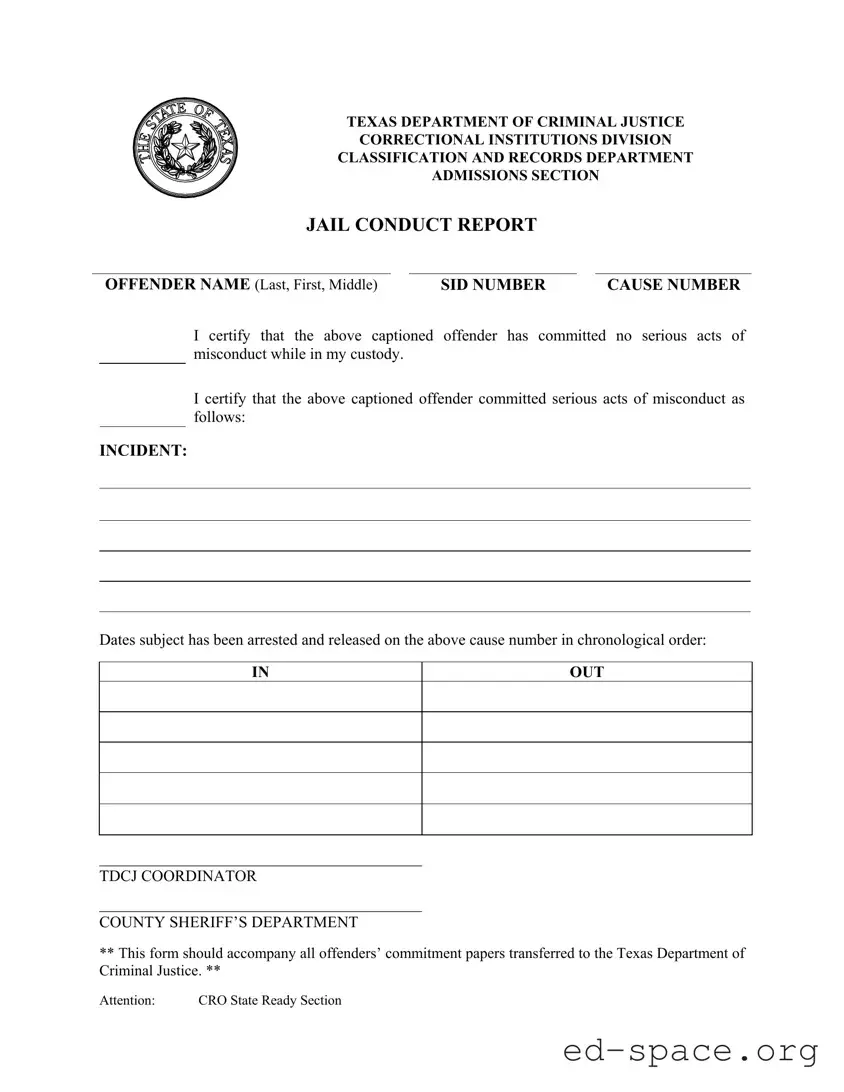
The Texas Jail Conduct Report form serves as a crucial document within the correctional system, specifically designed to track the behavior of offenders during their time in custody. This form requires the offender's name, SID number, and cause number, ensuring that all pertinent information is clearly linked to the individual in question. It serves a dual purpose: it certifies whether the offender has committed serious acts of misconduct while incarcerated or confirms their good behavior. The form outlines the specific incidents of misconduct, if any, and includes a chronological record of the dates on which the offender was arrested and subsequently released. Additionally, it mandates the signatures of both the TDCJ Coordinator and the County Sheriff’s Department, further validating the report's authenticity. Importantly, this document must accompany all commitment papers when offenders are transferred to the Texas Department of Criminal Justice, ensuring that their conduct is duly noted and considered during their incarceration and rehabilitation process.
| Fact Name | Details |
|---|---|
| Purpose of the Form | The Texas Jail Conduct Report form is used to document an offender's behavior while in custody, ensuring accurate records are maintained for their classification and transfer. |
| Required Information | The form requires the offender's name, SID number, cause number, and details regarding any serious acts of misconduct during their incarceration. |
| Certification | It includes a certification section where the responsible authority must affirm whether the offender committed serious acts of misconduct. |
| Governing Law | This form is governed by the Texas Government Code, specifically under Title 1, Chapter 501, which outlines the responsibilities of the Texas Department of Criminal Justice. |
After gathering the necessary information, you will be ready to fill out the Texas Jail Conduct Report form. Make sure to have all details at hand to ensure accuracy. Follow these steps to complete the form correctly.
What is the Texas Jail Conduct Report form?
The Texas Jail Conduct Report form is a document used by correctional facilities to record an offender's behavior while in custody. It provides a summary of any serious acts of misconduct or certifies that the offender has maintained good conduct during their time in jail.
Who needs to fill out the Texas Jail Conduct Report form?
This form must be completed by the jail staff or the TDCJ coordinator responsible for overseeing the offender's conduct. It is essential for ensuring accurate records are maintained regarding an offender's behavior.
What information is required on the form?
The form requires the offender's name, SID number, and cause number. Additionally, it includes a section for detailing any serious acts of misconduct and a chronological record of the dates the offender was arrested and released related to the cause number.
What does it mean to certify the offender's conduct?
By certifying the offender's conduct, the jail staff confirms whether the offender has committed serious acts of misconduct or has behaved well while in custody. This certification is crucial for the offender's record and future evaluations.
What happens if an offender has committed serious acts of misconduct?
If an offender has committed serious acts of misconduct, the form must detail these incidents. This information can impact the offender's classification and future treatment within the correctional system.
Where should the completed Texas Jail Conduct Report form be sent?
The completed form should accompany all offenders' commitment papers when they are transferred to the Texas Department of Criminal Justice. It must be sent to the CRO State Ready Section for processing.
Is the Texas Jail Conduct Report form necessary for all offenders?
Yes, this form is required for all offenders being transferred to the Texas Department of Criminal Justice. It ensures that the receiving facility has a complete understanding of the offender's conduct history.
Can the form be used for offenders who have not committed any misconduct?
Yes, the form can also be used to certify that an offender has committed no serious acts of misconduct. This positive record is beneficial for the offender's future evaluations.
What is the role of the TDCJ coordinator in this process?
The TDCJ coordinator is responsible for overseeing the completion of the form. They ensure that all necessary information is accurately recorded and that the form is submitted with the offender's commitment papers.
How does the Texas Jail Conduct Report form impact an offender's future?
The information on this form can significantly affect an offender's classification, parole eligibility, and overall treatment within the correctional system. A positive conduct report can lead to better opportunities for the offender.
Incomplete Information: Many individuals fail to provide all necessary details. Missing the offender's full name, SID number, or cause number can lead to processing delays.
Incorrect Dates: It's crucial to list the arrest and release dates accurately. Errors in chronological order can confuse the review process.
Failing to Certify: Some individuals neglect to check the appropriate certification box. This oversight can result in the form being considered invalid.
Omitting Serious Acts of Misconduct: If serious acts of misconduct occurred, they must be clearly documented. Failing to include this information can misrepresent the offender's behavior.
Not Following Submission Guidelines: The form must accompany the commitment papers. Ignoring this requirement can lead to delays in processing the offender's paperwork.
The Texas Jail Conduct Report form is an essential document used in the correctional system to record an offender's behavior while in custody. Several other forms and documents complement this report, providing a comprehensive view of an offender's history and conduct. Below is a list of these related documents.
These documents work together to create a detailed profile of an offender's conduct and circumstances within the correctional system. Each plays a critical role in ensuring that the offender's rights are protected and that appropriate measures are taken for their rehabilitation and reintegration into society.
The Texas Jail Conduct Report form is an essential document used in the correctional system. It serves as a record of an offender's behavior while in custody. There are several other documents that share similarities with this report. Here’s a closer look at four of them:
Each of these documents plays a crucial role in maintaining order and safety within correctional facilities. They help ensure that offenders are appropriately classified and managed based on their behavior while incarcerated.
When filling out the Texas Jail Conduct Report form, it’s important to follow certain guidelines to ensure accuracy and compliance. Here’s a list of things you should and shouldn’t do:
Understanding the Texas Jail Conduct Report form is essential for anyone involved in the correctional system. However, several misconceptions can lead to confusion. Here are seven common misunderstandings about this important document:
Many believe that the Texas Jail Conduct Report is only necessary for serious acts of misconduct. In reality, the form serves to document both serious and non-serious behavior, providing a complete picture of an offender's conduct.
While jail staff typically complete the report, it can also involve input from other relevant authorities. This ensures a comprehensive assessment of the offender's behavior.
Some think the report is optional when transferring offenders. However, it is mandatory for all commitment papers sent to the Texas Department of Criminal Justice, ensuring proper documentation.
This form does not limit itself to incidents occurring within jail walls. It also tracks behavior during the entire period of custody, including arrests and releases.
Many assume that the conduct report has no bearing on future evaluations. In fact, it plays a crucial role in assessing an offender's behavior for parole considerations and other legal matters.
While certain details may be protected, the information on the conduct report can be shared with relevant agencies and parties involved in the offender's case.
Some believe that the Texas Jail Conduct Report is an outdated practice. However, it remains a vital tool for maintaining order and accountability within the correctional system.
Clearing up these misconceptions can lead to a better understanding of the Texas Jail Conduct Report form and its importance in the correctional process.
Here are some key takeaways about filling out and using the Texas Jail Conduct Report form: