Homepage Blank Texas Homestead Exemption PDF Form
Content Overview

The Texas Homestead Exemption form is a critical document for homeowners seeking to reduce their property tax burden. This application allows eligible individuals to claim various exemptions on their primary residence, which can significantly lower their taxable value. Homeowners must complete the form accurately and submit it to the Harris County Appraisal District by specific deadlines, typically between January 1 and April 30 of the tax year. The form requires essential information, including the applicant's ownership status, details about the property, and any applicable exemptions, such as those for individuals aged 65 and older or for disabled persons. It is important to note that incomplete applications cannot be processed, which underscores the necessity for thoroughness. Additionally, applicants must be prepared to provide supporting documentation, such as proof of residency and ownership, as well as respond promptly to any requests for further information from the chief appraiser. Understanding the requirements and timelines associated with this form is vital for homeowners who wish to take full advantage of the exemptions available to them.


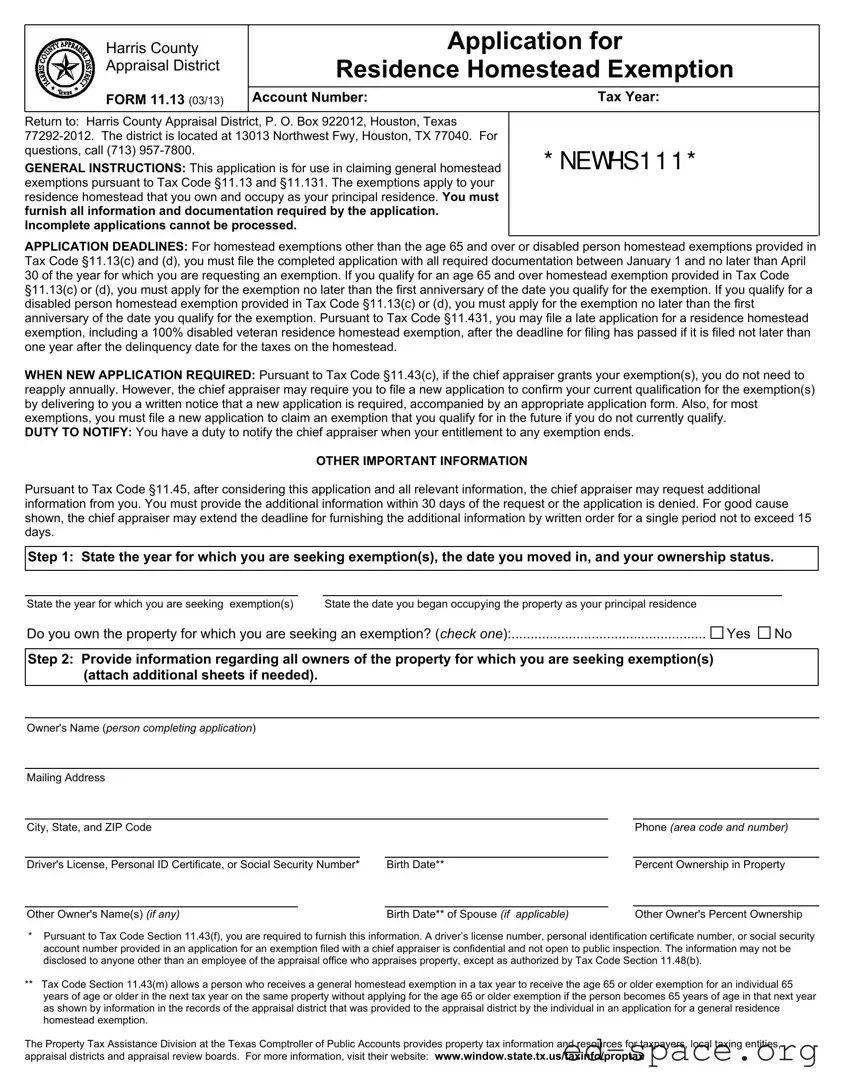
Document Preview

Harris County
Appraisal District
FORM 11.13 (03/13)
Account Number:
Tax Year:
* NEWHS111*
Application for
Residence Homestead Exemption
Return to: Harris County Appraisal District, P. O. Box 922012, Houston, Texas
77292-2012. The district is located at 13013 Northwest Fwy, Houston, TX 77040. For
questions, call (713) 957-7800.
GENERAL INSTRUCTIONS: This application is for use in claiming general homestead
exemptions pursuant to Tax Code §11.13 and §11.131. The exemptions apply to your
residence homestead that you own and occupy as your principal residence. You must
furnish all information and documentation required by the application.
Incomplete applications cannot be processed.
APPLICATION DEADLINES: For homestead exemptions other than the age 65 and over or disabled person homestead exemptions provided in
Tax Code §11.13(c) and (d), you must file the completed application with all required documentation between January 1 and no later than April
30 of the year for which you are requesting an exemption. If you qualify for an age 65 and over homestead exemption provided in Tax Code
§11.13(c) or (d), you must apply for the exemption no later than the first anniversary of the date you qualify for the exemption. If you qualify for a
disabled person homestead exemption provided in Tax Code §11.13(c) or (d), you must apply for the exemption no later than the first
anniversary of the date you qualify for the exemption. Pursuant to Tax Code §11.431, you may file a late application for a residence homestead
exemption, including a 100% disabled veteran residence homestead exemption, after the deadline for filing has passed if it is filed not later than
one year after the delinquency date for the taxes on the homestead.
WHEN NEW APPLICATION REQUIRED: Pursuant to Tax Code §11.43(c), if the chief appraiser grants your exemption(s), you do not need to
reapply annually. However, the chief appraiser may require you to file a new application to confirm your current qualification for the exemption(s)
by delivering to you a written notice that a new application is required, accompanied by an appropriate application form. Also, for most
exemptions, you must file a new application to claim an exemption that you qualify for in the future if you do not currently qualify.
DUTY TO NOTIFY: You have a duty to notify the chief appraiser when your entitlement to any exemption ends.
OTHER IMPORTANT INFORMATION
Pursuant to Tax Code §11.45, after considering this application and all relevant information, the chief appraiser may request additional
information from you. You must provide the additional information within 30 days of the request or the application is denied. For good cause
shown, the chief appraiser may extend the deadline for furnishing the additional information by written order for a single period not to exceed 15
days.
Step 1: State the year for which you are seeking exemption(s), the date you moved in, and your ownership status.
State the year for which you are seeking exemption(s) State the date you began occupying the property as your principal residence
Do you own the property for which you are seeking an exemption? (check one):................................................... Yes No
Step 2: Provide information regarding all owners of the property for which you are seeking exemption(s)
(attach additional sheets if needed).
Owner's Name (person completing application)
Mailing Address
City, State, and ZIP Code Phone (area code and number)
Percent Ownership in Property
Other Owner's Name(s) (if any)
Driver's License, Personal ID Certificate, or Social Security Number*
Other Owner's Percent Ownership
Birth Date**
Birth Date** of Spouse (if applicable)
* Pursuant to Tax Code Section 11.43(f), you are required to furnish this information. A driver’s license number, personal identification certificate number, or social security
account number provided in an application for an exemption filed with a chief appraiser is confidential and not open to public inspection. The information may not be
disclosed to anyone other than an employee of the appraisal office who appraises property, except as authorized by Tax Code Section 11.48(b).
** Tax Code Section 11.43(m) allows a person who receives a general homestead exemption in a tax year to receive the age 65 or older exemption for an individual 65
years of age or older in the next tax year on the same property without applying for the age 65 or older exemption if the person becomes 65 years of age in that next year
as shown by information in the records of the appraisal district that was provided to the appraisal district by the individual in an application for a general residence
homestead exemption.
The Property Tax Assistance Division at the Texas Comptroller of Public Accounts provides property tax information and resources for taxpayers, local taxing entities,
appraisal districts and appraisal review boards. For more information, visit their website: www.window.state.tx.us/taxinfo/proptax
Step 3: Describe the property for which you are seeking exemption(s).
Street Address, City, State, and ZIP Code
Legal Description (if known) Appraisal District Account Number (if known)
Number of acres (not to exceed 20) used for residential occupancy of the structure:
(Note: the structure and the land and improvements must have identical ownership)......................... acres
For a MANUFACTURED HOME, state the make, model and identification number
Step 4: Identify exemptions that apply to you and state whether you are transferring a tax ceiling.
Brief descriptions of qualifications for the exemptions listed are provided under each listing; however, to obtain complete information, you should
consult the Tax Code. For assistance, you may contact your appraisal district or the Comptroller’s Property Tax Assistance Division. If your
appraisal district has not provided with this application a list of taxing units served by the appraisal district with all residential homestead
exemptions each taxing unit offers, you may call the appraisal district to determine what homestead exemptions are offered by your taxing units.
GENERAL RESIDENCE HOMESTEAD EXEMPTION (Tax Code §11.13): You may qualify for this exemption if for the current year and, if
filing a late application, for the year for which you are seeking an exemption: (1) you owned this property on January 1; (2) you occupied it
as your principal residence on January 1; and (3) you and your spouse do not claim a residence homestead exemption on any other
property.
DISABLED PERSON EXEMPTION (Tax Code §11.13(c), (d)): You may qualify for this exemption if you are under a disability for purposes
of payment of disability insurance benefits under Federal Old-Age, Survivors, and Disability Insurance. You can’t receive an age 65 or older
exemption if you receive this exemption.
AGE 65 OR OLDER EXEMPTION (Tax Code §11.13(c), (d)): You may qualify for this exemption if you are 65 years of age or older. You
cannot receive a disability exemption if you receive this exemption.
SURVIVING SPOUSE OF INDIVIDUAL WHO QUALIFIED FOR AGE 65 OR OLDER EXEMPTION UNDER TAX CODE
§11.13(d) (Tax Code §11.13(q)): You may qualify for this exemption if: (1) your deceased spouse died in a year in which he or she qualified
for the exemption under Tax Code §11.13(d); (2) you were 55 years of age or older when your deceased spouse died; and (3) the property
was your residence homestead when your deceased spouse died and remains your residence homestead. You can’t receive this exemption
if you receive an exemption under Tax Code §11.13(d).
Name of Deceased Spouse Date of Death
100% DISABLED VETERANS EXEMPTION (Tax Code §11.131): You may qualify for this exemption if you are a disabled veteran who
receives from the United States Department of Veterans Affairs or its successor: (1) 100 percent disability compensation due to a
service-connected disability; and (2) a rating of 100 percent disabled or individual unemployability. If you qualify for a 100% disabled
veteran’s exemption after January 1 of a tax year that begins on or after January 1, 2012, you may receive the exemption for the applicable
portion of that tax year immediately on qualification for the exemption.
SURVIVING SPOUSE OF DISABLED VETERAN WHO RECEIVED THE 100% DISABLED VETERAN’S EXEMPTION (Tax Code §11.131):
You may qualify for this exemption if you were married to a disabled veteran who qualified for an exemption under Tax Code §11.131 at the
time of his or her death and: (1) you have not remarried since the death of the disabled veteran and (2) the property was your residence
homestead when the disabled veteran died and remains your residence homestead.
Name of Deceased Spouse Date of Death
Check if you seek to transfer a school tax limitation from your last home pursuant to Tax Code §11.26(h).
Step 5: Attach required documents.
Include with ALL applications (Note: The chief appraiser may not approve an exemption unless the address on the driver’s license or
state-issued personal identification certificate corresponds to the address on the applicant’s vehicle registration receipt or utility bill
AND the address indicated on the application form.):
1) a copy of the applicant’s driver’s license or state-issued personal identification certificate; and
2) a copy of the applicant’s vehicle registration receipt; or
a) if the applicant does not own a vehicle, an affidavit to that effect signed by the applicant; and
b) a copy of a utility bill in the applicant’s name for the property for which exemption is sought.
Include with an application for a request for an AGE 65 OR OLDER OR DISABLED exemption:
In addition to the information identified above, an applicant for an age 65 or older or disabled exemption who is not specifically identified on a
deed or other instrument recorded in the applicable real property records as an owner of the residence homestead must provide an affidavit or
other compelling evidence establishing the applicant’s ownership of an interest in the homestead.
Include with an application for a request for a 100% DISABLED VETERANS exemption:
In addition to the information identified above, an applicant for a 100% disabled veterans exemption or the surviving spouse of a disabled
veteran who qualified for the 100% disabled veteran’s exemption must provide documentation from the United States Department of Veterans
Affairs or its successor indicating that the veteran received 100 percent disability compensation due to a service-connected disability and had a
rating of 100 percent disabled or individual unemployability.
Include with applications for MANUFACTURED HOMES:
For a manufactured home to qualify for a residence homestead, applicant must ALSO include:
1) a copy of the statement of ownership and location for the manufactured home issued by the Texas Department of Housing and Community
Affairs showing that the applicant is the owner of the manufactured home;
2) a copy of the purchase contract or payment receipt showing that the applicant is the purchaser of the manufactured home; or
3) a sworn affidavit by the applicant indicating that:
a) the applicant is the owner of the manufactured home;
b) the seller of the manufactured home did not provide the applicant with a purchase contract; and
c) the applicant could not locate the seller after making a good faith effort.
Do you have an exclusive right to occupy this unit because you own stock in a cooperative housing corporation?..... Yes No
Step 6: (Cooperative Housing Residents) Provide statement regarding your right to occupy the property.
Step 7: Read, sign, and date.
By signing this application, you state that the facts in this application are true and correct, that you do not claim a residence homestead
exemption on another residence homestead in Texas, and that you do not claim a residence homestead exemption on a residence homestead
outside of Texas.
NOTICE REGARDING PENALTIES FOR MAKING OR FILING AN APPLICATION CONTAINING A FALSE STATEMENT: If you make a
false statement on this form, you could be found guilty of a Class A misdemeanor or a state jail felony under Section 37.10, Penal
Code.
Your signature on this application constitutes a sworn statement that you have read and understand the Notice Regarding Penalties for Making
or Filing an Application Containing a False Statement.
sign
here
â
Authorized Signature Date
Printed Name
Affidavits: Complete and have notarized, if applicable (see Step 5, above).
NON-OWNERSHIP OF MOTOR VEHICLE AFFIDAVIT
STATE OF TEXAS
COUNTY OF
Before me, the undersigned authority, personally appeared ,
who, being by me duly sworn, deposed as follows:
“My name is . I am over 18 years of age and I am otherwise fully competent
to make this affidavit. I have personal knowledge of the facts contained herein and all of same are true and correct.
I do not own a vehicle.
Further, Affiant sayeth not.”
Signature of Affiant SUBSCRIBED AND SWORN TO before me this, the
day of ,
Notary Public in and for the State of Texas
My Commission expires:
AGE 65 OR OLDER/DISABLED EXEMPTION AFFIDAVIT
STATE OF TEXAS
COUNTY OF
Before me, the undersigned authority, personally appeared ,
who, being by me duly sworn, deposed as follows:
“My name is . I am over 18 years of age and I am otherwise fully competent
to make this affidavit. I have personal knowledge of the facts contained herein and all of same are true and correct.
I have a percent ownership in the residence homestead identified in the foregoing exemption application.
Further, Affiant sayeth not.”
Signature of Affiant SUBSCRIBED AND SWORN TO before me this, the
day of ,
Notary Public in and for the State of Texas
My Commission expires:
MANUFACTURED HOME AFFIDAVIT
STATE OF TEXAS
COUNTY OF
Before me, the undersigned authority, personally appeared ,
who, being by me duly sworn, deposed as follows:
“My name is . I am over 18 years of age and I am otherwise fully competent
to make this affidavit. I have personal knowledge of the facts contained herein and all of same are true and correct.
I am the owner of the manufactured home identified in the foregoing exemption application. The seller of the manufactured home did not provide me with a
purchase contract and I could not locate the seller after making a good faith effort.
Further, Affiant sayeth not.”
Signature of Affiant SUBSCRIBED AND SWORN TO before me this, the
day of ,
Notary Public in and for the State of Texas
My Commission expires:

Form Specifications

Fact Name Description
Application Purpose The Texas Homestead Exemption form is used to claim general homestead exemptions for properties that individuals own and occupy as their principal residence.
Filing Deadline Applications must be submitted between January 1 and April 30 for the tax year in question, unless qualifying for exemptions for individuals aged 65 or older or disabled, which have different deadlines.
Governing Laws The exemptions are governed by Texas Tax Code §11.13 and §11.131, among others, which outline eligibility criteria and application procedures.
Notification Requirement Applicants must notify the chief appraiser when their eligibility for any exemption ends, ensuring that the appraisal district has current information.

Texas Homestead Exemption: Usage Guidelines

Filling out the Texas Homestead Exemption form is a straightforward process. It is important to provide accurate information to ensure your application is processed smoothly. Follow these steps carefully to complete the form correctly.

  1. State the year for which you are seeking exemption(s), the date you moved in, and your ownership status.
  2. Provide information regarding all owners of the property for which you are seeking exemption(s). Include the owner’s name, mailing address, phone number, and other required details.
  3. Describe the property for which you are seeking exemption(s). Include the street address, legal description, appraisal district account number, and number of acres used for residential occupancy.
  4. Identify exemptions that apply to you and state whether you are transferring a tax ceiling. Check the appropriate boxes for the exemptions you qualify for.
  5. Attach required documents. Include a copy of your driver’s license or state-issued ID, vehicle registration receipt, and any additional documentation needed for specific exemptions.
  6. If applicable, provide a statement regarding your right to occupy the property if you reside in cooperative housing.
  7. Read, sign, and date the application. Ensure you understand the penalties for providing false information before signing.

Your Questions, Answered

What is the Texas Homestead Exemption form?

The Texas Homestead Exemption form is an application used to claim exemptions on property taxes for your primary residence. It allows homeowners to reduce the taxable value of their home, which can lead to lower property taxes. The form must be completed accurately and submitted to the Harris County Appraisal District along with necessary documentation.

Who is eligible for the homestead exemption?

To qualify for the homestead exemption, you must own and occupy the property as your principal residence. You cannot claim a homestead exemption on more than one property at a time. Additional exemptions are available for individuals aged 65 and older, disabled persons, and surviving spouses of qualifying individuals.

What are the application deadlines for the homestead exemption?

For most homestead exemptions, applications must be submitted between January 1 and April 30 of the tax year for which you are requesting the exemption. If you qualify for an exemption based on age or disability, you must apply by the first anniversary of when you qualify. Late applications may be accepted under certain conditions, but they must be submitted within one year of the tax delinquency date.

Do I need to reapply for the homestead exemption every year?

If your exemption is granted, you typically do not need to reapply annually. However, if the chief appraiser requests a new application to confirm your eligibility, you must comply. Also, if your circumstances change and you no longer qualify, you must notify the appraisal district.

What documents are required to submit with the application?

When applying for the homestead exemption, you must include a copy of your driver’s license or state-issued ID, a vehicle registration receipt, or an affidavit if you do not own a vehicle. Additionally, utility bills in your name are required. Specific exemptions, such as those for age or disability, may require additional documentation.

What happens if I submit an incomplete application?

If your application is incomplete, it cannot be processed. The chief appraiser may request additional information, which you must provide within 30 days. Failure to do so may result in denial of your application. It is essential to ensure all required information and documentation are included when submitting your application.

Can I transfer my homestead exemption to a new property?

Yes, you may be able to transfer your homestead exemption to a new property under certain conditions. This often applies to individuals aged 65 and older or disabled veterans. You will need to file a new application for the new property and indicate your desire to transfer the exemption.

Where do I send my completed application?

Your completed application should be mailed to the Harris County Appraisal District at P.O. Box 922012, Houston, Texas 77292-2012. You can also visit their office at 13013 Northwest Fwy, Houston, TX 77040. If you have questions, you can reach them at (713) 957-7800.

Common mistakes

  1. Missing Information: Many applicants forget to fill in all required fields. Ensure that you provide your name, address, and ownership status. Incomplete forms cannot be processed.

  2. Wrong Deadline: People often miss the filing deadline. Remember, applications must be submitted between January 1 and April 30 for the current tax year, unless you qualify for an age or disability exemption.

  3. Incorrect Documentation: Failing to include necessary documents is a common mistake. Always attach a copy of your driver’s license or state ID and a utility bill or vehicle registration that matches the address on your application.

  4. Not Updating Ownership Changes: If your ownership status changes, you need to notify the chief appraiser. Failing to do so can lead to issues with your exemption status.

  5. Ignoring Additional Information Requests: If the chief appraiser asks for more information, respond within 30 days. Not doing this can result in your application being denied.

Documents used along the form

The Texas Homestead Exemption form is essential for homeowners seeking tax relief on their primary residence. Along with this form, several other documents may be required to support your application. Below is a list of commonly used forms and documents that can assist in the exemption process.

  • Driver’s License or State-Issued ID: A copy of the applicant's driver’s license or state-issued personal identification certificate is necessary to verify identity and residency.
  • Vehicle Registration Receipt: This document proves vehicle ownership and must correspond with the address on the exemption application. If the applicant does not own a vehicle, an affidavit stating this is required.
  • Utility Bill: A recent utility bill in the applicant’s name serves as additional proof of residency at the property for which the exemption is sought.
  • Affidavit of Non-Ownership of Vehicle: If the applicant does not own a vehicle, this notarized affidavit must be submitted to affirm this status.
  • Age 65 or Older/Disabled Exemption Affidavit: This affidavit must be completed and notarized by applicants seeking exemptions based on age or disability, confirming ownership and eligibility.
  • Manufactured Home Affidavit: If the property is a manufactured home, this affidavit is necessary to establish ownership and confirm that a purchase contract was not provided by the seller.

Gathering these documents can streamline the application process and help ensure that your claim for the Texas Homestead Exemption is processed efficiently. It is important to keep all documentation accurate and up to date to avoid any delays or complications.

Similar forms

The Texas Homestead Exemption form shares similarities with several other documents related to property ownership and tax exemptions. Here’s a list of seven documents that reflect these similarities:

  • Property Tax Exemption Application: Like the homestead exemption form, this application is used to claim tax exemptions on property, requiring proof of ownership and occupancy.
  • Disabled Veterans Exemption Form: This document is specifically for veterans seeking tax relief due to disability, similar to how the homestead exemption assists homeowners based on their residency status.
  • Age 65 or Older Exemption Application: This form is designed for seniors to claim tax benefits, paralleling the homestead exemption in its focus on specific demographic qualifications.
  • Surviving Spouse Exemption Form: Just as the homestead exemption provides benefits based on residency, this form allows surviving spouses to claim exemptions based on their deceased partner’s qualifications.
  • Affidavit of Non-Ownership of Motor Vehicle: This affidavit is often required alongside exemption applications, mirroring the need for supporting documentation found in the homestead exemption process.
  • Manufactured Home Affidavit: Similar to the homestead exemption, this affidavit verifies ownership of a manufactured home and its eligibility for tax exemptions, emphasizing the need for ownership proof.
  • Income Verification Form for Tax Exemptions: This form is used to confirm income levels for various tax exemptions, akin to how the homestead exemption requires income and ownership verification.

Dos and Don'ts

When filling out the Texas Homestead Exemption form, it is essential to approach the process with care and attention to detail. Here are five key dos and don'ts to keep in mind:

  • Do ensure you file your application by the deadline, which is between January 1 and April 30 for most exemptions.
  • Do provide all required documentation, including your driver’s license and proof of residency.
  • Do double-check that all information is accurate and complete before submission to avoid delays.
  • Don't forget to notify the chief appraiser if your eligibility for the exemption changes.
  • Don't submit an incomplete application, as it will not be processed.

By adhering to these guidelines, applicants can navigate the process more smoothly and increase their chances of receiving the exemption they seek.

Misconceptions

Understanding the Texas Homestead Exemption can be complex, and several misconceptions often arise. Here are nine common misunderstandings:

  1. Homestead Exemptions Are Automatic: Many believe that once they qualify for a homestead exemption, they will automatically receive it each year. In reality, you must notify the chief appraiser if your eligibility changes.
  2. Only Homeowners Can Apply: Some think that only those who own their home can apply for the exemption. However, renters who have a long-term lease and meet certain criteria may also qualify.
  3. Filing Late is Impossible: There is a belief that if you miss the filing deadline, you cannot apply at all. In fact, you can file a late application within one year of the tax delinquency date.
  4. All Properties Qualify: Not every property qualifies for the homestead exemption. The property must be your principal residence, and you cannot claim an exemption on multiple properties simultaneously.
  5. Age 65 or Older Exemption is Automatic: Many assume that once they turn 65, they automatically receive the age 65 or older exemption. You must apply for it within a year of qualifying.
  6. Documentation is Optional: Some individuals think that they can submit the application without providing all required documents. Incomplete applications cannot be processed.
  7. Exemptions Transfer Automatically: There is a misconception that if you move, your exemptions will automatically transfer to your new home. You must file a new application for the new property.
  8. Only One Type of Exemption Can Be Claimed: Many believe they can only claim one exemption. However, it is possible to qualify for multiple exemptions, such as age 65 or older and disabled veteran exemptions.
  9. Exemptions Are the Same Across Texas: People often think that the homestead exemption process is the same in every Texas county. In reality, different counties may have varying requirements and deadlines.

Being informed about these misconceptions can help ensure that you take full advantage of the benefits available to you under the Texas Homestead Exemption program.

Key takeaways

Filling out the Texas Homestead Exemption form can be straightforward if you keep a few key points in mind. Here are some important takeaways to help you navigate the process:

  • Eligibility Requirements: Ensure you own and occupy the property as your principal residence. You cannot claim the exemption on more than one property.
  • Application Deadline: Submit your application by April 30 for the current tax year, unless you qualify for age 65 or disabled exemptions, which have different deadlines.
  • Complete Documentation: Include all required documents, such as your driver’s license and proof of residence. Incomplete applications cannot be processed.
  • Notification Duty: If your eligibility for the exemption changes, you must notify the chief appraiser promptly to avoid issues with your exemption status.
  • Reapplication Not Always Necessary: If granted an exemption, you typically do not need to reapply annually unless requested by the chief appraiser.

By keeping these points in mind, you can ensure a smoother experience when applying for the Texas Homestead Exemption.