Homepage Blank Texas Ethics Of Engineering Exam PDF Form
Content Overview

The Texas Ethics of Engineering Exam form is a crucial document designed to assess the understanding of ethical and professional responsibilities among engineering license applicants in Texas. This examination is based on the Texas Engineering Practice Act and Board Rules, which outline the standards governing engineering practices within the state. Candidates have two options for taking the exam: they can either download and fill out the answer sheet EB-01 while referencing the Texas Engineering Practice Act and Board Rules, or they can complete the exam online, where all necessary materials are readily accessible. The examination aims to ensure that applicants are well-versed in the ethical, professional, and legal standards that apply to engineering practices. It emphasizes the importance of compliance with the Act and board rules, which have been established to protect public health, safety, and welfare. The exam includes a series of scenarios that reflect real-life ethical dilemmas engineers may face, requiring candidates to apply their knowledge to select the best answers. A passing score of 92% is required to meet the Board's standards, and candidates are permitted to retake the exam if they do not succeed on their first attempt. By fostering a thorough understanding of these principles, the Texas Ethics of Engineering Exam serves as a foundational step for aspiring engineers to navigate their professional responsibilities effectively.

Document Preview

"Texas Engineering Professional Conduct and Ethics Examination”-- Texas Board of Professional Engineers and Land Surveyors
Version XIII-- Page 1 of 9
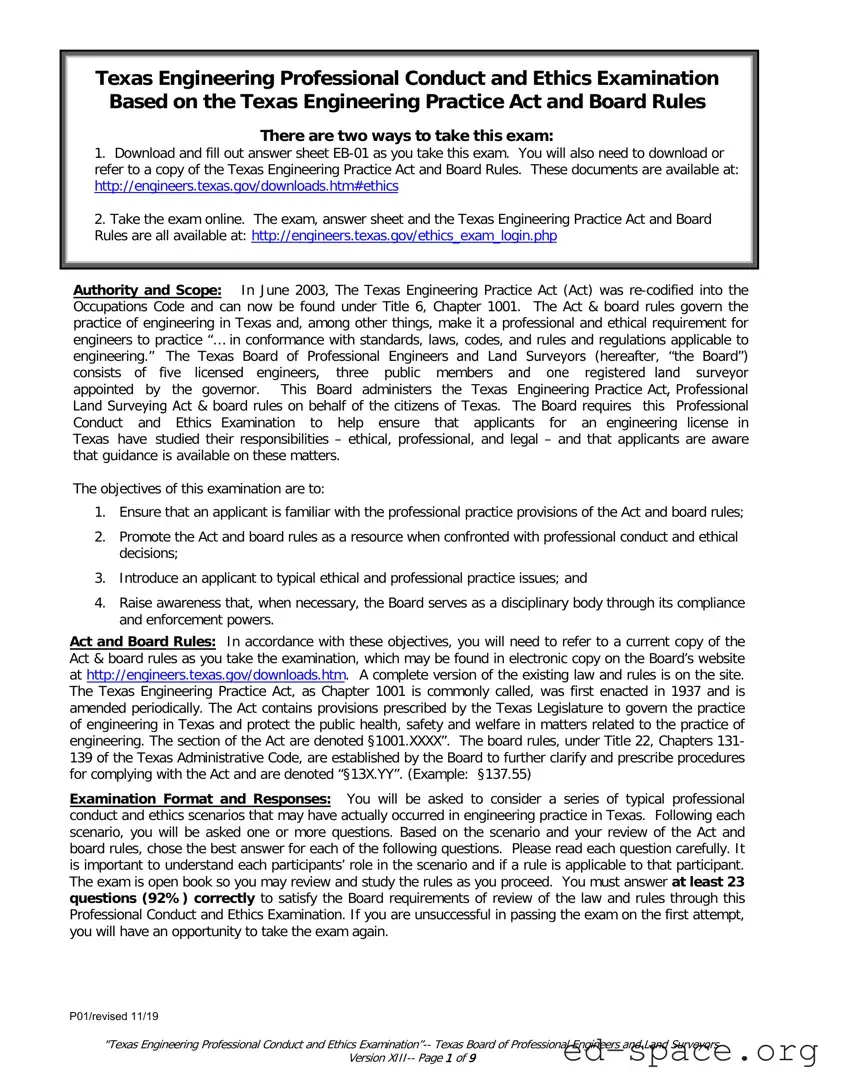
Texas Engineering Professional Conduct and Ethics Examination
Based on the Texas Engineering Practice Act and Board Rules
There are two ways to take this exam:
1. Download and fill out answer sheet EB-01 as you take this exam. You will also need to download or
refer to a copy of the Texas Engineering Practice Act and Board Rules. These documents are available at:
http://engineers.texas.gov/downloads.htm#ethics
2. Take the exam online. The exam, answer sheet and the Texas Engineering Practice Act and Board
Rules are all available at: http://engineers.texas.gov/ethics_exam_login.php
Authority and Scope: In June 2003, The Texas Engineering Practice Act (Act) was re-codified into the
Occupations Code and can now be found under Title 6, Chapter 1001. The Act & board rules govern the
practice of engineering in Texas and, among other things, make it a professional and ethical requirement for
engineers to practice “… in conformance with standards, laws, codes, and rules and regulations applicable to
engineering.” The Texas Board of Professional Engineers and Land Surveyors (hereafter, “the Board”)
consists of five licensed engineers, three public members and one registered land surveyor
appointed by the governor. This Board administers the Texas Engineering Practice Act, Professional
Land Surveying Act & board rules on behalf of the citizens of Texas. The Board requires this Professional
Conduct and Ethics Examination to help ensure that applicants for an engineering license in
Texas have studied their responsibilities ethical, professional, and legal and that applicants are aware
that guidance is available on these matters.
The objectives of this examination are to:
1. Ensu
re that an applicant is familiar with the professional practice provisions of the Act and board rules;
2. Promote the Act and board rules as a resource when confronted with professional conduct and ethical
decisions;
3. Introduce an applicant to typical ethical and professional practice issues; and
4. Raise awareness that, when necessary, the Board serves as a disciplinary body through its compliance
and enforcement powers.
Act and Board Rules: In accordance with these objectives, you will need to refer to a current copy of the
Act & board rules as you take the examination, which may be found in electronic copy on the Board’s website
at
http://engineers.texas.gov/downloads.htm. A complete version of the existing law and rules is on the site.
The Texas Engineering Practice Act, as Chapter 1001 is commonly called, was first enacted in 1937 and is
amended periodically. The Act contains provisions prescribed by the Texas Legislature to govern the practice
of engineering in Texas and protect the public health, safety and welfare in matters related to the practice of
engineering. The section of the Act are denoted §1001.XXXX”. The board rules, under Title 22, Chapters 131-
139 of the Texas Administrative Code, are established by the Board to further clarify and prescribe procedures
for complying with the Act and are denoted “§13X.YY”. (Example: §137.55)
Examination Format and Responses: You will be asked to consider a series of typical professional
conduct and ethics scenarios that may have actually occurred in engineering practice in Texas. Following each
scenario, you will be asked one or more questions. Based on the scenario and your review of the Act and
board rules, chose the best answer for each of the following questions. Please read each question carefully. It
is important to understand each participants’ role in the scenario and if a rule is applicable to that participant.
The exam is open book so you may review and study the rules as you proceed. You must answer at least 23
questions (92%) correctly to satisfy the Board requirements of review of the law and rules through this
Professional Conduct and Ethics Examination. If you are unsuccessful in passing the exam on the first attempt,
you will have an opportunity to take the exam again.
P01/revised 11/19
"Texas Engineering Professional Conduct and Ethics Examination”-- Texas Board of Professional Engineers and Land Surveyors
Version XIII-- Page 2 of 9
Texas Engineering Professional Conduct and Ethics Examination
Scenario 1
Direct Supervision and Sealing of Engineering Work
B
rian is a graduate engineer and has passed the
FE exam but is not yet licensed. He is employed
by a small engineering firm, and works with Jim,
a licensed professional engineer and owner of
the company. The firm is retained to do the
structural design of a new rural public school.
The project is assigned to Brian.
A
fter completing his preliminary calculations for
the structure, Brian does a computer analysis of
some of the more complex aspects of the
design. This computer analysis shows Brian’s
hand calculations are essentially correct.
Although Brian feels he is quite thorough and
conscientious, he notices that Jim is rarely in the
office, provides little or no supervision, and
never checks Brian’s work before sealing and
submitting the plans and specifications to the
client for the bidding and construction phases.
B
rian wonders if Jim is in conformance with the
Act and board rules and decides to discuss the
matter with him.
Question 1. The board rule that most clearly
addresses sealing requirements is:
A) §137.55(a)
B) §137.59(a)
C) §137.33(b)
D) §137.63(c)(1)
E) §137.63(b)(2)
After talking with Brian, Jim agrees that he
needs to review the design. He studies it in
detail, noting a few minor errors in the wind
loading that Brian used, but finds nothing that
would require changes in the design when
constructed at that location.
Brian appreciates the feedback and becomes
more comfortable in his job. Then Brian learns
P01/revised 11/19
that Jim has given the design plans and
specifications to his brother, Christopher, a
construction contractor, not a licensed engineer.
R
ather than hire an engineer, Christopher
incorporates the design documents into a design-
build proposal for a like-sized (small) school. Jim is
aware of this and does not object.
Question 2. Which board rule best relates to Jim
knowingly allowing Christopher to use his design as
described?
A) §137.63(c)(1)
B) §137.33(i)
C) §137.55(b)
D) §137.65(a)
E) §137.33(f)
Question 3. Which section of the Act or board
rule relates to Christopher’s actions?
A) § 137.59(a)
B) § 137.65
C) § 139.13
D) § 1001.004
E) § 139.17
In
part due to the competitive advantage afforded
by using an existing set of drawings, Christopher’s
company wins the design-build contract for the
school. Christopher studied mechanical
engineering in college and designs the mechanical
systems for the school. He knows he needs an
engineer’s seal on the drawings before he can get
a permit to start construction. He has a good
friend, David, who is a mechanical engineer
licensed in Texas, so Christopher asks David to seal
the drawings.
David obtains a digital copy of Christopher’s
drawings, carefully reviews each sheet, adds the
title block and other administrative designations,
and affixes his engineer’s seal to the drawings.
"Texas Engineering Professional Conduct and Ethics Examination”-- Texas Board of Professional Engineers and Land Surveyors
Version XIII-- Page 3 of 9
David’s act of sealing Christopher’s design
drawings can be evaluated based on definitions
in §131.81 of Act and board rules, in particular,
direct supervision,
” “
responsible charge,
” and
responsible supervision
.”
Question 4. Does David meet the
requirements of direct supervision in as defined
in §131.81 of the board rules?
A) Yes
B) No
Se
aling work not performed under an engineer’s
direct supervision is commonly termed “plan
stamping.” Violations of the Act or any rule or
regulation of the Board is sufficient cause for the
Board to suspend or revoke an engineer’s
license, to issue a formal or informal reprimand,
or to issue administrative fines.
Question 5. What Section of the Act allows the
Board to discipline a license holder?
A) §1001.4525
B) §1001.203
C) §1001.405
D) §1001.407
E) §1001.451
Question 6. Assume that David is found to have
sealed work not performed under his direct
supervision, what would be the recommended
sanction for this violation based on the table in
§139.35(b)?
A) Reprimand/$1,500 fine
B) 2 year suspension/ $4,000 fine
C) 3 year suspension/$5,000 fine
D) Revocation/$5,000 fine
E) 1 year suspension/$750 fine
Scenario 2
“Why Licensure?”
Trish is an unlicensed software engineer and has
wondered why licensing of engineers is
important.
Her friend José, a licensed engineer, explains
that the licensing process was established by
the Texas Legislature after a tragic explosion of
a school in New London, Texas in 1937, in
which more than 200 children and teachers
were killed.
José elaborates that the Law states that the
privilege of practicing engineering is entrusted
only to those persons duly licensed, this in order
to protect the health, safety and welfare of the
public.
José gives Trish a copy of the Act and board
rules for reference. Although Trish works for an
industry that is exempt” from the requirement
of licensure, she learns that if she ever offers or
provides engineering services outside her
company, she will be required to be licensed.
P01/revised 11/19
Question 7. Which Section of the Texas Act
would exempt an engineering employee working
solely for a manufacturing firm from the
engineering licensure provisions of the Act?
A) §1001.057
B) §1001.056
C) §1001.060
D) §1001.058
E) §1001.055
T
hrough further inquiry, Trish learns that she
cannot advance to the top administrative positions
of her company unless she has an engineering
license. She informs the corporate engineering
director of her interest in licensure, and he
encourages her to pursue it.
A
fter studying the Act and board rules, Trish learns
that the licensure process requires, among other
things, documentation of her engineering
experience and suitable engineering references.
But this causes Trish to be concerned about a
previous employment situation which she left due
to difficult personal reasons not related to her
technical abilities.
"Texas Engineering Professional Conduct and Ethics Examination”-- Texas Board of Professional Engineers and Land Surveyors
Version XIII-- Page 4 of 9
Although she knows she is technically
competent and is a talented engineer, Trish is
fairly certain that her former supervisor,
Quentin, a licensed engineer, holds a grudge
against her and will not give her a favorable
reference because of the difficult circumstances
surrounding her departure. Nevertheless, Trish
decides to ask Quentin to verify this portion of
her engineering experience in her application
since he was her engineering supervisor.
Question 8. Which Section in the Act or which
board rules should protect Trish from a retaliatory
action from her former supervisor?
A) §1001.212
B) §1001.452
C) §133.51(c)
D) §137.63(c)(2)
E) §137.37
Scenario 3
Competitive Bidding, Political Contributions, and Marketing
Rachelle, a licensed engineer and corporate
officer in her engineering firm, has been very
involved in community affairs over her entire
professional career, and is supportive of political
candidates who represent what she believes to
be better government.
A local county official, Phillip, has gained acclaim
by seeking better recreational facilities for the
economically disadvantaged persons of his
county. Phillip sends Rachelle a Request for
Proposal (RFP) which requests a bid for a
hydrology study associated with a new phase of
development in a low-lying park area.
The RFP emphasizes that County funds are
limited, that Phillip intends that the project help
as many disadvantaged persons as possible, and
that the fee will be considered in selection of the
engineer.
While Rachelle is sympathetic with Phillip’s
aspirations to help the disadvantaged, she
responds to the RFP with a letter stating that
competitive bidding for engineering services in
the public sector is prohibited by law under the
Professional Services Procurement Act (PSPA).
She reminded Phillip that, according to the
Texas board rules, an engineer can be
sanctioned for bidding engineering services on
public works.
Question 9. Which Section of the Act or board
rule most clearly directs an engineer on the
P01/revised 11/19
matter of competitive bidding for public work with
a governmental entity or their representative?
A) §
1001.203
B) §1001.402
C) §1001.407
D) §137.57(a)
E) §137.53(a)
Question 10. Do the Act or board rules prohibit
competitive bidding for engineering services in the
private sector?
A) Yes
B) No
R
achelle’s firm opens a new branch office in a city
where several politicians ask for significant support
and, in some instances, it appears that
“inducements” are necessary to be awarded
engineering work. Despite her inclination to
contribute financially to worthy candidates, the
venal demeanor of these local politicians concerns
Rachelle.
Question 11. Which board rule gives guidance to
engineers on the matter of “inducements?
A) §137.57(b)
B) §137.57(c)
C) §137.57(d)
D) §137.63(c)(4)
E) §137.63(c)(5)
Rachelle decides to continue her tradition of
contributing to individual candidates and to the
engineering political action committee. She is
"Texas Engineering Professional Conduct and Ethics Examination”-- Texas Board of Professional Engineers and Land Surveyors
Version XIII-- Page 5 of 9
satisfied that she is doing so to promote better
government and is not contributing amounts
that would be construed as “buying” work.
L
ater, Rachelle’s firm has the opportunity to
submit a Statement of Qualifications (SOQ) on a
very large, high-profile transportation project in
the city. The city will give preference for “local
talent.
Her business development team leader, Pearce,
assembles the company’s experience record and
prepares project-specific résumés for each
member of the project team for inclusion in the
SOQ. A fierce competitor, Pearce drafts the
SOQ, embellishing (actually, overstating) the
firm’s “local” capability to perform the
engineering services for the City. Among other
things, the SOQ attributes key expertise needed
for the proposed transportation project to a
senior engineer but that engineer works in an
out-of-state branch of Rachelle’s firm. Pearce
includes him in the SOQ, but fails to mention he
is not “local.”
While reviewing the final draft of the SOQ, just
prior to submittal, Rachelle notices these
embellishments. Although it is not likely that
any of the SOQ reviewers (City officials) will pick
up on how Pearce has “embellished” her firm’s
qualifications, this troubles Rachelle.
In
particular, Rachelle wonders whether it is
deceiving to represent her firm in the way the SOQ
describes its capabilities and experience.
Question 12. Which Section of the Act or which
board rule most clearly directs Rachelle and her
firm regarding the representations in the SOQ?
A) §1001.203
B) §1001.407
C) §137.77
D) §137.61(b)
E) §137.63(b)(3)
Rachelle also notices that the Texas Act gives the
Board authority to levy a fine for making
misleading statements prohibited by Texas board
rule §137.57(b).
Question 13. What is the suggested sanction for
making a fraudulent statement or
misrepresentation according to rule §139.35(b)?
A) 1 year suspension/$750 fine
B) 2 year suspension/ $4,000 fine
C) 3 year suspension/$5,000 fine
D) Revocation/$5,000 fine
E) Boards discretion
Scenario 4
Practice in Accordance with Accepted Engineering Practices and Standards
Van Zandt, a retired petroleum engineer,
relocates to a major metropolitan area. After a
time, Van Zandt decides he can put his
engineering skills to use by working as a sole
proprietor engineer, doing part-time consulting
on residential type construction issues.
He believes that if he mastered the intricacies of
a refinery that he is qualified to consult for
residential construction.
The work keeps him busy, the projects are quick
and simple, paperwork is minimal, and the
money is good. Thus Van Zandt soon finds him
doing a brisk business, but then he hits a run of
bad luck.
P01/revised 11/19
A
s part of a routine inspection, Van Zandt issues a
letter, bearing his Texas engineer’s seal, that states
and certifies that foundation repairs for a residence
are in conformance with industry standards.
H
owever, a subsequent engineering inspection by
another engineer determined that the foundation
repairs did not meet city codes or industry
standards and that engineer filed a complaint
against Van Zandt.
The Board investigated the complaint and found
that Van Zandt did not support his opinions and,
since the letter contained false, deceitful and/or
misleading information, Van Zandt was not acting
as a faithful agent for his client.
P01/revised 11/19
"Texas Engineering Professional Conduct and Ethics Examination”-- Texas Board of Professional Engineers and Land Surveyors
Version XIII-- Page 6 of 9
Question 14. Where in the Act or board rules
can Van Zandt find the specific mandate
pertaining to his responsibility to be a faithful
agent for his client?
A) §1001.103
B) §137.55(b)
C) §137.57(a) and (b)
D) §137.63(a)
E) §137.63(b)(4)
So
me time later, Van Zandt testifies as an
expert witness in a lawsuit. He makes the
following statements under oath based on his
own engineering judgment:
The contact of a pier to a beam under the
west wall foundation of the client’s retail
store was reduced by only 10%, and
A slab surface 17 inches out of level over
170 feet would be “within tolerance.”
E
vidence discovered by another engineer
showed the actual reduction in pier-to-beam
contact was 82%, not 90%, and raised doubts
about Van Zandt’s opinion regarding the
levelness of the slab surface.
F
urthermore, the second engineer’s report
contained significant evidence in photos,
graphics, and analytical calculations, and
showed that Van Zandt’s first statement was
inaccurate and the second statement was both
inaccurate and misleading.
V
an Zandt’s “quick and dirty” approach did not
include adequate modeling, calculations, or
analysis and thus afforded no basis for his
statements at the time of his testimony.
T
he court determined that providing such
testimony without fully disclosing the basis and
rationale for his opinion was contrary to
generally accepted scientific and engineering
standards and principles, again putting Van
Zandt before the Board.
Question 15. Which Section of the Act or
board rules most clearly directs an engineer
regarding his or her responsibilities when giving
expert testimony?
A) §1001.213
B) §1001.004
C) §137.59(c)
D) §137.63(b)(4)
E) §137.61(b)
Question 16. When approached with disciplinary
action, Van Zandt claimed that he was not subject
to such actions per the expert witness exemption in
the Act. In reviewing §1001.004(e), is this true?
A)
Yes
B) No
V
an Zandt’s ultimate downfall was related to
another project, in which he wrote a letter, with his
Texas professional engineer seal affixed, to the
potential buyer of a home outside the city limits
regarding his inspection of the septic system. Van
Zandt stated that the septic system was
constructed in accordance with the rules existing at
that time and he certified that the septic system
was functioning adequately.
B
ut a professional sanitarian retained by the realtor
inspected the same septic system the following
week and provided a written report, in which he
stated that the system appeared to be “non-
standard.” It was not constructed in accordance
with state regulations and, in fact, constituted a
health hazard with raw sewage exposed to the
atmosphere through a non-sealable lid.
Su
bsequently, a county official inspected the same
system and provided a written report to the
residents indicating that the system could not be
permitted and was illegally discharging sewage.
T
he Board deemed Van Zandt incompetent to
practice in this area. He was also found grossly
negligent, in part because he failed to identify a
potentially dangerous sewage disposal situation
that could potentially harm the public.
Question 17. Which Section of the Act or board
rules determines gross negligence by an engineer
is a violation?
A) §1001.302(d)
B) §137.55(b)
C) §131.81(16)
D) §131.81(15)
E) §137.63(c)(2)
"Texas Engineering Professional Conduct and Ethics Examination”-- Texas Board of Professional Engineers and Land Surveyors
Version XIII-- Page 7 of 9
Scenario 5
Conflict of Interest
G
eorge is a graduate mechanical engineer, and
having passed the FE exam during his senior
year in college, he now works as an Engineer in
Training (EIT) for a medium-sized engineering
firm under the supervision of Alex, a licensed
professional engineer.
T
he firm is contemplating submitting a
qualifications package for the mechanical design
related to a multi-story hospital addition.
George’s mother happens to be a prominent
physician and a liaison official of the hospital
board and has some influence in the final
selection of the engineering firm that gets this
project.
G
eorge recognizes that a conflict of interest may
exist and decides to inform Alex, but before he
does, he checks the Act and board rules for
guidance.
Question 18. Which Section of the Act or
which board rule concerns conflicts of interest?
A) §137.57(d)
B) §139.13
C) §139.17
D) §1001.053
E) §137.53
George tells Alex about the possible conflict of
interest, but Alex takes the position that since
George is not a principal in the firm, no problem
exists. He tells George not to worry, and
proceeds to submit the firm’s qualifications for
consideration, making no mention of George’s
employment in the submittal.
George believes he has done all he needs to do
by informing his employer of the possible
conflict of interest.
Also, George discusses the matter with his
mother, and based on their conversation he
feels sure that she would not grant any favors
because of his involvement in the project.
P01/revised 11/19
Still, the fact that Alex failed to mention him in the
qualifications package seems improper and causes
George to remain uneasy. Should Alex have done
more? Should George do more?
Question 19. Under which board rule is a
licensed engineer such as Alex
obligated
to inform
the client?
A) §137.55(a)
B) §137.61(c)
C) §137.57(c)
D) §137.63(c)(4)
E) §137.65(b)
S
hortly thereafter, Alex recognizes that George’s
relationship may be perceived as an ethical issue
and decides to disclose the matter to all affected
parties, in particular, to the hospital board.
A
lex’s firm is awarded the contract and Alex
assigns George to do the HVAC design.
A
s it happens, Alex has a friend who manufactures
automatic shut-off valves which are marketed to
both design and mechanical contractor firms. Alex
gets a small percentage of the profit from his friend
when he specifies their use.
He instructs George to specify these valves on the
project.
G
eorge is concerned by this request, but since he is
not personally getting anything for specifying the
valves, he proceeds with the design as instructed.
Question 20. Which Section of the Act or which
board rule best prohibits Alex’s actions to specify
these valves?
A) §137.57(c)
B) §137.53
C) §137.59(a)
D) §1001.4526
E) §137.63(c)(5)
A short time later, George realizes that the scope
"Texas Engineering Professional Conduct and Ethics Examination”-- Texas Board of Professional Engineers and Land Surveyors
Version XIII-- Page 8 of 9
of this project requires that he optimize the
design through the use of a proprietary software
program, one which the firm does not yet own
and which will cost a few thousand dollars.
When George informs Alex of this need, Alex
breaks into a broad smile and tells George, “I’m
way ahead of you. Here, take this!
Mu
ch to George’s delight, Alex hands him the
software. George is very pleased until, while
uploading the program, he realizes that this is a
pirated copy of the program that Alex
“borrowed” from a previous employer.
Question 21. Which Section of the Act or which
board rule best addresses Alex’s dishonest practice
when appropriating the pirated software?
A) §137.55(a)
B) §137.59(a)
C) §137.35
D) §137.63(b)(3)
E) §1001.452
Scenario 6
Practicing Without a License
Jeff,
an electrical engineer, submitted
engineered design drawings for a parking
garage lighting and vertical conveyance system
to the Zip Company. The drawings bore his
Texas engineer seal and signature and were
dated December 12, 2003. But Board records
revealed that Jeff’s Texas engineer license
expired on October 1, 2003.
Jeff renewed his license on January 2, 2004.
Although his license is now current, the
engineering work Jeff provided for the project
while his license was expired was unlawful.
Question 22. Which Section of the board rule
or Act best indicates that Jeff’s actions were
illegal in sealing the documents?
A) §137.7
B) §137.37
C) §137.33(i)
D) §1001.351
E) §1001.353
It turns out that Jeff’s Texas engineer license
expired simply because he failed to immediately
notify the Board in writing of his
mailing address change that occurred when he
changed jobs in May 2000. This resulted in Jeff
not receiving the renewal statement that
the Board mailed to his previous address.
Question 23. Informing the Board immediately of
a change in address is required by which Section of
the Act or board rule listed below?
A) §1001.351
B) §1001.353
C) §137.5
D) §137.37
E) §137.33(i)
Je
ff also learned that, according to board rule
§137.5, he must also inform the board when he
changes employment.
Scenario 7
Moral Courage
Denzel, a successful licensed civil engineer,
becomes the president of his firm and puts in
place a company code of ethics, drawing on
several codes as models. Denzel’s early
experience has convinced him that professional
responsibilities go beyond just obeying the law.
P01/revised 11/19
For example, he recalls a situation in the mid-
1980s when one of his geotechnical colleagues,
Maria, observed inadequate shoring in a major
utility trench. This was not Maria’s project but was
designed by one of her competitors, Paul.
"Texas Engineering Professional Conduct and Ethics Examination”-- Texas Board of Professional Engineers and Land Surveyors
Version XIII-- Page 9 of 9
Although Maria attempted to bring the
deficiencies to Paul’s attention, it became clear
to her that Paul was highly distracted and was
not adequately monitoring the project. Further,
Maria knew that while it would be easier for her
to ignore this possibly dangerous situation; if
she did ignore the potential problem, she felt
she would not be “protecting the health, safety,
and welfare of the public” which is a vital
responsibility of an engineer.
Question 24. If Paul fails to correct the
situation, which Section of the Act or board rules
informs Maria about her responsibility to report
Paul to the appropriate authority or the Texas
Board?
A) §1001.552
B) §137.55(c)
C) §137.61(b)
D) §139.11
E) §137.51
Much later, just before his retirement, Denzel
becomes occupied with a new challenge.
His firm wins a contract with the City to design a
new overpass and provide engineering services
during the construction phase. The project was
assigned to one of their most respected
engineers, Bill, a PE who designs the overpass
and in the design specifications, he specifies the
use of concrete barriers between opposing lanes
for traffic control in the detour lanes around the
construction zone.
After submitting the final design drawings and
specifications, sealed in accordance with state
law, the City engineer calls and requests that,
for financial reasons, the traffic control
measures consisting of large plastic barrels be
placed instead of concrete barriers as specified
in Bill’s submittal.
Bill informs Denzel that the applicable design
standards do allow for the use of barrels, but he
opposes the change, expressing the concern
that the change might compromise the level of
safety needed in this particular situation
because of the high traffic volume and under-
enforced speed limits. Denzel supports Bill’s
opinion.
P01/revised 11/19
N
ever-the-less, the City’s transportation engineer,
also a PE, decides that the additional risk is
acceptable, and makes the change in Bill’s design
specifications.
Bi
ll and Denzel are aware of this change but make
no further comment.
Question 25. Which Section in the board rules
most clearly instructs engineers in the Board’s
requirements when making changes to the design
work done by another engineer?
A) §137.33(h)
B) §137.57(c)
C) §137.33(b)
D) §137.33(i)
E) §137.33(f)
A
n unfortunate accident occurs during construction
of the overpass. A tragic head-on collision
between two vehicles resulted in the loss of several
lives. This tragedy would likely have been
prevented if different decisions had been made by
the city engineer regarding the use of concrete
barriers instead of plastic barrels.
T
his sad experience, late in his career, was a
sobering reminder to Denzel that a high standard
of care in engineering practice is crucial in the
engineering profession.
It
also made Denzel convey to all his engineers
that when they agree to allow someone to make
changes in their design and specifications, they
must take that decision very seriously.
H
e reminded his engineers that it is their
responsibility to always be on the lookout for
situations that may put the public in “Harm’s way”
and to always striving for excellence and high
standards to protect the health, safety and welfare
of the citizens of Texas.

Form Specifications

Fact Name Description
Exam Purpose The Texas Ethics of Engineering Exam ensures that engineering applicants understand their ethical, professional, and legal responsibilities.
Exam Format Applicants can take the exam either by downloading an answer sheet or online, with both formats requiring reference to the Texas Engineering Practice Act and Board Rules.
Governing Laws The exam is governed by the Texas Engineering Practice Act, codified in the Occupations Code under Title 6, Chapter 1001.
Passing Criteria To pass the exam, applicants must correctly answer at least 23 questions, which is 92% of the total.
Board Composition The Texas Board of Professional Engineers and Land Surveyors consists of five licensed engineers, three public members, and one registered land surveyor.
Disciplinary Actions Violations of the Act or Board rules can lead to sanctions such as suspension, revocation of licenses, or fines.

Texas Ethics Of Engineering Exam: Usage Guidelines

To complete the Texas Ethics of Engineering Exam form, you will need to gather some documents and understand the process. The exam can be taken either by downloading a paper answer sheet or online. Make sure to have a copy of the Texas Engineering Practice Act and Board Rules handy, as you will refer to them while answering the exam questions.

  1. Visit the Texas Board of Professional Engineers website.
  2. Choose your preferred method of taking the exam: download the answer sheet EB-01 or take the exam online.
  3. If you choose to download the answer sheet, click on the appropriate link and save the document to your computer.
  4. Download or refer to a copy of the Texas Engineering Practice Act and Board Rules from the website.
  5. Read through the exam instructions carefully.
  6. Begin the exam by answering the questions based on the scenarios provided.
  7. As you answer each question, refer back to the Texas Engineering Practice Act and Board Rules as needed.
  8. Make sure to answer at least 23 questions correctly to meet the passing requirement.
  9. If you are taking the exam online, follow the prompts to submit your answers once completed.
  10. If you do not pass on your first attempt, note that you can retake the exam.

Your Questions, Answered

What is the Texas Ethics of Engineering Exam?

The Texas Ethics of Engineering Exam is a professional conduct and ethics examination designed for individuals seeking to obtain an engineering license in Texas. It is based on the Texas Engineering Practice Act and the Board Rules, ensuring that applicants understand their ethical, professional, and legal responsibilities as engineers. The exam consists of various scenarios that reflect real-life situations in engineering practice, and it requires candidates to answer questions based on these scenarios while referring to the relevant laws and rules.

How can I take the Texas Ethics of Engineering Exam?

There are two methods to take the exam. First, you can download and fill out answer sheet EB-01 while referring to a copy of the Texas Engineering Practice Act and Board Rules. These documents are available on the Texas Board of Professional Engineers and Land Surveyors website. Alternatively, you can take the exam online, where you will find the exam, answer sheet, and the necessary documents all in one place. This flexibility allows you to choose the method that best fits your needs.

What is the passing requirement for the exam?

To pass the Texas Ethics of Engineering Exam, you must answer at least 23 questions correctly, which is equivalent to a score of 92%. This requirement ensures that candidates have a strong understanding of the laws and ethical guidelines governing engineering practice in Texas. If you do not pass on your first attempt, you will have the opportunity to retake the exam.

What topics are covered in the exam?

The exam covers a range of topics related to professional conduct and ethics in engineering. Candidates will encounter scenarios that address direct supervision, sealing of engineering work, competitive bidding, and ethical decision-making. The questions are designed to promote familiarity with the Texas Engineering Practice Act and Board Rules, highlighting the importance of ethical behavior in the engineering profession.

What happens if I fail the exam?

If you do not pass the exam on your first try, you will be allowed to retake it. The Board understands that some candidates may need additional time to study and grasp the material. It is important to review the Texas Engineering Practice Act and Board Rules thoroughly before attempting the exam again, as this will increase your chances of success.

Where can I find the Texas Engineering Practice Act and Board Rules?

You can access the Texas Engineering Practice Act and Board Rules on the Texas Board of Professional Engineers and Land Surveyors website. These documents are available for download and serve as essential resources while you prepare for the exam. Familiarizing yourself with these materials is crucial, as they provide the foundation for understanding your responsibilities as a licensed engineer in Texas.

Common mistakes

  1. Failing to read the Texas Engineering Practice Act and board rules thoroughly before taking the exam. Understanding these documents is crucial for answering questions accurately.

  2. Not downloading or referring to the correct version of the answer sheet EB-01. Using an outdated or incorrect form can lead to submission errors.

  3. Overlooking the requirement to answer at least 23 questions correctly. Many candidates underestimate the passing criteria and do not prepare adequately.

  4. Ignoring the open book nature of the exam. Some individuals attempt to memorize information instead of using the resources available to them.

  5. Misunderstanding the roles of participants in the scenarios presented. This can lead to incorrect answers if the specific responsibilities are not recognized.

  6. Failing to take note of the disciplinary actions outlined in the Act and board rules. Awareness of these can influence how candidates approach their answers.

  7. Neglecting to review the definitions related to direct supervision and other key terms. Misinterpretation of these definitions can result in selecting the wrong answers.

  8. Not considering the implications of ethical violations. Many candidates do not fully grasp how their answers relate to real-world consequences.

  9. Submitting the exam without double-checking for completeness. Errors in filling out personal information or omitting answers can lead to disqualification.

Documents used along the form

The Texas Ethics of Engineering Exam form is an essential document for engineers seeking licensure in Texas. Alongside this form, several other documents are often required to ensure compliance with ethical and professional standards. Below is a list of these accompanying forms and documents, each serving a specific purpose in the licensure process.

  • Texas Engineering Practice Act: This is the foundational legal document that outlines the laws governing engineering practices in Texas. It details the responsibilities and ethical obligations of licensed engineers, ensuring public safety and welfare.
  • Board Rules: These rules supplement the Texas Engineering Practice Act by providing specific guidelines and procedures that engineers must follow. They clarify the expectations for professional conduct and the process for compliance with the Act.
  • Answer Sheet EB-01: This document is used by candidates taking the Texas Ethics of Engineering Exam. It allows them to record their answers during the exam, which can be taken either online or in a printed format.
  • Application for Licensure: This application is submitted by individuals seeking to become licensed engineers in Texas. It requires documentation of educational qualifications, work experience, and references, ensuring that candidates meet the necessary criteria for licensure.
  • Continuing Education Records: Licensed engineers must maintain records of their continuing education activities. These records demonstrate compliance with ongoing professional development requirements, which are essential for license renewal.

Understanding these documents is crucial for engineers navigating the licensure process in Texas. Each form plays a significant role in ensuring that engineers uphold the highest standards of ethics and professionalism in their practice.

Similar forms

  • Professional Engineer License Application: Similar to the Texas Ethics of Engineering Exam form, this application requires individuals to demonstrate their understanding of engineering ethics and professional conduct as part of the licensure process.
  • Continuing Education Documentation: Like the exam form, this documentation ensures that engineers remain informed about ethical standards and legal requirements through ongoing education.
  • Engineering Code of Ethics: This document outlines the ethical principles engineers must follow, paralleling the focus of the exam on ethical responsibilities and professional conduct.
  • Disciplinary Action Reports: These reports provide insight into violations of ethical standards, similar to how the exam highlights the consequences of unethical behavior in engineering practice.
  • Engineering Practice Act: This act serves as the legal foundation for engineering practice in Texas, much like the exam form emphasizes understanding the Act and its implications for professional conduct.
  • Standards of Practice Guidelines: These guidelines provide a framework for ethical engineering practices, akin to the scenarios presented in the exam that challenge applicants to apply ethical reasoning.
  • Ethics Training Certificates: These certificates confirm completion of ethics training, similar to the knowledge assessment that the Texas Ethics of Engineering Exam provides for prospective engineers.

Dos and Don'ts

When filling out the Texas Ethics of Engineering Exam form, consider the following guidelines:

  • Read the instructions carefully before starting.
  • Ensure you have the latest version of the Texas Engineering Practice Act and Board Rules.
  • Choose the correct method for taking the exam: online or paper.
  • Keep your answers clear and concise.
  • Review each question and scenario thoroughly before answering.

Avoid these common mistakes:

  • Do not rush through the exam; take your time to understand each question.
  • Avoid using outdated materials; always refer to the current Act and rules.
  • Do not ignore the open book nature of the exam; use your resources wisely.
  • Refrain from guessing if unsure; it’s better to skip a question than to answer incorrectly.
  • Do not forget to check your answers before submission.

Misconceptions

Here are five common misconceptions about the Texas Ethics of Engineering Exam:

  • The exam can be taken without studying the Texas Engineering Practice Act and Board Rules. This is incorrect. Candidates must refer to these documents while taking the exam, as they provide essential context for the questions.
  • Only licensed engineers need to take this exam. In reality, the exam is required for all applicants seeking an engineering license in Texas, regardless of their current licensure status.
  • The exam is a closed book test. This is a misconception. The Texas Ethics of Engineering Exam is open book, allowing candidates to consult the Act and Board Rules as they answer questions.
  • Passing the exam on the first attempt is mandatory. This is not true. If a candidate does not pass the exam initially, they have the opportunity to retake it.
  • The exam only covers technical engineering knowledge. This is misleading. The exam focuses on ethical and professional conduct, ensuring that candidates understand their responsibilities beyond technical skills.

Key takeaways

Key Takeaways for Filling Out and Using the Texas Ethics of Engineering Exam Form

  • Two options are available for taking the exam: download the answer sheet or take it online.
  • Familiarize yourself with the Texas Engineering Practice Act and Board Rules; these are essential resources for the exam.
  • The exam is open book, allowing you to reference the Act and board rules as you answer questions.
  • You must answer at least 23 questions correctly to pass, which is 92% of the total questions.
  • If you do not pass on your first attempt, you can retake the exam.
  • Read each scenario and question carefully to understand the roles and applicable rules.
  • Be aware that sealing work not performed under direct supervision can lead to serious disciplinary actions.
  • The exam covers typical ethical and professional issues that engineers may face in practice.
  • Consult the Board's website for the most current versions of the Act and board rules as you prepare.