Homepage Blank Texas Dwc069 PDF Form
Content Overview

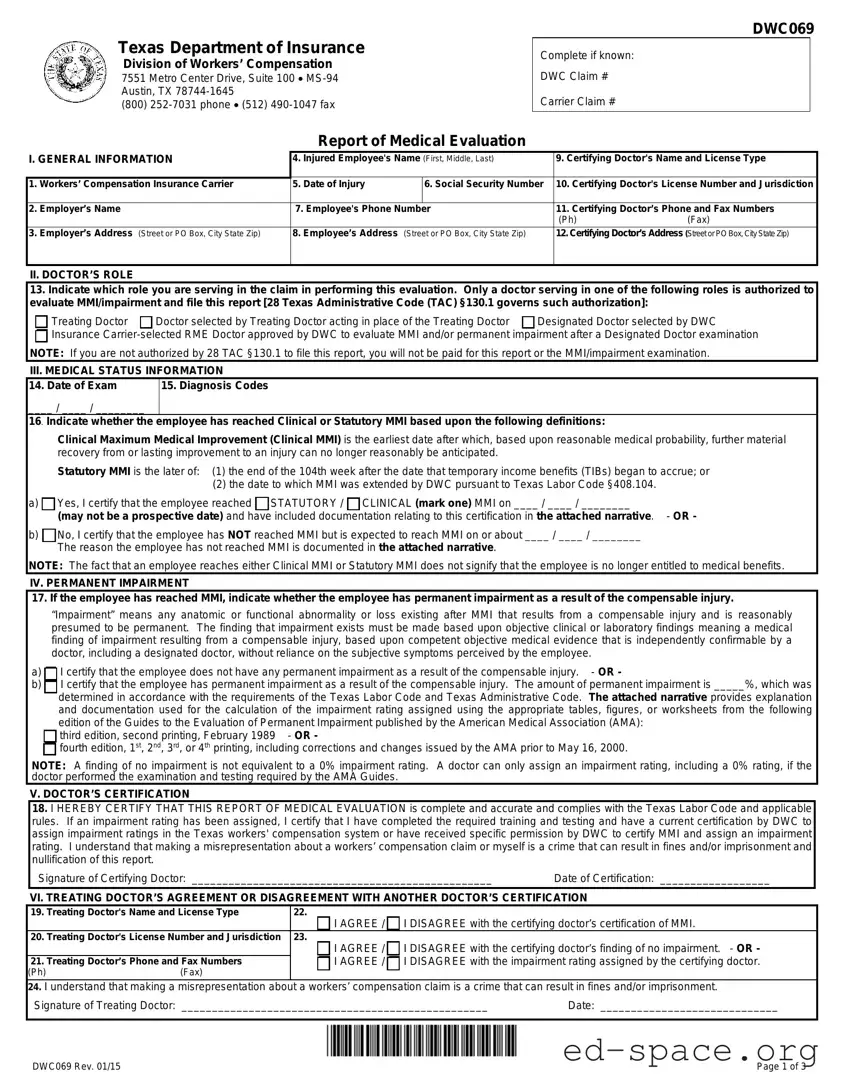
The Texas DWC069 form, also known as the Report of Medical Evaluation, plays a crucial role in the workers' compensation process within the state. This form is designed to document the medical evaluation of an injured employee, providing essential information about their condition and recovery status. It requires details such as the injured employee's name, social security number, and the specifics of their injury, including the date it occurred. The form is filled out by a certifying doctor, who must be authorized to assess Maximum Medical Improvement (MMI) and any permanent impairment resulting from the injury. The doctor’s role is clearly defined, with options for different types of evaluators, including treating doctors and designated doctors. The evaluation must include the doctor’s certification regarding whether the employee has reached MMI and, if applicable, the percentage of permanent impairment. The form also emphasizes the importance of accurate and honest reporting, as misrepresentation can lead to serious consequences. Once completed, the DWC069 must be filed with multiple parties, including the insurance carrier and the injured employee, ensuring transparency and proper communication throughout the claims process.
Document Preview

DWC069
DWC069 Rev. 01/15 Page 1 of 3
Texas Department of Insurance
Division of Workers’ Compensation
7551 Metro Center Drive, Suite 100 MS-94
Austin, TX 78744-1645
(800) 252-7031 phone (512) 490-1047 fax
Complete if known:
DWC Claim #
Carrier Claim #
Report of Medical Evaluation
I. GENERAL INFORMATION
4. Injured Employee's Name (First, Middle, Last)
9. Certifying Doctor's Name and License Type
1. Workers’ Compensation Insurance Carrier
5. Date of Injury
6. Social Security Number
10. Certifying Doctor's License Number and Jurisdiction
2. Employer’s Name
7. Employee's Phone Number 11. Certifying Doctor’s Phone and Fax Numbers
(Ph) (Fax)
3. Employer’s Address (Street or PO Box, City State Zip)
8. Employee’s Address (Street or PO Box, City State Zip) 12. Certifying Doctor’s Address (Street or PO Box, City State Zip)
II. DOCTOR’S ROLE
13. Indicate which role you are serving in the claim in performing this evaluation. Only a doctor serving in one of the following roles is authorized to
evaluate MMI/impairment and file this report [28 Texas Administrative Code (TAC) §130.1 governs such authorization]:
Treating Doctor Doctor selected by Treating Doctor acting in place of the Treating Doctor Designated Doctor selected by DWC
Insurance Carrier-selected RME Doctor approved by DWC to evaluate MMI and/or permanent impairment after a Designated Doctor examination
NOTE: If you are not authorized by 28 TAC §130.1 to file this report, you will not be paid for this report or the MMI/impairment examination.
III. MEDICAL STATUS INFORMATION
14. Date of Exam
____ / ____ / ________
15. Diagnosis Codes
16. Indicate whether the employee has reached Clinical or Statutory MMI based upon the following definitions:
Clinical Maximum Medical Improvement (Clinical MMI) is the earliest date after which, based upon reasonable medical probability, further material
recovery from or lasting improvement to an injury can no longer reasonably be anticipated.
Statutory MMI is the later of: (1) the end of the 104th week after the date that temporary income benefits (TIBs) began to accrue; or
(2) the date to which MMI was extended by DWC pursuant to Texas Labor Code §408.104.
a) Yes, I certify that the employee reached STATUTORY / CLINICAL (mark one) MMI on ____ / ____ / ________
(may not be a prospective date) and have included documentation relating to this certification in the attached narrative. - OR -
b) No, I certify that the employee has NOT reached MMI but is expected to reach MMI on or about ____ / ____ / ________
The reason the employee has not reached MMI is documented in the attached narrative.
NOTE: The fact that an employee reaches either Clinical MMI or Statutory MMI does not signify that the employee is no longer entitled to medical benefits.
IV. PERMANENT IMPAIRMENT
17. If the employee has reached MMI, indicate whether the employee has permanent impairment as a result of the compensable injury.
“Impairment” means any anatomic or functional abnormality or loss existing after MMI that results from a compensable injury and is reasonably
presumed to be permanent. The finding that impairment exists must be made based upon objective clinical or laboratory findings meaning a medical
finding of impairment resulting from a compensable injury, based upon competent objective medical evidence that is independently confirmable by a
doctor, including a designated doctor, without reliance on the subjective symptoms perceived by the employee.
a) I certify that the employee does not have any permanent impairment as a result of the compensable injury. - OR -
b) I certify that the employee has permanent impairment as a result of the compensable injury. The amount of permanent impairment is _____%, which was
determined in accordance with the requirements of the Texas Labor Code and Texas Administrative Code. The attached narrative provides explanation
and documentation used for the calculation of the impairment rating assigned using the appropriate tables, figures, or worksheets from the following
edition of the Guides to the Evaluation of Permanent Impairment published by the American Medical Association (AMA):
third edition, second printing, February 1989 - OR -
fourth edition, 1
st
, 2
nd
, 3
rd
, or 4
th
printing, including corrections and changes issued by the AMA prior to May 16, 2000.
NOTE: A finding of no impairment is not equivalent to a 0% impairment rating. A doctor can only assign an impairment rating, including a 0% rating, if the
doctor
p
erformed the examination and testin
g
re
q
uired b
y
the AMA Guides.
V. DOCTOR’S CERTIFICATION
18. I HEREBY CERTIFY THAT THIS REPORT OF MEDICAL EVALUATION is complete and accurate and complies with the Texas Labor Code and applicable
rules. If an impairment rating has been assigned, I certify that I have completed the required training and testing and have a current certification by DWC to
assign impairment ratings in the Texas workers' compensation system or have received specific permission by DWC to certify MMI and assign an impairment
rating. I understand that making a misrepresentation about a workers’ compensation claim or myself is a crime that can result in fines and/or imprisonment and
nullification of this report.
Signature of Certifying Doctor: _________________________________________________ Date of Certification: __________________
VI. TREATING DOCTOR’S AGREEMENT OR DISAGREEMENT WITH ANOTHER DOCTOR’S CERTIFICATION
19. Treating Doctor's Name and License Type
22.
I AGREE / I DISAGREE with the certifying doctor’s certification of MMI.
20. Treating Doctor's License Number and Jurisdiction 23.
I AGREE / I DISAGREE with the certifying doctor’s finding of no impairment. - OR -
I AGREE / I DISAGREE with the impairment rating assigned by the certifying doctor.
21. Treating Doctor’s Phone and Fax Numbers
(Ph) (Fax)
24. I understand that making a misrepresentation about a workers’ compensation claim is a crime that can result in fines and/or imprisonment.
Signature of Treating Doctor: __________________________________________________ Date: _____________________________
DWC069
DWC069 Rev. 01/15 Page 2 of 3
Frequently Asked Questions
Report of Medical Evaluation (DWC Form-069)
INSTRUCTIONS FOR DOCTORS:
Who can file the DWC Form-069?
Treating Doctor: Doctor chosen by the employee who is primarily responsible for employee's injury-related health care.
Doctor Selected by Treating Doctor: Doctor selected by the treating doctor to evaluate permanent impairment and
Maximum Medical Improvement (MMI). This doctor acts in the place of the treating doctor. Such a doctor must be selected if
the treating doctor is not authorized to certify MMI or assign an impairment rating in those cases in which the employee has
permanent impairment. An authorized treating doctor may also choose to select another doctor to perform the
evaluation/certification.
Designated Doctor: Doctor selected by the Texas Department of Insurance, Division of Workers’ Compensation (DWC) to
resolve a question over MMI or permanent impairment.
Insurance Carrier-Selected RME Doctor: Doctor selected by the insurance carrier to evaluate MMI and/or permanent
impairment. An insurance carrier-selected Required Medical Examination (RME) Doctor is only authorized to certify MMI,
evaluate permanent impairment, and assign an impairment rating when specifically approved by DWC prior to the examination
and only after a designated doctor has completed the same.
AUTHORIZATION: In addition to the requirement of acting in an eligible role, 28 Texas Administrative Code §130.1 provides the
following requirements:
Employee has permanent impairment: Only a doctor certified by DWC to assign impairment ratings or who receives specific
permission by exception granted by DWC is authorized to certify MMI and to assign an impairment rating.
Employee does not have permanent impairment: A doctor not certified or exempted from certification by DWC is only
authorized to determine whether an employee has permanent impairment and, in the event that the employee has no
impairment, certify MMI.
INVALID CERTIFICATION: Certification by a doctor who is not authorized is invalid.
Under what circumstances and when am I required to file the DWC Form-069?
If the employee has reached MMI, you must file the DWC Form-069 no later than the seventh working day after the later of: (a) date of
the certifying examination; or (b) receipt of all medical information necessary to certify MMI. Only a Designated Doctor is subject to this
requirement if the employee has not reached MMI.
Where do I file the form?
The DWC Form-069 and required narrative shall be filed with:
the insurance carrier;
the treating doctor (if a doctor other than the treating doctor files the report);
DWC;
injured employee; and
injured employee’s representative (if any).
The report must be filed by facsimile or electronic transmission unless an exception applies. The specific requirements are shown
below. To file this form with DWC, fax to (512) 490-1047
.
Insurance Carrier
Treating Doctor
DWC
Injured Employee
Injured Employee’s Representative
Designated Doctor fax or e-mail fax or e-mail
fax or e-mail unless recipient has not
provided these numbers; then by other
verifiable means
Treating Doctor
Doctor Selected by Treating Doctor
Insurance Carrier-Selected RME Doctor
fax or e-mail
fax or e-mail unless recipient has
not provided these numbers; then
by other verifiable means
fax or e-mail unless recipient has not
provided these numbers; then by other
verifiable means
Do I have to maintain documentation regarding the examination and report?
The certifying doctor must maintain the original copy of the report and narrative and documentation of the following:
date of the examination;
date any medical records necessary to make the certification of MMI were received, and from whom the medical records were
received; and
date, addresses, and means of delivery that required reports were transmitted or mailed by the certifying doctor.
Where can I find more information about the Report of Medical Evaluation?
See 28 TAC §130.1 through §130.4 and §130.6 for the complete requirements regarding the filing of this report, including required
documentation. The complete text of these rules is available on the Texas Department of Insurance website at
www.tdi.texas.gov/wc/rules/index.html. If you have additional questions, call 1-800-372-7713, Option #3.
DWC069
DWC069 Rev. 01/15 Page 3 of 3
IMPORTANT INFORMATION FOR INJURED EMPLOYEES:
What if I disagree with the doctor's certification of Maximum Medical Improvement (MMI) and/or permanent impairment rating
for my workers' compensation claim?
If this is the first evaluation of your MMI and/or permanent impairment, you or your representative may dispute:
the certification of MMI; and/or
the assigned impairment rating.
To file the dispute, contact your local DWC field office or call 1-800-252-7031 to request:
the appointment of a designated doctor (DD), if one has not been appointed; or
a Benefit Review Conference (BRC).
Important Note: Your dispute must be filed within 90 days after the written notice is delivered to you or the certification of MMI and/or
the assigned impairment rating may become final.
NOTE: With few exceptions, upon your request, you are entitled to be informed about the information DWC collects about
you; receive and review the information (Government Code, §§552.021 and 552.023); and have DWC correct information that is
incorrect (Government Code, §559.004).

Form Specifications

Fact Name Details
Governing Law The DWC069 form is governed by the Texas Labor Code §408.104 and 28 Texas Administrative Code §130.1.
Purpose This form is used to report medical evaluations related to workers' compensation claims in Texas.
Filing Deadline The form must be filed no later than the seventh working day after the examination date or after receiving necessary medical information.
Authorized Doctors Only certain doctors, such as treating doctors or designated doctors, are authorized to complete and submit the DWC069 form.
MMI Certification Doctors must certify whether the injured employee has reached Maximum Medical Improvement (MMI) based on specific criteria.
Dispute Process If an injured employee disagrees with the MMI certification, they can dispute it within 90 days by contacting their local DWC office.

Texas Dwc069: Usage Guidelines

Completing the Texas DWC069 form is a straightforward process, but it requires careful attention to detail. This form is essential for reporting medical evaluations related to workers' compensation claims. Once you have filled out the form correctly, you will need to submit it to the appropriate parties, including the insurance carrier and the Division of Workers’ Compensation.

  1. Start by entering the Workers’ Compensation Insurance Carrier name at the top of the form.
  2. Fill in the Employer’s Name and their Address (Street or PO Box, City, State, Zip).
  3. Provide the Injured Employee's Name (First, Middle, Last) and their Social Security Number.
  4. Record the Date of Injury and the Employee's Phone Number.
  5. Complete the Employee’s Address (Street or PO Box, City, State, Zip).
  6. Enter the Certifying Doctor's Name and their License Type.
  7. Provide the Certifying Doctor's License Number and Jurisdiction.
  8. Fill in the Certifying Doctor’s Phone and Fax Numbers.
  9. Complete the Certifying Doctor’s Address (Street or PO Box, City, State, Zip).
  10. Indicate the Doctor’s Role in the claim by checking the appropriate box.
  11. Enter the Date of Exam and the Diagnosis Codes.
  12. Determine if the employee has reached Clinical or Statutory MMI and mark the appropriate option.
  13. If applicable, indicate whether the employee has Permanent Impairment and provide the percentage if there is impairment.
  14. In the Doctor’s Certification section, sign and date the report, ensuring all information is accurate.
  15. If applicable, complete the Treating Doctor’s Agreement or Disagreement section, including signature and date.

After completing the form, ensure that you keep a copy for your records. Then, submit the DWC069 form and any necessary documentation to the insurance carrier, the treating doctor, the Division of Workers’ Compensation, and the injured employee. This submission can usually be done via fax or electronic transmission. It’s important to follow these steps carefully to ensure compliance with Texas workers' compensation regulations.

Your Questions, Answered

What is the Texas DWC069 form?

The Texas DWC069 form, officially known as the Report of Medical Evaluation, is a document used in the Texas workers' compensation system. It is primarily utilized by medical professionals to report on an injured employee's Maximum Medical Improvement (MMI) status and any permanent impairment resulting from a workplace injury. This form must be completed by authorized doctors who are involved in the employee's care.

Who is authorized to complete the DWC069 form?

Only specific medical professionals can complete the DWC069 form. These include the treating doctor, a doctor selected by the treating doctor, a designated doctor appointed by the Texas Department of Insurance, and an insurance carrier-selected Required Medical Examination (RME) doctor, provided they have received prior approval from the Division of Workers’ Compensation (DWC).

When must the DWC069 form be filed?

The DWC069 form must be filed no later than the seventh working day after the date of the examination or after receiving all necessary medical information to certify MMI. This requirement applies only if the employee has reached MMI. If the employee has not reached MMI, only a designated doctor is required to file the form.

Where should the DWC069 form be submitted?

The completed DWC069 form should be submitted to several parties: the insurance carrier, the treating doctor (if applicable), the DWC, the injured employee, and the employee’s representative if one exists. The submission can be made via fax or electronic transmission, unless other arrangements have been made.

What happens if I disagree with my doctor’s MMI certification?

If an injured employee disagrees with the doctor’s certification of MMI or the assigned permanent impairment rating, they have the right to dispute it. This can be done by contacting the local DWC field office or calling the DWC directly to request a designated doctor or a Benefit Review Conference (BRC). It’s important to file the dispute within 90 days of receiving the written notice to ensure it is considered.

What documentation must a doctor maintain when filing the DWC069 form?

Doctors must keep the original copy of the DWC069 form along with any narratives and documentation related to the examination. This includes the date of the examination, the date medical records necessary for certification were received, and the details of how the reports were transmitted to the relevant parties.

What is the difference between Clinical MMI and Statutory MMI?

Clinical MMI refers to the earliest date after which further recovery from an injury is not expected based on reasonable medical probability. Statutory MMI, on the other hand, is defined as either the end of the 104th week after temporary income benefits began or the date extended by the DWC. Understanding these distinctions is crucial for both doctors and injured employees.

Where can I find additional information about the DWC069 form?

For more detailed information regarding the DWC069 form and its requirements, individuals can refer to the Texas Department of Insurance website. The complete text of the relevant rules can be found under 28 Texas Administrative Code §130.1 through §130.4 and §130.6. For any further questions, the DWC can be contacted directly at 1-800-372-7713, Option #3.

Common mistakes

  1. Incomplete Information: Failing to fill out all required fields can lead to delays. Ensure that every section is completed, including the employee's name, date of injury, and social security number.

  2. Incorrect Dates: Entering prospective dates for MMI certification is a common mistake. The date of MMI must reflect an actual date, not a future date.

  3. Missing Documentation: Not attaching necessary documentation to support the MMI certification can invalidate the report. Include all relevant narratives and medical records.

  4. Unauthorized Signatures: Having someone other than the certifying doctor sign the form is a serious error. Only the doctor who performed the evaluation should sign the report.

  5. Incorrect Role Selection: Misidentifying the role of the doctor in the claim can lead to complications. Ensure the correct role is selected from the options provided on the form.

Documents used along the form

The Texas DWC069 form, known as the Report of Medical Evaluation, is an essential document in the workers' compensation process. It is primarily used to certify an injured employee's Maximum Medical Improvement (MMI) and any permanent impairment resulting from their injury. Alongside this form, several other documents are commonly utilized to ensure a comprehensive understanding of the case and to facilitate the claims process. Below is a list of these documents, each with a brief description.

  • DWC Form-031: This form is used to report an employee's injury to the Texas Department of Insurance. It includes details about the injury and is essential for initiating a workers' compensation claim.
  • DWC Form-042: Known as the Request for Designated Doctor Examination, this form is submitted when there is a need for a designated doctor to evaluate the MMI or impairment rating of an injured worker.
  • DWC Form-045: This form is the Request for a Benefit Review Conference. It is used when there is a dispute regarding the benefits owed to an injured worker and serves to initiate a formal review process.
  • DWC Form-069 Narrative: A narrative report that accompanies the DWC069 form. It provides detailed medical information and rationale behind the doctor's findings regarding MMI and impairment.
  • DWC Form-073: This is the Employee's Notice of Injury or Occupational Disease form. It informs the employer about the injury and is crucial for documenting the incident.
  • DWC Form-076: The Request for Medical Records form allows doctors to obtain necessary medical records from previous healthcare providers, which are vital for making an accurate assessment of the employee’s condition.
  • DWC Form-081: This form is used to report the results of a Required Medical Examination (RME). It details the findings from the examination conducted by the insurance carrier's selected doctor.
  • DWC Form-082: The Report of Injury form is utilized by employers to document workplace injuries. It is essential for record-keeping and for the claims process.
  • DWC Form-084: This form is the Notice of Change of Treating Doctor. It is used when an injured employee changes their treating physician and ensures that all parties are informed of the change.
  • DWC Form-086: The Request for a Hearing form is used to appeal decisions made regarding workers' compensation claims. It initiates the legal process for disputes over benefits or other related issues.

Understanding these forms and their purposes can significantly aid in navigating the complexities of the Texas workers' compensation system. Each document plays a crucial role in ensuring that injured employees receive the appropriate medical evaluations and benefits they are entitled to, fostering a smoother claims process for all parties involved.

Similar forms

The Texas DWC069 form, known as the Report of Medical Evaluation, shares similarities with several other important documents used in workers' compensation cases. Here are seven documents that are comparable to the DWC069 form, along with a brief explanation of how they relate:

  • DWC Form-053: Employee's Claim for Compensation - This form is used by employees to formally initiate a claim for workers' compensation benefits, outlining the details of the injury and the claim process. Like the DWC069, it is essential for documenting the employee's condition and the claims process.
  • DWC Form-041: Employer's First Report of Injury - This document is completed by the employer to report an employee's injury to the insurance carrier. It serves as an initial record of the incident, similar to how the DWC069 provides a medical evaluation following the injury.
  • DWC Form-032: Designated Doctor Examination Report - This form is filled out by a designated doctor who evaluates the employee's medical condition. Like the DWC069, it assesses the employee's maximum medical improvement and impairment rating.
  • DWC Form-040: Request for Designated Doctor Examination - This form is used to request an evaluation by a designated doctor. It is similar to the DWC069 in that both are focused on determining the employee's medical status and eligibility for benefits.
  • DWC Form-007: Notice of Injury or Illness - This notice is provided to the insurance carrier to inform them of an employee's injury. It serves as a preliminary step, while the DWC069 provides a detailed medical evaluation after the injury has occurred.
  • DWC Form-006: Employee's Notice of Injury or Illness - This document is submitted by the employee to notify their employer of an injury. It is akin to the DWC069 in that it is part of the overall documentation required for processing a workers' compensation claim.
  • DWC Form-041: Employer's First Report of Injury - This form is used by employers to report an injury to the insurance carrier. It is similar to the DWC069 as both documents play a crucial role in the workers' compensation process, though they serve different functions in the timeline of a claim.

Understanding these forms and their similarities can help both employees and employers navigate the complexities of workers' compensation claims more effectively.

Dos and Don'ts

When filling out the Texas DWC069 form, it's important to follow certain guidelines to ensure accuracy and compliance. Here’s a list of things you should and shouldn’t do:

  • Do provide complete and accurate information for each section of the form.
  • Do include all required documentation to support your certification.
  • Do ensure that the certifying doctor is authorized to complete the evaluation and sign the report.
  • Do file the form within the required timeframe after the examination.
  • Don't leave any sections blank unless specifically instructed to do so.
  • Don't submit the form without verifying that all information is correct and complete.

Misconceptions

Understanding the Texas DWC069 form is crucial for anyone involved in the workers' compensation process. However, several misconceptions can lead to confusion. Here are six common myths about the DWC069 form, along with clarifications to help clear the air.

  • Myth 1: Only treating doctors can file the DWC069 form.
  • This is not true. While treating doctors often file the form, other qualified doctors, such as designated doctors or those selected by the insurance carrier, can also submit it if they are authorized to evaluate MMI and impairment.

  • Myth 2: The DWC069 form is only for employees who have reached Maximum Medical Improvement (MMI).
  • This is a misconception. The form is required for both employees who have reached MMI and those who have not. If an employee has not reached MMI, the designated doctor must still file the form to document their status.

  • Myth 3: A doctor can assign a 0% impairment rating without conducting a proper examination.
  • This is incorrect. A doctor can only assign any impairment rating, including a 0%, if they have performed the necessary examination and testing as outlined by the AMA Guides. Simply stating there is no impairment is not enough.

  • Myth 4: If a doctor certifies MMI, the employee is no longer entitled to medical benefits.
  • This is misleading. Reaching MMI does not mean that an employee loses their right to medical benefits. They may still be eligible for ongoing medical care as needed.

  • Myth 5: The DWC069 form can be filed at any time after the examination.
  • This is false. The form must be filed no later than the seventh working day after the examination or after all necessary medical information has been received. Timeliness is key in this process.

  • Myth 6: Once the DWC069 form is submitted, it cannot be contested.
  • This is incorrect. Employees have the right to dispute the certification of MMI or the impairment rating within 90 days of receiving notice. This ensures that employees can challenge any discrepancies they believe exist.

By addressing these misconceptions, individuals can navigate the workers' compensation process with greater confidence and clarity. Understanding the nuances of the DWC069 form is essential for both employees and medical professionals involved in these claims.

Key takeaways

The Texas DWC069 form is a crucial document in the workers' compensation process. Here are key takeaways for its completion and use:

  • The form must be completed accurately and submitted in a timely manner to avoid invalid certification.
  • It is essential to provide complete general information, including the injured employee's name, date of injury, and social security number.
  • Only authorized doctors can evaluate Maximum Medical Improvement (MMI) and file the report.
  • Doctors must indicate their role in the claim clearly, as this determines their authority to certify MMI and assign impairment ratings.
  • Documentation supporting the certification of MMI must be included with the form.
  • If the employee has not reached MMI, the doctor must provide an expected date for when MMI is anticipated.
  • Permanent impairment must be assessed based on objective clinical findings, and the impairment rating should be calculated according to the AMA Guides.
  • Doctors are required to maintain records of the examination and any relevant medical documentation.
  • Submission of the form must be done electronically or by fax, unless otherwise specified.
  • Injured employees have the right to dispute the MMI certification or impairment rating within 90 days of receiving the notice.

Understanding these points can help ensure that the DWC069 form is filled out correctly and serves its intended purpose in the workers' compensation process.