Homepage Blank Texas Divorce PDF Form
Content Overview

When navigating the divorce process in Texas, understanding the Texas Divorce form is crucial for those seeking an uncontested divorce. This form serves as a key document that initiates the legal proceedings, enabling individuals to formally request the dissolution of their marriage. To use this form effectively, it’s essential to recognize whether your case is uncontested, meaning both spouses agree on all relevant issues, or contested, where disagreements exist. The form is designed for straightforward situations, such as when neither spouse is pregnant, there are no pending bankruptcies, and at least one spouse has lived in Texas for the required six months prior to filing. It’s important to note that these forms are not appropriate for contested divorces or cases involving specific complexities, such as spousal support or property division. The process involves several steps, including filing the Original Petition for Divorce, serving legal notice to the other spouse, and waiting for mandatory periods before finalizing the divorce. Additionally, having a lawyer’s guidance can help ensure that all necessary legal rights are protected, particularly when navigating the complexities of child custody or property division. Familiarity with the Texas Divorce form and its requirements can significantly ease the process and lead to a more favorable outcome.


Document Preview

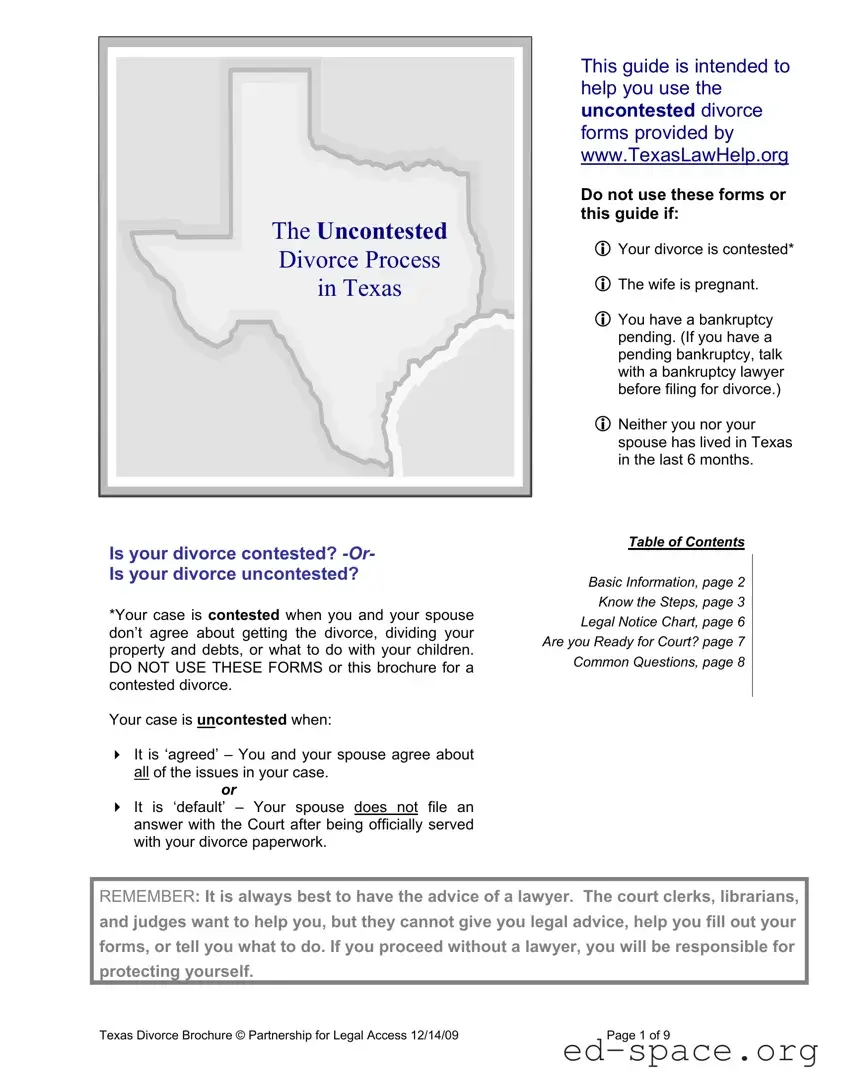
This guide is intended to
help you use the
uncontested divorce
forms provided by
www.TexasLawHelp.org
Do not use these forms or
this guide if:
Your divorce is contested*
The wife is pregnant.
You have a bankruptcy
pending. (If you have a
pending bankruptcy, talk
with a bankruptcy lawyer
before filing for divorce.)
Neither you nor your
spouse has lived in Texas
in the last 6 months.
The Uncontested
Divorce Process
in Texas
Table of Contents
Is your divorce contested? -Or-
Is your divorce uncontested?
*Your case is contested when you and your spouse
don’t agree about getting the divorce, dividing your
property and debts, or what to do with your children.
DO NOT USE THESE FORMS or this brochure for a
contested divorce.
Your case is un
contested when:
It is ‘agreed’ – You and your spouse agree about
all
of the issues in your case.
or
It is ‘default’ – Your spouse does not
file an
answer with the Court after being officially served
with your divorce paperwork.
Basic Information, page 2
Know the Steps, page 3
Legal Notice Chart, page 6
Are you Ready for Court? page 7
Common Questions, page 8
REMEMBER: It is always best to have the advice of a lawyer. The court clerks, librarians,
and judges want to help you, but they cannot give you legal advice, help you fill out your
forms, or tell you what to do. If you proceed without a lawyer, you will be responsible for
protecting yourself.
Texas Divorce Brochure © Partnership for Legal Access 12/14/09 Page 1 of 9
Texas Divorce Brochure © Partnership for Legal Access 12/14/09 Page 2 of 9
Basic Information
What is a divorce?
A divorce ends your marriage.
A divorce decree says who keeps what property and who pays what
debts.
Where do I get divorced?
You can get divorced in Texas if you or your spouse has lived in
Texas for the last 6 months.
File your divorce in the county courthouse where you or
your
spouse has lived for the last 90 days.
Why do I need to wait until after the baby is born?
Most Texas courts will not finalize a divorce if the wife is pregnant,
even if the baby is not the husband’s. Instead, the courts wait until
after the baby is born so that orders regarding the baby can be
included in the divorce decree.
Do I need a lawyer?
You do not have to have a lawyer to get a divorce, but it’s a good idea especially if:
Important Note:
The www.TexasLawHelp.org
forms are forms used in a
basic, uncontested divorce.
You will need to hire a
lawyer to draft forms for
special issues like spousal
support, transfer of land and
houses, division of retirement
and investment accounts, etc.
You need an attorney for a
contested divorce, especially
if temporary support or
restraining orders are needed.
DO NOT use the
www.TexasLawHelp.org
forms for a contested divorce.
You and your spouse do not agree (the divorce is contested).
Your spouse has a lawyer.
You are afraid for your safety or your children’s safety.
You are unsure how to divide property such as retirement and real estate correctly.
Getting a divorce can be complicated. If you make a mistake, it could affect your children, your
property, and your income. Try to speak to a lawyer about your legal rights before you file your
Petition for Divorce. Some lawyers will unbundle their services. They will “coach” you to represent
yourself and only charge for the services you request. Other lawyers are available only if you hire
them to handle every step of the case. If you can’t afford to hire a lawyer, contact your local Legal
Aid office.
What forms do I need?
There are several form packets to choose from on www.TexasLawHelp.org.
Choose the Divorce without Children forms if you do not have minor children of the marriage or
if
you have child support and visitation orders already in place.
Choose the Divorce with Children forms if children were born or adopted during the marriage and
the children are younger than 18 or have not graduated from high school. Exception
: If you already
have final court orders for custody and support of the children, and you are not asking for a change
to those orders in the divorce process, then use the Divorce without Children forms and attach a
copy of the current custody and support orders (showing the judge’s signature) to the Decree.
If you cannot afford the court filing fees, you should also file an Affidavit of Inability to Pay Costs.
This form tells the court about your income and assets and asks the court to waive the filing fee.
The Default Judgment Kit explains what you need to do to get a final judgment when your spouse
will not respond to the divorce. This kit includes instructions and explanations about what you must
do, a checklist for the forms you need, and the forms you can use.
If you cannot find your spouse, review the Legal Notice, the Service by Posting, and the Service
by Publication, kits on
www.TexasLawHelp.org
.
Divorce in Texas – Know the Steps
Step 1. Fill out the Original Petition for Divorce.
This form tells the judge and your spouse that you want a divorce.
Step 2. Make 2 copies of your completed Original Petition for Divorce.
NOTE: In most counties family law
cases are heard in the district courts
and all paperwork is filed in the
District Clerk’s Office. In counties
where family law cases are heard in
county courts, you would file your
paper work in the County Clerk’s
Office.
Step 3. File your Original Petition for Divorce.
Take the original and 2 copies of your completed Original
Petition for Divorce to the Courthouse. File your papers with
the District Clerk’s Office.
The clerk will ask you to pay a fee (around $250 - $300) to
file your Original Petition for Divorce. If you cannot afford the
fee, you should also file an Affidavit of Inability to Pay Costs.
This form tells the court about your income and assets and asks the court to waive the filing fee.
The clerk will stamp your papers with the date you file. She will also assign a cause number and
a judicial district. The clerk will keep the original and give back your copies. Keep a copy for
yourself in a safe place. You will need the other copy to give legal notice to your spouse.
Step 4. Give Your Spouse “Legal Notice.”
You must notify your spouse that you are asking the court for a divorce and you must prove to
the court that you did so. This is called giving “legal notice.” There are 4 ways to give legal
notice:
1) Waiver of Citation. You may give legal
notice by giving your spouse a file-stamped copy
of your Original Petition for Divorce and a
Waiver of Citation that he or she signs in front of
a notary
and files with the Court. If you choose
this method, do not give your spouse the Waiver
of Citation until after you file your Original
Petition for Divorce.*
Read the Legal
Notice chart on
page 6 to select
the method of
notice you plan
to use.
*The Waiver of Citation in this packet is a global
waiver. By signing a global waiver, your spouse
gives up the right to be given a copy of the
divorce Petition by Official Service and
the right to know what orders you will
ask the judge to make regarding
your children and property. If
your spouse signs the Waiver of
Citation provided in this packet
s/he does not have to sign the
Decree of Divorce or go to
court.
2) Answer. If your spouse agrees
to the divorce and wants to know
what orders you will request, or when
hearings are scheduled, then s/he should sign
and file an Answer instead of a Waiver. If your
spouse files an Answer, s/he must also agree to
and sign the Decree of Divorce to finish your
divorce without a contested hearing. You do not
need to have your spouse officially served.
3) Official Service in Person or by Mail. You
can have an official process server give notice
to your spouse either in person or by certified
mail.
If you are having your spouse served in jail
, do
not use Official Service by Mail. Instead, send
your divorce paperwork to an official server in
that county so that your spouse can be
personally served.
After your spouse is served the official server
fills out a Return of Service form stating
when and where your spouse was
served. This is proof to the court
that you notified your spouse of
the divorce.
The Return of
Service form must
be filed with the clerk’s office.
4) Official Service by
Publication or Posting. Either
Publication or Posting is used when a
spouse can’t be found. You will have to
prove to the judge that you tried hard to find
your spouse. You may have to pay your
spouse’s attorney’s fees. There is more
information about this type of service at
www.TexasLawHelp.org
.
Texas Divorce Brochure © Partnership for Legal Access 12/14/09 Page 3 of 9
Step 5. Wait.
61 Day Waiting Period – (Applies in Most cases)
In most cases, you must wait at least 61 days from the day you filed your Original Petition for
Divorce before you can finish your divorce. You can always wait longer than 61 days, but your
divorce cannot be finished in less than 61 days. When counting the 61 days, count the day you
filed your Original Petition for Divorce on a calendar, and then count out 61 more days.
The 61 Day Waiting Period can be waived in cases of domestic violence if:
You have an active Protective Order against your spouse who committed family violence during
your marriage, or your spouse has received deferred adjudication or a final conviction for
committing family violence against you or a member of your household.
Other Waiting Periods
21 Day Answer Period – (Applies in Official Service cases only)
If your spouse was served with legal notice by an official process server, you must wait at least
21 days after your spouse was served, to see if your spouse will file an answer. This 21-day
period may or may not fall within the 61 day waiting period. When counting the 21 days, count
the day your spouse was served on a calendar, and then count out 21 more days. Go to the next
Monday on the calendar. This is the last official day of your spouse’s answer period. However,
your spouse can file an answer any time before you finish your divorce.
7 Day Waiting Period – (Applies in Posting cases only)
If you spouse was served by Posting add an additional 7 days to the 21 day answer period. Go
to the next Monday on the calendar. This is the last official day of your spouse’s answer period.
However, your spouse can file an answer any time before you finish your divorce.
10 Day Waiting Period – (Applies in Official Service cases only)
If your spouse was served with legal notice by an official process server, the official process
server fills out a return of service form stating when and where your spouse was served. The
return of service must be on file with the District Clerk’s office for 10 days. When counting the
10 days, do not count the day your spouse was served or the day you go to court. There must
be 10 days in between.
Step 6. Determine if your case is contested or
uncontested.
What about mediation?
If you and your spouse do not agree on all
issues you should consider mediation. In
mediation, an independent person will try to
help you reach an agreement. The divorce
process is usually easier when you have an
agreement. Talk to a lawyer first so that you
understand your legal rights.
Mediation is not
a good idea if you are afraid
of your spouse.
How did your spouse respond to the court when you gave
him or her legal notice?
You case is contested if your spouse files an answer
and does not agree to the terms of the divorce.
Your uncontested case is ‘agreed’ if you and your
spouse agree on what to put in your Decree of Divorce,
your spouse has signed a waiver or answer, and your
spouse is willing to sign your Decree of Divorce.
Your uncontested case is ‘default’ if your spouse did
not file an answer after being officially served by the Official
Service Process method. After the waiting periods have
passed, call the Clerk’s Office to find out if your spouse filed
an answer. If your spouse did not file an answer you can
finish your divorce without your spouse. Download the
“Default Judgment Kit” from www.TexasLawHelp.org
. This
kit includes the extra paperwork you will need to finish your
divorce by default.
Texas Divorce Brochure © Partnership for Legal Access 12/14/09 Page 4 of 9
Step 7. Find out when the Court hears
uncontested divorce cases.
Call the District Clerk’s Office to find out when the
Court in your county hears uncontested divorce
cases. Some courts in big counties have an
“uncontested docket” where they hear uncontested
divorce cases every day. Other courts, especially
those in smaller counties, only hear uncontested
divorce cases on certain days.
Step 8. Write your Decree of Divorce.
Fill out your Decree of Divorce. This is the paper
the judge signs, granting your divorce. The
Decree of Divorce also says who keeps what
property and who pays what debts.
If you and
your spouse have children, the decree of divorce
says who makes decisions about your children,
when the children see each parent and which
parent pays child support and provides health
insurance for the children. The decree of divorce
may include other orders such as who pays
spousal support and how much.
It’s best to have a lawyer review your Decree of
Divorce before your present it to the Court. You
may also need to hire a lawyer to write additional
documents if you are dividing retirement benefits
or a 401(k) account or transferring ownership of a
house or land.
Step 9. Go to court.
Bring all of your paperwork to the courthouse on the
day the court in your county hears uncontested divorce cases. Read “Are you ready for court?”
on page 7.
If your case is agreed
bring:
1) a copy of your Original Petition of
Divorce; and
2) the Waiver of Citation or Answer signed
by your spouse; and
3) “Information on Suit Affecting the Family
Relationship” form; and
4) your Decree of Divorce, (if your spouse
filed an answer, make sure s/he signed
the Decree of Divorce).
If your case is default
bring:
1) a copy of your Original Petition of Divorce;
and
2) your Decree of Divorce; and
3) Military Servicemember’s Affidavit and
Certificate of Last Known Address, (these
forms are part of the Default Judgment Kit at
www.TexasLawHelp.org)
; and
4) “Information on Suit Affecting the Family
Relationship” form
Step 10. Finish your divorce by filing your decree in the District Clerk’s Office.
Take your paperwork back to the Clerk’s Office after it is signed by the Judge. Your divorce is not final
until the paperwork is filed. File the “Information on Suit Affecting the Family Relationship” form.
NOTE: In some counties, the court, not you, files the signed Decree in the Clerk’s Office.
The clerk will keep the original documents and make copies for you for a fee. You might consider asking
the clerk for a certified copy of your Decree of Divorce. If you have child support orders, ask the clerk
what you need to do to set up your child support account and wage withholding. There will be a fee.
Steps in a divorce if your
case is Uncontested
1
Fill out the Original Petition for
Divorce.
2
Make 2 copies of your completed
Original Petition for Divorce.
3
File your Original Petition for
Divorce.
4
Give Your Spouse “Legal Notice.”
5
Wait the required waiting periods.
6
Determine if your case is
uncontested or contested case
before proceeding.
7
Learn when & where the court
hears uncontested
divorces.
8
Write your Decree of Divorce.
9
Go to court and get the needed
signatures.
10
Finish your Uncontested
divorce by filing the signed
decree in the Clerk’s Office.
Texas Divorce Brochure © Partnership for Legal Access 12/14/09 Page 5 of 9
Giving Legal Notice in Agreed and Default Divorces:
Proving to the Court You Notified your Spouse of the Divorce
Your spouse agrees to all
parts of the divorce and
does not want to be
notified of hearings or
sign the decree,
THEN USE
Waiver of Citation method
Your spouse wants to sign
the decree, to know what
orders you will ask for,
or wants to know when
hearings are scheduled,
The server will mail the
paperwork by certified mail,
return receipt requested.
You want to give the
divorce papers to
your spouse yourself
AND . . .
THEN USE
Spouse files Answer method *
You want a constable,
sheriff’s officer or other
official process server to
deliver the paperwork or
your spouse is in jail,
THEN USE
Official Service by Official Server method
You have a good mailing
address for your spouse
and
you can be sure your
spouse will be the person
who signs the green
certified mail card and
your spouse is not in jail,
If you can locate your spouse AND . . .
You want someone
else to give your
spouse the divorce
papers or you
believe your spouse
would not respond
using the Waiver or
Answer methods
AND . . .
THEN USE
Official Service by Mail method
You don’t have children
or valuable property
THEN USE
Official Service by Posting method
You have children or
valuable property
If you don’t know
where your spouse
lives, works, or
can be found
AND . . .
THEN USE
Official Service By Publication method
WAIVE
R
The official server needs to
personally
give your spouse
the paperwork, unless s/he
voluntarily files an Answer.*
The Waiver of Citation is
a form signed by the
responding spouse and
filed with the court to
show that he or she has
received a notice and
waives the right to know
what orders for child
support & property you
will ask the judge to make.
A server will post
notice of your divorce
at the courthouse for
7 days.
The Answer is a form
filed by the respondent
instead of the Waiver
of Citation when the
respondent wants to
retain certain rights.
If you serve by
publication, your
spouse has the right to
an attorney and you
would have to pay for
the attorney’s fees.
Texas Divorce Brochure © Partnership for Legal Access 12/14/09 Page 6 of 9
Are you ready for court?
Be prepared:
Get to the courthouse early to find parking and your courtroom.
When the courtroom opens, go in and tell the clerk you are present. The clerk usually sits next to the judge’s bench.
Most courtrooms do not allow children.
SAMPLE TESTIMONY FOR DIVORCE WITHOUT
CHILDREN
My name is ___________________. I filed this suit for divorce
from my spouse ________________. (State your spouse’s
name.)
At the time I filed this divorce, I had lived in Texas for at least
the last six (6) months, and in ________ County for at least
ninety (90) days.
My marriage to ______________________(State your spouse’s
name)__________________ has become unworkable because
of differences and misunderstandings between us. There is no
reasonable chance that we will get back together.
There are no children born to or adopted of this marriage, who
are under 18 years old and we are not currently expecting any
other children.
I am requesting that the community property and debts be
divided as set forth in the Decree of Divorce. I believe this
division is fair.
(OPTIONAL) I am (or My spouse is) requesting a name change
to the name that was used before we were married:
_________(State the name used before marriage)
I would respectfully request the Court to grant my divorce.
SAMPLE TESTIMONY FOR DIVORCE WITH CHILDREN
My name is ___________________. I filed this suit for divorce
from my spouse _____________________. (State your spouse’s
name.)
At the time I filed for divorce, I had lived in Texas for at least
the last six (6) months, and in _______ County for at least
ninety (90) days.
I am seeking a divorce because of differences and
misunderstandings between us. There is no reasonable
expectation that we will get back together.
I am requesting that the community property and our debts be
divided as set forth in the Decree of Divorce. I believe this
division is fair to both of us, and to our children.
We have ___ child(ren) of this marriage, who are under 18 years
old. (State the number of children you have with your spouse
who are under 18 years old) We are not expecting any other
children of the marriage.
I am requesting that conservatorship and child support be
ordered as set forth in the Decree of Divorce. I believe that
these orders would be in the best interest of our child(ren).
(OPTIONAL)
I am (or My spouse is) requesting a name change to the name
used before we were married: ______State the name used before
marriage)
I would respectfully request the court to grant my divorce.
When you are in court:
Dress neatly. Do not wear shorts, tank
tops, or hats. Do not chew gum, or bring
food or drink into the courtroom.
Turn off your cell phone.
Stand up when the judge enters the
courtroom.
Be calm and polite to everyone. Avoid
gestures and facial expressions.
Do not talk to the judge or your spouse,
unless it is your turn to speak.
The judge may not call your case right
away. Wait patiently. If you have to leave
the courtroom, tell the clerk where you are
going.
If friends or relatives come to court with you,
ask them to follow these rules, too.
About testimony
In some counties, the judge will ask you questions.
In other counties, you will be expected to have
testimony prepared.
The judge will call your case.
You will raise your right hand and swear to
tell the truth.
The judge will ask you questions. Wait until
the judge finishes speaking before you start
to speak.
If you do not understand a question, say, “I
don’t understand.” If you do not know an
answer, say, “I don’t know.”
Tell the truth and don’t exaggerate. Give
complete answers.
Speak slowly and loud enough so everyone
in court can hear you.
Call the judge “Your Honor.”
Say “Yes” or “No” out loud. It’s not enough
to nod or shake your head.
The judge will listen to what you say and
review your papers. If everything is in order,
the judge will sign your Final Decree of
Divorce.
Texas Divorce Brochure © Partnership for Legal Access 12/14/09 Page 7 of 9
Common Questions
Is it difficult to handle a contested case
without a lawyer?
Terms to Know
Petitioner: The spouse who asks the court for a
divorce by filing a Petition. Even if both spouses
want the divorce, only one spouse can be the
petitioner.
----------------
Respondent is the other spouse.
----------------
Contested: A divorce is contested when the
spouses don’t agree about getting the divorce,
dividing property and debts, or what to do about
child support and custody.
----------------
Uncontested: Either the divorce is agreed (both
parties agree on all the issues) or default (the
respondent does not file an Answer).
----------------
Uncontested Docket is the court that hears
divorce cases when the case is either an agreed
(uncontested) or a default divorce.
----------------
Petition: This is the form the petitioner files to
ask the court for a divorce.
----------------
Decree: This is the form that the judge signs to
grant the divorce. A divorce decree says who
keeps what property and who pays what debts.
In a divorce involving children, a divorce decree
says which parent pays child support and
provides health insurance. The decree also says
when the child can visit a parent and which
parent makes certain decisions about the child.
A divorce decree can include other orders, such
as spousal support.
----------------
File: Giving legal papers to the courthouse
clerk. There is usually a fee to file a petition,
have a citation issued, or to have copies made.
----------------
Official Process Server: A constable, sheriff, or
private process server who delivers court papers
and files notice that the delivery was made in the
Clerk’s Office. There is a fee for Official Process
Service. If your spouse lives or is jailed in
another county, learn who provides Official
process Service in your spouse’s county by
asking the Clerk’s Office of that county. Contact
information for Texas clerk’s offices can be found
at htt
p
://www.txlaw.or
g
/clerks.html.
Yes. The
court rules are very hard to understand if you
are not a lawyer. If you make a mistake, the judge may
not be able to see your side of the case. A mistake can
affect your children, your property, and your income. If
at all possible you should hire a lawyer. If you cannot
afford a lawyer, contact your local Legal Aid Office.
Where can I read the laws about divorce?
You can read the Texas Family Code at
http://tlo2.tlc.state.tx.us/statutes/fa.toc.htm
.
You can the Texas Rules of Civil (court) Procedure at
www.supreme.courts.state.tx.us/rules/trcphome.asp
.
How long will it take to get divorced?
It will take at least
61 days after the day you file your
Original Petition for Divorce.
When can I get married again?
You must wait at least 30 days after the judge signs
your Decree of Divorce.
Exception: There is no waiting period if you want to
remarry the spouse you just divorced. If you want to
marry some one else, you can ask the judge who
signed your Decree of Divorce for permission to marry
sooner than 30 days. This is called a Waiver of the 30
Day Prohibition Against Remarriage.
Can I get divorced if I do not know where
my spouse is?
Yes. But first, you must prove to the court that you have
tried hard to find your spouse. Read about service by
posting and publication at www.TexasLawHelp.org
.
What if I started my divorce in a different
county?
You can finish your divorce in the county where you
originally filed if you or
your spouse had lived in that
county for at least 90 days and Texas for at least 6
months at the time you filed your Petition for
Divorce. If you want to have the case heard in the
county where you are now living, talk to a lawyer.
Texas Divorce Brochure © Partnership for Legal Access 12/14/09 Page 8 of 9
If my spouse and I do not own any property together, do we still have to fill
out the property and debt sections on the Decree of Divorce form?
Yes. Anything you or your spouse purchased during your marriage, even if it was purchased after
you separated, is community property. Any debts you or your spouse incurred during your marriage,
even if they were incurred after you separated, are community debts. Answer each section carefully
so you will be able to keep any property that belongs to you.
If my spouse filed an Answer, but later agrees to sign the Decree of Divorce,
can I still go to an Uncontested Docket?
Yes, if your spouse has signed the Decree of Divorce.
How much will child support be?
In most cases, the court uses a special formula to calculate child support. This is called Guideline
support. Usually, the supporting parent pays the following amounts to the parent with whom the
children live most of the time.
number of
Children*
Percent of Supporting
Parent’s Income After Taxes
1 child = 20%
2 children = 25%
3 children = 30%
4 children = 35%
5 children = 40%
For help calculating child
support you can use the child
support calculator at
www.TexasLawHelp.org.
*Important Note:
The formula is different if the supporting parent also has children with someone else.
Use the child support calculator at
www.TexasLawHelp.org
or talk to a lawyer.
The Court ca
n order a child support amount different from guideline support if the Court determines
that amount to be in the best interest of the child.
Where do I send my child support payments?
The State Disbursement Unit, P.O. Box 659791, San Antonio, Texas, 78265-9791.
Can child support be paid directly to the other parent?
No. Unless the court orders otherwise, all child support payments must be sent to the State
Disbursement Unit, P.O. Box 659791, San Antonio, Texas, 78265-9791.
What if I already have court orders regarding my children?
If there is a final court order for the custody and support of your children and you are not
asking to
change that order, you can file your divorce using the Divorce No Children forms at
www.TexasLawHelp.org
. When you fill out your Original Petition for Divorce include information
about your children and your current custody and support order. You must attach a copy of your
current custody and support order to your Decree of Divorce.
If there is a final order for the custody and support of your children and you do want to change those
orders talk to a lawyer
Texas Divorce Brochure © Partnership for Legal Access 12/14/09 Page 9 of 9
11/2/2011
The Uncontested Divorce
Process in Texas
With Children under
18 years old.
There should be
11 forms
In this packet:
Petition
1. Original Petition for Divorce (8 Pages).
2. Exhibit: Out of State Party Affidavit (3 pages).
Respondent’s Forms
3. Waiver of Service (2 Pages).
4. Answer (2 Pages).
Final Decree
5. Final Decree of Divorce (8 Pages).
Parenting Plan Exhibits
6. Exhibit Conservatorship (Custody), Rights and Duties Order (3 Pages).
7. Exhibit Possession and Access (Visitation) Order (6 Pages).
8. Exhibit Child Support Order (3 Pages).
9. Exhibit Medical Support Order (3 Pages).
10. Exhibit Family Information (3 Pages).
11. Employer’s Order to Withhold Earnings for Child Support (3 Pages).

Form Specifications

Fact Name Description
Eligibility Requirements To use the Texas Divorce form, either you or your spouse must have lived in Texas for the last 6 months.
Contested vs. Uncontested These forms are only for uncontested divorces, where both parties agree on all issues. If there is disagreement, do not use these forms.
Waiting Period After filing the Original Petition for Divorce, you must wait at least 61 days before finalizing the divorce, unless there are special circumstances like domestic violence.
Legal Notice You must provide legal notice to your spouse about the divorce. This can be done through various methods, including Waiver of Citation or Official Service.
Governing Law The Texas Family Code governs the divorce process in Texas, specifically sections related to divorce procedures and requirements.

Texas Divorce: Usage Guidelines

Filling out the Texas Divorce form is a crucial step in the process of obtaining a divorce. It requires careful attention to detail to ensure that all necessary information is accurately provided. After completing the form, you will need to follow specific steps to file and serve it properly. This will help you move forward with your uncontested divorce.

  1. Fill out the Original Petition for Divorce. This form indicates your request for a divorce to the court and your spouse.
  2. Make 2 copies of your completed Original Petition for Divorce.
  3. File your Original Petition for Divorce. Take the original and 2 copies to the courthouse. File the documents with the District Clerk’s Office. Pay the filing fee (typically between $250 and $300). If you cannot afford the fee, file an Affidavit of Inability to Pay Costs.
  4. Give your spouse “Legal Notice.” You must notify your spouse about the divorce. There are several methods to do this:
    • Waiver of Citation: Provide your spouse with a file-stamped copy of the petition and a waiver form to sign.
    • Official Service in Person or by Mail: Use a process server to deliver the documents to your spouse.
    • Answer: If your spouse agrees to the divorce, they can file an answer instead of being served.
  5. Wait for the required periods. Typically, you must wait at least 61 days after filing the petition before finalizing the divorce. If your spouse was served, you may need to wait an additional 21 days to see if they file an answer.
  6. Determine if your case is contested or uncontested. If your spouse files an answer and disagrees with the terms, your case is contested. If they do not respond, your case is uncontested.
  7. Find out when the court hears uncontested divorce cases. Contact the District Clerk’s Office to learn the schedule for hearings.
  8. Write your Decree of Divorce. This document outlines the terms of the divorce, including property division and child custody arrangements.
  9. Go to court. Bring all necessary documents on the scheduled day for uncontested divorce hearings.
  10. Finish your divorce. After the judge signs your decree, file it with the District Clerk’s Office to finalize your divorce.

Your Questions, Answered

What is an uncontested divorce in Texas?

An uncontested divorce occurs when both spouses agree on all terms related to the divorce, including property division, debt allocation, and child custody arrangements. This type of divorce is often quicker and less expensive than a contested divorce, where disagreements exist. In an uncontested divorce, the couple can either submit an agreed petition or proceed with a default judgment if one spouse does not respond to the divorce filing.

How do I file for divorce in Texas?

To file for divorce in Texas, you need to complete the Original Petition for Divorce. Start by filling out this form, then make two copies. You must file the original and the copies at the courthouse in the county where you or your spouse has lived for the past 90 days. There is typically a filing fee, which ranges from $250 to $300. If you cannot afford this fee, you can submit an Affidavit of Inability to Pay Costs to request a waiver. After filing, you must give your spouse legal notice of the divorce proceedings.

What happens if my spouse does not respond to the divorce filing?

If your spouse does not respond after being served with legal notice, you may proceed with a default divorce. This means you can finalize the divorce without your spouse's participation. You will need to follow specific steps, including submitting a Default Judgment Kit, which provides the necessary paperwork and instructions for completing the process. It is crucial to ensure that you have properly served your spouse and documented the service, as this will be required by the court.

Do I need a lawyer to get a divorce in Texas?

Common mistakes

  1. Using the wrong form: People often choose the incorrect divorce form. If you have children, you must use the "Divorce with Children" forms. If there are no children, use the "Divorce without Children" forms. Choosing the wrong packet can delay your case.

  2. Not providing legal notice: Failing to properly notify your spouse about the divorce can lead to complications. You must give legal notice through methods like Waiver of Citation or Official Service. If this step is skipped, your divorce may not be valid.

  3. Ignoring waiting periods: Many individuals overlook the required waiting periods. In Texas, there is typically a 61-day waiting period after filing your petition. Ignoring this can result in the court rejecting your case.

  4. Not consulting a lawyer: Some people think they can handle everything without legal help. However, complex issues like property division or child custody can arise. Consulting a lawyer can provide clarity and ensure your rights are protected.

Documents used along the form

When navigating the divorce process in Texas, several additional forms and documents may be necessary alongside the Texas Divorce form. These documents help ensure that all legal requirements are met and that the process runs smoothly. Below is a list of commonly used forms that you should consider.

  • Affidavit of Inability to Pay Costs: This form is essential for individuals who cannot afford the court filing fees. It provides the court with information about your income and assets and requests a waiver of the filing fee.
  • Default Judgment Kit: If your spouse does not respond to the divorce petition, this kit outlines the steps needed to obtain a final judgment. It includes instructions, a checklist of required forms, and the forms themselves.
  • Waiver of Citation: This document allows your spouse to waive their right to be formally served with the divorce papers. By signing this, they acknowledge the divorce proceedings and agree to the terms without needing to appear in court.
  • Information on Suit Affecting the Family Relationship: This form is required in divorce cases involving children. It provides the court with necessary information about the family dynamics and the children involved.

Ensure you have all the necessary documents ready to streamline your divorce process. Missing paperwork can lead to delays, so it is crucial to act promptly and accurately. Seek assistance if needed, and stay informed about each step.

Similar forms

The Texas Divorce form shares similarities with several other legal documents. Each document serves a distinct purpose but has overlapping functions in the divorce process. Below are seven documents that are similar to the Texas Divorce form, along with explanations of their similarities:

  • Original Petition for Divorce: This document initiates the divorce process by formally requesting a divorce from the court. Like the Texas Divorce form, it outlines the reasons for the divorce and the desired outcomes, such as property division and custody arrangements.
  • Decree of Divorce: This is the final order issued by the court that legally ends the marriage. Similar to the Texas Divorce form, it details how property and debts will be divided and any arrangements regarding children, ensuring all terms agreed upon during the divorce are documented.
  • Waiver of Citation: This document allows a spouse to waive their right to be formally served with divorce papers. It is similar to the Texas Divorce form in that it facilitates an uncontested divorce by indicating that both parties agree to the terms without the need for court intervention.
  • Answer: When a spouse responds to the Original Petition for Divorce, they file an Answer. This document is akin to the Texas Divorce form as it outlines the spouse's agreement or disagreements with the terms proposed in the divorce petition.
  • Affidavit of Inability to Pay Costs: This form is used to request a waiver of court fees for those who cannot afford them. It parallels the Texas Divorce form by ensuring that financial barriers do not prevent individuals from filing for divorce.
  • Default Judgment Kit: This kit is used when one spouse does not respond to the divorce petition. It is similar to the Texas Divorce form in that it provides instructions and necessary forms to finalize the divorce without the other spouse's participation.
  • Information on Suit Affecting the Family Relationship: This document provides the court with essential information about the family dynamics involved in the divorce. Like the Texas Divorce form, it is crucial for establishing custody and support arrangements.

Dos and Don'ts

When filling out the Texas Divorce form, consider the following dos and don'ts:

  • Do ensure that your divorce is uncontested before using the forms provided.
  • Do check that you or your spouse has lived in Texas for the last six months.
  • Do file your Original Petition for Divorce with the District Clerk’s Office and keep copies for your records.
  • Do seek legal advice if you have questions or concerns about your situation.
  • Don't use these forms if your divorce is contested or if your wife is pregnant.
  • Don't proceed without understanding the implications of your decisions regarding property and children.
  • Don't forget to provide legal notice to your spouse after filing your petition.
  • Don't assume that the court clerks can give you legal advice or help with form completion.

Misconceptions

  • All divorces in Texas are uncontested. Many people believe that every divorce can be filed using the same forms. However, this is not true. If you and your spouse do not agree on key issues like property division or child custody, your divorce is contested. You cannot use the uncontested divorce forms in such cases.
  • Pregnancy does not affect the divorce process. Some individuals think that pregnancy is irrelevant in divorce proceedings. In Texas, most courts will not finalize a divorce if the wife is pregnant. They wait until after the baby is born to include any necessary orders regarding the child in the divorce decree.
  • Legal advice is not necessary for a divorce. There is a common misconception that anyone can handle their divorce without legal help. While it is possible to file for divorce without a lawyer, it is strongly advised to seek legal advice. Mistakes can have serious consequences, especially regarding child custody and property division.
  • Filing fees are fixed and non-negotiable. Many people assume that filing fees for divorce are set in stone. In reality, if you cannot afford the filing fees, you can file an Affidavit of Inability to Pay Costs. This form requests the court to waive the fees based on your financial situation.

Key takeaways

When filling out and using the Texas Divorce form, it's essential to understand the process and requirements. Here are some key takeaways:

  • Eligibility Criteria: Ensure that your divorce is uncontested. If you and your spouse agree on all issues, you can proceed with the uncontested divorce forms. If there are disagreements, you will need a different process.
  • Waiting Period: After filing your Original Petition for Divorce, you must wait at least 61 days before finalizing the divorce. This waiting period can be waived in cases of domestic violence.
  • Legal Notice: You must provide legal notice to your spouse about the divorce. This can be done through various methods, including a Waiver of Citation or Official Service.
  • Documentation: Gather all necessary documents before going to court. This includes your Original Petition for Divorce, the Decree of Divorce, and any signed waivers or answers from your spouse.
  • Consider Legal Assistance: While you can represent yourself, having a lawyer can be beneficial, especially if there are complex issues like property division or child custody involved.

These points will help guide you through the process of filling out and using the Texas Divorce form effectively.