Homepage Blank Texas Department Of Aging And Disability Services PDF Form
Content Overview

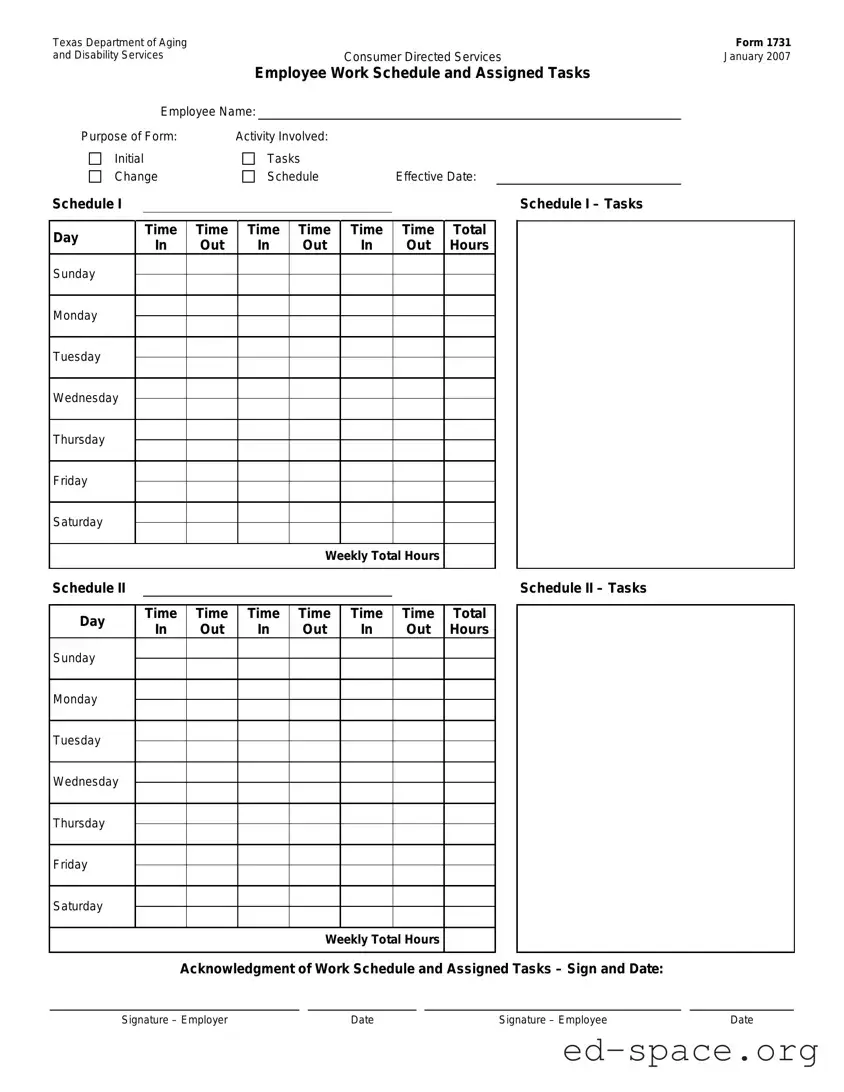
The Texas Department of Aging and Disability Services form, specifically Form 1731, plays a crucial role in the management of Consumer Directed Services. This form is designed to outline the employee work schedule and assigned tasks for caregivers working with individuals receiving services. It requires the employee's name and details various activities involved in their role. The form includes sections for initial tasks and any changes to the schedule, ensuring clarity and accountability. Schedule I and Schedule II sections allow for a comprehensive breakdown of daily tasks, specifying the time in and out for each day of the week. This structured approach helps both employers and employees track hours worked and tasks performed effectively. At the end of the form, there is a space for acknowledgment, where both the employer and employee must sign and date to confirm their agreement on the work schedule and assigned tasks. This process is essential for maintaining transparency and ensuring that all parties are on the same page regarding expectations and responsibilities.

Document Preview

Texas Department of Aging
and Disability Services
Consumer Directed Services
Employee Work Schedule and Assigned Tasks
Form 1731
January 2007
Employee Name:
Purpose of Form: Activity Involved:
Initial Tasks
Change Schedule Effective Date:
Schedule I
Schedule I – Tasks
Day
Time
In
Time
Out
Time
In
Time
Out
Time
In
Time
Out
Total
Hours
Sunday
Monday
Tuesday
Wednesday
Thursday
Friday
Saturday
Weekly Total Hours
Schedule II
Schedule II – Tasks
Day
Time
In
Time
Out
Time
In
Time
Out
Time
In
Time
Out
Total
Hours
Sunday
Monday
Tuesday
Wednesday
Thursday
Friday
Saturday
Weekly Total Hours
Acknowledgment of Work Schedule and Assigned Tasks – Sign and Date:
Signature – Employer Date Signature – Employee Date

Form Specifications

Fact Name Description
Form Title Texas Department of Aging Form 1731
Purpose of Form This form is used for Consumer Directed Services to outline employee work schedules and assigned tasks.
Effective Date The form is dated January 2007, indicating when it was last updated.
Employee Information It requires the employee's name to ensure proper identification and accountability.
Task Scheduling Two schedules are provided (Schedule I and Schedule II) for detailing tasks and hours.
Weekly Total Hours Each schedule includes a section to calculate the total hours worked for the week.
Acknowledgment Section The form includes a space for both employer and employee signatures to confirm the work schedule.
Governing Law This form is governed by Texas state laws related to aging and disability services.

Texas Department Of Aging And Disability Services: Usage Guidelines

Filling out the Texas Department of Aging and Disability Services form requires attention to detail. You will provide information about the employee's work schedule and assigned tasks. Make sure to have all necessary information ready before you begin.

  1. Start by entering the Employee Name at the top of the form.
  2. Identify the purpose of the form and the activity involved. Fill in these sections as needed.
  3. For Schedule I, fill in the Effective Date of the schedule.
  4. Complete the Schedule I – Tasks section:
    • For each day of the week (Sunday to Saturday), fill in the In and Out times.
    • Calculate the total hours worked for each day and write them in the Total Hours column.
  5. Repeat the process for Schedule II:
    • Fill in the In and Out times for each day of the week.
    • Calculate and write the total hours for Schedule II.
  6. At the bottom of the form, find the Acknowledgment of Work Schedule and Assigned Tasks section.
  7. Both the employer and employee should sign and date the form in the designated areas.

Once you have completed the form, review it for accuracy. Make sure all sections are filled out correctly before submitting it to the appropriate department.

Your Questions, Answered

What is the purpose of the Texas Department of Aging and Disability Services Form 1731?

The Texas Department of Aging and Disability Services Form 1731 is designed to facilitate the Consumer Directed Services (CDS) program. This form outlines the employee's work schedule and assigned tasks, ensuring that both employers and employees have a clear understanding of expectations and responsibilities.

Who needs to complete this form?

This form must be completed by both the employer and the employee involved in the Consumer Directed Services program. It is essential for documenting the work schedule and tasks assigned to the employee who provides care or support services.

What information is required on the form?

The form requires several key pieces of information, including the employee's name, the purpose of the form, activity involved, initial tasks, and any changes to the schedule. Additionally, it includes detailed sections for two schedules, where days, times, and total hours worked can be recorded.

How should the work schedule be documented?

Work schedules should be documented in the Schedule I and Schedule II sections of the form. For each day of the week, the employer needs to indicate the times the employee is expected to work, including in and out times, to calculate total hours worked for that day and for the week.

What happens if there are changes to the work schedule?

If there are changes to the work schedule, the employer must update the form accordingly. It is crucial to note the effective date of the changes and ensure that both the employer and employee sign the updated form to acknowledge the new schedule.

Is there a specific format for recording tasks on the form?

Yes, tasks should be listed clearly in the designated sections of the form. Each task should be outlined in a way that both the employer and employee understand what is expected. This clarity helps prevent misunderstandings about job responsibilities.

What is the significance of the acknowledgment section?

The acknowledgment section is important as it serves as a formal agreement between the employer and employee regarding the work schedule and assigned tasks. Both parties must sign and date this section to confirm their understanding and acceptance of the outlined information.

How often should this form be updated?

The form should be updated whenever there are changes to the employee's work schedule or assigned tasks. Regular updates help maintain accurate records and ensure that both parties are on the same page regarding expectations.

Where can I obtain the Texas Department of Aging and Disability Services Form 1731?

The form can typically be obtained from the Texas Department of Aging and Disability Services website or through local offices that administer the Consumer Directed Services program. It is advisable to check for the most current version of the form to ensure compliance with any updates.

What should I do if I have questions about filling out the form?

If you have questions about filling out the form, it is recommended to contact the Texas Department of Aging and Disability Services directly or consult with a representative from the Consumer Directed Services program. They can provide guidance and clarify any uncertainties you may have.

Common mistakes

  1. Incomplete Information: One common mistake is not filling out all required fields. Each section of the form is important for ensuring accurate processing. Omitting details such as the employee's name or the effective date can lead to delays.

  2. Incorrect Time Entries: People often make errors when recording work hours. It is crucial to ensure that the "In" and "Out" times are accurately noted for each day. Mistakes here can affect payment and scheduling.

  3. Not Signing the Form: Failing to provide signatures from both the employer and the employee is a frequent oversight. Both parties must acknowledge the work schedule and assigned tasks to validate the form.

  4. Neglecting to Review the Schedule: Before submitting, it is essential to review the entire form. Overlooking discrepancies or errors in the tasks assigned can lead to confusion and miscommunication later on.

Documents used along the form

When working with the Texas Department of Aging and Disability Services (DADS), several forms and documents may be necessary to ensure proper communication and documentation of services. Each of these forms plays a crucial role in the management and delivery of care for individuals receiving assistance. Below is a list of commonly used documents alongside the DADS form.

  • Consumer Directed Services (CDS) Enrollment Form: This form is essential for individuals who wish to participate in the CDS program. It outlines the responsibilities and rights of the consumer and the service providers.
  • Service Plan: A detailed document that outlines the specific services an individual will receive. It includes goals, timelines, and the responsibilities of both the consumer and the service provider.
  • Employee Time Sheet: This form tracks the hours worked by employees providing care. It helps ensure accurate payment and accountability for services rendered.
  • Incident Report: Used to document any unusual occurrences or accidents involving the consumer. This report is vital for maintaining safety and addressing any concerns promptly.
  • Authorization for Release of Information: This document allows the sharing of personal information between service providers and other relevant parties, ensuring that care is coordinated effectively.
  • Assessment Form: A comprehensive evaluation of the consumer's needs, preferences, and capabilities. This form helps tailor services to fit the individual’s specific situation.
  • Monthly Monitoring Report: This report is used to track the progress of the consumer and ensure that the services provided are meeting their needs. It often includes feedback from both the consumer and the service provider.
  • Emergency Contact Information: A simple but critical document that lists individuals to contact in case of an emergency. This ensures that caregivers have immediate access to important contacts.
  • Caregiver Training Record: This form documents the training and qualifications of caregivers. It ensures that they are adequately prepared to provide the necessary support to consumers.
  • Consumer Satisfaction Survey: A tool used to gather feedback from consumers regarding the services they receive. This feedback is invaluable for improving service quality and consumer experience.

Each of these documents serves a specific purpose and contributes to the overall care and support of individuals receiving services through the Texas Department of Aging and Disability Services. Proper completion and management of these forms help ensure that the needs of consumers are met with compassion and efficiency.

Similar forms

The Texas Department of Aging and Disability Services Form 1731 is designed to help manage employee work schedules and assigned tasks in consumer-directed services. Several other documents serve similar purposes in various contexts. Here’s a list of nine such documents:

  • Employee Time Sheet: This document tracks the hours worked by an employee, detailing start and end times for each shift. Like Form 1731, it helps ensure accurate record-keeping for payroll and compliance.
  • Work Schedule Template: A simple outline of an employee's work hours over a specified period. Similar to Form 1731, it provides clarity on when an employee is expected to work and their assigned tasks.
  • Task Assignment Sheet: This sheet details specific tasks assigned to employees for a given timeframe. It mirrors the task assignment aspect of Form 1731, ensuring that all parties understand their responsibilities.
  • Employee Acknowledgment Form: A document where employees confirm receipt and understanding of their work schedule and tasks. This is akin to the acknowledgment section in Form 1731, emphasizing communication between employer and employee.
  • Shift Change Request Form: Used when an employee needs to change their scheduled hours. This form serves a similar purpose to the change schedule section in Form 1731, allowing for flexibility while maintaining structure.
  • Daily Activity Log: This log records daily tasks performed by an employee. It aligns with Form 1731 by providing a detailed account of work done, which can be useful for performance evaluations.
  • Weekly Work Summary: A summary that outlines the total hours worked and tasks completed over a week. It complements Form 1731 by providing a broader view of an employee's contributions.
  • Payroll Report: This report compiles employee hours and tasks for payroll processing. Like Form 1731, it ensures that accurate information is available for timely payment.
  • Performance Review Document: Used to evaluate an employee's work based on their assigned tasks and hours. This document relates to Form 1731 by assessing how well employees fulfill their responsibilities.

Dos and Don'ts

When filling out the Texas Department of Aging and Disability Services form, it is essential to follow certain guidelines to ensure accuracy and compliance. Here are five things you should and shouldn’t do:

  • Do double-check all entries. Ensure that names, dates, and times are correctly filled in to avoid any confusion later.
  • Don't leave any sections blank. Each part of the form must be completed to prevent delays in processing.
  • Do use clear and legible handwriting. If filling out the form by hand, make sure your writing is easy to read to avoid misinterpretation.
  • Don't forget to sign and date the acknowledgment section. Both the employer and employee must provide their signatures to validate the information.
  • Do keep a copy for your records. Having a copy of the completed form can be helpful for future reference.

Misconceptions

Understanding the Texas Department of Aging and Disability Services (DADS) form can be challenging. Many people hold misconceptions about its purpose and usage. Here are five common misconceptions:

  • 1. The form is only for employees in nursing homes. Many believe that this form applies solely to nursing home staff. In reality, it is designed for a broader range of settings, including home care for individuals with disabilities and the elderly.
  • 2. The form is optional. Some think that completing the form is a choice. However, it is a required document for organizations utilizing Consumer Directed Services (CDS) to ensure proper scheduling and task assignment.
  • 3. Only the employer needs to sign the form. A common misunderstanding is that only the employer's signature is necessary. In fact, both the employer and the employee must sign to confirm acknowledgment of the work schedule and assigned tasks.
  • 4. The form does not need to be updated. Some individuals assume that once the form is filled out, it remains unchanged. On the contrary, any adjustments to the work schedule or tasks should be documented on a new form to maintain accurate records.
  • 5. The form is only relevant for scheduling. While the primary purpose is to outline work schedules, it also serves to clarify the tasks assigned to employees. This clarity helps prevent misunderstandings and ensures that everyone is on the same page regarding responsibilities.

By addressing these misconceptions, individuals can better navigate the requirements of the Texas Department of Aging and Disability Services form and ensure compliance with the necessary guidelines.

Key takeaways

When filling out the Texas Department of Aging and Disability Services form, it is important to keep the following key points in mind:

  • Form Identification: The form is officially known as Texas Department of Aging Form 1731.
  • Purpose: This form is used for Consumer Directed Services, which allows individuals to manage their own care.
  • Employee Information: Clearly write the employee's name at the top of the form to ensure proper identification.
  • Activity Involved: Specify the activities that the employee will be responsible for during their work schedule.
  • Initial and Change Schedules: Indicate whether the schedule is an initial setup or a change to an existing schedule.
  • Daily Tasks: Schedule I and Schedule II sections must include specific tasks assigned to the employee for each day of the week.
  • Time Tracking: Record the start and end times for each shift to accurately reflect total hours worked.
  • Acknowledgment: Both the employer and employee must sign and date the form to confirm agreement on the work schedule and assigned tasks.