Homepage Blank Texas Dec 1 PDF Form
Content Overview

The Texas Dec 1 form, formally known as the Texas Homeowners Policy Declarations Page, serves as a crucial document for homeowners in Texas, summarizing the essential details of their insurance coverage. This form outlines the named insured, policy number, and effective and expiration dates of the policy, providing a clear framework for the coverage period. It specifies the address of the insured property, along with construction details and classification rates, which are vital for determining premium costs. The form delineates various coverage limits, including those for the dwelling, other structures, and personal property, both on and off the premises. Additionally, it includes liability coverage, detailing limits for personal liability and medical payments to others. Homeowners will also find information regarding deductibles, premium adjustments, and mortgage holder details, which are critical for understanding financial responsibilities in the event of a claim. Overall, the Texas Dec 1 form encapsulates the key components of a homeowner's insurance policy, ensuring that policyholders have a comprehensive overview of their coverage and obligations.
Document Preview

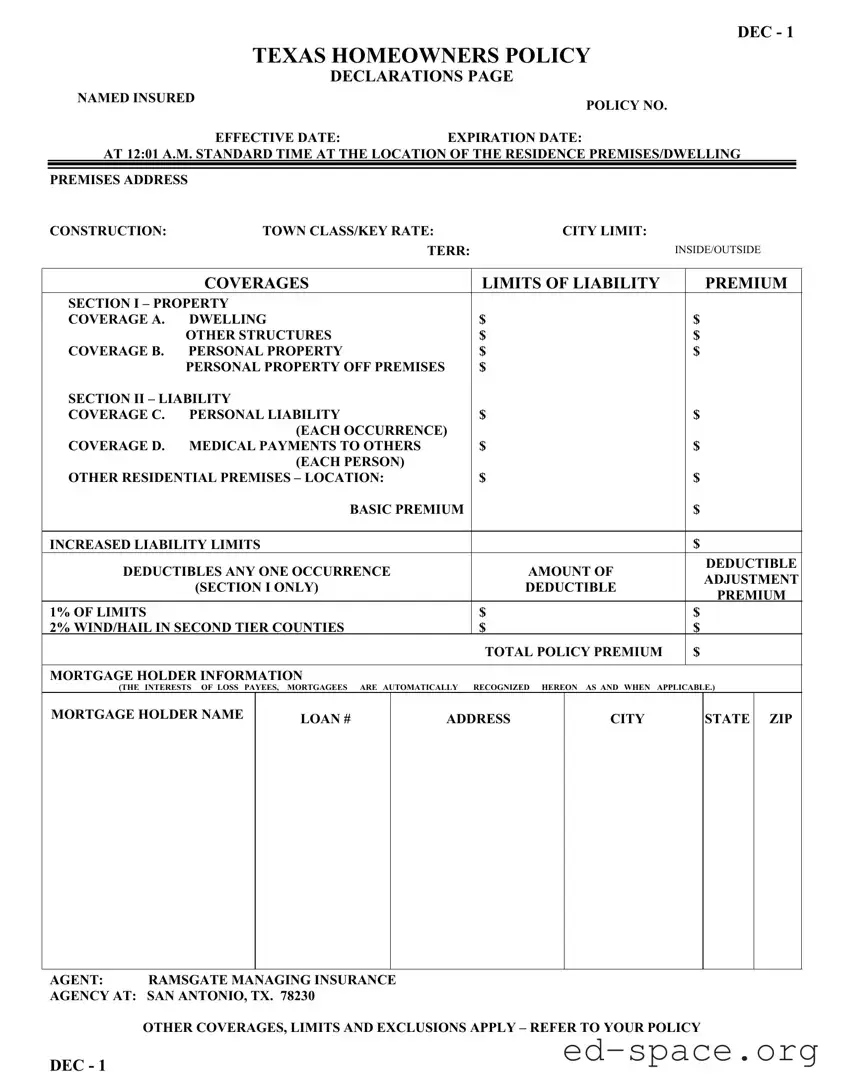
DEC -1
TEXAS HOMEOWNERS POLICY
DECLARATIONS PAGE
NAMED INSURED
POLICY NO.
EFFECTIVE DATE: EXPI
R
ATION DATE:
AT 12:01 A.M. STANDARD TIME AT THE LOCATION OF THE RESIDENCE PREMISES/DWELLING
PREMISES ADDRESS
CONSTRUCTION: TOWN CLASS/KEY RATE: CITY LIMIT:
TERR:
INSIDE/OUTSIDE
COVERAGES LIMITS OF LIABILITY PREMIUM
SECTION I
PROPERTY
COVERAGE A. DWELLING $ $
OTHE
R
STRUCTURES $ $
COVERAGE B. PERSONAL PROPERTY $ $
PERSONAL PROPERTY OFF PREMISES $
SECTION II
LIABILITY
COVERAGE C. PERSONAL LIABILITY $$
(EACH OCCURRENCE)
COVERAGE D. MEDICAL PAYMENTS TO OTHERS $ $
(EACH PERSON)
OTHE
R
RESIDENTIAL PREMISES
LOCATION: $ $
BASIC PREMIUM $
LIMITSINCREASED LIABILITY
$
DEDUCTIBLE
DEDUCTIBLES ANY ONE OCCURRENCE AMOUNT OF
ADJUSTMENT
(SECTION I ONLY) DEDUCTIBLE
PREMIUM
1% OF $ $
2%
LIMITS
WIND/HAIL IN SECO ND TIE
R
COUNTIES $ $
TOTAL POLICY PREMIUM $
MORTGAGE HOLDE
R
INFORMATION
(THE INTERESTS OF LOSS PAYEES, MORTGAGEES ARE AUTOMATICALLY RECOGNIZED HEREON AS AND WHEN APPLICABLE.)
MORTGAGE HOLDE
R
NAME
LOAN # ADDRESS CITY STATE ZIP
AGENT: RAMSGATE MANAGING INSURANCE
AGENCY AT: SAN ANTONIO, TX. 78230
OTHE
R
COVERAGES, LIMITS AND EXCLUSIONS APPLY
REFE
R
TO YOU
R
POLICY
DEC -1

Form Specifications

Fact Name Description
Form Title DEC - 1 Texas Homeowners Policy Declarations Page
Named Insured The form identifies the individual or entity covered under the policy.
Policy Number Each policy is assigned a unique number for identification purposes.
Effective Date The date when the coverage begins, typically at 12:01 A.M.
Expiration Date This indicates when the policy coverage ends.
Coverage Limits Details the maximum amounts payable under various coverage sections.
Deductibles Specifies the amounts the insured must pay out-of-pocket before coverage kicks in.
Governing Law This form is governed by the Texas Insurance Code.

Texas Dec 1: Usage Guidelines

Filling out the Texas Dec 1 form is an important step in securing your homeowners insurance. After completing this form, you will be able to provide the necessary information to your insurance provider. This information will help determine your coverage and premiums.

  1. Begin by entering your named insured information at the top of the form.
  2. Fill in your policy number.
  3. Indicate the effective date and expiration date of your policy.
  4. Provide the address of the residence or dwelling premises.
  5. Specify the construction type of your home.
  6. Indicate the town class/key rate.
  7. State whether your property is inside or outside city limits.
  8. List the coverage limits for Section I - Property Coverage:
    • Dwelling
    • Other Structures
    • Personal Property
    • Personal Property Off Premises
  9. Complete Section II - Liability Coverage by filling in:
    • Personal Liability (each occurrence)
    • Medical Payments to Others (each person)
  10. Provide information on any other residential premises and their respective limits.
  11. Fill in the basic premium and any increased liability limits.
  12. Specify the deductibles for any one occurrence and the amount of deductible adjustment for Section I only.
  13. Indicate the deductible premium for 1% and 2% wind/hail in second-tier counties.
  14. Calculate and enter the total policy premium.
  15. Provide mortgage holder information, including name, loan number, and address.
  16. Lastly, note the agent's information, which is Ramsgate Managing Insurance Agency located in San Antonio, TX.

Your Questions, Answered

What is the Texas Dec 1 form?

The Texas Dec 1 form is the Homeowners Policy Declarations page. It outlines key details about your homeowner's insurance policy, including coverage limits, premiums, and important dates. This document serves as a summary of your insurance coverage and is essential for understanding your policy's terms.

What information is included on the Texas Dec 1 form?

This form includes details such as the named insured, policy number, effective and expiration dates, coverage limits for dwelling, other structures, and personal property. It also lists liability coverage, medical payments to others, and any applicable deductibles. Additionally, it provides information about your mortgage holder, if applicable.

How do I read the coverage limits on the Texas Dec 1 form?

The coverage limits are shown next to each type of coverage. For example, you will see limits for dwelling coverage, personal property, and liability coverage. These amounts indicate the maximum your insurance will pay for claims related to those specific areas. Understanding these limits helps you know your financial protection in case of a loss.

What does the premium section indicate?

The premium section shows the total amount you will pay for your insurance policy. It breaks down the basic premium, any increased liability limits, and the deductibles. This section helps you understand the cost of your coverage and any adjustments that may apply based on your specific situation.

What is the significance of the deductible amounts?

The deductible is the amount you must pay out of pocket before your insurance coverage kicks in. The Texas Dec 1 form lists different deductible amounts for various types of coverage. Knowing your deductible helps you prepare financially for potential claims and understand your policy's terms better.

Who is listed as the mortgage holder on the Texas Dec 1 form?

If you have a mortgage on your home, the mortgage holder's information will be included on the form. This typically includes the name of the lender, loan number, and their address. The interests of the mortgage holder are automatically recognized in the policy, meaning they are protected in case of a loss.

What should I do if I find an error on the Texas Dec 1 form?

If you notice any errors on your Texas Dec 1 form, it's important to contact your insurance agent immediately. They can help correct any mistakes and ensure that your policy accurately reflects your coverage and personal information. Keeping your documents accurate is crucial for your protection.

Where can I find more details about my coverage?

For more information about your coverage, refer to the full policy document associated with your Texas Dec 1 form. This document outlines specific coverages, limits, and exclusions that apply to your policy. If you have questions, your insurance agent can provide clarity and assistance.

Common mistakes

  1. Incomplete Information: One common mistake is failing to fill out all required fields. Each section, including the named insured and policy number, must be completed accurately to avoid processing delays.

  2. Incorrect Property Address: Providing an incorrect address for the residence premises can lead to complications. Ensure the address matches official documents, including city, state, and zip code.

  3. Misstated Coverage Limits: Individuals often miscalculate or misstate coverage limits for property and liability. Double-check these figures to ensure they reflect the intended protection levels.

  4. Omitting Mortgage Holder Information: Neglecting to include the mortgage holder's name and address can result in issues with claims. This information is crucial for recognizing interests in the policy.

  5. Ignoring Deductibles: Failing to specify the deductible amounts can lead to confusion. Be sure to indicate both the standard and any additional deductibles for wind or hail damage.

  6. Not Reviewing the Policy Premium: Many overlook the total policy premium and its breakdown. It's essential to verify that all calculations align with expectations and that no fees are unaccounted for.

Documents used along the form

The Texas DEC-1 form serves as the declarations page for homeowners insurance policies in Texas. It outlines the key details of the insurance coverage, including limits, premiums, and property information. Along with the DEC-1 form, several other documents are commonly used in conjunction with it to provide a comprehensive understanding of the insurance policy and related obligations. Below is a list of these documents, each described briefly.

  • Texas Homeowners Policy Form: This is the actual policy document that provides detailed terms, conditions, and coverage options. It outlines the rights and responsibilities of both the insurer and the insured.
  • Endorsements: These are modifications or additions to the original policy. They can provide additional coverage, limit coverage, or clarify terms in the policy.
  • Proof of Loss Form: This document is used to report a claim to the insurance company. It details the damages or losses incurred and is necessary for the claims process.
  • Claim Form: Similar to the proof of loss form, this document is specifically for initiating a claim. It collects information about the incident that led to the claim.
  • Mortgagee Clause: This clause is included in the policy to protect the interests of the mortgage lender. It ensures that the lender is notified of any changes to the policy or claims made against it.
  • Declarations Page: Often referred to as the dec page, this document summarizes the key details of the insurance policy, including coverage limits, premiums, and the insured property.
  • Notice of Cancellation: This document is issued by the insurance company to inform the insured that their policy will be canceled. It provides details about the reason for cancellation and any applicable timelines.
  • Renewal Notice: This is sent to the insured prior to the policy's expiration date. It outlines the terms for renewal and any changes in coverage or premium amounts.

These documents work in tandem with the Texas DEC-1 form to create a complete picture of the homeowner's insurance policy. Understanding each of these forms is crucial for homeowners to ensure they are adequately covered and aware of their rights and responsibilities under the policy.

Similar forms

The Texas DEC-1 form serves as a crucial document in the realm of homeowners insurance. It provides a comprehensive overview of the insurance policy, including coverage details and limits. Several other documents share similarities with the Texas DEC-1 form in terms of purpose and structure. Below is a list of ten such documents:

  • Homeowners Insurance Policy Declarations Page: This document outlines the basic details of a homeowners insurance policy, including the named insured, policy number, effective dates, and coverage limits, similar to the Texas DEC-1 form.
  • Auto Insurance Declarations Page: Like the Texas DEC-1, this page summarizes the auto insurance policy, detailing coverage types, limits, and premiums, making it easy for policyholders to understand their protection.
  • renters Insurance Declarations Page: This document provides a summary of the coverage for personal property and liability, paralleling the structure of the Texas DEC-1 by listing coverage limits and premiums.
  • Condo Insurance Declarations Page: Similar to the Texas DEC-1, this page details coverage for condominium owners, including property coverage and liability limits, ensuring clarity for the policyholder.
  • Landlord Insurance Declarations Page: This document outlines coverage for rental properties, much like the Texas DEC-1, highlighting property and liability coverage for landlords.
  • Flood Insurance Declarations Page: This page summarizes flood insurance coverage, including limits and premiums, akin to the Texas DEC-1 in providing essential details for homeowners.
  • Umbrella Insurance Declarations Page: This document provides an overview of additional liability coverage beyond standard policies, similar to how the Texas DEC-1 outlines liability limits.
  • Business Owners Policy Declarations Page: This document summarizes coverage for small businesses, detailing property and liability limits in a format reminiscent of the Texas DEC-1.
  • Motorcycle Insurance Declarations Page: Like the Texas DEC-1, this page outlines coverage specifics, including property damage and liability limits, tailored for motorcycle owners.
  • Boat Insurance Declarations Page: This document details coverage for watercraft, providing limits and premiums in a manner similar to the Texas DEC-1, ensuring clarity for boat owners.

Each of these documents serves to inform the policyholder about their coverage, limits, and premiums, facilitating a better understanding of their insurance needs.

Dos and Don'ts

When filling out the Texas Dec 1 form, it’s important to be careful and thorough. Here are some key points to keep in mind:

  • Do read the entire form before you start filling it out. Understanding each section will help you provide accurate information.
  • Do fill in your name and address clearly. This ensures that your policy is linked to the correct individual and property.
  • Do double-check the policy number. Make sure it matches any previous documents you have.
  • Do provide accurate construction details of your home. This information affects your coverage and premium.
  • Do list all coverages and limits accurately. Ensure the numbers reflect what you want for your policy.
  • Don’t leave any sections blank. Every part of the form needs to be completed to avoid delays.
  • Don’t guess on any figures. If you’re unsure, consult your insurance agent for guidance.
  • Don’t forget to sign and date the form. An unsigned form can lead to complications in processing your policy.
  • Don’t ignore the mortgage holder information. Ensure it is correct to avoid issues with claims in the future.

By following these tips, you can help ensure that your Texas Dec 1 form is filled out correctly and completely.

Misconceptions

The Texas Dec 1 form is an important document for homeowners insurance, yet several misconceptions often arise. Below is a list of common misunderstandings about this form.

  • It is only for new policies. The Texas Dec 1 form can also be used for policy renewals and changes, not just new applications.
  • All coverage limits are the same. Coverage limits vary based on individual needs and the specifics of the property. Each homeowner should review their limits carefully.
  • It covers everything automatically. The form outlines specific coverages, but not all damages or losses are covered. Homeowners should review their policy for exclusions.
  • Deductibles are fixed. Deductibles can vary based on the policy and the type of claim. Homeowners should confirm their deductible amounts.
  • Mortgage information is optional. Providing mortgage holder information is crucial, as it ensures that the mortgagee's interests are protected in case of a loss.
  • Agents have no role after issuing the policy. Agents remain available for questions and assistance throughout the policy term, providing ongoing support to homeowners.
  • The form is only for residential properties. While primarily for residential properties, it can also apply to certain types of residential premises that may not be owner-occupied.
  • Premiums are non-negotiable. Premiums can sometimes be adjusted based on coverage choices, discounts, and other factors. Homeowners should discuss options with their agents.

Understanding these misconceptions can help homeowners make informed decisions regarding their insurance coverage and ensure they have the protection they need.

Key takeaways

When filling out and using the Texas Dec 1 form, keep these key points in mind:

  • Accurate Information: Ensure that all details, such as the named insured and policy number, are filled out correctly. Mistakes can lead to complications in coverage.
  • Coverage Limits: Review the coverage limits for both property and liability. Understand what is covered and the maximum amounts you can claim.
  • Deductibles: Be aware of the deductibles listed. This is the amount you will need to pay out of pocket before your insurance kicks in.
  • Mortgage Holder Details: If you have a mortgage, include the mortgage holder's information. This ensures that their interests are protected in case of a claim.
  • Consult Your Agent: If you have questions or need clarification, reach out to your insurance agent. They can provide guidance tailored to your situation.