Homepage Blank Texas Civil Case Information Sheet PDF Form
Content Overview

The Texas Civil Case Information Sheet is an essential document designed to streamline the filing process for various civil cases, including family law, probate, and mental health matters. When initiating a new case or filing a post-judgment petition, this form must be completed and submitted alongside the original petition or application. It serves a crucial role in collecting pertinent information that will be used for statistical and administrative purposes by the Texas Judicial Council. Importantly, it does not replace or supplement other required filings and is not admissible in court. The form requires detailed contact information from the person completing it, including their name, address, and email, along with the names of all parties involved in the case. Additionally, it asks for the case type, allowing the filer to select the most relevant category that reflects the core issue at hand. Furthermore, it provides options for indicating any procedures or remedies being sought, thus ensuring that all necessary details are captured efficiently. By adhering to the guidelines outlined in the Civil Case Information Sheet, filers can help facilitate a smoother legal process while ensuring compliance with Texas court requirements.


Document Preview

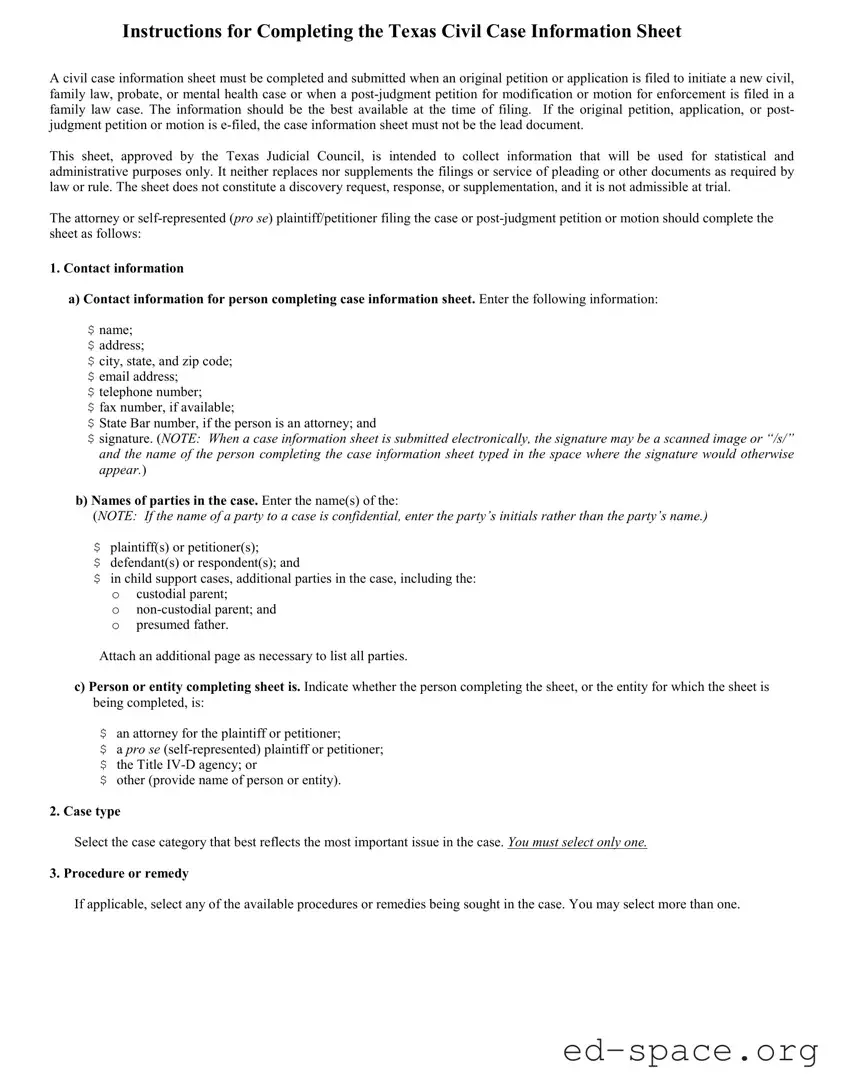
Instructions for Completing the Texas Civil Case Information Sheet
A civil case information sheet must be completed and submitted when an original petition or application is filed to initiate a new civil,
family law, probate, or mental health case or when a post-judgment petition for modification or motion for enforcement is filed in a
family law case. The information should be the best available at the time of filing. If the original petition, application, or post-
judgment petition or motion is e-filed, the case information sheet must not be the lead document.
This sheet, approved by the Texas Judicial Council, is intended to collect information that will be used for statistical and
administrative purposes only. It neither replaces nor supplements the filings or service of pleading or other documents as required by
law or rule. The sheet does not constitute a discovery request, response, or supplementation, and it is not admissible at trial.
The attorney or self-represented (pro se) plaintiff/petitioner filing the case or post-judgment petition or motion should complete the
sheet as follows:
1. Contact information
a) Contact information for person completing case information sheet. Enter the following information:
$ name;
$ address;
$ city, state, and zip code;
$ email address;
$ telephone number;
$ fax number, if available;
$ State Bar number, if the person is an attorney; and
$ signature. (NOTE: When a case information sheet is submitted electronically, the signature may be a scanned image or “/s/
and the name of the person completing the case information sheet typed in the space where the signature would otherwise
appear.)
b) Names of parties in the case. Enter the name(s) of the:
(NOTE: If the name of a party to a case is confidential, enter the party’s initials rather than the party’s name.)
$ plaintiff(s) or petitioner(s);
$ defendant(s) or respondent(s); and
$ in child support cases, additional parties in the case, including the:
o custodial parent;
o non-custodial parent; and
o presumed father.
Attach an additional page as necessary to list all parties.
c) Person or entity completing sheet is. Indicate whether the person completing the sheet, or the entity for which the sheet is
being completed, is:
$ an attorney for the plaintiff or petitioner;
$ a pro se (self-represented) plaintiff or petitioner;
$ the Title IV-D agency; or
$ other (provide name of person or entity).
2. Case type
Select the case category that best reflects the most important issue in the case.
You must select only one.
3. Procedure or remedy
If applicable, select any of the available procedures or remedies being sought in the case. You may select more than one.
(e.g., John Smith v. All American Insurance Co; In re Mary Ann Jones; In the Matter of the Estate of George Jackson)
A civil case information sheet must be completed and submitted when an original petition or application is filed to initiate a new civil, family law, probate, or mental
health case or when a post-judgment petition for modification or motion for enforcement is filed in a family law case. The information should be the best available at
the time of filing. This sheet, approved by the Texas Judicial Council, is intended to collect information that will be used for statistical purposes only. It neither replaces
nor supplements the filings or service of pleading or other documents as required by law or rule. The sheet does not constitute a discovery request, response, or
supplementation, and it is not admissible at trial.
1. Contact information for person completing case information sheet: Names of parties in case: Person or entity completing sheet is:
Name:
_____________________________
Address:
_____________________________
City/State/Zip:
_____________________________
Signature:
_____________________________
Email:
____________________________
Telephone:
____________________________
Fax:
____________________________
State Bar No:
____________________________
Plaintiff(s)/Petitioner(s):
_________________________________
_________________________________
Defendant(s)/Respondent(s):
_________________________________
_________________________________
_________________________________
[Attach additional page as necessary to list all parties]
Attorney for Plaintiff/Petitioner
Pro Se Plaintiff/Petitioner
Title IV-D Agency
Other: _________________________
Additional Parties in Child Support Case:
Custodial Parent:
_________________________________
Non-Custodial Parent:
_________________________________
Presumed Father:
_________________________________
2. Indicate case type, or identify the most important issue in the case (select only 1):
Civil
Family Law
Injury or Damage
Real Property
Marriage Relationship
Post-judgment Actions
(non-Title IV-D)
Consumer/DTPA
Debt/Contract
Fraud/Misrepresentation
Other Debt/Contract:
____________________
Foreclosure
Home Equity—Expedited
Other Foreclosure
Franchise
Insurance
Landlord/Tenant
Non-Competition
Partnership
Other Contract:
______________________
Assault/Battery
Construction
Defamation
Malpractice
Accounting
Legal
Medical
Other Professional
Liability:
_______________
Motor Vehicle Accident
Premises
Product Liability
Asbestos/Silica
Other Product Liability
List Product:
_________________
Other Injury or Damage:
_________________
Eminent Domain/
Condemnation
Partition
Quiet Title
Trespass to Try Title
Other Property:
____________________
Annulment
Declare Marriage Void
Divorce
With Children
No Children
Enforcement
ModificationCustody
ModificationOther
Title IV-D
Enforcement/Modification
Paternity
Reciprocals (UIFSA)
Support Order
Related to Criminal
Matters Other Family Law Parent-Child Relationship
Expunction
Judgment Nisi
Non-Disclosure
Seizure/Forfeiture
Writ of Habeas Corpus
Pre-indictment
Other: _______________
Enforce Foreign
Judgment
Habeas Corpus
Name Change
Protective Order
Removal of Disabilities
of Minority
Other:
__________________
Adoption/Adoption with
Termination
Child Protection
Child Support
Custody or Visitation
Gestational Parenting
Grandparent Access
Parentage/Paternity
Termination of Parental
Rights
Other Parent-Child:
_____________________
Other Civil
Discrimination
Retaliation
Termination
Workers’ Compensation
Other Employment:
______________________
Administrative Appeal
Antitrust/Unfair
Competition
Code Violations
Foreign Judgment
Intellectual Property
Lawyer Discipline
Perpetuate Testimony
Securities/Stock
Tortious Interference
Other: _______________
Tax
Probate & Mental Health
Tax Appraisal
Tax Delinquency
Other Tax
Probate/Wills/Intestate Administration
Dependent Administration
Independent Administration
Other Estate Proceedings
GuardianshipAdult
GuardianshipMinor
Mental Health
Other: ____________________
3. Indicate procedure or remedy, if applicable (may select more than 1):
Appeal from Municipal or Justice Court
Arbitration-related
Attachment
Bill of Review
Certiorari
Class Action
Declaratory Judgment
Garnishment
Interpleader
License
Mandamus
Post-judgment
Prejudgment Remedy
Protective Order
Receiver
Sequestration
Temporary Restraining Order/Injunction
Turnover
C
IVIL
C
ASE
I
NFORMATION
S
HEET
C
AUSE NUMBER (FOR CLERK USE ONLY): _______________________________ COURT (FOR CLERK USE ONLY): ______________________
S
TYLED
___________________________________________________________________________________________________

Form Specifications

Fact Name Details
Purpose The Texas Civil Case Information Sheet is used to collect information for statistical and administrative purposes when initiating certain civil cases.
Filing Requirement This sheet must be submitted with an original petition or application for civil, family law, probate, or mental health cases, or with post-judgment petitions in family law cases.
Confidentiality If a party's name is confidential, only their initials should be entered on the form.
Legal Standing The form is approved by the Texas Judicial Council and is governed by Texas Rule of Civil Procedure 78.

Texas Civil Case Information Sheet: Usage Guidelines

Completing the Texas Civil Case Information Sheet is a crucial step when initiating a civil, family law, probate, or mental health case. This form gathers essential information to aid in the administrative process. After filling out the form, it should be submitted alongside the original petition or application to ensure proper case management.

  1. Contact Information:
    • Enter your name, address, city, state, and zip code.
    • Provide your email address, telephone number, and fax number (if available).
    • If you are an attorney, include your State Bar number and signature. If submitting electronically, you can use a scanned signature or type “/s/” followed by your name.
  2. Names of Parties in the Case:
    • List the names of the plaintiff(s) or petitioner(s).
    • List the defendant(s) or respondent(s).
    • For child support cases, include additional parties such as the custodial parent, non-custodial parent, and presumed father. If necessary, attach an additional page to list all parties.
  3. Person or Entity Completing the Sheet:
    • Indicate whether you are an attorney for the plaintiff/petitioner, a pro se plaintiff/petitioner, the Title IV-D agency, or another entity (provide the name).
  4. Case Type:
    • Select the case category that best reflects the most important issue in your case. Choose only one option.
  5. Procedure or Remedy:
    • If applicable, select any available procedures or remedies being sought in the case. You may choose more than one option.

Your Questions, Answered

What is the Texas Civil Case Information Sheet?

The Texas Civil Case Information Sheet is a form that must be completed and submitted when initiating a new civil case, family law case, probate case, or mental health case. It is also required for post-judgment petitions in family law cases. The form collects essential information for statistical and administrative purposes and does not replace any legal documents required by law.

When do I need to submit the Texas Civil Case Information Sheet?

You need to submit this form when you file an original petition or application for a new case or when you file a post-judgment petition for modification or a motion for enforcement in a family law case. It is essential to provide the best available information at the time of filing.

Who is responsible for completing the form?

The form should be completed by the attorney or self-represented (pro se) plaintiff or petitioner filing the case. If an attorney is involved, their State Bar number must also be included. If the filing is electronic, a scanned signature or "/s/" followed by the typed name is acceptable.

What kind of information is required on the form?

The form requires contact information for the person completing it, names of all parties involved in the case, and the type of case being filed. You will also need to indicate whether you are the plaintiff, defendant, or another party, as well as the case type and any procedures or remedies being sought.

Can I use initials instead of full names on the form?

Yes, if the name of a party involved in the case is confidential, you can enter the party's initials instead of their full name. This is particularly relevant in sensitive cases, such as those involving minors or certain family law matters.

Is the information on this form admissible in court?

No, the information provided on the Texas Civil Case Information Sheet is not admissible at trial. It is strictly for statistical and administrative purposes and does not serve as a discovery request or response.

What happens if I do not submit the form?

Failure to submit the Texas Civil Case Information Sheet may result in delays in processing your case. Some courts may require the form to be filed as a condition for proceeding with your case, so it is advisable to complete and submit it as required.

How do I determine the case type for the form?

You should select the case category that best reflects the primary issue in your case. The form allows you to choose only one case type, so it is important to carefully review the options and select the one that most accurately represents your situation.

Can I select more than one procedure or remedy on the form?

Yes, you can select multiple procedures or remedies if they apply to your case. The form provides a list of available options, and you can check all that are relevant to your situation.

Is there a specific format for the case style on the form?

Yes, the case style should be formatted to include the names of the parties involved, such as "John Smith v. All American Insurance Co." or "In re Mary Ann Jones." This format helps to clearly identify the case and the parties involved.

Common mistakes

  1. Incomplete Contact Information: One common mistake is failing to provide complete contact information for the individual filling out the form. This includes not only the name but also the address, email, and phone number. Omitting any of these details can lead to delays in processing the case.

  2. Incorrect Case Type Selection: Selecting the wrong case type can significantly impact the handling of the case. It is crucial to carefully choose the category that best reflects the main issue. Many people mistakenly select multiple categories instead of just one, which is against the instructions.

  3. Failure to Indicate All Parties: When listing the parties involved in the case, some individuals forget to include all relevant parties, especially in child support cases. It's important to ensure that all custodial and non-custodial parents, as well as any other necessary parties, are listed accurately.

  4. Neglecting to Sign the Form: A common oversight is forgetting to sign the case information sheet. Without a signature, the document may be deemed incomplete. Whether submitting electronically or in person, a signature is essential to validate the submission.

Documents used along the form

The Texas Civil Case Information Sheet is an important document that must be filed when initiating various types of civil cases. It collects essential information for administrative purposes. Along with this form, there are other documents that may also be required to ensure the case is properly filed and processed. Below is a list of some commonly used forms that accompany the Texas Civil Case Information Sheet.

  • Original Petition or Application: This document formally initiates a civil lawsuit. It outlines the plaintiff's claims and the relief sought from the court. It is essential for establishing the basis of the case.
  • Service of Process: This document is used to notify the defendant that a lawsuit has been filed against them. It includes the original petition and is delivered to the defendant to ensure they are aware of the legal action.
  • Affidavit of Indigency: If a party cannot afford court fees, this form may be submitted to request a waiver of those fees. It provides the court with information about the individual’s financial situation.
  • Notice of Hearing: This document informs all parties involved about the date and time of a scheduled court hearing. It ensures that everyone is aware of when they need to appear in court.

Each of these documents plays a vital role in the civil litigation process. Properly completing and submitting them along with the Texas Civil Case Information Sheet helps to facilitate a smoother court experience for all parties involved.

Similar forms

  • Texas Family Code Affidavit: Similar to the Texas Civil Case Information Sheet, this affidavit collects essential details when filing family law cases. It requires information about the parties involved and the nature of the case, ensuring that the court has a clear understanding of the situation at hand.
  • Texas Probate Court Information Sheet: This document serves a purpose akin to the civil case information sheet but focuses specifically on probate matters. It gathers data about the decedent, the heirs, and the type of probate action being initiated, helping streamline the court's processing of probate cases.
  • Texas Eviction Case Information Sheet: This sheet is used in eviction cases and collects information about the landlord, tenant, and the nature of the eviction. Like the civil case information sheet, it aims to provide the court with pertinent details to facilitate a swift resolution.
  • Texas Small Claims Case Information Sheet: This document is tailored for small claims cases. It gathers essential information about the parties involved and the claim being made. Similar to the civil case information sheet, it serves to assist the court in understanding the case's context and facilitating an efficient hearing.

Dos and Don'ts

When filling out the Texas Civil Case Information Sheet, it's essential to follow specific guidelines to ensure accuracy and compliance. Here’s a list of things you should and shouldn't do:

  • Do provide accurate contact information, including your name, address, and email.
  • Do include all parties involved in the case, using initials for confidential names.
  • Do select only one case type that best reflects the primary issue.
  • Do indicate the person or entity completing the sheet clearly.
  • Do ensure your signature is included, even if it's a typed version for electronic submissions.
  • Don't leave any required fields blank; provide the best available information.
  • Don't submit the case information sheet as the lead document if e-filing.
  • Don't add unnecessary details or explanations; stick to the form's requirements.
  • Don't use full names if confidentiality is a concern; initials are acceptable.
  • Don't forget to attach an additional page if you have more parties to list.

Misconceptions

When dealing with the Texas Civil Case Information Sheet, several misconceptions can arise. Understanding the true nature and purpose of this form can help ensure that it is completed correctly and effectively. Here are four common misconceptions:

  • The form is a legal requirement for all cases. While the Texas Civil Case Information Sheet must be submitted when filing certain types of cases, it is not required for every legal action. It is specifically needed for initiating new civil, family law, probate, or mental health cases, as well as for post-judgment petitions in family law cases.
  • The information provided will be used in court. Many people mistakenly believe that the information on the case information sheet will be presented as evidence in court. In reality, this form is intended solely for statistical and administrative purposes. It does not replace any legal filings or pleadings and is not admissible at trial.
  • Only attorneys need to complete the form. This is not accurate. Both attorneys and self-represented individuals (pro se) must complete the Texas Civil Case Information Sheet when filing appropriate cases. The process is designed to be accessible to all parties involved in the legal system.
  • The form does not require accurate information. Some individuals might think that they can provide vague or incomplete information. However, it is crucial to provide the best available information at the time of filing. This ensures that the court can properly categorize and manage the case.

By addressing these misconceptions, individuals can approach the Texas Civil Case Information Sheet with greater clarity and confidence, leading to a smoother filing process.

Key takeaways

When filling out and using the Texas Civil Case Information Sheet, keep these key points in mind:

  • Mandatory Submission: This form must be submitted whenever you file an original petition or application to start a new civil, family law, probate, or mental health case. It is also required for post-judgment petitions in family law cases.
  • Best Available Information: Provide the most accurate and complete information available at the time of filing. This helps ensure the case is processed efficiently.
  • Not a Legal Document: The information sheet serves statistical and administrative purposes only. It does not replace other required filings and is not admissible in court.
  • Contact Details: Include contact information for the person completing the sheet. This includes names of all parties involved, their roles, and any relevant details, such as email addresses and phone numbers.