Homepage Blank Texas Child Power of Attorney PDF Form
Content Overview

The Texas Child Power of Attorney form serves as a vital legal tool for parents and guardians who need to delegate specific parental rights to another trusted adult. This form is particularly useful in situations where a parent may be temporarily unavailable, such as during travel or medical emergencies. By completing this document, a parent can grant authority for another individual to make decisions regarding the child’s education, healthcare, and general welfare. It is essential to understand that this power of attorney is limited in scope and does not terminate parental rights; rather, it provides a framework for responsible caregiving during a designated period. Moreover, the form must be signed and notarized to ensure its validity, making it a formal agreement that protects the interests of the child. With the right information and understanding of the process, parents can confidently establish this legal arrangement, ensuring their child’s needs are met even in their absence.


Document Preview

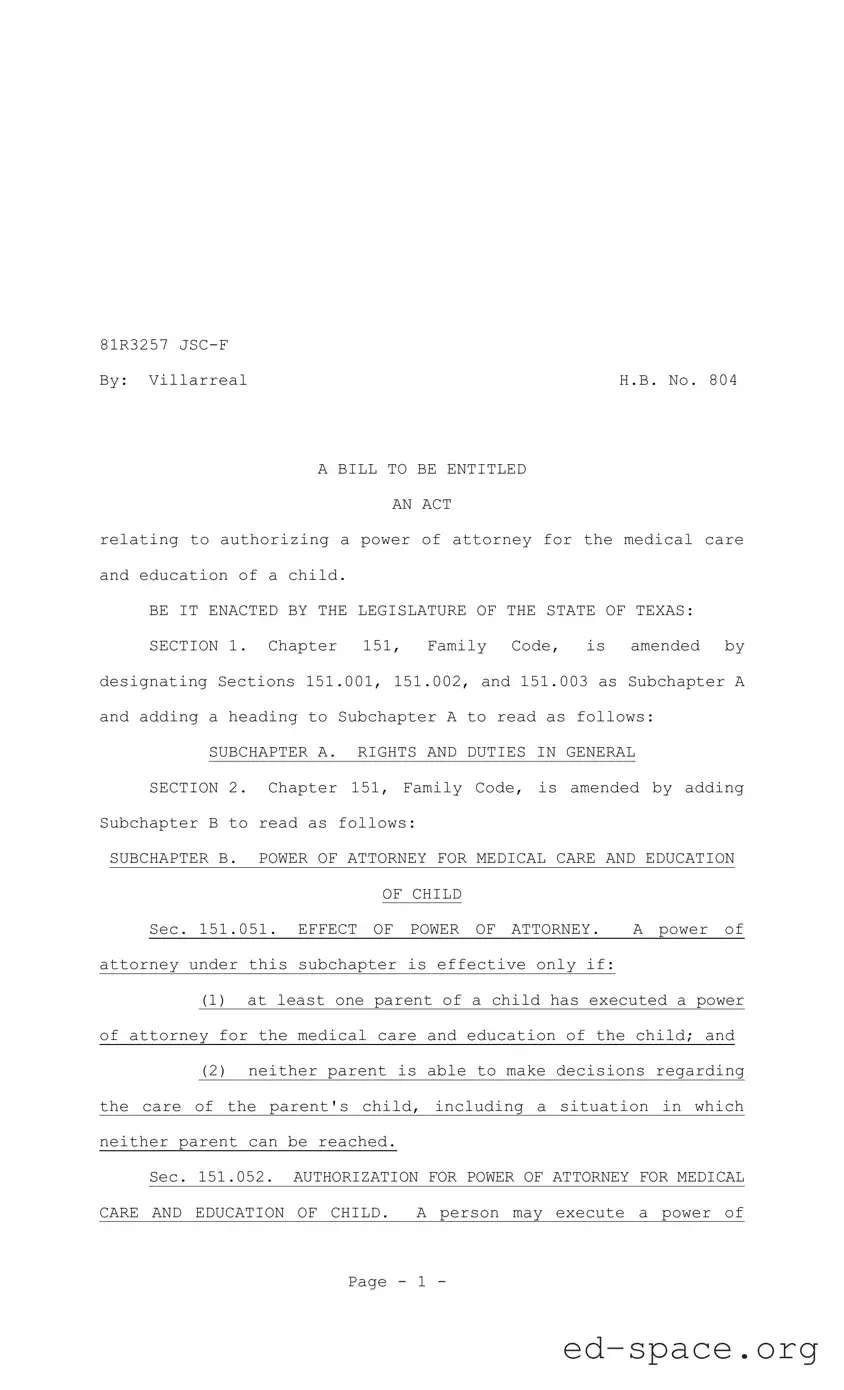
81R3257 JSC-F
By: Villarreal H.B. No. 804
A BILL TO BE ENTITLED
AN ACT
relating to authorizing a power of attorney for the medical care
and education of a child.
BE IT ENACTED BY THE LEGISLATURE OF THE STATE OF TEXAS:
SECTION 1. Chapter 151, Family Code, is amended by
designating Sections 151.001, 151.002, and 151.003 as Subchapter A
and adding a heading to Subchapter A to read as follows:
SUBCHAPTER A. RIGHTS AND DUTIES IN GENERAL
SECTION 2. Chapter 151, Family Code, is amended by adding
Subchapter B to read as follows:
SUBCHAPTER B. POWER OF ATTORNEY FOR MEDICAL CARE AND EDUCATION
OF CHILD
Sec. 151.051. EFFECT OF POWER OF ATTORNEY. A power of
attorney under this subchapter is effective only if:
(1) at least one parent of a child has executed a power
of attorney for the medical care and education of the child; and
(2) neither parent is able to make decisions regarding
the care of the parent's child, including a situation in which
neither parent can be reached.
Sec. 151.052. AUTHORIZATION FOR POWER OF ATTORNEY FOR MEDICAL
CARE AND EDUCATION OF CHILD. A person may execute a power of
Page - 1 -
______________________________
______________________________
______________________________
______________________________
______________________________
______________________________
______________________________
______________________________
______________________________
H.B. No. 804
attorney appointing another person as the person's agent to make
decisions regarding the medical care and education of the person's
child.
Sec. 151.053. FORM. (a) A power of attorney for the medical
care and education of a child must be in substantially the
following form:
POWER OF ATTORNEY FOR THE MEDICAL CARE AND EDUCATION OF A CHILD
Part I: To be filled out and/or initialed by parent(s).
Minor Child's Name_________________________________
Mother/Legal Guardian's Name & Address
Father/Legal Guardian's Name & Address
Caregiver's Name & Address
(check one of the following)
(____) Both parents are living and have signed this
document;
(____) One parent is deceased;
Page -2 -
H.B. No. 804
(____) The parent-child relationship has been terminated
for one of the parents;
(____) The decision-making authority of one parent has
been limited by a court order;
(____) One parent is the sole managing conservator of the
minor child and has sent a copy of this document, by certified
mail, return receipt requested, to the other parent at that
parent's last known address; or
(____) The other parent has not consented to the
appointment or consent cannot be obtained because
______________________________.
Temporary care-giving authority regarding the minor child will
be given to the caregiver during the period of the following
type(s) of hardship (check at least one):
(____) the serious illness or incarceration of a parent
or legal guardian;
(____) the physical or mental condition of the parent or
legal guardian or the child is such that care and supervision of
the child cannot be provided;
(____) the need for medical or mental health treatment
(including substance abuse treatment) by the parent or legal
guardian;
(____) the military deployment of the parent or legal
guardian; or
(____) other (please describe)
Page -3 -
H.B. No. 804
__________________________________________________, at a time when
the other parent or legal guardian, if applicable, is unable to
care for the child.
(____) I/We the undersigned, authorize the named caregiver to
do one or more of the following (check as appropriate):
(_____) enroll the child in school and extracurricular
activities;
(_____) obtain medical, dental, and mental health
treatment for the child; and
(_____) provide for the child's food, lodging, housing,
recreation, and travel.
(____) I/We grant the following additional powers to the named
caregiver:___________________________________________.
(____) I/We understand that this document does not provide
legal custody to the caregiver. If at any time I/we disagree with a
decision of the named caregiver or choose to make any health care
or educational decisions for my/our child, I/we must revoke the
power of attorney, in writing, and provide written documentation to
the health care provider and the local education agency (i.e.,
school).
(____) I/We understand that this document may be terminated by
another written document signed by either parent with legal
authority or by any order of a court with competent jurisdiction.
Part II: To be initialed by caregiver as applicable.
(____) I understand that this document, properly executed,
Page -4 -
______________________________
______________________________
H.B. No. 804
gives me the right to enroll the minor child in the local education
agency serving the area where I reside.
(____) I understand that this document does not provide me
with legal custody of the minor child.
(____) I understand that, prior to enrollment, the local
education agency may require documentation of the minor child's
residence with a caregiver and/or documentation or other
verification of the validity of the stated hardship.
(____) I understand that, except to the extent limited by
federal law, I shall be assigned the rights, duties, and
responsibilities that would otherwise be assigned to the parent,
legal guardian, or legal custodian of the minor child.
(____) I understand that if the minor child ceases to reside
with me, I am required by law to notify any person, school, or
health care provider to whom I have given this document.
I/We declare under penalty of perjury under the laws of the
State of Texas that the foregoing is true and correct.
Signed this ___ day of __________, 20__.
Mother/Legal Guardian
The Mother/Legal Guardian, ______________________, personally
appeared before me this _____ day of ____________, 20__.
Notary Public in and for the State of Texas
My commission expires: ___________________
Page -5 -
______________________________
______________________________
______________________________
______________________________
H.B. No. 804
Signed this ___ day of __________, 20__.
Father/Legal Guardian
The Father/Legal Guardian, ______________________, personally
appeared before me this _____ day of ____________, 20__.
Notary Public in and for the State of Texas
My commission expires: ___________________
Signed this ___ day of __________, 20__.
Caregiver
The Caregiver, ______________________, personally appeared
before me this _____ day of ____________, 20__.
Notary Public in and for the State of Texas
My commission expires: ___________________
NOTICE TO THE LOCAL EDUCATION AGENCY AND/OR HEALTH CARE
PROVIDER: No person, school official, or health care provider who
acts in good faith reliance on a power of attorney for care of a
minor child to enroll the child in school or to provide medical,
dental, or mental health care, without actual knowledge of facts
contrary to those authorized, is subject to criminal or civil
liability to any person, or is subject to professional disciplinary
action for such reliance. This immunity applies even if medical,
dental, or mental health care is provided to a minor child or the
Page -6 -
H.B. No. 804
child is enrolled in a school in contravention of the wishes of the
child's parent, if the person, school official, or health care
provider has been provided a copy of an appropriately executed
power of attorney for care of the minor child and has not been
provided written documentation that the parent has revoked the
power of attorney for care of the minor child. Nothing in this
document relieves any individual from liability for a violation of
any other law.
(b) A power of attorney for the medical care and education of
a child is legally sufficient under this chapter if the wording of
the form complies substantially with Subsection (a), the form is
properly completed, and the signatures of the parent or parents, as
applicable, and the caregiver are acknowledged.
Sec. 151.054. TERMINATION OF AGENT'S AUTHORITY. (a) The
authority of an agent appointed in a power of attorney for the
medical care and education of a child executed by the child's
parent or parents terminates:
(1) on the appointment and qualification of a guardian
of the person appointed for the child under Chapter XIII, Texas
Probate Code; or
(2) on revocation of the power of attorney by either
parent who executed the power of attorney.
(b) An agent's authority with regard to a child under a power
of attorney is terminated if a parent of the child who did not
execute the power of attorney presents to the court evidence that
Page -7 -
H.B. No. 804
the parent is able to make decisions regarding the care of the
child.
Sec. 151.055. USE OF POWER OF ATTORNEY IN APPOINTING GUARDIAN
OF THE PERSON FOR CHILD. (a) A power of attorney for the medical
care and education of a child executed under this subchapter is not
considered a written declaration of appointment of a guardian
authorized by Section 676(d), Texas Probate Code.
(b) If a person who executes a power of attorney for the
medical care and education of a child under this subchapter does
not execute a written declaration of appointment of a guardian
authorized by Section 676(d), Texas Probate Code, and an
application for the appointment of a guardian of the person for the
child is pending under Chapter XIII, Texas Probate Code, the court
may consider the person appointed as the agent under the power of
attorney for the medical care and education of a child in
appointing a qualified person to serve as guardian of the person
for the child under Section 676(c), Texas Probate Code.
SECTION 3. This Act takes effect September 1, 2009.
Page -8 -

Form Specifications

Fact Name Description
Definition The Texas Child Power of Attorney form allows a parent or guardian to designate another adult to make decisions for their child.
Governing Law This form is governed by Texas Family Code, Section 751.
Purpose The form is used to grant temporary authority for child care and decision-making.
Duration The power of attorney remains effective until revoked or until the specified time period expires.
Revocation A parent or guardian can revoke the power of attorney at any time, provided they notify the designated adult.
Eligibility Only a parent or legal guardian can complete and sign this form.
Required Information The form requires details about the child, the agent, and the scope of authority granted.
Agent's Authority The agent can make decisions related to education, health care, and general welfare.
Notarization The form must be signed in the presence of a notary public to be valid.
Limitations The agent cannot make decisions regarding the child's adoption or consent to marriage.

Texas Child Power of Attorney: Usage Guidelines

Filling out the Texas Child Power of Attorney form is an important step for parents or guardians who wish to grant temporary authority to another adult regarding their child’s care. This process involves several key steps to ensure that the form is completed accurately and effectively.

  1. Begin by downloading the Texas Child Power of Attorney form from a reliable source or obtain a physical copy.
  2. Read through the entire form carefully to understand the sections that need to be filled out.
  3. In the first section, provide the full name of the child, including any middle names.
  4. Next, enter the child’s date of birth and current address. Ensure that this information is accurate.
  5. Identify the person who will be given power of attorney. Write their full name, relationship to the child, and address.
  6. Specify the duration for which the power of attorney is granted. This could be a specific date range or until a certain event occurs.
  7. In the designated section, list the specific powers you are granting to the agent. This can include medical decisions, educational decisions, and other care-related matters.
  8. Both the parent or guardian and the agent must sign the form. Ensure that all signatures are dated appropriately.
  9. If required, have the form notarized to validate the signatures. This step may be necessary for the form to be legally recognized.
  10. Make copies of the completed form for your records and for the agent.

Your Questions, Answered

What is a Texas Child Power of Attorney form?

The Texas Child Power of Attorney form allows a parent or legal guardian to grant another individual the authority to make decisions on behalf of their child. This can include decisions about education, healthcare, and general welfare. It is particularly useful in situations where the parent is unable to care for the child temporarily, such as during travel or medical emergencies.

Who can be designated as an agent in the Texas Child Power of Attorney?

The person you choose to act as your agent must be at least 18 years old and capable of making decisions. This could be a family member, friend, or trusted individual. It’s essential to select someone who you believe will act in the best interest of your child.

How long does the Texas Child Power of Attorney remain in effect?

The Texas Child Power of Attorney is generally effective until the specified expiration date, if one is included, or until it is revoked by the parent or guardian. If no expiration date is provided, it typically remains valid until the child turns 18 or the parent decides to revoke it.

Do I need to have the Texas Child Power of Attorney form notarized?

Yes, the form must be signed in the presence of a notary public to be legally valid. This step ensures that the document is recognized and can be used effectively in various situations where authority is needed.

Can I revoke the Texas Child Power of Attorney once it is established?

Absolutely. A parent or legal guardian can revoke the Texas Child Power of Attorney at any time. To do so, it is advisable to create a written revocation notice and provide it to the agent and any relevant parties to ensure everyone is informed of the change.

What happens if I do not have a Texas Child Power of Attorney in place?

If you do not have a Texas Child Power of Attorney, you may face challenges in making important decisions for your child during times of need. Without this document, others may not have the legal authority to act on your behalf, which could lead to delays or complications in care and decision-making.

Common mistakes

  1. Not providing complete information about the child. Ensure that the child's full name, date of birth, and address are accurately filled in.

  2. Failing to identify the agent clearly. It’s important to include the agent's full name, address, and relationship to the child.

  3. Omitting signatures. Both the parent and the agent must sign the form. Without these signatures, the document is invalid.

  4. Not dating the form. Always include the date when the form is signed to establish when the power of attorney takes effect.

  5. Using incorrect or outdated forms. Always ensure you are using the most current version of the Texas Child Power of Attorney form.

  6. Neglecting to specify the powers granted. Clearly outline what decisions the agent can make on behalf of the child.

  7. Not considering the duration of the power of attorney. Specify how long the power of attorney will remain in effect.

  8. Ignoring notarization requirements. In some cases, having the document notarized is necessary for it to be legally binding.

  9. Forgetting to keep copies. Always retain a copy of the completed form for your records and provide a copy to the agent.

  10. Not reviewing the form for accuracy. Double-check all information before submitting the form to avoid errors.

Documents used along the form

The Texas Child Power of Attorney form is a vital document that allows a parent or guardian to designate another person to make decisions on behalf of their child. This can be particularly useful in situations where the parent is temporarily unavailable or unable to fulfill their duties. Alongside this form, there are several other documents that may be necessary or beneficial in similar circumstances. Below is a list of some of these documents, each serving a unique purpose in ensuring the well-being and legal protection of a child.

  • Medical Power of Attorney: This document allows a parent to authorize another individual to make medical decisions for their child if the parent is unable to do so. It is crucial in emergencies where immediate medical care is needed.
  • Authorization for Release of Medical Records: This form permits healthcare providers to share a child's medical information with designated individuals. It is essential for ensuring that caregivers can access necessary medical history when caring for the child.
  • Child Care Agreement: This informal document outlines the responsibilities and expectations between the parent and the caregiver. It can help clarify duties such as transportation, education, and discipline.
  • Travel Consent Form: If a child will be traveling with someone other than a parent, this document provides permission for the child to travel. It can help prevent misunderstandings or legal issues during travel.
  • Guardianship Designation: In cases where a parent may not be able to care for their child for an extended period, this document formally appoints a guardian. It ensures that the child has a stable living situation during the parent's absence.
  • School Authorization Form: This form allows a designated individual to make educational decisions on behalf of the child, including enrolling them in school or attending parent-teacher meetings.

Each of these documents plays a significant role in safeguarding a child's interests and ensuring that their needs are met when a parent cannot be present. Understanding and utilizing these forms can provide peace of mind for parents and caregivers alike, ensuring that children receive the care and attention they deserve.

Similar forms

The Texas Child Power of Attorney form shares similarities with several other legal documents. Each serves a specific purpose in granting authority or managing responsibilities. Here are eight documents that have comparable functions:

  • General Power of Attorney: This document allows one person to act on behalf of another in a wide range of matters, similar to the way the Texas Child Power of Attorney allows a designated person to make decisions for a child.
  • Medical Power of Attorney: This form specifically gives someone the authority to make medical decisions for another person. Like the Child Power of Attorney, it ensures that someone can act in the best interest of another when needed.
  • Durable Power of Attorney: This document remains effective even if the principal becomes incapacitated. It parallels the Child Power of Attorney in that it provides ongoing authority during critical times.
  • Limited Power of Attorney: This grants authority for specific tasks or time periods. Similarly, the Child Power of Attorney is limited to the child's needs and specific situations.
  • Guardianship Documents: These establish a legal guardian for a minor, providing similar authority to make decisions for the child, akin to what the Child Power of Attorney allows.
  • Consent Forms for Medical Treatment: These forms allow a parent or guardian to authorize medical treatment for a child, similar to the powers granted in the Child Power of Attorney.
  • Trust Documents: These can designate a trustee to manage assets for a minor. Like the Child Power of Attorney, they ensure that someone is responsible for the child's welfare.
  • Child Custody Agreements: These outline parental rights and responsibilities regarding a child. They share the focus on the child's best interests, similar to the intentions behind the Child Power of Attorney.

Dos and Don'ts

When filling out the Texas Child Power of Attorney form, it’s important to ensure that the process is smooth and effective. Here’s a list of things you should and shouldn’t do:

  • Do read the entire form carefully before starting.
  • Do provide accurate and complete information about the child and the agent.
  • Do sign the form in front of a notary public to ensure its validity.
  • Do keep a copy of the signed form for your records.
  • Don't leave any sections blank; incomplete forms can lead to complications.
  • Don't use outdated versions of the form; always check for the latest version.
  • Don't assume that verbal agreements are sufficient; everything should be documented.
  • Don't forget to discuss the responsibilities with the appointed agent to ensure they understand their role.

Misconceptions

The Texas Child Power of Attorney form is a useful legal tool, but several misconceptions surround its purpose and function. Understanding these misconceptions can help ensure that parents and guardians make informed decisions. Here are eight common misunderstandings:

  1. It is only for emergencies.

    Many believe this form is only necessary during emergencies. In reality, it can be used for planned situations, such as travel or temporary relocation.

  2. It gives up parental rights.

    Some think that signing this form means relinquishing parental rights. However, the form allows for temporary delegation of authority while retaining overall parental rights.

  3. It is permanent.

    There is a misconception that the Power of Attorney is a permanent arrangement. In fact, it is temporary and can be revoked at any time by the parent or guardian.

  4. Only one parent needs to sign.

    People often assume that only one parent’s signature is required. If both parents have legal custody, both must agree and sign the form.

  5. It can be used for any purpose.

    Some individuals think the form grants unlimited powers. The Texas Child Power of Attorney is specific in its scope, typically covering day-to-day decisions and care, not legal or financial matters.

  6. It is the same as a guardianship.

    Many confuse this form with a guardianship. While both involve care for a child, guardianship is a more formal legal process with court oversight, unlike the Power of Attorney.

  7. It requires a lawyer to complete.

    Some believe a lawyer is necessary to fill out this form. While legal advice can be beneficial, parents can complete it without an attorney, as long as they follow the guidelines.

  8. It is not legally binding.

    There is a misconception that this form lacks legal weight. In fact, when executed properly, it is legally binding and recognized by various institutions and authorities.

By addressing these misconceptions, parents and guardians can better navigate the complexities of the Texas Child Power of Attorney form and ensure that their children are cared for in accordance with their wishes.

Key takeaways

When considering the Texas Child Power of Attorney form, there are several important points to keep in mind. This document allows a parent or legal guardian to grant specific powers to another individual regarding the care of their child. Here are some key takeaways:

  1. Purpose: The form is primarily used to give temporary authority to someone else to make decisions for your child, such as medical or educational choices.
  2. Eligibility: Only a parent or legal guardian can fill out this form to delegate authority.
  3. Duration: The powers granted can be limited to a specific time frame, making it a flexible option for short-term needs.
  4. Specific Powers: Clearly outline what powers you are granting. This can include decisions about health care, education, and travel.
  5. Revocation: You can revoke the power of attorney at any time, as long as you follow the proper procedures.
  6. Notarization: The form must be signed in the presence of a notary public to be legally binding.
  7. Limitations: Be aware that this document does not give the agent the right to make decisions about the child's permanent custody.
  8. Emergency Situations: This form can be particularly useful in emergencies when a parent cannot be present to make decisions.
  9. Consultation: It’s advisable to consult with a legal professional to ensure that the form meets your specific needs and complies with Texas law.
  10. Communication: Discuss the arrangement with the person you are appointing to ensure they understand their responsibilities and your expectations.

By keeping these points in mind, you can effectively utilize the Texas Child Power of Attorney form to ensure your child's needs are met, even when you are not available.