Homepage Blank Texas Certificate Insurance PDF Form
Content Overview

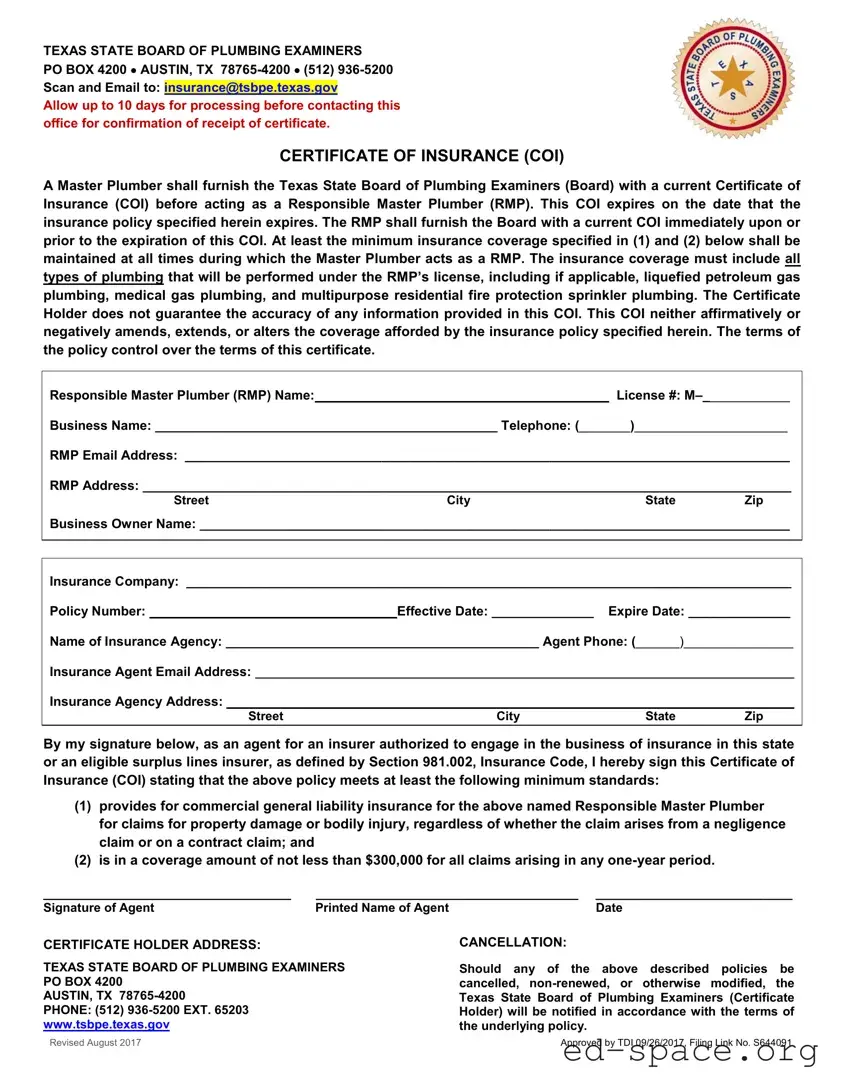
The Texas Certificate of Insurance (COI) form is a critical document for Master Plumbers seeking to operate as Responsible Master Plumbers (RMP) in the state of Texas. Before assuming this role, it is mandatory for a Master Plumber to submit a current COI to the Texas State Board of Plumbing Examiners. This form serves multiple purposes, including confirming that the plumber has the necessary insurance coverage to protect against claims of property damage or bodily injury. The COI must reflect coverage amounts of at least $300,000 for all claims within a year and include all plumbing activities under the RMP’s license, such as liquefied petroleum gas plumbing and medical gas plumbing. It is essential for RMPs to keep their COIs up to date, as the document expires when the underlying insurance policy does. The form also contains sections for important details, including the names of the RMP, the business, and the insurance agency, ensuring that all parties are accurately identified. Additionally, the COI includes a cancellation clause, which mandates that the Texas State Board of Plumbing Examiners be notified if the insurance policy is canceled or modified. Understanding the requirements and implications of this form is crucial for compliance and protection in the plumbing industry.

Document Preview

Revised August 2017 Approved by TDI 09/26/2017, Filing Link No. S644091
TEXAS STATE BOARD OF PLUMBING EXAMINERS
PO BOX 4200 AUSTIN, TX 78765-4200 (512) 936-5200
Scan and Email to: [email protected]
Allow up to 10 days for processing before contacting this
office for confirmation of receipt of certificate.
CERTIFICATE OF INSURANCE (COI)
A Master Plumber shall furnish the Texas State Board of Plumbing Examiners (Board) with a current Certificate of
Insurance (COI) before acting as a Responsible Master Plumber (RMP). This COI expires on the date that the
insurance policy specified herein expires. The RMP shall furnish the Board with a current COI immediately upon or
prior to the expiration of this COI. At least the minimum insurance coverage specified in (1) and (2) below shall be
maintained at all times during which the Master Plumber acts as a RMP. The insurance coverage must include all
types of plumbing that will be performed under the RMP’s license, including if applicable, liquefied petroleum gas
plumbing, medical gas plumbing, and multipurpose residential fire protection sprinkler plumbing. The Certificate
Holder does not guarantee the accuracy of any information provided in this COI. This COI neither affirmatively or
negatively amends, extends, or alters the coverage afforded by the insurance policy specified herein. The terms of
the policy control over the terms of this certificate.
Responsible Master Plumber (RMP) Name: License #: M____________
Business Name: _______________________________________________ Telephone: (_______)_____________________
RMP Email Address: ___________________________________________________________________________________
RMP Address: _________________________________________________________________________________________
Street City State Zip
Business Owner Name: _________________________________________________________________________________
Insurance Company: ___________________________________________________________________________________
Policy Number: Effective Date: ______________ Expire Date: ______________
Name of Insurance Agency: ___________________________________________ Agent Phone: (______)_______________
Insurance Agent Email Address:
Insurance Agency Address:
Street City State Zip
By my signature below, as an agent for an insurer authorized to engage in the business of insurance in this state
or an eligible surplus lines insurer, as defined by Section 981.002, Insurance Code, I hereby sign this Certificate of
Insurance (COI) stating that the above policy meets at least the following minimum standards:
(1) provides for commercial general liability insurance for the above named Responsible Master Plumber
for claims for property damage or bodily injury, regardless of whether the claim arises from a negligence
claim or on a contract claim; and
(2) is in a coverage amount of not less than $300,000 for all claims arising in any one-year period.
__________________________________ ____________________________________ ___________________________
Signature of Agent Printed Name of Agent Date
CERTIFICATE HOLDER ADDRESS:
TEXAS STATE BOARD OF PLUMBING EXAMINERS
PO BOX 4200
AUSTIN, TX 78765-4200
PHONE: (512) 936-5200 EXT. 65203
www.tsbpe.texas.gov
CANCELLATION:
Should any of the above described policies be
cancelled, non-renewed, or otherwise modified, the
Texas State Board of Plumbing Examiners (Certificate
Holder) will be notified in accordance with the terms of
the underlying policy.

Form Specifications

Fact Name Description
Purpose of the Certificate The Certificate of Insurance (COI) is required for Master Plumbers to act as Responsible Master Plumbers (RMP) in Texas. It must be submitted to the Texas State Board of Plumbing Examiners prior to performing plumbing work under the RMP license.
Insurance Coverage Requirements The COI must provide commercial general liability insurance with coverage of at least $300,000 for all claims within a one-year period. This coverage must include all plumbing types performed under the RMP’s license, including specialized services like liquefied petroleum gas plumbing.
Expiration and Renewal The COI expires on the same date as the insurance policy it represents. It is the responsibility of the RMP to provide a current COI immediately upon or before the expiration of the existing certificate.
Governing Laws The issuance and requirements of the COI are governed by the Texas Insurance Code, specifically Section 981.002, which defines eligible surplus lines insurers and outlines the necessary insurance standards for Master Plumbers.

Texas Certificate Insurance: Usage Guidelines

Completing the Texas Certificate of Insurance form is a straightforward process that requires careful attention to detail. Once you have filled out the form, ensure that all information is accurate before submitting it to the Texas State Board of Plumbing Examiners. This will help facilitate the processing of your certificate.

  1. Begin by entering the Responsible Master Plumber (RMP) Name in the designated field.
  2. Next, write the License Number in the space provided, ensuring it follows the format M‒____________.
  3. Fill in the Business Name associated with the RMP.
  4. Provide a contact telephone number for the RMP, including area code.
  5. Enter the RMP's email address in the appropriate field.
  6. Complete the RMP Address section with the street address, city, state, and zip code.
  7. Next, write the Business Owner's Name.
  8. Indicate the Insurance Company name that provides the coverage.
  9. Fill in the Policy Number for the insurance policy.
  10. Enter the Effective Date of the insurance policy.
  11. Provide the Expiration Date of the insurance policy.
  12. Write the Name of the Insurance Agency that issued the policy.
  13. Include the Agent's Phone Number, ensuring to include the area code.
  14. Fill in the Insurance Agent's Email Address.
  15. Complete the Insurance Agency Address with the street, city, state, and zip code.
  16. Sign the form as an agent for the insurer, ensuring that your signature is clear.
  17. Print your name below your signature.
  18. Date the form by writing the current date in the specified area.

After completing these steps, review the form for accuracy and completeness. Once verified, submit the form by scanning and emailing it to the provided address. Allow up to ten days for processing before following up for confirmation of receipt.

Your Questions, Answered

What is the purpose of the Texas Certificate of Insurance (COI)?

The Texas Certificate of Insurance (COI) serves as proof that a Master Plumber has the necessary insurance coverage required to operate as a Responsible Master Plumber (RMP). This document must be submitted to the Texas State Board of Plumbing Examiners before the plumber can assume the responsibilities associated with the RMP designation. The COI ensures that the plumber is covered for potential claims related to property damage or bodily injury that may arise during their work.

What are the minimum insurance requirements specified in the COI?

The COI mandates that the Responsible Master Plumber must maintain at least the following minimum insurance coverage: commercial general liability insurance that covers claims for property damage or bodily injury, regardless of whether the claim arises from negligence or contract. Additionally, the coverage must be no less than $300,000 for all claims that occur within any one-year period. This ensures adequate protection for both the plumber and the public.

How long is the COI valid, and what should be done upon its expiration?

The Certificate of Insurance is valid until the specified insurance policy expires. It is crucial for the Responsible Master Plumber to provide the Texas State Board of Plumbing Examiners with a current COI immediately upon or prior to the expiration of the existing COI. This proactive approach helps maintain compliance and ensures that the plumber can continue to operate without interruption.

What happens if the insurance policy is canceled or modified?

If any of the insurance policies described in the COI are canceled, non-renewed, or modified, the Texas State Board of Plumbing Examiners will be notified according to the terms of the underlying policy. This notification is essential for maintaining transparency and ensuring that the Board is aware of any changes that could impact the plumber's coverage.

How can I submit the COI to the Texas State Board of Plumbing Examiners?

The completed Certificate of Insurance can be submitted by scanning the document and emailing it to [email protected]. It is important to allow up to 10 days for processing before reaching out to the Board for confirmation of receipt. This timeline helps ensure that all submissions are handled efficiently.

Who is responsible for signing the COI?

The COI must be signed by an agent representing an insurer authorized to conduct business in Texas or by an eligible surplus lines insurer. This signature verifies that the insurance policy meets the minimum standards outlined in the COI. The agent’s printed name and the date of signing must also be included to validate the document.

Common mistakes

  1. Neglecting to provide accurate contact information: It's essential to include correct phone numbers and email addresses. Incorrect details can lead to communication issues.

  2. Failing to sign the form: A signature is required to validate the Certificate of Insurance. Without it, the form is incomplete.

  3. Omitting the effective and expiration dates: These dates are crucial. They indicate the validity of the insurance coverage.

  4. Not including the correct policy number: Ensure that the policy number matches the insurance documentation. An incorrect number can cause delays.

  5. Ignoring the minimum coverage requirements: The insurance must meet the specified minimums. Failure to do so may result in rejection.

  6. Providing incomplete business information: Include the full business name and address. Incomplete details can hinder processing.

  7. Submitting the form without verifying details: Always double-check for errors before submission. Simple mistakes can lead to significant delays.

  8. Not submitting the form in the correct format: Ensure the form is filled out legibly and in the required format. Illegible forms may be returned.

  9. Failing to notify the Board of policy changes: If there are any changes to the insurance policy, notify the Texas State Board of Plumbing Examiners promptly.

  10. Not allowing sufficient processing time: After submission, allow up to 10 days for processing. Contacting the Board too soon can lead to frustration.

Documents used along the form

When working with the Texas Certificate of Insurance (COI) form, several other documents are often required to ensure compliance and proper documentation. Each of these forms plays a vital role in the licensing and insurance process for Responsible Master Plumbers (RMPs). Below is a list of these essential documents.

  • Application for Master Plumber License: This form is necessary for individuals seeking to obtain their Master Plumber license. It includes personal information, work history, and proof of relevant experience.
  • Proof of Liability Insurance: This document serves as evidence that the RMP has the required liability insurance coverage. It details the policy limits and coverage types to confirm compliance with state regulations.
  • Continuing Education Certificates: RMPs must complete a certain number of continuing education hours to maintain their license. These certificates confirm that the plumber has completed the required training and education.
  • Business Registration Documents: If the RMP operates a plumbing business, these documents prove that the business is registered and in good standing with the state. They may include articles of incorporation or partnership agreements.
  • Worker’s Compensation Insurance Certificate: This certificate demonstrates that the RMP has worker’s compensation insurance, which protects employees in case of work-related injuries. It is crucial for compliance with labor laws.
  • Financial Responsibility Affidavit: This affidavit confirms that the RMP has the financial means to cover potential claims. It may require disclosure of assets or other financial information.

Collectively, these documents help ensure that Responsible Master Plumbers operate within the legal framework and maintain the necessary standards of practice. Having all required forms ready and up to date is essential for a smooth licensing process.

Similar forms

The Texas Certificate of Insurance (COI) is an important document for Master Plumbers, ensuring they meet specific insurance requirements. Several other documents serve similar purposes in different contexts, providing proof of insurance or compliance. Here’s a look at nine documents that are similar to the Texas COI:

  • Certificate of Liability Insurance (CLI): This document verifies that a business has liability insurance coverage. Like the Texas COI, it outlines the coverage limits and effective dates, ensuring that the business is protected against potential claims.
  • Certificate of Insurance (COI) for Contractors: Often required for contractors working on public or private projects, this certificate confirms that the contractor has the necessary insurance coverage. It shares similar elements with the Texas COI, including coverage details and expiration dates.
  • Workers' Compensation Certificate: This document shows that a business has workers' compensation insurance, protecting employees in case of work-related injuries. Both certificates serve to reassure stakeholders that the business meets legal insurance requirements.
  • General Liability Insurance Certificate: This certificate is proof of general liability insurance coverage, similar to the Texas COI. It protects against claims of bodily injury or property damage, ensuring compliance with industry standards.
  • Professional Liability Insurance Certificate: Required for professionals like doctors and lawyers, this document provides proof of coverage against malpractice claims. Like the Texas COI, it specifies coverage limits and effective dates.
  • Auto Insurance Certificate: This document verifies that a vehicle is insured, similar to how the Texas COI verifies insurance for plumbing work. It includes details about the policyholder, coverage limits, and expiration dates.
  • Environmental Liability Insurance Certificate: This certificate provides proof of coverage for businesses that handle hazardous materials. It functions similarly to the Texas COI by ensuring compliance with environmental regulations.
  • Surety Bond Certificate: While not an insurance document, a surety bond certificate guarantees that a contractor will fulfill their obligations. It shares the purpose of protecting stakeholders, much like the Texas COI does for plumbing professionals.
  • Health Insurance Certificate: This document confirms that an individual or group has health insurance coverage. Like the Texas COI, it outlines the specifics of the coverage and serves as proof for compliance with health regulations.

Understanding these documents can help you navigate the insurance landscape more effectively, ensuring you have the necessary coverage for your specific needs.

Dos and Don'ts

Filling out the Texas Certificate of Insurance form can seem daunting, but it doesn’t have to be. Here are some important dos and don’ts to keep in mind.

  • Do provide accurate information.
  • Do ensure that the insurance coverage meets the minimum requirements.
  • Don't leave any sections blank.
  • Don't forget to sign the form.

Being thorough and careful will help you avoid delays. Remember, the Texas State Board of Plumbing Examiners needs this information to process your application smoothly.

Misconceptions

Misconceptions about the Texas Certificate of Insurance (COI) can lead to confusion for Master Plumbers and their clients. Here are six common misunderstandings:

  • 1. The COI guarantees coverage. Many believe that the COI itself provides insurance coverage. In reality, it merely confirms that an insurance policy exists. The actual terms of the policy dictate coverage.
  • 2. The COI is a one-time requirement. Some think that submitting the COI is a one-and-done process. However, the COI must be current and submitted whenever it expires or when changes occur in the insurance policy.
  • 3. Any insurance policy qualifies. Not all insurance policies meet the requirements set by the Texas State Board of Plumbing Examiners. The policy must include specific coverage types and minimum amounts to be acceptable.
  • 4. The Certificate Holder verifies information. There is a misconception that the Certificate Holder, in this case, the Texas State Board of Plumbing Examiners, verifies the accuracy of the information on the COI. This is not the case; the responsibility lies with the Master Plumber and their insurance agent.
  • 5. The COI covers all plumbing activities. Some assume that the COI covers all types of plumbing work automatically. It is crucial to ensure that the policy includes coverage for all plumbing types performed under the Responsible Master Plumber’s license.
  • 6. The COI is not time-sensitive. Many overlook the importance of timely submission. The COI must be submitted immediately upon expiration to avoid any lapse in coverage while acting as a Responsible Master Plumber.

Understanding these misconceptions can help ensure compliance and protect both the Master Plumber and their clients.

Key takeaways

Filling out the Texas Certificate of Insurance (COI) form is a critical step for Master Plumbers seeking to operate as Responsible Master Plumbers (RMP). Here are key takeaways to consider:

  • The COI must be submitted to the Texas State Board of Plumbing Examiners before the Master Plumber can act as an RMP.
  • This certificate expires on the same date as the insurance policy it references.
  • It is the responsibility of the RMP to provide a current COI immediately prior to or upon expiration of the existing COI.
  • Minimum insurance coverage must include commercial general liability insurance for property damage or bodily injury claims.
  • The coverage amount must be no less than $300,000 for all claims within any one-year period.
  • The COI must cover all plumbing activities performed under the RMP's license, including specialized plumbing services.
  • The Certificate Holder does not guarantee the accuracy of the information provided in the COI.
  • The terms of the insurance policy take precedence over the information on the COI.
  • Agents must sign the COI, confirming that the policy meets the minimum standards set forth.
  • In the event of policy cancellation or modification, the Board will be notified according to the policy's terms.

Understanding these key points can help ensure compliance with Texas regulations and maintain the necessary insurance coverage for plumbing operations.