Homepage Blank Texas Burial Transit Permit PDF Form
Content Overview

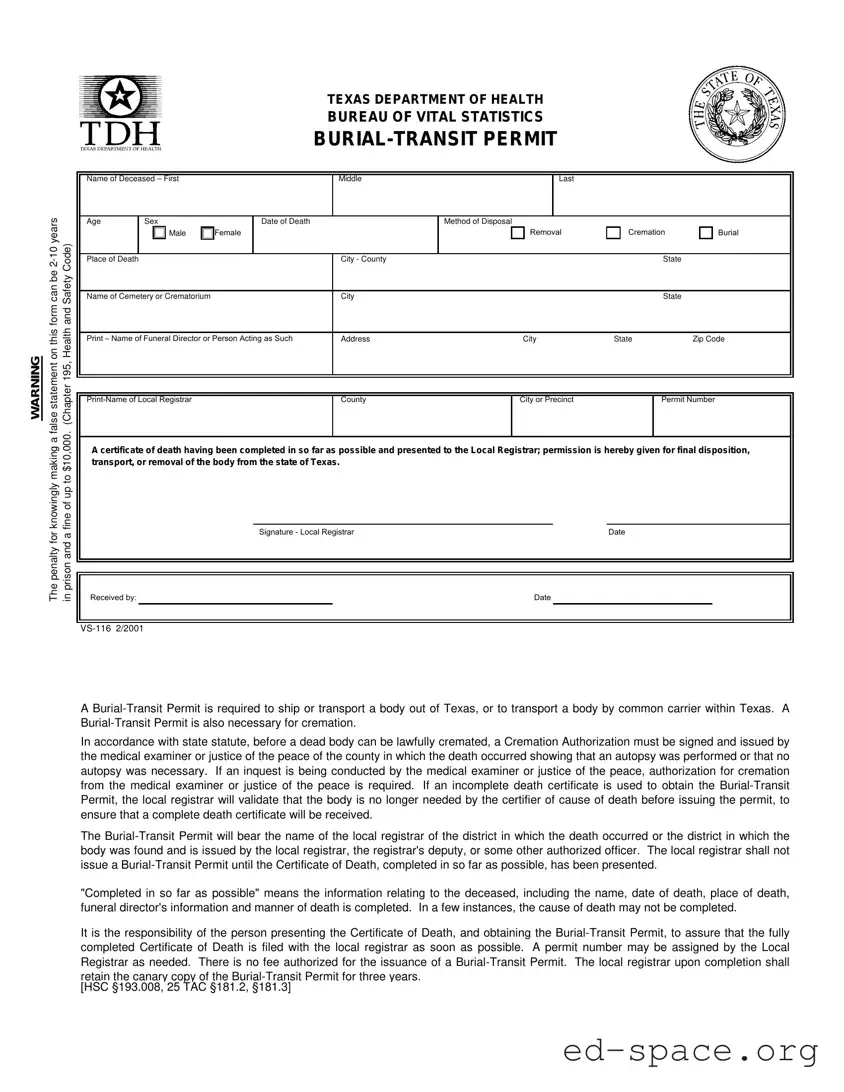
The Texas Burial Transit Permit is a crucial document that facilitates the lawful transport and final disposition of a deceased individual's body. It is required when shipping a body out of Texas or transporting it within the state by common carrier. This form is also essential for cremation, ensuring that all legal protocols are followed. Before cremation can occur, a Cremation Authorization must be secured from the medical examiner or justice of the peace, confirming whether an autopsy was performed or if one was unnecessary. The process involves presenting a completed Certificate of Death to the local registrar, who must validate that the body is no longer needed for examination. The Burial Transit Permit includes important details such as the name of the deceased, date of death, and the method of disposal. It is issued by the local registrar or an authorized officer, who retains a copy of the permit for three years. Importantly, there is no fee for obtaining this permit, but providing accurate information is essential to avoid potential penalties, including fines or imprisonment for false statements. Understanding the requirements and process for the Burial Transit Permit is vital for families navigating this difficult time.

Document Preview

Age
Male
Female
Burial
Received by:
It is the responsibility of the person presenting the Certificate of Death, and obtaining the Burial-Transit Permit, to assure that the fully
completed Certificate of Death is filed with the local registrar as soon as possible. A permit number may be assigned by the Local
Registrar as needed. There is no fee authorized for the issuance of a Burial-Transit Permit. The local registrar upon completion shall
retain the canary copy of the Burial-Transit Permit for three years.
[HSC §193.008, 25 TAC §181.2, §181.3]
A Burial-Transit Permit is required to ship or transport a body out of Texas, or to transport a body by common carrier within Texas. A
Burial-Transit Permit is also necessary for cremation.
In accordance with state statute, before a dead body can be lawfully cremated, a Cremation Authorization must be signed and issued by
the medical examiner or justice of the peace of the county in which the death occurred showing that an autopsy was performed or that no
autopsy was necessary. If an inquest is being conducted by the medical examiner or justice of the peace, authorization for cremation
from the medical examiner or justice of the peace is required. If an incomplete death certificate is used to obtain the Burial-Transit
Permit, the local registrar will validate that the body is no longer needed by the certifier of cause of death before issuing the permit, to
ensure that a complete death certificate will be received.
The Burial-Transit Permit will bear the name of the local registrar of the district in which the death occurred or the district in which the
body was found and is issued by the local registrar, the registrar's deputy, or some other authorized officer. The local registrar shall not
issue a Burial-Transit Permit until the Certificate of Death, completed in so far as possible, has been presented.
"Completed in so far as possible" means the information relating to the deceased, including the name, date of death, place of death,
funeral director's information and manner of death is completed. In a few instances, the cause of death may not be completed.
Removal
State
VS-116 2/2001
Print – Name of Funeral Director or Person Acting as Such
County
City or Precinct
Permit Number
Name of Deceased – First
Sex
Last
Date of Death
Date
State
TEXAS DEPARTMENT OF HEALTH
BURIAL-TRANSIT PERMIT
Print-Name of Local Registrar
Middle
BUREAU OF VITAL STATISTICS
Cremation
City - County
City
Name of Cemetery or Crematorium
WARNING
The penalty for knowingly making a false statement on this form can be 2-10 years
in prison and a fine of up to $10,000. (Chapter 195, Health and Safety Code)
Place of Death
Address City State Zip Code
Date
Signature - Local Registrar
A certificate of death having been completed in so far as possible and presented to the Local Registrar; permission is hereby given for final disposition,
transport, or removal of the body from the state of Texas.

Form Specifications

Fact Name Details
Purpose The Texas Burial Transit Permit is required for shipping or transporting a body out of Texas or within Texas by common carrier.
Cremation Requirement A Burial-Transit Permit is necessary for cremation, and a Cremation Authorization must be signed by the medical examiner or justice of the peace.
Certificate of Death The local registrar will not issue the permit until a completed Certificate of Death is presented.
Incomplete Death Certificate If an incomplete death certificate is used, the local registrar will validate that the body is no longer needed for certification before issuing the permit.
Issuing Authority The permit is issued by the local registrar, registrar's deputy, or another authorized officer in the district where the death occurred.
Retention Period The local registrar must retain the canary copy of the Burial-Transit Permit for three years after issuance.
Governing Laws The issuance of the Burial-Transit Permit is governed by Health and Safety Code §193.008 and 25 TAC §181.2, §181.3.

Texas Burial Transit Permit: Usage Guidelines

After obtaining the Texas Burial Transit Permit form, you will need to fill it out accurately to ensure the proper transport or disposal of the deceased's body. This process is essential for complying with state laws regarding burial and cremation. Follow these steps to complete the form correctly.

  1. Identify the Deceased: Enter the name of the deceased in the fields provided: First, Middle, and Last.
  2. Fill in Personal Details: Indicate the age and sex of the deceased. Choose either Male or Female.
  3. Record Date of Death: Write the date of death in the designated space.
  4. Specify Method of Disposal: Mark the appropriate box for the method of disposal, such as Removal, Cremation, or Burial.
  5. Indicate Place of Death: Provide the city, county, and state where the death occurred.
  6. Provide Cemetery or Crematorium Information: Enter the name of the cemetery or crematorium, along with the city and state.
  7. Funeral Director's Information: Print the name of the funeral director or the person acting in that capacity, followed by their address, city, state, and zip code.
  8. Local Registrar Details: Print the name of the local registrar, along with the county and city or precinct.
  9. Permit Number: Leave the permit number field blank; it will be filled in by the local registrar.
  10. Signature and Date: The local registrar will sign and date the form upon issuance.

Once you have filled out the form, it must be submitted to the local registrar along with a completed Certificate of Death. This step is crucial for obtaining the Burial-Transit Permit, which allows for the legal transportation or cremation of the deceased. Ensure all information is accurate and complete to avoid any delays in the process.

Your Questions, Answered

What is a Texas Burial Transit Permit?

A Texas Burial Transit Permit is a legal document required for the transport or removal of a deceased body from the state of Texas or for its transportation within Texas by common carrier. This permit is also essential for cremation. It ensures that the body is handled in accordance with state laws and that all necessary authorizations have been obtained.

Who is responsible for obtaining the Burial Transit Permit?

The responsibility for obtaining the Burial Transit Permit typically falls on the funeral director or the person acting on their behalf. This individual must present a completed Certificate of Death to the local registrar to receive the permit. It is crucial that the Certificate of Death includes all required information about the deceased, including their name, date of death, and place of death.

What happens if the Certificate of Death is incomplete?

If an incomplete Certificate of Death is presented when applying for the Burial Transit Permit, the local registrar will verify that the body is no longer needed for examination by the certifier of the cause of death. This step is essential to ensure that a complete Certificate of Death will be filed with the local registrar as soon as possible. The local registrar will not issue the permit until the necessary information has been provided.

Is there a fee for obtaining a Burial Transit Permit?

No fee is authorized for the issuance of a Burial Transit Permit in Texas. This means that families and funeral directors can obtain the necessary permit without incurring additional costs during what is often a difficult time.

How long is the Burial Transit Permit valid?

The Burial Transit Permit does not have a specific expiration date; however, the local registrar retains the canary copy of the permit for three years after its issuance. This retention helps maintain a record of the transport or disposition of the deceased's body, ensuring compliance with state regulations.

Common mistakes

  1. Neglecting to Complete the Certificate of Death: Before obtaining the Burial-Transit Permit, ensure the Certificate of Death is filled out as completely as possible. Missing information can delay the process.

  2. Incorrectly Filling Out Personal Information: Double-check the name of the deceased, including first, middle, and last names. Errors can lead to complications during the permit application process.

  3. Omitting the Method of Disposal: Clearly indicate whether the body will be buried or cremated. This detail is crucial for the permit's validity.

  4. Failing to Obtain Necessary Authorizations: If an autopsy is required, ensure that the medical examiner or justice of the peace has signed the Cremation Authorization before applying for the permit.

  5. Not Presenting the Permit to the Local Registrar: The Burial-Transit Permit must be presented to the local registrar for validation. Failing to do so can result in delays.

  6. Ignoring the Signature Requirement: The local registrar must sign the Burial-Transit Permit. Without this signature, the permit is not valid.

  7. Using an Incomplete Death Certificate: If the Certificate of Death is not fully completed, the local registrar may require additional verification before issuing the permit.

  8. Not Retaining a Copy: After the permit is issued, keep a copy for personal records. This can be important for future reference or legal purposes.

Documents used along the form

The Texas Burial Transit Permit is an essential document for the transportation or final disposition of a deceased individual. However, it is often accompanied by several other forms and documents that facilitate this process. Understanding these additional documents can help ensure compliance with legal requirements and streamline the arrangements during a difficult time.

  • Certificate of Death: This document provides official confirmation of an individual's death. It includes vital information such as the deceased's name, date of death, and cause of death. The certificate must be completed and presented to the local registrar before a Burial-Transit Permit can be issued.
  • Cremation Authorization: Required when cremation is planned, this form must be signed by a medical examiner or justice of the peace. It indicates that an autopsy was either performed or deemed unnecessary, allowing for the cremation process to proceed legally.
  • Embalming Authorization: This document grants permission for the embalming of the body. It is typically signed by the next of kin or legal representative and ensures that the body is preserved for viewing or transportation.
  • Funeral Service Contract: This agreement outlines the services to be provided by the funeral home. It includes details about the costs, services selected, and any special requests made by the family, ensuring clarity and understanding between the family and the funeral provider.
  • Disposition Permit: This document is often required by local authorities to authorize the final disposition of the body, whether through burial, cremation, or another method. It ensures that the chosen method complies with local regulations.
  • Authorization for Removal: This form is necessary for the legal removal of the body from the place of death. It must be signed by the next of kin or a legally authorized representative, allowing funeral personnel to transport the deceased.
  • Local Registrar's Report: This report includes information about the deceased and the circumstances of death. It is submitted to the local registrar and is essential for the completion of the death certificate and other related documents.
  • Health Department Permit: In some cases, especially for cremations or burials that may raise health concerns, a permit from the health department may be required. This document ensures that the body is handled in accordance with health regulations.

Each of these documents plays a crucial role in the process of handling the deceased's remains. Understanding their purposes and requirements can help families navigate the legal landscape during a challenging time, ensuring that all necessary steps are taken for a respectful and lawful disposition.

Similar forms

  • Death Certificate: This document records the details of a person's death, including their name, date of death, and cause of death. Similar to the Burial-Transit Permit, a completed death certificate is necessary before the permit can be issued.
  • Cremation Authorization: Required for cremation, this authorization must be signed by a medical examiner or justice of the peace. Like the Burial-Transit Permit, it ensures that proper procedures are followed before the body is disposed of.
  • Permit for Burial: This document grants permission for the burial of a deceased individual. It shares similarities with the Burial-Transit Permit in that both are necessary for the final disposition of a body.
  • Transportation Permit: This permit is needed for transporting a body across state lines. It functions similarly to the Burial-Transit Permit, which is required for transporting a body out of Texas.
  • Local Registrar's Authorization: This is a document issued by the local registrar, allowing for the final disposition of a body. It parallels the Burial-Transit Permit by ensuring that all legal requirements are met before proceeding with the burial or cremation.
  • Inquest Report: If an inquest is conducted, this report may be necessary to proceed with the cremation or burial. It relates to the Burial-Transit Permit by providing the legal backing needed for the final disposition of the deceased.

Dos and Don'ts

When filling out the Texas Burial Transit Permit form, it is essential to approach the task with care and attention to detail. Here are six guidelines to help ensure the process goes smoothly.

  • Do ensure all information is accurate. Double-check the name of the deceased, age, date of death, and method of disposal. Accuracy is crucial to avoid delays.
  • Do provide a completed Certificate of Death. The local registrar requires this document to issue the Burial-Transit Permit. Ensure it is filled out as completely as possible.
  • Do sign the form where indicated. The signature of the local registrar is necessary for the permit to be valid. Make sure to leave space for this signature.
  • Don't submit an incomplete application. If any required information is missing, the local registrar may not issue the permit, causing unnecessary delays.
  • Don't forget to check for local regulations. Different counties may have specific requirements, so it’s wise to verify what is needed in your area.
  • Don't make false statements. Providing inaccurate information can lead to serious penalties, including fines or imprisonment.

By following these guidelines, you can help ensure that the process of obtaining a Burial Transit Permit is efficient and compliant with Texas regulations.

Misconceptions

  • Misconception 1: A Burial-Transit Permit is only needed for cremation.

    This is incorrect. A Burial-Transit Permit is required for shipping or transporting a body out of Texas, as well as for transport by common carrier within the state. It is also necessary for cremation.

  • Misconception 2: The Burial-Transit Permit can be issued without a death certificate.

    In reality, a completed Certificate of Death must be presented to the local registrar before a Burial-Transit Permit can be issued. This ensures that all necessary information about the deceased is recorded.

  • Misconception 3: There is a fee for obtaining a Burial-Transit Permit.

    This is not true. The local registrar does not charge any fee for the issuance of a Burial-Transit Permit. It is provided at no cost.

  • Misconception 4: The local registrar can issue a Burial-Transit Permit without verifying the cause of death.

    This is misleading. The local registrar must validate that the body is no longer needed by the certifier of the cause of death before issuing the permit, especially if an incomplete death certificate is presented.

  • Misconception 5: The Burial-Transit Permit is valid indefinitely.

    Actually, the local registrar retains the canary copy of the Burial-Transit Permit for three years. This indicates that there are time limits associated with the permit's validity.

Key takeaways

Filling out and using the Texas Burial Transit Permit form is an important process. Here are key takeaways to keep in mind:

  • A Burial-Transit Permit is necessary to transport a body out of Texas or within Texas by common carrier. It is also required for cremation.
  • The permit can only be issued after a Certificate of Death has been completed as much as possible and presented to the Local Registrar.
  • Before cremation, a Cremation Authorization must be signed by the medical examiner or justice of the peace.
  • If an inquest is ongoing, authorization for cremation is still required from the medical examiner or justice of the peace.
  • The local registrar will validate that the body is no longer needed by the certifier of cause of death before issuing the permit if an incomplete death certificate is used.
  • The Burial-Transit Permit will include the name of the local registrar and will be issued by them or an authorized officer.
  • It is the responsibility of the individual obtaining the permit to ensure that a fully completed Certificate of Death is filed promptly.
  • There is no fee for obtaining a Burial-Transit Permit, and the local registrar must keep a copy for three years.