Homepage Blank Texas Blue PDF Form
Content Overview

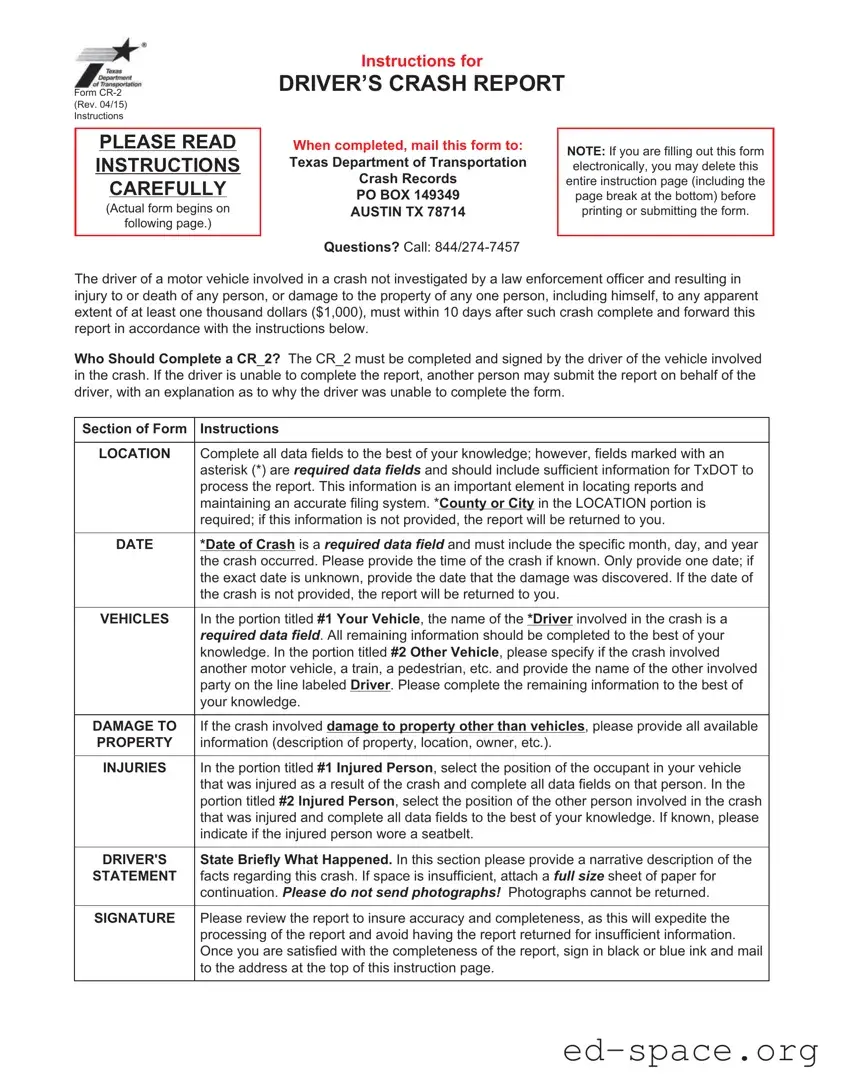
The Texas Blue form, officially known as Form CR-2, serves a critical function in documenting motor vehicle crashes that do not involve law enforcement investigation. This form must be completed by the driver involved in a crash that results in injury, death, or property damage exceeding $1,000. It is essential to submit this report within ten days of the incident to ensure compliance with state regulations. The form requires various details, including the date and location of the crash, information about the vehicles involved, and any injuries sustained. Notably, specific fields are marked as required, emphasizing the importance of providing accurate and complete information. Additionally, the form includes sections for a narrative description of the crash and a signature to confirm the accuracy of the report. Proper completion of the Texas Blue form is vital for maintaining accurate records and facilitating the processing of claims and investigations. By understanding the components and requirements of this form, drivers can navigate the aftermath of a crash more effectively.
Document Preview

Questions? Call: 844/274-7457
The driver of a motor vehicle involved in a crash not investigated by a law enforcement officer and resulting in
injury to or death of any person, or damage to the property of any one person, including himself, to any apparent
extent of at least one thousand dollars ($1,000), must within 10 days after such crash complete and forward this
report in accordance with the instructions below.
Who Should Complete a CR_2? The CR_2 must be completed and signed by the driver of the vehicle involved
in the crash. If the driver is unable to complete the report, another person may submit the report on behalf of the
driver, with an explanation as to why the driver was unable to complete the form.
Form CR-2
(Rev. 04/15)
Instructions
Instructions for
DRIVER’S CRASH REPORT
NOTE: If you are filling out this form
electronically, you may delete this
entire instruction page (including the
page break at the bottom) before
printing or submitting the form.
PLEASE READ
INSTRUCTIONS
CAREFULLY
(Actual form begins on
following page.)
When completed, mail this form to:
Texas Department of Transportation
Crash Records
PO BOX 149349
AUSTIN TX 78714
Please review the report to insure accuracy and completeness, as this will expedite the
processing of the report and avoid having the report returned for insufficient information.
Once you are satisfied with the completeness of the report, sign in black or blue ink and mail
to the address at the top of this instruction page.
SIGNATURE
State Briefly What Happened. In this section please provide a narrative description of the
facts regarding this crash. If space is insufficient, attach a full size sheet of paper for
continuation. Please do not send photographs! Photographs cannot be returned.
DRIVER'S
STATEMENT
In the portion titled #1 Injured Person, select the position of the occupant in your vehicle
that was injured as a result of the crash and complete all data fields on that person. In the
portion titled #2 Injured Person, select the position of the other person involved in the crash
that was injured and complete all data fields to the best of your knowledge. If known, please
indicate if the injured person wore a seatbelt.
INJURIES
If the crash involved damage to property other than vehicles, please provide all available
information (description of property, location, owner, etc.).
DAMAGE TO
PROPERTY
In the portion titled #1 Your Vehicle, the name of the *Driver involved in the crash is a
required data field. All remaining information should be completed to the best of your
knowledge. In the portion titled #2 Other Vehicle, please specify if the crash involved
another motor vehicle, a train, a pedestrian, etc. and provide the name of the other involved
party on the line labeled Driver. Please complete the remaining information to the best of
your knowledge.
VEHICLES
*Date of Crash is a required data field and must include the specific month, day, and year
the crash occurred. Please provide the time of the crash if known. Only provide one date; if
the exact date is unknown, provide the date that the damage was discovered. If the date of
the crash is not provided, the report will be returned to you.
DATE
Complete all data fields to the best of your knowledge; however, fields marked with an
asterisk (*) are required data fields and should include sufficient information for TxDOT to
process the report. This information is an important element in locating reports and
maintaining an accurate filing system. *County or City in the LOCATION portion is
required; if this information is not provided, the report will be returned to you.
LOCATION
InstructionsSection of Form
Questions? Call: 844/274-7457
* Indicates Required Field
DRIVER’S CRASH REPORT
(Please read instructions on reverse side)
Form CR-2 (Rev. 04/15)
Page 1 of 1
LOCATION
WESNorth
miles
* County:
Place Where
Crash Occurred
If crash was outside city limits,
indicate distance from nearest town
Road on which
crash occurred
Block Number Street or Road Name
Route Number
Street or Road Name
Block Number
Route Number
Complete one:
• Intersecting street
• Not at intersection
Feet
North S E W
of
of
* City or Town:
City or Town
Constr.
Zone
Yes
No
Speed
Limit
Speed
Limit
No
Yes
Zone
Constr.
Show nearest intersecting numbered highway. If urban, show nearest intersecting street.
DATE
* Date of Crash
Day of Week Hour
a.m.
p.m.
If exactly noon or
midnight, so state.
Train
Policy NumberZipStateCityAddressInsurance Company Name (not the agent)
Insurance
Information
ZipCity & StateMail AddressM.I.FirstLast
Owner
ZipCity & StateMail AddressM.I.FirstLast
Driver
NumberStateYearSedan, Truck, Van, etc.Chevy, Ford, etc.
License
Plate
Type of
Vehicle
Make/
Model
Year
Model
Other Bicyclist Pedestrian
(Complete information you have available — if unknown, mark "Not Known")
Motor Vehicle
#2 — Other Vehicle
Policy Number
ZipStateCityAddressInsurance Company Name (not the agent)
Insurance
Information
$
Approx. cost to repair
your vehicle
ZipCity & StateMail AddressM.I.FirstLast
Owner
NumberState
Race Sex Date of Birth
Driver’s
License
ZipCity & StateMail AddressM.I.FirstLast
* Driver
NumberStateYearSedan, Truck, Van, etc.Chevy, Ford, etc.
License
Plate
Type of
Vehicle
Make/
Model
Year
Model
Vehicle Ident. No.
#1 — Your Vehicle
VEHICLES
For
additional
vehicles
use
another
form.
$
Approx. cost to repair
Name object, show ownership, and state nature of damage.
Damage to Property
other than vehicles
Not Used Used
Seat Belt
Describe Injury
Date of Death Was Person Killed? Race Sex
Age
Address
Name
Other Pedestrian Passenger Driver
#2 Injured Person
Not Used Used
Seat Belt
Describe Injury
Date of Death Was Person Killed? Race Sex
Address
Name
Other Pedestrian Passenger Driver
#1 Injured Person
INJURIES
Age
Date of Report
(Please use blue or black ink only.)
* Driver’s Signature
Please do not send photographs.
(If space is insufficient, continue on another page.)
State Briefly What Happened.

Form Specifications

Fact Name Details
Form Title Driver’s Crash Report (Form CR-2)
Governing Law Texas Transportation Code, Section 550.062
Submission Deadline The report must be submitted within 10 days of the crash.
Required Fields Fields marked with an asterisk (*) are mandatory for processing.
Who Completes the Form The driver involved must complete the form; if unable, another person can submit it with an explanation.
Location Information County or City must be provided; failure to do so will result in the report being returned.
Injury Reporting Details about injured persons must be included, including seatbelt usage if known.
Signature Requirement The driver must sign the report in blue or black ink before submission.

Texas Blue: Usage Guidelines

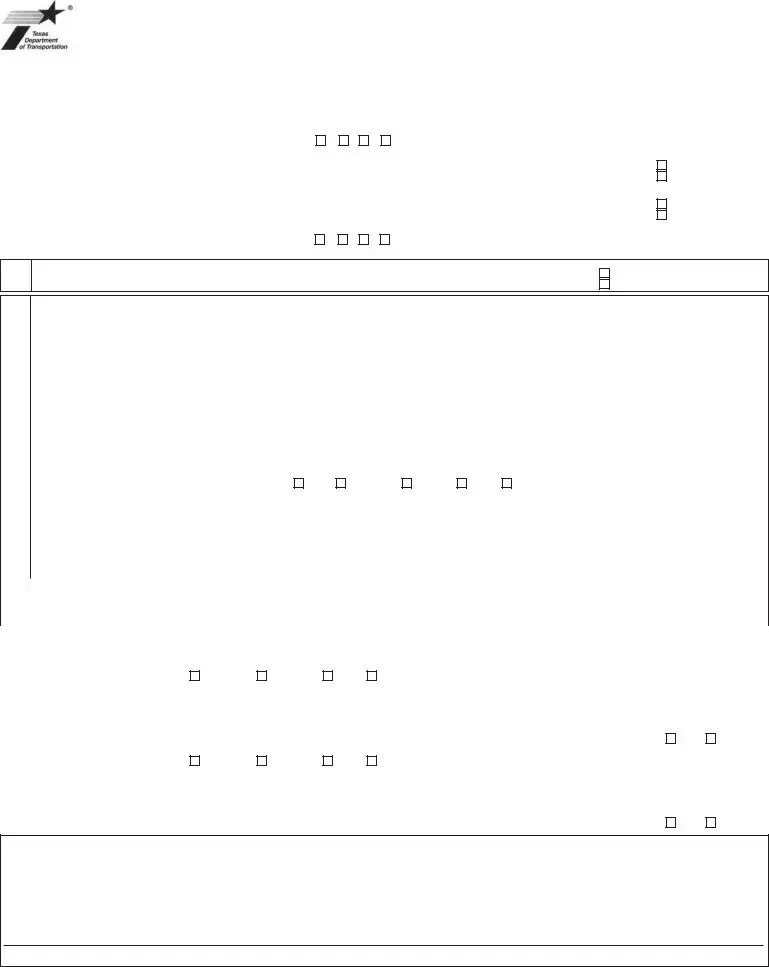
Filling out the Texas Blue form, also known as the Driver’s Crash Report (Form CR-2), is an important step following a motor vehicle crash that meets specific criteria. Completing this form accurately ensures that the necessary information is submitted to the Texas Department of Transportation (TxDOT) within the required timeframe. Below are the steps to guide you through the process of filling out the form.

  1. Begin by providing the location of the crash. Fill in the county and city or town where the incident occurred. Ensure these fields are marked with an asterisk (*) are completed, as missing this information may result in the report being returned.
  2. Next, enter the date of the crash, including the specific month, day, and year. If known, also provide the time of the crash. If the exact date is uncertain, use the date when the damage was discovered.
  3. In the section labeled #1 Your Vehicle, fill in the driver’s information, including name, address, and driver’s license number. Complete the vehicle details such as make, model, and year. Include the vehicle identification number and the approximate cost of repairs.
  4. For section #2 Other Vehicle, indicate if another vehicle, train, pedestrian, or other entity was involved. Provide as much information as you can about the other party, including their name and vehicle details.
  5. If there was damage to property other than vehicles, describe the property and state the approximate repair costs.
  6. In the injuries section, specify the details of any injured persons. For #1 Injured Person, indicate their role (driver, passenger, etc.) and fill in their details. Repeat for #2 Injured Person.
  7. Provide a brief narrative of what happened during the crash in the section labeled Driver's Statement. If you need more space, attach an additional sheet of paper.
  8. Finally, review the entire report for accuracy and completeness. Once satisfied, sign the form in black or blue ink and prepare it for mailing to the TxDOT address provided at the top of the instruction page.

Your Questions, Answered

What is the Texas Blue Form?

The Texas Blue Form, officially known as Form CR-2, is a Driver’s Crash Report that must be completed by the driver involved in a motor vehicle crash that was not investigated by law enforcement. This form is necessary when there are injuries, fatalities, or property damage exceeding $1,000. It must be submitted within 10 days of the crash to the Texas Department of Transportation (TxDOT).

Who is required to complete the CR-2 form?

The driver of the vehicle involved in the crash is responsible for completing and signing the CR-2 form. If the driver is unable to fill out the form due to circumstances such as injury, another individual may submit it on their behalf. In such cases, an explanation of the driver’s inability to complete the report should accompany the submission.

What information is required on the form?

The form requires several key pieces of information. Fields marked with an asterisk (*) are mandatory. These include details about the crash location, date, vehicles involved, and injuries sustained. For example, you must provide the county or city where the crash occurred, the date of the crash, and the names of all drivers involved. Incomplete forms, especially those missing required fields, will be returned.

How should the narrative section be completed?

In the narrative section titled "State Briefly What Happened," you should provide a clear and concise description of the events leading up to the crash. This is your opportunity to explain the circumstances, such as weather conditions or traffic signals. If you need more space than provided, you can attach an additional sheet of paper. Remember, photographs are not allowed and cannot be submitted with the report.

What happens if the form is not submitted on time?

If the CR-2 form is not submitted within the required 10-day period, you may face penalties. Timely submission is crucial not only for compliance but also for ensuring that all necessary documentation is available for insurance and legal purposes. Failure to comply could complicate any claims or legal matters arising from the crash.

Where do I send the completed form?

Once the CR-2 form is completed and signed, it should be mailed to the Texas Department of Transportation at the address provided on the instruction page. The address is PO Box 149349, Austin, TX 78714. It is essential to ensure that the form is sent to the correct location to avoid delays in processing.

What should I do if I have questions while filling out the form?

If you encounter any difficulties or have questions while completing the CR-2 form, you can reach out for assistance. The Texas Department of Transportation has a dedicated helpline at 844-274-7457, where representatives can provide guidance and answer your questions regarding the form and the reporting process.

Common mistakes

  1. Missing Required Fields: Many individuals overlook the fields marked with an asterisk (*). These fields are essential for processing the report. If they are not filled out, the report will be returned.

  2. Incorrect Date of Crash: Providing an incorrect date can lead to confusion. It is crucial to include the specific month, day, and year of the crash. If the exact date is unknown, the date when damage was discovered should be used instead.

  3. Inadequate Description of the Crash: The narrative section is important. Failing to provide a clear and concise description of what happened can result in delays. This section should be thorough, and if more space is needed, an additional sheet can be attached.

  4. Incomplete Vehicle Information: In the vehicle sections, all available information should be provided. If there is another vehicle involved, details about that vehicle and its driver must be included. Omitting this information can hinder the investigation.

  5. Signature Issues: Signing the report is a critical step. Some people forget to sign or use the wrong color ink. The report must be signed in black or blue ink to be valid.

Documents used along the form

The Texas Blue form, officially known as the Driver’s Crash Report (Form CR-2), is an essential document for reporting motor vehicle accidents that do not involve law enforcement. In addition to this form, there are several other documents that individuals may need to use in conjunction with it. Each of these forms serves a specific purpose in the context of accident reporting, insurance claims, and legal proceedings.

  • Texas Motor Vehicle Accident Report (Form CR-3): This form is used when a law enforcement officer investigates a crash. It provides a detailed account of the incident, including witness statements, diagrams, and the officer’s assessment of fault.
  • Insurance Claim Form: After an accident, individuals typically need to file a claim with their insurance company. This form outlines the details of the accident, the damages incurred, and the parties involved, allowing the insurance company to process the claim efficiently.
  • Medical Report: If there are injuries resulting from the accident, a medical report may be necessary. This document provides a detailed account of the injuries sustained, treatment received, and any ongoing medical needs, which can be crucial for insurance claims or legal actions.
  • Witness Statement Form: This form gathers information from individuals who witnessed the accident. Witness statements can provide valuable insights into the circumstances surrounding the crash, helping to establish fault.
  • Release of Liability Form: In some cases, parties may wish to settle matters privately without involving insurance. A release of liability form can be used to document that one party agrees not to pursue further claims against another party in exchange for compensation.
  • Property Damage Claim Form: If the accident resulted in damage to property other than vehicles, this form is necessary for filing a claim for repairs or compensation related to that damage.
  • Accident Reconstruction Report: In complex cases, experts may be called upon to reconstruct the accident scene. This report provides a detailed analysis of how the accident occurred, which can be critical in legal disputes.
  • Affidavit of Non-Ownership: If a driver was not the owner of the vehicle involved in the accident, this affidavit can clarify ownership issues, which may be important for liability determinations.
  • Subrogation Form: This document allows an insurance company to recover costs from another party after they have paid a claim. It is often used when the other party is found to be at fault.

Understanding these additional forms and documents can help individuals navigate the complexities of accident reporting and claims processes more effectively. Each document plays a vital role in ensuring that all parties involved can address the consequences of an accident appropriately and expediently.

Similar forms

The Texas Blue form, officially known as Form CR-2, serves as a driver’s crash report. It shares similarities with several other important documents used in the context of vehicle accidents and insurance claims. Below is a list of eight documents that are comparable to the Texas Blue form, highlighting how they are similar.

  • SR-1 Form (California): This form is used to report a motor vehicle accident in California. Like the Texas Blue form, it requires details about the crash, including date, time, and parties involved.
  • Accident Report Form (Florida): This document is essential for reporting accidents in Florida. It gathers similar information, such as the location of the crash and any injuries sustained, mirroring the structure of the Texas Blue form.
  • Form MV-104 (New York): In New York, this form is used to report accidents. It also requires a narrative description of the incident, much like the driver’s statement section in the Texas Blue form.
  • Driver’s Accident Report (Virginia): Virginia's version collects information on the crash and the involved parties, paralleling the requirements found in the Texas Blue form.
  • Accident Report (Illinois): This form serves a similar purpose in Illinois, requiring details about the crash, vehicle damage, and injuries, akin to the Texas Blue form.
  • Form 1000 (Georgia): Used in Georgia, this form requests information about the crash, including damages and injuries, reflecting the Texas Blue form's focus on comprehensive reporting.
  • Motor Vehicle Accident Report (Ohio): Ohio's report form also requires similar information regarding the accident, including the parties involved and any injuries, similar to the Texas Blue form.
  • Crash Report (Michigan): This document in Michigan collects data on the accident, including details about the vehicles and injuries, paralleling the structure and purpose of the Texas Blue form.

Dos and Don'ts

When filling out the Texas Blue form (Form CR-2), it is important to follow specific guidelines to ensure accuracy and completeness. Below is a list of things you should and shouldn't do:

  • Do complete all required fields marked with an asterisk (*) to avoid delays in processing.
  • Do provide a clear and concise narrative in the "What Happened" section to describe the crash.
  • Do review the entire form for accuracy before submitting to prevent it from being returned.
  • Do mail the completed form to the Texas Department of Transportation as instructed.
  • Don't leave any required fields blank, as this will result in the report being returned.
  • Don't include photographs with your submission, as they cannot be returned.
  • Don't provide incomplete information about the vehicles or injured persons involved.
  • Don't forget to sign the form in black or blue ink before mailing it.

Misconceptions

Understanding the Texas Blue form, officially known as Form CR-2, is crucial for drivers involved in accidents. However, several misconceptions surround this form. Here are four common misunderstandings:

  • Misconception 1: The form is only for major accidents.
  • Many people believe that the Texas Blue form is only necessary for serious accidents involving significant injuries or fatalities. In reality, the form must be completed for any crash that results in property damage of at least $1,000, regardless of the severity of injuries.

  • Misconception 2: Only law enforcement can file the report.
  • Another common belief is that only police officers can complete the Texas Blue form. This is not true. The driver involved in the crash is responsible for filling out the form. If the driver is unable to do so, another person can submit the report on their behalf, provided they include an explanation.

  • Misconception 3: The report does not need to be submitted promptly.
  • Some individuals think they can take their time submitting the report. However, the Texas Department of Transportation requires that the form be completed and mailed within 10 days of the crash. Delays can lead to complications or the report being rejected.

  • Misconception 4: All fields on the form are optional.
  • Many assume that all fields on the Texas Blue form are optional. This is misleading. Certain fields, marked with an asterisk (*), are mandatory. Failing to provide this required information can result in the report being returned for completion.

Key takeaways

Filling out the Texas Blue form, also known as Form CR-2, is essential for reporting a crash that wasn't investigated by law enforcement. Here are some key takeaways to keep in mind:

  • Timeliness is Crucial: You must complete and submit the form within 10 days of the crash.
  • Who Should Fill It Out: The driver involved in the crash should complete the form. If they are unable, someone else can do it on their behalf with an explanation.
  • Required Information: Fields marked with an asterisk (*) are mandatory. Missing this information can lead to the report being returned.
  • Accurate Location Details: Provide the county or city where the crash occurred. Incomplete location details will result in delays.
  • Specifics Matter: Include the exact date and time of the crash. If unknown, use the date damage was discovered.
  • Injury Reporting: Clearly indicate who was injured and provide as much detail as possible about their injuries and seatbelt usage.
  • Review Before Submission: Double-check your report for accuracy. A complete and accurate form helps expedite processing.

By following these guidelines, you can ensure that your report is processed smoothly and efficiently.