Homepage Blank Texas Application Exemption PDF Form
Content Overview

The Texas Application for Exemption form is a crucial document for nonprofit religious organizations seeking to obtain tax exemptions from state sales tax, hotel occupancy tax, and franchise tax. To qualify, these organizations must be structured groups of individuals who regularly convene at a designated location for the primary purpose of conducting religious worship services according to their beliefs. Importantly, exemption from federal tax is not a prerequisite for state tax exemption. The relevant Texas Tax Code sections outline the criteria and stipulations for such exemptions. However, not all groups that engage in religious activities will meet the necessary qualifications; for instance, evangelistic associations and groups that merely support religious activities may not be eligible. Organizations that have received federal tax exemptions under specific sections of the Internal Revenue Code may still qualify for state exemptions, but they must adhere to different rules regarding sales and franchise taxes. The application process requires the submission of supporting documentation and may involve additional inquiries from the Comptroller's office to verify the organization’s status. For those navigating this process, detailed guidance and resources are readily available online, ensuring that organizations can successfully apply for the exemptions they need to operate effectively.


Document Preview

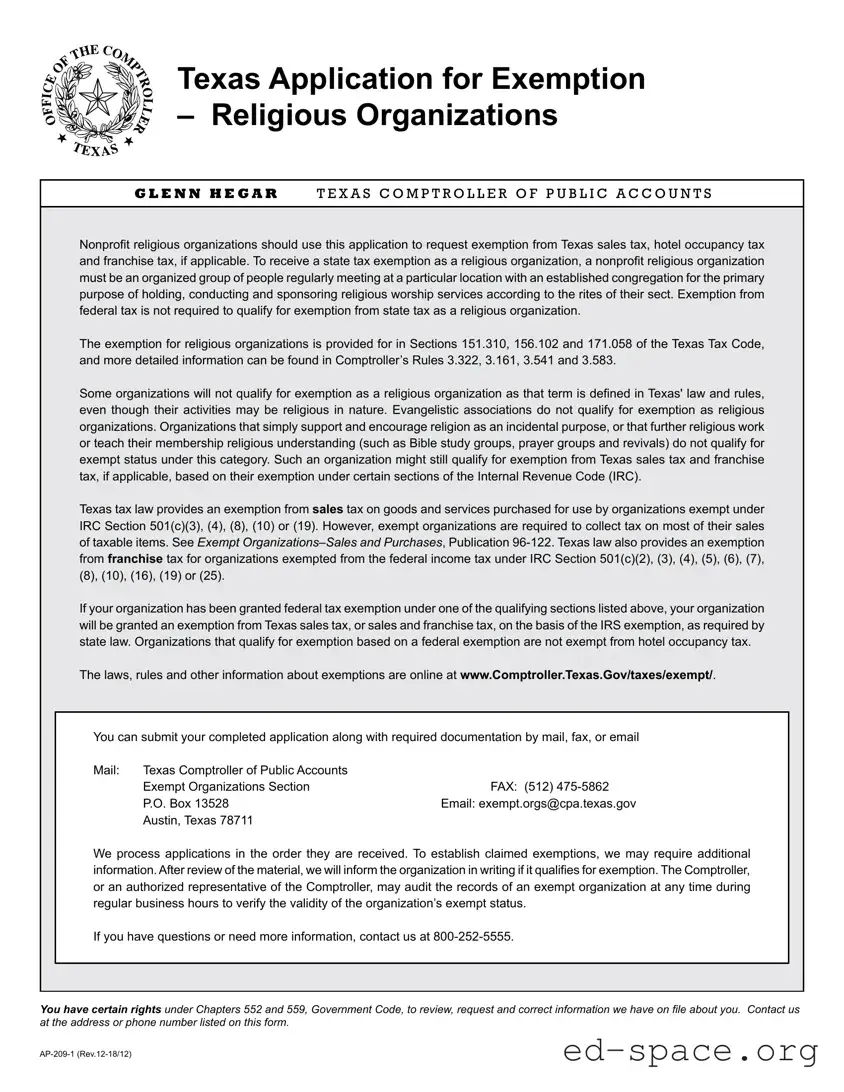
Texas Application for Exemption
– Religious Organizations
GLENN HEGAR TEXAS COMPTROLLER OF PUBLIC ACCOUNTS
Nonprot religious organizations should use this application to request exemption from Texas sales tax, hotel occupancy tax
and franchise tax, if applicable. To receive a state tax exemption as a religious organization, a nonprot religious organization
must be an organized group of people regularly meeting at a particular location with an established congregation for the primary
purpose of holding, conducting and sponsoring religious worship services according to the rites of their sect. Exemption from
federal tax is not required to qualify for exemption from state tax as a religious organization.
The exemption for religious organizations is provided for in Sections 151.310, 156.102 and 171.058 of the Texas Tax Code,
and more detailed information can be found in Comptroller’s Rules 3.322, 3.161, 3.541 and 3.583.
Some organizations will not qualify for exemption as a religious organization as that term is dened in Texas' law and rules,
even though their activities may be religious in nature. Evangelistic associations do not qualify for exemption as religious
organizations. Organizations that simply support and encourage religion as an incidental purpose, or that further religious work
or teach their membership religious understanding (such as Bible study groups, prayer groups and revivals) do not qualify for
exempt status under this category. Such an organization might still qualify for exemption from Texas sales tax and franchise
tax, if applicable, based on their exemption under certain sections of the Internal Revenue Code (IRC).
Texas tax law provides an exemption from sales tax on goods and services purchased for use by organizations exempt under
IRC Section 501(c)(3), (4), (8), (10) or (19). However, exempt organizations are required to collect tax on most of their sales
of taxable items. See Exempt Organizations–Sales and Purchases, Publication 96-122. Texas law also provides an exemption
from franchise tax for organizations exempted from the federal income tax under IRC Section 501(c)(2), (3), (4), (5), (6), (7),
(8), (10), (16), (19) or (25).
If your organization has been granted federal tax exemption under one of the qualifying sections listed above, your organization
will be granted an exemption from Texas sales tax, or sales and franchise tax, on the basis of the IRS exemption, as required by
state law. Organizations that qualify for exemption based on a federal exemption are not exempt from hotel occupancy tax.
The laws, rules and other information about exemptions are online at www.Comptroller.Texas.Gov/taxes/exempt/.
You can submit your completed application along with required documentation by mail, fax, or email
Mail: Texas Comptroller of Public Accounts
Exempt Organizations Section
P.O. Box 13528
Austin, Texas 78711
FAX: (512) 475-5862
We process applications in the order they are received. To establish claimed exemptions, we may require additional
information. After review of the material, we will inform the organization in writing if it qualies for exemption. The Comptroller,
or an authorized representative of the Comptroller, may audit the records of an exempt organization at any time during
regular business hours to verify the validity of the organization’s exempt status.
If you have questions or need more information, contact us at 800-252-5555.
You have certain rights under Chapters 552 and 559, Government Code, to review, request and correct information we have on le about you. Contact us
at the address or phone number listed on this form.
AP-209-1 (Rev.12-18/12)
*AP20920W121812*
*AP20920W121812*
* A P 2 0 9 2 0 W 1 2 1 8 1 2 *
1. ORGANIZATION NAME
(Legal name as provided in Articles of Incorporation, or, if unincorporated, the governing document.)
2. ORGANIZATION MAILING ADDRESS
Street number, P.O. Box or rural route and box number
City State/Province ZIP code County (or country, if outside the U.S.)
3. Texas taxpayer number (if applicable) ...............................................................................................................
4. a) Enter ling information issued by the Texas Secretary of State:
Month Day Year
File number ............................................. File date .......................................
11. Contact information of the person submitting this application
Name Email address
Organization name Daytime phone (Area code and number) Extension
Address City State ZIP code
10. Physical address (no P.O. Box) where worship services are conducted
We will notify you by email when the exemption has been added to let you know where the exemption can be veried online. If an email address is not
provided, indicate where our response should be mailed: organization's mailing address or mailing address of the submitter.
Option A (Member of a common denomination or convention of churches):
Name of parent Parent organization
organization website
Option B (Independent or nondenominational church):
OR
b)
of families represented in the average attendance
7. Make only one selection as the organization's primary purpose:
Religious worship services Ministry Youth group Missionary Bible study Evangelistic association
8. Date of rst worship service ................................................................................................................................................
Time Frequency
9. Time and frequency of worship services ................................................
5. Federal Employer Identication Number (FEIN) (Required if applying for exemption on the basis of a federal exemption) .......
6. Average attendance
If average attendance is less than 50, indicate the number
at worship service ................ ...................
Check this box if this organization is not registered with the Texas Secretary of State.
AP-209-2
(Rev.12-18/12)
Texas Application for Exemption
– Religious Organizations
• Remove all staples • Type or print. • Do NOT write in shaded areas.
SECTION A
SECTION B
Provide the following supporting information as it applies to the appropriate option below:
If your organization is a church that is a member of a common denomination or convention of churches, and the parent organization either has a
501(c)(3) federal group exemption, or has previously obtained a religious exemption in Texas for the churches under its jurisdiction, your church
can obtain exemption based on its a󰀩liation with the parent organization. Attach a letter from the parent organization stating that your church is a
recognized subordinate, or provide the website of the parent organization where your church's a󰀩liation can be veried.
The following must be included with your application. Information may be in the form of a bulletin, brochure, written statement or website:
Your organization's statement of faith;
The regular order of what takes place during worship services (for example, invocation, sermon, hymns, closing prayer);
Evidence that services are open to the public and how they are advertised to the public;
A description of the facility where the worship services are regularly conducted (pictures are accepted but not required and will not be returned).
Special note to unincorporated entities: Include your organization's governing documents, such as the bylaws or constitution.
Special note to non-Texas organizations: Include a le-stamped copy of your organization's formation documents AND a current Certicate
of Existence from the Secretary of State or equivalent o󰀩cer in your home state.
If your church has its own 501(c)(3) federal exemption, provide a copy of the IRS determination letter along with the information in option A or B so
that we may update our records.
Applications received without supporting documentation will be returned.

Form Specifications

Fact Name Fact Details
Purpose of the Form The Texas Application for Exemption is used by nonprofit religious organizations to request exemptions from Texas sales tax, hotel occupancy tax, and franchise tax.
Eligibility Criteria To qualify, organizations must be an established group meeting regularly for religious worship, following the rites of their sect. Federal tax exemption is not required for state exemption.
Governing Laws The exemptions for religious organizations are governed by Sections 151.310, 156.102, and 171.058 of the Texas Tax Code.
Application Submission Completed applications can be submitted via mail, fax, or email. Additional information may be requested during the review process.

Texas Application Exemption: Usage Guidelines

Filling out the Texas Application for Exemption form is a straightforward process, but it requires careful attention to detail. Once completed, this form will be submitted to the Texas Comptroller of Public Accounts for review. The following steps will guide you through the process of filling out the application accurately.

  1. Gather Necessary Information: Before starting, collect all required documents, including your organization’s Articles of Incorporation or governing documents, and any relevant identification numbers.
  2. Section A - Organization Details: Begin by entering the legal name of your organization in the first field. Ensure that you type or print clearly and avoid writing in the shaded areas.
  3. Mailing Address: Fill in the organization’s mailing address, including street number, city, state, ZIP code, and county.
  4. Texas Taxpayer Number: If applicable, provide your Texas taxpayer number in the designated space.
  5. Filing Information: Enter the file number or the date of filing issued by the Texas Secretary of State. If your organization is not registered, check the appropriate box.
  6. Federal Employer Identification Number (FEIN): Include the FEIN if you are applying for exemption based on a federal exemption.
  7. Average Attendance: Indicate the average attendance at worship services. If fewer than 50 people attend, specify the number of families represented.
  8. Primary Purpose: Select one option that best describes the organization’s primary purpose from the provided list.
  9. Date and Time of Worship Services: Fill in the date of the first worship service and the frequency of services.
  10. Physical Address: Provide the physical address where worship services are conducted, ensuring no P.O. Box is used.
  11. Contact Information: Enter the contact details of the person submitting the application, including name, email address, organization name, and daytime phone number.
  12. Supporting Information: Depending on your organization’s affiliation, prepare the necessary documentation as outlined in Section B. This may include letters from parent organizations or statements of faith for independent churches.
  13. Review the Application: Carefully review the completed form for accuracy and completeness. Ensure all required documentation is attached.
  14. Submit the Application: Send the completed application and supporting documents to the Texas Comptroller of Public Accounts via mail, fax, or email as specified in the instructions.

Once the application is submitted, the Texas Comptroller will process it in the order received. Be prepared to provide additional information if requested. After the review, notification will be sent regarding the status of the exemption request.

Your Questions, Answered

What is the Texas Application Exemption form for religious organizations?

The Texas Application for Exemption is a form that nonprofit religious organizations use to request exemption from certain state taxes, including sales tax, hotel occupancy tax, and franchise tax. To qualify, an organization must be an established group that regularly meets at a specific location for the primary purpose of conducting religious worship services. It's important to note that exemption from federal tax is not a requirement for this state exemption.

Who qualifies as a religious organization under Texas law?

To be considered a religious organization, a group must meet specific criteria outlined in Texas law. This includes being an organized group that holds regular worship services. However, not all groups with religious activities qualify. For instance, evangelistic associations and groups that primarily support religion without conducting worship services do not qualify for this exemption. Organizations that may fall under different sections of the Internal Revenue Code might still qualify for other types of tax exemptions.

What types of taxes can a religious organization be exempt from?

Religious organizations may be exempt from Texas sales tax and franchise tax if they meet the necessary criteria. However, organizations that qualify for exemption based on federal tax exemption under specific sections of the Internal Revenue Code will not be exempt from hotel occupancy tax. Each type of tax exemption has its own requirements, so it's essential to understand the distinctions.

How can a religious organization apply for tax exemption?

To apply for tax exemption, organizations must complete the Texas Application for Exemption form and submit it along with the required documentation. Applications can be sent via mail, fax, or email to the Texas Comptroller of Public Accounts. It's crucial to include all necessary information and supporting documents to avoid delays in processing. The application will be reviewed in the order it is received, and additional information may be requested to establish the claimed exemptions.

What happens after submitting the application?

Once the application is submitted, it will be processed by the Texas Comptroller's office. The organization will receive written notification regarding its exemption status. The Comptroller or a designated representative may audit the organization's records to verify its exempt status at any time during regular business hours. This ensures that the organization continues to meet the criteria for exemption.

Where can organizations find more information about the exemption process?

Organizations can find detailed information about the exemption process, including the relevant laws and rules, on the Texas Comptroller's website. The site provides resources and guidance for understanding the requirements for tax exemption and how to navigate the application process. For additional questions, organizations can contact the Comptroller’s office directly for assistance.

Common mistakes

  1. Failing to Provide Complete Information: Many applicants do not fill in all required fields. Every section needs to be completed accurately. Missing information can lead to delays or outright rejection of the application.

  2. Incorrect Organization Name: Using a different name than what is stated in the Articles of Incorporation is a common mistake. Ensure the legal name matches exactly to avoid complications.

  3. Not Including Required Documentation: Some applicants forget to attach necessary documents. This includes statements of faith, worship service details, and, if applicable, proof of affiliation with a parent organization.

  4. Ignoring Email Communication: Applicants may overlook the importance of providing a valid email address. Without this, you will miss notifications about your application status and verification details.

  5. Neglecting to Sign the Application: Some individuals forget to sign the application form. An unsigned application is incomplete and cannot be processed.

Documents used along the form

The Texas Application for Exemption form is essential for nonprofit religious organizations seeking tax exemptions. Alongside this form, several other documents may be required to establish eligibility and support the application. Here are six commonly used forms and documents that can accompany the Texas Application for Exemption:

  • IRS Determination Letter: This letter confirms an organization’s federal tax-exempt status under the Internal Revenue Code. It is crucial for organizations applying for state exemptions based on their federal status.
  • Bylaws or Constitution: These governing documents outline the structure and rules of the organization. They provide evidence of the organization’s purpose and operations, which is necessary for unincorporated entities.
  • Statement of Faith: This document articulates the beliefs and principles of the organization. It helps demonstrate the religious nature of the organization and is often required for independent or nondenominational churches.
  • Worship Service Schedule: A description of the regular order of worship services is needed. This includes details about the frequency and format of services, showing that the organization actively conducts religious worship.
  • Evidence of Public Access: This can include brochures, bulletins, or advertisements that show services are open to the public. This documentation supports claims of community engagement and outreach.
  • Certificate of Existence: For organizations formed outside Texas, this document confirms that the organization is legally registered in its home state. It is required along with formation documents when applying for exemption.

These documents collectively strengthen the application for tax exemption, providing the necessary evidence of the organization’s religious nature and compliance with state requirements. Proper preparation and submission of these forms can facilitate a smoother review process by the Texas Comptroller's office.

Similar forms

The Texas Application for Exemption form shares similarities with several other documents used for tax exemption purposes. Here are four documents that are similar, along with a brief explanation of how they relate:

  • IRS Form 1023: This is the application for recognition of exemption under Section 501(c)(3) of the Internal Revenue Code. Like the Texas Application for Exemption, it requires detailed information about the organization’s structure, purpose, and activities to determine eligibility for tax-exempt status.
  • IRS Form 990: This form is an annual information return that tax-exempt organizations must file. It provides transparency about the organization's financial activities, similar to how the Texas Application requires documentation to establish eligibility for state tax exemptions.
  • Texas Franchise Tax Exemption Application: This document is used by organizations seeking exemption from franchise tax in Texas. Both forms assess the organization's purpose and activities to determine if they meet the necessary criteria for tax exemption.
  • Texas Sales Tax Exemption Certificate: This certificate allows qualifying organizations to make tax-exempt purchases. Similar to the Texas Application for Exemption, it requires proof of the organization’s status and purpose to confirm eligibility for sales tax exemptions.

Dos and Don'ts

When filling out the Texas Application Exemption form, it is important to approach the process with care. Below is a list of things you should and shouldn't do to ensure a smooth application experience.

  • Do ensure that all information is accurate and complete. Double-check names, addresses, and identification numbers to avoid delays.
  • Do provide all required supporting documentation. Missing documents can lead to your application being returned.
  • Do submit the application through the correct channels. Use mail, fax, or email as indicated in the instructions.
  • Do keep a copy of your application for your records. This will help if you need to reference it in the future.
  • Do follow up if you do not receive confirmation. Contact the Comptroller’s office to check the status of your application.
  • Don't write in the shaded areas of the form. This can cause confusion and may lead to processing errors.
  • Don't forget to remove all staples from your application. Stapled documents can be difficult to process.
  • Don't submit incomplete applications. Incomplete forms will be returned, which can delay your exemption status.
  • Don't provide false information. Misrepresentation can result in denial of your application and potential legal consequences.
  • Don't wait until the last minute to submit your application. Allow ample time for processing and any potential follow-up requests.

By following these guidelines, you can help ensure that your application for exemption is processed efficiently and effectively.

Misconceptions

There are several misconceptions surrounding the Texas Application for Exemption form for religious organizations. Understanding these misconceptions can help organizations navigate the application process more effectively. Below are nine common misconceptions along with clarifications.

  • All religious groups automatically qualify for tax exemption. Not all organizations that consider themselves religious qualify. Only organized groups with a defined congregation and regular worship services meet the criteria.
  • Federal tax exemption is necessary for state exemption. Organizations do not need to have federal tax exemption to qualify for state tax exemption as a religious organization.
  • Evangelistic associations qualify for exemption. Evangelistic associations do not qualify for tax exemption under Texas law, despite their religious activities.
  • Supportive religious activities guarantee tax exemption. Organizations that primarily support or encourage religion, like Bible study groups or prayer groups, do not qualify for exemption.
  • All nonprofit organizations are exempt from sales tax. Nonprofit organizations must meet specific criteria to qualify for sales tax exemption, including being recognized under certain sections of the Internal Revenue Code.
  • If exempt from federal taxes, the organization is exempt from all state taxes. Organizations that qualify for federal exemption are not automatically exempt from hotel occupancy tax under Texas law.
  • Exempt organizations do not need to collect sales tax. Even exempt organizations are required to collect sales tax on most taxable sales they make.
  • Documentation is not necessary for the application. Supporting documentation is crucial for the application process. Applications submitted without the required documents will be returned.
  • Applications are processed immediately. The Texas Comptroller processes applications in the order they are received, which may take time. Additional information may also be requested before a decision is made.

Understanding these misconceptions can help organizations better prepare for the application process and ensure compliance with Texas tax laws.

Key takeaways

Filling out the Texas Application for Exemption form can be a crucial step for nonprofit religious organizations seeking tax relief. Here are key takeaways to keep in mind:

  • Eligibility Criteria: To qualify for exemption, an organization must be a structured group that regularly meets for religious worship at a specific location.
  • No Federal Requirement: Organizations do not need to have federal tax exemption to be eligible for state tax exemption as a religious entity.
  • Specific Definitions: Not all religious activities qualify for exemption. For example, evangelistic associations and groups that only support religion incidentally do not meet the criteria.
  • Federal Exemption Connection: Organizations with federal exemptions under certain sections of the Internal Revenue Code may qualify for state tax exemptions as well.
  • Tax Types Covered: The application can provide exemptions from Texas sales tax, hotel occupancy tax, and franchise tax, depending on the organization’s qualifications.
  • Application Submission: Completed applications can be submitted via mail, fax, or email, ensuring all required documentation is included.
  • Processing Time: Applications are processed in the order they are received, and additional information may be requested to establish claimed exemptions.
  • Audits Possible: The Comptroller may audit the records of exempt organizations to verify their exempt status, emphasizing the importance of maintaining accurate records.

By understanding these key points, organizations can navigate the application process more effectively and ensure they meet the necessary criteria for tax exemptions in Texas.