Homepage Blank Texas Ap 209 PDF Form
Content Overview

The Texas AP 209 form serves as a vital tool for nonprofit religious organizations seeking tax exemptions in the state. This application allows these organizations to request exemptions from Texas sales tax, hotel occupancy tax, and, if applicable, franchise tax. To qualify, a nonprofit religious organization must consist of a group of individuals who regularly gather at a designated location with an established congregation, primarily dedicated to conducting religious worship services in accordance with their sect's practices. Notably, organizations do not need to have federal tax exemption status to be eligible for state tax exemptions. The Texas Tax Code outlines specific provisions for these exemptions, and additional guidance can be found in the Comptroller’s Rules. However, it’s important to note that not all groups with religious activities will qualify. For instance, evangelistic associations and groups that merely support religious activities do not meet the criteria for exemption. Instead, they may explore other avenues for tax relief based on their federal tax status. The application process requires careful attention to detail, including submitting necessary documentation to verify eligibility. Organizations can expect to receive a response within ten working days after submission, and they should be prepared for potential audits to confirm their exempt status. For further assistance, the Texas Comptroller's Tax Assistance staff is available to answer any questions.


Document Preview

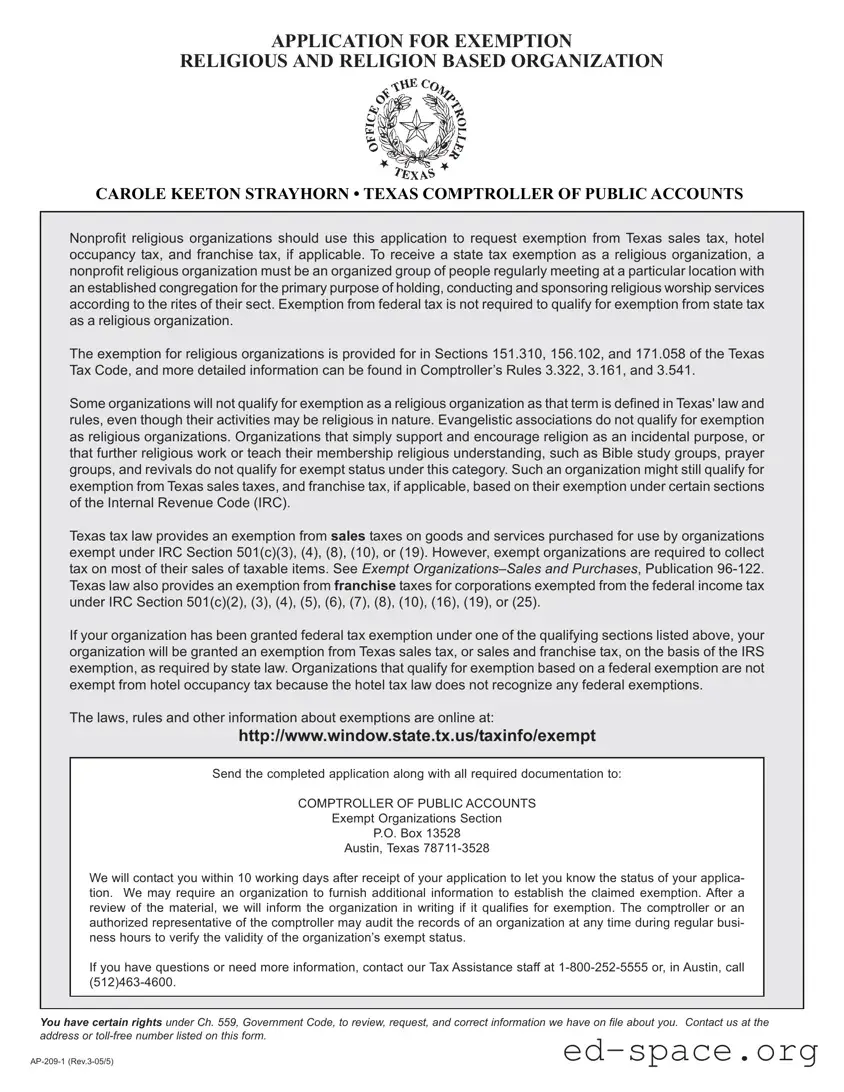
You have certain rights under Ch. 559, Government Code, to review, request, and correct information we have on file about you. Contact us at the
address or toll-free number listed on this form.
APPLICATION FOR EXEMPTION
RELIGIOUS AND RELIGION BASED ORGANIZATION
CAROLE KEETON STRAYHORN • TEXAS COMPTROLLER OF PUBLIC ACCOUNTS
Nonprofit religious organizations should use this application to request exemption from Texas sales tax, hotel
occupancy tax, and franchise tax, if applicable. To receive a state tax exemption as a religious organization, a
nonprofit religious organization must be an organized group of people regularly meeting at a particular location with
an established congregation for the primary purpose of holding, conducting and sponsoring religious worship services
according to the rites of their sect. Exemption from federal tax is not required to qualify for exemption from state tax
as a religious organization.
The exemption for religious organizations is provided for in Sections 151.310, 156.102, and 171.058 of the Texas
Tax Code, and more detailed information can be found in Comptroller’s Rules 3.322, 3.161, and 3.541.
Some organizations will not qualify for exemption as a religious organization as that term is defined in Texas' law and
rules, even though their activities may be religious in nature. Evangelistic associations do not qualify for exemption
as religious organizations. Organizations that simply support and encourage religion as an incidental purpose, or
that further religious work or teach their membership religious understanding, such as Bible study groups, prayer
groups, and revivals do not qualify for exempt status under this category. Such an organization might still qualify for
exemption from Texas sales taxes, and franchise tax, if applicable, based on their exemption under certain sections
of the Internal Revenue Code (IRC).
Texas tax law provides an exemption from sales taxes on goods and services purchased for use by organizations
exempt under IRC Section 501(c)(3), (4), (8), (10), or (19). However, exempt organizations are required to collect
tax on most of their sales of taxable items. See Exempt Organizations–Sales and Purchases, Publication 96-122.
Texas law also provides an exemption from franchise taxes for corporations exempted from the federal income tax
under IRC Section 501(c)(2), (3), (4), (5), (6), (7), (8), (10), (16), (19), or (25).
If your organization has been granted federal tax exemption under one of the qualifying sections listed above, your
organization will be granted an exemption from Texas sales tax, or sales and franchise tax, on the basis of the IRS
exemption, as required by state law. Organizations that qualify for exemption based on a federal exemption are not
exempt from hotel occupancy tax because the hotel tax law does not recognize any federal exemptions.
The laws, rules and other information about exemptions are online at:
http://www.window.state.tx.us/taxinfo/exempt
Send the completed application along with all required documentation to:
COMPTROLLER OF PUBLIC ACCOUNTS
Exempt Organizations Section
P.O. Box 13528
Austin, Texas 78711-3528
We will contact you within 10 working days after receipt of your application to let you know the status of your applica-
tion. We may require an organization to furnish additional information to establish the claimed exemption. After a
review of the material, we will inform the organization in writing if it qualifies for exemption. The comptroller or an
authorized representative of the comptroller may audit the records of an organization at any time during regular busi-
ness hours to verify the validity of the organization’s exempt status.
If you have questions or need more information, contact our Tax Assistance staff at 1-800-252-5555 or, in Austin, call
(512)463-4600.
AP-209-1 (Rev.3-05/5)
AP-209-2
(Rev.3-05/5)
Page 1
TEXAS APPLICATION FOR TAX EXEMPTION
FOR RELIGIOUS AND RELIGION-BASED ORGANIZATIONS
• TYPE OR PRINT
• Do NOT write in shaded areas.
1. ORGANIZATION NAME
(Legal name as provided in Articles of Incorporation, or, if unincorporated, the governing document. For out-of-state corporations, name must match the official corporate name as filed in the home state of charter)
2. ORGANIZATION MAILING ADDRESS
Street number, P.O. Box, or rural route and box number
City State/province ZIP code County (or country, if outside the U.S.)
3. Texas Taxpayer number (if applicable) ................................................................................................................
4. For TEXAS corporations ONLY, filing information issued by the Secretary of State:
File Number .............................................. File Date .......................................
5. For NON-TEXAS corporations ONLY, filing information issued by the Texas Secretary of State:
Certificate of Authority File Number ............. File Date ...............................
Home State Date of Home State Filing
of Incorporation ....... Incorporation ... or Registration Number .......
6. Federal Employer's Identification Number (EIN) (Required if applying for exemption on the basis of a federal exemption) ......
7. Average attendance If average attendance is less than 50, indicate the number
at worship service ................ of families represented in the average attendance ...................
8. Date of first worship service ................................................................................................................................................
Time Frequency
9. Time and frequency of worship services ................................................
10. Name, address and daytime phone number of the person submitting this application.
Name Title
Organization Name Daytime Phone (Area code and number) Extension
Address City State Zip
If address provided is not the same as the organization's mailing address, indicate to which address our response should be mailed:
To organization mailing address To mailing address of submitter
SECTION A
Month Day Year
Month Day Year
Month Day Year
Option A (Member of a common denomination or convention of churches):
z If your organization is a church that is a member of a common denomination or convention of churches, and the parent organization
either has a 501(c)(3) federal group exemption, or has previously obtained a religious exemption in Texas for the churches under its
jurisdiction, your church can obtain exemption based on its affiliation with the parent organization. Attach a letter from the parent
organization stating that your church is a recognized subordinate, or provide the web address of the parent organization where your
church's affiliation can be verified.
Option B (Independent church or nondenominational church that does not meet the requirements under Option A):
z A copy of your organization’s governing document (file-stamped Articles of Incorporation, or Bylaws or Constitution or Articles of
Association if not incorporated)
z A copy of your group’s statement of faith.
z Documentation such as a bulletin, brochure, Web address (URL) or written statement that indicates the regular order of what takes
place during the worship services.
z A statement containing the physical address (no P.O. Box) and a description of the facility where worship services are regularly
conducted. If available, include pictures of the interior and exterior of the facility. If renting or leasing, include a copy of the rental/lease
agreement.
z A statement confirming the services are open to the public. The statement must indicate how the services are advertised to the public.
If your church has its own 501(c)(3) federal exemption, provide a copy of the IRS determination letter along with the information in option A
or B so that we may update our records.
APPLICATIONS RECEIVED WITHOUT SUPPORTING DOCUMENTATION REQUIRED
UNDER OPTION A
OR OPTION B WILL BE RETURNED.
SECTION B
Provide the following additional information as it applies to the appropriate option below:

Form Specifications

Fact Name Description
Purpose The Texas AP 209 form is used by nonprofit religious organizations to apply for exemptions from Texas sales tax, hotel occupancy tax, and franchise tax.
Eligibility Criteria To qualify, organizations must regularly meet at a specific location for religious worship and have an established congregation. Not all religious activities qualify.
Governing Laws Exemptions are governed by Sections 151.310, 156.102, and 171.058 of the Texas Tax Code, along with Comptroller’s Rules 3.322, 3.161, and 3.541.
Federal Exemption A federal tax exemption is not required to qualify for state tax exemption. However, organizations may still need to collect tax on certain sales.

Texas Ap 209: Usage Guidelines

Completing the Texas AP 209 form is a crucial step for nonprofit religious organizations seeking a tax exemption. After filling out this form, you will need to submit it along with any required documentation to the appropriate state office. The process is straightforward, but attention to detail is essential to ensure your application is processed smoothly.

  1. Gather Required Information: Before starting, collect all necessary documents, including your organization’s governing documents and any relevant identification numbers.
  2. Section A - Organization Information: Fill in the legal name of your organization as stated in your Articles of Incorporation or governing document. If unincorporated, use the name from your governing document.
  3. Mailing Address: Provide the complete mailing address, including street number, city, state, ZIP code, and county.
  4. Texas Taxpayer Number: If applicable, enter your Texas taxpayer number in the designated space.
  5. Filing Information for Texas Corporations: If your organization is a Texas corporation, include the file number and date issued by the Secretary of State.
  6. Filing Information for Non-Texas Corporations: For organizations incorporated outside Texas, provide the Certificate of Authority file number, date, home state of incorporation, and home state filing or registration number.
  7. Federal Employer Identification Number (EIN): Enter your EIN, which is required if applying for exemption based on federal status.
  8. Average Attendance: Indicate the average attendance at worship services. If it is less than 50, also note the number of families represented.
  9. Date of First Worship Service: Provide the date when the first worship service was held, along with the time and frequency of services.
  10. Contact Information: Fill in the name, title, organization name, daytime phone number, and address of the person submitting the application. Specify where responses should be mailed if different from the organization’s mailing address.
  11. Section B - Additional Information: Depending on your organization type, provide the necessary documentation as outlined in either Option A or Option B.
  12. Submit the Application: Once completed, send the application and all required documents to the Comptroller of Public Accounts at the specified address.

After submission, expect to hear back within 10 working days regarding the status of your application. Be prepared to provide additional information if requested. This process ensures that your organization is recognized appropriately for tax exemption purposes.

Your Questions, Answered

What is the purpose of the Texas AP 209 form?

The Texas AP 209 form is used by nonprofit religious organizations to request exemption from certain state taxes, including sales tax, hotel occupancy tax, and franchise tax. To qualify, the organization must be an established group that meets regularly for religious worship. The form serves as a formal application to demonstrate that the organization meets the criteria outlined in Texas tax law.

Who qualifies as a religious organization under the Texas tax law?

To qualify as a religious organization, a group must have a defined congregation that regularly meets at a specific location for the primary purpose of conducting religious services. It is important to note that not all groups with religious activities qualify. For example, evangelistic associations and groups that primarily support religion without conducting regular worship services do not meet the criteria for exemption. Organizations that have federal tax exemptions under certain sections of the Internal Revenue Code may still qualify for state tax exemptions based on those federal designations.

What documentation is required when submitting the AP 209 form?

When submitting the AP 209 form, organizations must provide specific documentation based on their classification. For those affiliated with a common denomination, a letter from the parent organization confirming the affiliation is required. Independent or non-denominational churches must submit their governing documents, a statement of faith, and additional information about their worship services, including how they are advertised to the public. Failure to include the necessary documentation may result in the application being returned.

How long does it take to process the AP 209 application?

Once the completed application and all required documentation are submitted, the Texas Comptroller's office will contact the organization within 10 working days to provide an update on the status of the application. Additional information may be requested during this process to establish the claimed exemption. After reviewing the materials, the organization will receive written confirmation regarding its exemption status.

Are there any taxes from which religious organizations are not exempt?

While religious organizations may qualify for exemptions from sales tax and franchise tax, they are not exempt from hotel occupancy tax. Texas law does not recognize federal exemptions when it comes to hotel taxes. Therefore, organizations should be aware of this limitation when planning events or activities that involve hotel accommodations.

Common mistakes

  1. Incomplete Organization Name: One common mistake is failing to provide the full legal name of the organization as listed in the Articles of Incorporation. Ensure that the name matches the official records to avoid delays.

  2. Incorrect Mailing Address: Applicants often overlook the importance of accurately filling out the mailing address. A missing or incorrect address can lead to missed communications regarding the application status.

  3. Missing Taxpayer Information: Some organizations forget to include their Texas Taxpayer number, if applicable. This information is crucial for processing the application efficiently.

  4. Neglecting Supporting Documentation: Failing to attach required documents, such as a governing document or statement of faith, is a frequent error. Applications without these documents will be returned, causing unnecessary delays.

  5. Inaccurate Attendance Information: Providing incorrect average attendance figures can hinder the application process. Make sure to report the actual average attendance or the number of families represented accurately.

Documents used along the form

The Texas AP 209 form serves as a crucial document for nonprofit religious organizations seeking tax exemptions. However, several other forms and documents often accompany this application to ensure compliance with state requirements. Each of these documents plays a significant role in establishing eligibility and providing necessary information to the Texas Comptroller of Public Accounts. Below is a list of commonly used forms and documents that may be required alongside the Texas AP 209.

  • Articles of Incorporation: This foundational document outlines the organization's purpose, structure, and governance. It is essential for establishing the legal identity of the organization.
  • Bylaws: These internal rules govern the operation of the organization. Bylaws typically detail the roles of officers, membership requirements, and procedures for meetings.
  • Statement of Faith: A written declaration that outlines the core beliefs and principles of the organization. This document helps demonstrate the religious nature of the organization.
  • Federal Employer Identification Number (EIN): This unique number assigned by the IRS is necessary for tax identification purposes. It is required when applying for federal tax exemptions.
  • IRS Determination Letter: This letter confirms the organization’s federal tax-exempt status under the Internal Revenue Code. It is crucial for organizations seeking state exemptions based on federal status.
  • Worship Service Documentation: This includes materials such as bulletins or brochures that describe the regular order of worship services. It helps verify that the organization conducts religious activities.
  • Facility Description: A statement detailing the physical location where worship services are held. This document should include the address and any relevant information about the facility.
  • Rental or Lease Agreement: If the organization does not own its place of worship, a copy of the rental or lease agreement is necessary to confirm the arrangement for conducting services.
  • Public Accessibility Statement: A document confirming that worship services are open to the public. This statement should describe how services are advertised to the community.
  • Parent Organization Letter: For churches affiliated with a larger denomination, a letter from the parent organization confirming the relationship and recognition is required for exemption eligibility.

In summary, these forms and documents are integral to the application process for tax exemptions for religious organizations in Texas. Each item provides vital information that supports the organization's claim for exemption and ensures compliance with state regulations. Proper preparation and submission of these documents can significantly facilitate the approval process.

Similar forms

The Texas AP 209 form is specifically designed for nonprofit religious organizations to apply for tax exemptions. Several other documents share similarities with this form, particularly in terms of their purpose and requirements. Below is a list of nine documents that are comparable to the Texas AP 209 form, along with a brief explanation of how they are similar.

  • IRS Form 1023: This form is used by organizations seeking federal tax-exempt status under Section 501(c)(3) of the Internal Revenue Code. Like the AP 209, it requires detailed information about the organization’s structure, purpose, and activities to establish eligibility for tax exemption.
  • IRS Form 990: Nonprofits must file this annual information return to maintain their tax-exempt status. Similar to the AP 209, it provides transparency regarding the organization’s finances and operations, which is crucial for compliance with tax laws.
  • Texas Form 05-102: This application is for organizations seeking a sales tax exemption in Texas. It parallels the AP 209 in that both forms require documentation to prove the organization’s purpose and activities to qualify for tax exemptions.
  • Texas Form 05-159: This form is used for claiming a franchise tax exemption. It is similar to the AP 209 as it also necessitates proof of the organization’s status and purpose to qualify for tax relief.
  • Texas Form 05-161: This application is for organizations seeking a hotel occupancy tax exemption. Like the AP 209, it requires evidence of the organization’s activities and purpose, although hotel tax exemptions are not based on federal status.
  • California Form 3500: This is the application for exemption from California state taxes for nonprofit organizations. It shares a similar objective with the AP 209, requiring detailed information about the organization’s structure and purpose.
  • New York Form ST-119.1: This form is used for claiming a sales tax exemption in New York. It is akin to the AP 209 in that it requires organizations to demonstrate their qualifying status and purpose for exemption.
  • Florida Form DR-5: This application is for nonprofit organizations seeking a sales tax exemption in Florida. Similar to the AP 209, it involves submitting documentation that verifies the organization’s nonprofit status and activities.
  • Ohio Form STEC-B: This is the application for a sales tax exemption for nonprofit organizations in Ohio. Like the AP 209, it requires proof of the organization’s charitable purpose and operational details to qualify for tax exemptions.

Dos and Don'ts

When filling out the Texas AP 209 form for tax exemption as a religious organization, there are several important steps to follow. Below is a list of things you should and shouldn't do to ensure your application is complete and accurate.

  • Do provide the legal name of your organization as it appears in your Articles of Incorporation.
  • Do ensure that all contact information is accurate, including the mailing address and daytime phone number.
  • Do attach all required documentation based on your organization's classification, whether you are part of a common denomination or an independent church.
  • Do clearly indicate the average attendance at worship services, including the number of families represented if attendance is less than 50.
  • Don't leave any shaded areas on the form blank; these are not for your input.
  • Don't submit the application without the necessary supporting documents, as incomplete applications will be returned.
  • Don't forget to include your Federal Employer's Identification Number (EIN) if applicable.
  • Don't assume that your organization qualifies for exemption without reviewing the specific requirements outlined in the Texas Tax Code.

Following these guidelines can help streamline the application process and increase the likelihood of receiving the exemption you are seeking.

Misconceptions

Misconceptions about the Texas AP 209 form can lead to confusion regarding tax exemptions for religious organizations. Here are four common misconceptions:

  • All religious organizations automatically qualify for tax exemption. This is not true. Only nonprofit religious organizations that meet specific criteria, such as having an established congregation and regularly conducting worship services, are eligible for exemption.
  • Federal tax exemption is required to qualify for state tax exemption. Many believe that a federal tax exemption is necessary for state tax exemption. However, Texas law allows for state tax exemptions independent of federal status.
  • Evangelistic associations qualify as religious organizations. This misconception is widespread, but evangelistic associations do not meet the definition of a religious organization under Texas law, even if their activities are religious in nature.
  • Organizations with federal exemptions are also exempt from hotel occupancy tax. This is incorrect. Texas law does not recognize federal exemptions for hotel occupancy tax, meaning that organizations must still pay this tax regardless of their federal status.

Understanding these misconceptions can help organizations navigate the exemption process more effectively and ensure compliance with Texas tax laws.

Key takeaways

When filling out and using the Texas AP 209 form for tax exemption as a religious organization, consider the following key takeaways:

  • Eligibility Criteria: Only nonprofit religious organizations that meet specific criteria can apply for exemption. This includes being an organized group that regularly meets for worship at a designated location.
  • Federal Exemption Not Required: An organization does not need to have federal tax exemption to qualify for state tax exemption as a religious organization in Texas.
  • Documentation is Crucial: Complete and accurate documentation is essential. Applications lacking required supporting documents will be returned, delaying the process.
  • Audit Rights: The Comptroller's office may audit the organization's records at any time during regular business hours to verify exempt status.
  • Contact Information: For assistance, organizations can reach the Tax Assistance staff at 1-800-252-5555 or (512) 463-4600 in Austin.