Homepage Blank Texas Ap 206 PDF Form
Content Overview

The Texas AP 206 form serves as an essential application for homeowners’ associations seeking exemption from the Texas franchise tax. This exemption is applicable to nonprofit corporations that primarily manage, construct, and maintain residential properties, such as condominiums or residential developments, that are legally restricted for residential use only. To qualify, the association must ensure that individual resident owners hold at least 51% of the voting control. The form outlines specific requirements, including the need to submit documentation that verifies the association's purpose and the residential nature of the property. It also details the voting rights structure within the association, necessitating clarity on how votes are distributed among members. The application process involves submitting the completed form and any supporting documents to the Texas Comptroller of Public Accounts. Upon receipt, the office will review the application and may request additional information if necessary. Understanding the nuances of this form is crucial for homeowners’ associations aiming to secure their tax-exempt status while complying with Texas tax laws.


Document Preview

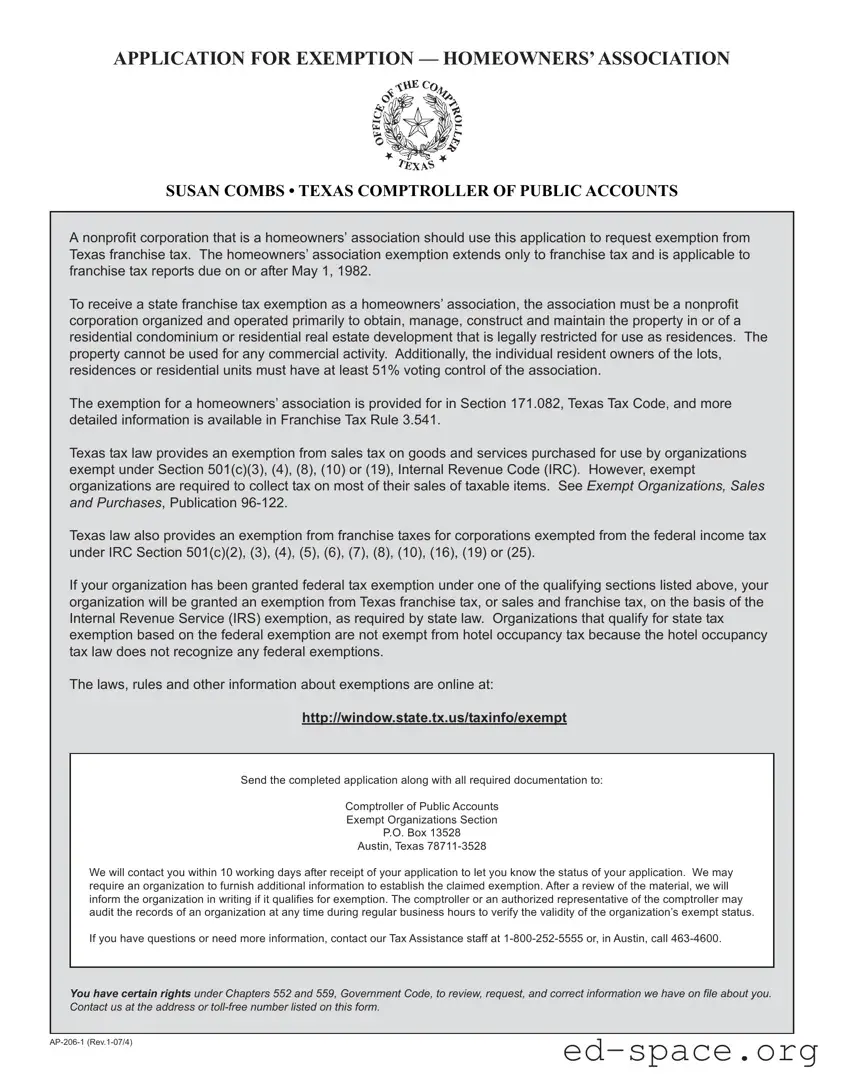
You have certain rights under Chapters 552 and 559, Government Code, to review, request, and correct information we have on file about you.
Contact us at the address or toll-free number listed on this form.
APPLICATION FOR EXEMPTION — HOMEOWNERS’ ASSOCIATION
SUSAN COMBS • TEXAS COMPTROLLER OF PUBLIC ACCOUNTS
AP-206-1 (Rev.1-07/4)
Send the completed application along with all required documentation to:
Comptroller of Public Accounts
Exempt Organizations Section
P.O. Box 13528
Austin, Texas 78711-3528
We will contact you within 10 working days after receipt of your application to let you know the status of your application. We may
require an organization to furnish additional information to establish the claimed exemption. After a review of the material, we will
inform the organization in writing if it qualifies for exemption. The comptroller or an authorized representative of the comptroller may
audit the records of an organization at any time during regular business hours to verify the validity of the organization’s exempt status.
If you have questions or need more information, contact our Tax Assistance staff at 1-800-252-5555 or, in Austin, call 463-4600.
A nonprofit corporation that is a homeowners’ association should use this application to request exemption from
Texas franchise tax. The homeowners’ association exemption extends only to franchise tax and is applicable to
franchise tax reports due on or after May 1, 1982.
To receive a state franchise tax exemption as a homeowners’ association, the association must be a nonprofit
corporation organized and operated primarily to obtain, manage, construct and maintain the property in or of a
residential condominium or residential real estate development that is legally restricted for use as residences. The
property cannot be used for any commercial activity. Additionally, the individual resident owners of the lots,
residences or residential units must have at least 51% voting control of the association.
The exemption for a homeowners’ association is provided for in Section 171.082, Texas Tax Code, and more
detailed information is available in Franchise Tax Rule 3.541.
Texas tax law provides an exemption from sales tax on goods and services purchased for use by organizations
exempt under Section 501(c)(3), (4), (8), (10) or (19), Internal Revenue Code (IRC). However, exempt
organizations are required to collect tax on most of their sales of taxable items. See Exempt Organizations, Sales
and Purchases, Publication 96-122.
Texas law also provides an exemption from franchise taxes for corporations exempted from the federal income tax
under IRC Section 501(c)(2), (3), (4), (5), (6), (7), (8), (10), (16), (19) or (25).
If your organization has been granted federal tax exemption under one of the qualifying sections listed above, your
organization will be granted an exemption from Texas franchise tax, or sales and franchise tax, on the basis of the
Internal Revenue Service (IRS) exemption, as required by state law. Organizations that qualify for state tax
exemption based on the federal exemption are not exempt from hotel occupancy tax because the hotel occupancy
tax law does not recognize any federal exemptions.
The laws, rules and other information about exemptions are online at:
http://window.state.tx.us/taxinfo/exempt
SPECIFIC INSTRUCTIONS
Item 1. The filed document of record, and any subsequent amendments, that establishes the
purpose of the property usually provides the qualifications for association membership, owners’
voting rights and whether the property is held exclusively for residential use. This document and the
plat map are filed with the local county clerk’s office, and may be referred to as the:
• Declaration;
• Deed Restrictions;
• Covenants, Conditions and Restrictions, or similar titles.
To complete Item 1, take the language directly from the appropriate controlling document, which is
normally the Articles of Incorporation but may be the association’s Declaration or Bylaws. Also,
specify in Item 1 the title of the document and the specific citation from which the language was
taken.
Item 2. To be eligible for exemption as a homeowners’ association, the property must be
residential and have no commercial property within the real estate development. A condominium
project or real estate development is considered residential if the property is legally restricted for use
as residences, with no commercial use allowed.
To complete Item 2, enter the total number of lots/units as shown on the plat map for the real estate
development. The plat map should be on file with the local county clerk’s office.
Item 3. To complete Item 3, enter the total number of lots/units owned by the individual resident
owners. Do not include any lots/units owned by the declarants, developers, builders, banks,
investors or similar parties. Do not include multiple-owned lots by an individual owner, unless an
exception applies. An exception occurs when an individual owner purchases two lots to construct a
single residential structure; in that case, the adjacent lot would be considered as being owned by the
individual resident owner, and the lot should be included in the total reported in Item 3.
Item 4. To complete Item 4, enter the total number of lots not included in Item 3. Include multiple-
owned lots by an individual owner, and all lots/units owned by parties other than the individual
resident owners. Attach a list identifying these owners and the number of lots owned.
In order to qualify for exemption as a homeowners’ association, these parties cannot control more
than 49% of the association’s total votes. Majority control cannot be held by a single individual or
family, or by one or more developers, declarants, banks, investors or similar parties.
Item 5. If the answer to number 5 is yes, also complete Items 5a and 5c. If the answer to number 5
is no, also complete Items 5b and 5c. For 5a, 5b and 5c, take the language directly from the
controlling documents. If the language is not found in the declaration, then look for it in the Articles
of Incorporation or bylaws. Also, provide the title of the document from which the language was
taken.
AP-206-2
(Rev.1-07/4)
AP-206-3
(Rev.1-07/4)
Page 1
TEXAS APPLICATION FOR STATE TAX EXEMPTION
FOR HOMEOWNERS’ ASSOCIATIONS
• TYPE OR PRINT
• Do NOT write in shaded areas.
PLEASE COMPLETE THE FOLLOWING INFORMATION
1. SEE INSTRUCTIONS The primary purpose of the corporation as quoted directly from the association's Articles of
Incorporation, Declaration, or Bylaws, including any subsequent amendments, is
as found in
2. SEE INSTRUCTIONS Number of lots/units shown on the plat map for the real estate development ..........
3. SEE INSTRUCTIONS Number of residential lots/units owned by individual owner .....................................
4. SEE INSTRUCTIONS Number of lots/units units owned by declarant, developers, builders,
banks, investors, or other similar parties .....................................................................................................
5. SEE INSTRUCTIONS Does the Declaration provide for different classes of votes? ....................................
If YES, must complete 5a and 5c. If NO, must complete 5b and 5c.
5a. Enter the voting rights for each class of member, as found in:
CLASS A:
CLASS B:
(List additional classes if necessary)
5b. Enter the language that identifies the number of votes each member is entitled to, including the declarant’s
voting rights.
Title of document and cite from which 5b was taken:
5c. List conditions that determine when the Declarant’s voting rights ceased, or converted to other conditions
allowing the individual owners to gain voting control of the association.
Title of document and cite from which 5c was taken:
6. Based on the information provided above, the date the individual resident owners
collectively gained voting control (at least 51 percent) of the association was: .....................................
7. Corporation name (For Texas corporations, name must match the official corporate name as on file with the Texas Secretary of State.
For out-of-state corporations, name must match the official corporate name as filed in the home state of charter)
YES NO
(Title of document and cite from which the language was taken)
Month Day Year
(Title of document and cite from which the language was taken)
(CONTINUED ON BACK SIDE)
Items 3 and 4 must equal the total reported in Item 2.
(Name) (Title)
(Corporation Name)
8. Name, address and daytime phone number of person submitting this application
9. Texas taxpayer number ...............................................................................................................
10. Federal employers identification number (if applicable) ........................................................................
11. For TEXAS corporations, filing information issued by the Secretary of State:
File Number ............................................ File Date ...................................
12. For NON-TEXAS corporations, filing information issued by the Texas Secretary of State:
Certificate of Authority File Number .......... File Date ...................................
Home State Date of Home State Filing
of Incorporation Incorporation or Registration Number
Month Day Year
Month Day Year
Month Day Year
AP-206-4
(Rev.1-07/4)
Page 2
TEXAS APPLICATION FOR STATE TAX EXEMPTION
FOR HOMEOWNERS’ ASSOCIATIONS
• TYPE OR PRINT
• Do NOT write in shaded areas.
Name Title
Firm or Company Name Daytime Phone (Area code and number) Extension
Address City State Zip
I, _____________________________________________ , ________________________________________________
of ________________________________________________________________________________________ , affirm
the homeowner's association is a nonprofit corporation.
I further state that the corporation is organized and operated primarily to obtain, manage, construct, and maintain property in
or of a residential condominium or residential real estate development.
The corporation will maintain proof that the condominium project or real estate development is legally restricted for use as
residences, with no commercial use allowed, and will also maintain proof that the collective resident owners of individual
lots, residences, or units control at least 51 percent of the votes of the corporation.
___________________________________________________ DATE _________________________________

Form Specifications

Fact Name Fact Description
Purpose The Texas AP 206 form is used by nonprofit homeowners’ associations to apply for exemption from Texas franchise tax.
Eligibility Date This exemption applies to franchise tax reports due on or after May 1, 1982.
Nonprofit Requirement The association must be a nonprofit corporation organized primarily for residential property management, construction, and maintenance.
Voting Control Individual resident owners must hold at least 51% of the voting control within the association to qualify for the exemption.
Governing Law The exemption is governed by Section 171.082 of the Texas Tax Code and detailed in Franchise Tax Rule 3.541.
Commercial Use Restriction The property must be exclusively residential, with no commercial activities allowed within the development.
Application Review Upon submission, the Comptroller’s office will review the application and inform the organization of its status within 10 working days.
Audit Rights The Comptroller or an authorized representative may audit the organization’s records during regular business hours to verify exempt status.

Texas Ap 206: Usage Guidelines

Filling out the Texas AP 206 form is a critical step for homeowners’ associations seeking exemption from franchise tax. This process requires careful attention to detail to ensure that all necessary information is accurately provided. Follow these steps to complete the form successfully.

  1. Gather necessary documents: Collect the association's Articles of Incorporation, Declaration, or Bylaws, along with the plat map that shows the real estate development.
  2. Complete Item 1: Quote the primary purpose of the corporation directly from the controlling document. Specify the title of the document and provide the specific citation.
  3. Fill out Item 2: Enter the total number of lots or units as indicated on the plat map.
  4. Complete Item 3: Input the total number of residential lots or units owned by individual resident owners. Exclude lots owned by developers or similar parties.
  5. Fill in Item 4: Enter the total number of lots or units owned by parties other than individual resident owners. Attach a list identifying these owners and the number of lots they own.
  6. Answer Item 5: Determine if the Declaration provides for different classes of votes. If yes, complete Items 5a and 5c. If no, complete Items 5b and 5c. Use language from the controlling documents.
  7. Complete Item 6: Enter the date when the individual resident owners collectively gained voting control (at least 51 percent) of the association.
  8. Fill out Item 7: Provide the corporation name, ensuring it matches the official name on file with the Texas Secretary of State.
  9. Complete Items 8-11: Fill in the name, address, and daytime phone number of the person submitting the application, along with the Texas taxpayer number and federal employer identification number, if applicable.
  10. Sign and date: The application must be signed by an authorized representative of the homeowners' association, affirming its nonprofit status and purpose.

Once the form is completed, submit it along with any required documentation to the Texas Comptroller of Public Accounts. Expect to hear back within ten working days regarding the status of your application. Additional information may be requested to verify the exemption status. Be prepared for potential follow-up to ensure a smooth process.

Your Questions, Answered

What is the Texas AP 206 form?

The Texas AP 206 form is an application that homeowners' associations in Texas use to request an exemption from the state's franchise tax. This exemption is available only to nonprofit corporations that are organized primarily to manage residential properties, such as condominiums or real estate developments, which are legally restricted for residential use. The form must be submitted along with supporting documentation to the Texas Comptroller of Public Accounts.

Who is eligible to apply for the exemption using the Texas AP 206 form?

To qualify for the exemption, a homeowners' association must be a nonprofit corporation. It should primarily operate to manage and maintain residential properties, with no commercial activities allowed. Additionally, at least 51% of the voting control must be held by individual resident owners of the properties. This ensures that the association is governed by the residents rather than outside interests.

What types of properties qualify for the exemption?

Only properties that are legally restricted for residential use qualify for the exemption. This includes residential condominiums and real estate developments that do not include any commercial properties. If any part of the property is used for commercial purposes, the association may not be eligible for the tax exemption.

What documentation is required to accompany the AP 206 form?

When submitting the AP 206 form, the association must include documentation that establishes its nonprofit status and its purpose. This may include the Articles of Incorporation, the Declaration, or Bylaws of the association. Additionally, a plat map showing the total number of lots or units in the development is required. Any other documents that demonstrate compliance with the exemption criteria should also be included.

How long does it take to process the application?

After the Texas Comptroller of Public Accounts receives the completed AP 206 application, they will contact the association within 10 working days to inform them of the application status. If additional information is needed, the comptroller may request it to establish the claimed exemption.

What happens if the application is denied?

If the application for exemption is denied, the comptroller will provide written notice explaining the reasons for the denial. The association may have the opportunity to address the issues raised and reapply for the exemption if they believe they meet the necessary criteria.

Can a homeowners' association lose its tax-exempt status?

Yes, a homeowners' association can lose its tax-exempt status if it fails to comply with the requirements set forth in the Texas Tax Code or if it engages in activities that do not align with its stated purpose as a nonprofit organization. The comptroller or an authorized representative may audit the association's records at any time to verify its exempt status.

What should associations do if they have questions about the AP 206 form?

If associations have questions or need further information regarding the AP 206 form, they can contact the Texas Tax Assistance staff. They can be reached at 1-800-252-5555 or, if calling from Austin, at 463-4600. It's advisable to seek clarification to ensure the application is completed accurately.

Where should the completed AP 206 form be sent?

The completed AP 206 form, along with all required documentation, should be mailed to the Comptroller of Public Accounts, Exempt Organizations Section, P.O. Box 13528, Austin, Texas 78711-3528. Ensuring that all necessary information is included will help facilitate the processing of the application.

Common mistakes

  1. Not including the correct document title and citation: When filling out Item 1, it's essential to specify the title of the document and the specific citation from which the language was taken. Failing to do this can lead to confusion and delays in processing your application.

  2. Incorrectly counting lots/units: In Item 2, ensure you enter the total number of lots/units shown on the plat map. Miscounting can result in disqualification for the exemption.

  3. Including ineligible properties: When completing Item 3, do not include lots/units owned by developers or similar parties. Only include those owned by individual resident owners to meet eligibility criteria.

  4. Failing to attach required documentation: In Item 4, if there are lots owned by parties other than individual resident owners, a list identifying these owners must be attached. Omitting this list can lead to complications.

  5. Misunderstanding voting control: Ensure that the individual resident owners control at least 51% of the votes, as mentioned in Item 6. Misinterpretation of control can affect your exemption status.

  6. Neglecting to check voting rights: In Item 5, it’s crucial to answer whether the Declaration provides for different classes of votes. This determines which additional items need to be completed. Ignoring this can result in incomplete information.

  7. Using outdated or incorrect information: Make sure that the corporation name in Item 7 matches the official name on file with the Texas Secretary of State. Discrepancies can delay processing.

  8. Failing to provide contact information: In Item 8, include accurate contact details for the person submitting the application. This ensures that the Comptroller's office can reach you if additional information is needed.

  9. Not reviewing the application: Before submission, review the entire application for accuracy and completeness. Small errors can lead to significant delays or rejection of the application.

Documents used along the form

When applying for exemption as a homeowners’ association in Texas using the AP 206 form, several additional documents may be necessary. These documents help establish eligibility and provide the required information to support the application. Below is a list of commonly used forms and documents.

  • Articles of Incorporation: This document outlines the establishment of the homeowners’ association as a nonprofit corporation. It includes essential details such as the name, purpose, and governance structure of the association.
  • Bylaws: Bylaws govern the internal management of the homeowners’ association. They specify the rules for meetings, voting procedures, and the responsibilities of board members and residents.
  • Plat Map: A plat map provides a visual representation of the property layout, including the number of lots or units within the residential development. It is crucial for confirming that the property is exclusively residential.
  • Declaration of Covenants, Conditions, and Restrictions (CC&Rs): This document details the rules and restrictions that apply to the property and its residents. It is vital for demonstrating compliance with residential use requirements.
  • Tax Exemption Certificate: If applicable, this certificate verifies that the homeowners’ association has received federal tax-exempt status. It supports the claim for state tax exemption based on federal qualifications.

Gathering these documents will strengthen your application for exemption. Ensure that all information is accurate and complete. This preparation can help facilitate a smoother review process by the Texas Comptroller of Public Accounts.

Similar forms

The Texas AP 206 form is designed for homeowners’ associations seeking exemption from franchise tax. It shares similarities with several other documents related to nonprofit organizations and tax exemptions. Here’s a list of documents that are comparable to the Texas AP 206 form:

  • IRS Form 1023: This form is used by organizations to apply for federal tax-exempt status under Section 501(c)(3) of the Internal Revenue Code. Like the AP 206, it requires detailed information about the organization's structure and purpose.
  • IRS Form 990: Nonprofit organizations must file this annual information return to maintain their tax-exempt status. Similar to the AP 206, it ensures compliance with tax laws and provides transparency about the organization’s financial activities.
  • Texas Form 05-102: This is the application for a Texas sales tax exemption for certain nonprofit organizations. It also requires proof of nonprofit status, paralleling the AP 206’s need for documentation to support the exemption claim.
  • Articles of Incorporation: This foundational document establishes a nonprofit corporation’s existence and purpose. The AP 206 references this document to confirm the association's qualifications, reflecting a similar requirement for legal recognition.
  • Bylaws: Bylaws outline the rules governing an organization’s operations. Like the AP 206, they define voting rights and membership, which are crucial for determining eligibility for tax exemptions.
  • Texas Franchise Tax Report: This report is required for most entities operating in Texas. While the AP 206 seeks an exemption from this tax, it still requires organizations to understand their obligations under the franchise tax law.
  • Texas Form 05-158: This form is used to apply for a hotel occupancy tax exemption for certain nonprofit organizations. Although it covers a different tax, it similarly requires proof of nonprofit status and operational guidelines.

Dos and Don'ts

When filling out the Texas AP 206 form for homeowners’ associations, it is essential to follow specific guidelines to ensure your application is processed smoothly. Below is a list of ten things you should and shouldn't do.

  • Do read the instructions carefully before starting the application.
  • Do ensure that your homeowners’ association is recognized as a nonprofit corporation.
  • Do provide accurate information regarding the number of residential units.
  • Do include a copy of the controlling document that establishes the purpose of the property.
  • Do specify the document title and citation in Item 1.
  • Don't include commercial properties in your application.
  • Don't misrepresent the voting control of the individual resident owners.
  • Don't leave any shaded areas blank; they are not for your input.
  • Don't forget to attach any required documentation to support your claims.
  • Don't submit the application without verifying all entries for accuracy.

Following these guidelines will help ensure that your application for exemption from Texas franchise tax is complete and accurate. If you have any questions, consider reaching out to the Tax Assistance staff for further clarification.

Misconceptions

Misconception 1: Homeowners' associations automatically qualify for tax exemption.

Many believe that simply being a homeowners' association guarantees tax exemption. This is incorrect. To qualify, the association must be a nonprofit corporation primarily focused on managing residential properties and must meet specific criteria outlined in Texas law.

Misconception 2: The exemption applies to all types of properties.

Some assume that the tax exemption extends to any property owned by the association. However, the exemption is limited to residential properties only. Any commercial activity within the property disqualifies the association from receiving the exemption.

Misconception 3: Voting control can be held by any member.

It is a common misunderstanding that any member can hold voting control. In reality, at least 51% of the voting control must be held by individual resident owners. Developers or similar parties cannot control more than 49% of the total votes.

Misconception 4: The application process is straightforward and requires minimal documentation.

While the application may seem simple, it requires detailed documentation to support the claim for exemption. Associations must provide specific information from their governing documents and may need to furnish additional information upon request from the comptroller’s office.

Key takeaways

When filling out the Texas AP 206 form, homeowners' associations should keep the following key points in mind:

  • The AP 206 form is used by nonprofit homeowners' associations to request exemption from Texas franchise tax.
  • This exemption applies only to franchise tax reports due on or after May 1, 1982.
  • To qualify, the association must be organized primarily for managing residential properties, with no commercial activity allowed.
  • At least 51% of voting control must be held by individual resident owners of the properties.
  • The exemption is defined under Section 171.082 of the Texas Tax Code.
  • Documentation such as Articles of Incorporation or bylaws should be referenced directly in the application.
  • Applications must be submitted to the Comptroller of Public Accounts, and additional information may be requested after submission.
  • Organizations with federal tax exemption under certain IRC sections may also qualify for state tax exemptions.
  • Audits may occur to verify the validity of the claimed exempt status at any time during regular business hours.

Understanding these points can help ensure that the application process runs smoothly and that the association maintains its tax-exempt status.