Homepage Blank Texas Ap 204 2 PDF Form
Content Overview

The Texas Application for Exemption, known as Form AP-204, serves as a crucial tool for organizations seeking relief from various taxes, including sales, franchise, and hotel taxes. This form is specifically designed for entities that qualify under specific categories, particularly those that do not fall under religious, charitable, educational, or homeowners' association exemptions. Organizations applying as qualifying 501(c) entities, among others, must complete this application to initiate the exemption process. It is essential to provide all required documentation alongside the application, as incomplete submissions will be returned for additional information. The Texas Comptroller of Public Accounts processes these applications in the order they are received, and organizations may be subject to audits to verify their exempt status. For further assistance, the Comptroller’s office offers a contact number and additional resources online, ensuring that applicants have access to the information they need to successfully navigate the exemption process.


Document Preview

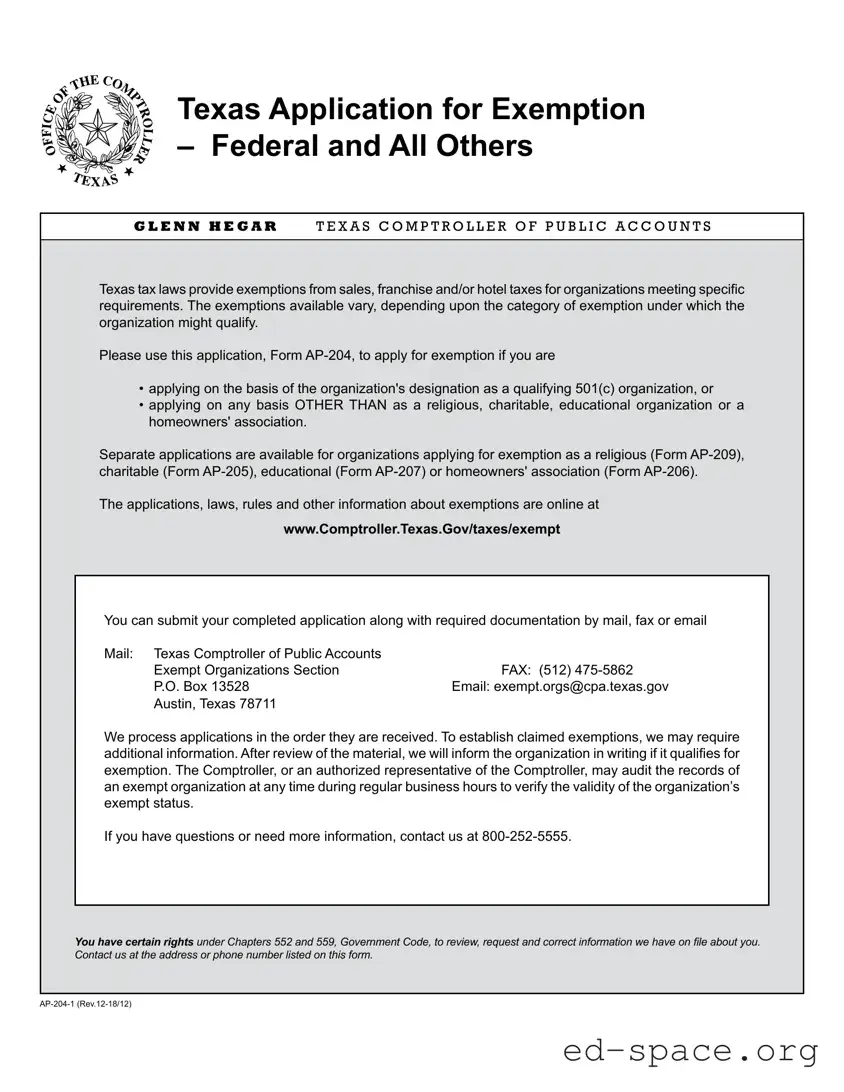
Texas Application for Exemption
– Federal and All Others
GLENN HEGAR TEXAS COMPTROLLER OF PUBLIC ACCOUNTS
Texas tax laws provide exemptions from sales, franchise and/or hotel taxes for organizations meeting specic
requirements. The exemptions available vary, depending upon the category of exemption under which the
organization might qualify.
Please use this application, Form AP-204, to apply for exemption if you are
applying on the basis of the organization's designation as a qualifying 501(c) organization, or
applying on any basis OTHER THAN as a religious, charitable, educational organization or a
homeowners' association.
Separate applications are available for organizations applying for exemption as a religious (Form AP-209),
charitable (Form AP-205), educational (Form AP-207) or homeowners' association (Form AP-206).
The applications, laws, rules and other information about exemptions are online at
www.Comptroller.Texas.Gov/taxes/exempt
You can submit your completed application along with required documentation by mail, fax or email
Mail: Texas Comptroller of Public Accounts
Exempt Organizations Section
P.O. Box 13528
Austin, Texas 78711
FAX: (512) 475-5862
We process applications in the order they are received. To establish claimed exemptions, we may require
additional information. After review of the material, we will inform the organization in writing if it qualies for
exemption. The Comptroller, or an authorized representative of the Comptroller, may audit the records of
an exempt organization at any time during regular business hours to verify the validity of the organization’s
exempt status.
If you have questions or need more information, contact us at 800-252-5555.
You have certain rights under Chapters 552 and 559, Government Code, to review, request and correct information we have on le about you.
Contact us at the address or phone number listed on this form.
AP-204-1 (Rev.12-18/12)
*AP20420W121812*
*AP20420W121812*
* A P 2 0 4 2 0 W 1 2 1 8 1 2 *
1.
2. ORGANIZATION NAME
(Legal name as provided on Articles of Incorporation, or if unincorporated, the governing document.)
3. ORGANIZATION MAILING ADDRESS
Street number, P.O. Box or rural route and box number
City State/Province ZIP Code County (or country, if outside the U.S.)
4. Texas taxpayer number (if applicable) ............................................................................................................................
5. Federal Employer Identication Number (EIN) (Required if applying for exemption on the basis of a federal exemption) ......................
6. a) Enter ling information issued by the Texas Secretary of State:
File Number ............................................................. File Date ................................................
Month Day Year
OR
b) Check this box if this organization is not registered with the Texas Secretary of State.
7. Contact information of the person submitting this application
Name Email Address
Firm or Company Name Daytime Phone (Area code and number) Extension
Address City State ZIP Code
Federal Exemption under qualifying Internal Revenue Code (IRC)
Credit Unions - Federal
Section 501(c). Attach IRS Determination Letter.
Credit Unions - State
Cemetery Corporations
Development Corporations
Certain Insurance Corporations for Farm Mutuals, Local Mutual Aid
Electric Cooperatives
Associations and Burial Associations
Emergency Medical Service Corporations
Certain Insurance Corporations Licensed as Title Insurance
Farmers' Cooperative Societies or cooperatives whose single
Companies and Title Insurance Agents
member is a farmers' cooperative described in Section 521(b)(1),
Certain Corporations Subject to the Insurance Code
IRC, that has at least 500 farmer-fruit grower members.
Chambers of Commerce
Health Facility Development Corporations
Convention and Tourist Promotional Agencies
Hospital Laundry Cooperative Associations
Cooperative Associations
Housing Finance Corporations
Cooperative Credit Associations
Local Organizing Committees
Corporations Exempted by Another Law
Lodges
Corporations with Business Interest In Solar Energy Devices
Marketing Associations
Corporations Organized for Agricultural Purposes
Nonprot Water Supply Corporations
Corporations Organized for Conservation Purposes
Open-End Investment Companies
Corporations Involved with City Natural Gas Facility
Corporations Organized to Promote County, City or Another Area
Corporations Organized to Provide Cooperative Housing
(Public Interest Organizations)
Corporations Organized to Provide Convalescent Homes for
Railway Terminal Corporations
Elderly
Recycling Operations
Corporations Organized for Student Loan Funds or Student
Telephone Cooperatives
Scholarship Purposes
Volunteer Fire Departments
Youth Athletic Organizations
We will notify you by email when the exemption has been added to let you know where the exemption can be veried online. If an email address is not
provided, indicate where our response should be mailed: organization's mailing address or mailing address of the submitter.
AP-204-2
(Rev.12-18/12)
Texas Application for Exemption
– Federal and All Others
• Remove All Staples • TYPE OR PRINT • Do NOT write in shaded areas.
Organizations applying for exemption under one of the categories listed below should check the appropriate box and complete this application.
Our publication, Guidelines to Texas Tax Exemptions (96-1045), includes a description of the additional documentation required for each category of
exemption. For the category you select, be sure to read the requirements listed in the publication. If you send in an application without including the
documentation described in the publication, we will return the application to you with a request for additional information. We are unable to
process incomplete applications.
Special n
ote to non-Texas organizations: Include a le-stamped copy of your organization's formation documents AND a current Certicate of
Existence from the Secretary of State or equivalent ocer in your home state.

Form Specifications

Fact Name Details
Purpose The Texas AP-204 form is used to apply for tax exemptions for qualifying organizations.
Eligibility Organizations must meet specific requirements to qualify for exemptions from sales, franchise, and hotel taxes.
Exemption Categories Exemptions vary based on the organization's designation, such as 501(c) organizations, but exclude religious, charitable, educational organizations, and homeowners' associations.
Application Submission Completed applications can be submitted via mail, fax, or email to the Texas Comptroller of Public Accounts.
Processing Order Applications are processed in the order they are received, and additional information may be requested.
Audit Rights The Comptroller may audit exempt organizations to verify their exempt status at any time during business hours.
Contact Information For questions, organizations can contact the Texas Comptroller at 800-252-5555 or through the provided email.
Governing Law The form is governed by Texas tax laws, specifically Chapters 552 and 559 of the Government Code.

Texas Ap 204 2: Usage Guidelines

Completing the Texas Application for Exemption – Federal and All Others (Form AP-204-2) is essential for organizations seeking tax exemptions under specific categories. Follow these steps to ensure accurate submission of the form.

  1. Begin by removing any staples from the form.
  2. Type or print your responses clearly. Avoid writing in shaded areas.
  3. Check the appropriate box that corresponds to your organization's category for exemption.
  4. Provide the legal name of your organization as it appears on the Articles of Incorporation or governing document.
  5. Fill in the organization’s mailing address, including street number, city, state, ZIP code, and county.
  6. If applicable, enter the Texas taxpayer number.
  7. Provide the Federal Employer Identification Number (EIN) if applying based on a federal exemption.
  8. Complete either section 6a or 6b:
    • For 6a, enter the filing information issued by the Texas Secretary of State, including the file number and file date.
    • For 6b, check the box if your organization is not registered with the Texas Secretary of State.
  9. Include additional documentation as required for the selected exemption category.
  10. Fill out the contact information for the person submitting the application, including name, email address, firm or company name, daytime phone number, and mailing address.
  11. Submit the completed application via mail, fax, or email to the Texas Comptroller of Public Accounts.

After submission, the application will be processed in the order received. Be prepared for potential requests for additional information to establish the claimed exemptions. A written notification will follow once the review is complete.

Your Questions, Answered

What is the Texas AP-204-2 form used for?

The Texas AP-204-2 form is an application for exemption from certain taxes, including sales, franchise, and hotel taxes. Organizations can use this form to apply for tax exemptions based on their designation as qualifying 501(c) organizations or for other specific categories. This form is essential for organizations seeking to confirm their exempt status under Texas tax laws.

Who should use the Texas AP-204-2 form?

This form is intended for organizations that do not qualify as religious, charitable, educational organizations, or homeowners' associations. If your organization falls into one of these categories, you should use the appropriate forms: AP-209 for religious organizations, AP-205 for charitable organizations, AP-207 for educational organizations, or AP-206 for homeowners' associations.

What documentation is required when submitting the AP-204-2 form?

When applying with the AP-204-2 form, it is crucial to include all necessary documentation as outlined in the publication "Guidelines to Texas Tax Exemptions." Incomplete applications will be returned, so ensure that you check the requirements for your specific category of exemption and attach any required supporting documents, such as an IRS Determination Letter for federal exemptions.

How can I submit the completed AP-204-2 form?

You have several options for submitting your completed application. You can mail it to the Texas Comptroller of Public Accounts at the address provided, fax it to (512) 475-5862, or email it to [email protected]. Choose the method that is most convenient for you to ensure your application is processed efficiently.

What is the processing time for the AP-204-2 form?

Applications are processed in the order they are received. The time it takes to process your application can vary depending on the volume of submissions. If additional information is needed to establish your claimed exemptions, the Comptroller's office will reach out to you. After review, you will receive written notification regarding your exemption status.

Can my organization be audited after receiving tax-exempt status?

Yes, the Comptroller or an authorized representative may audit the records of an exempt organization at any time during regular business hours. This is done to verify the validity of your organization's exempt status. It is important to maintain accurate records to support your exemption claims.

How can I contact the Comptroller's office for further assistance?

If you have any questions or need more information regarding the AP-204-2 form or the exemption process, you can contact the Texas Comptroller's office at 800-252-5555. They are available to assist you with any concerns you may have about your application or the requirements for exemption.

Common mistakes

  1. Incomplete Documentation: Many applicants forget to include the necessary documentation required for their specific category of exemption. Without this, the application will be returned.

  2. Incorrect Organization Name: It's crucial to provide the legal name of the organization exactly as it appears on the Articles of Incorporation or governing document. Errors here can lead to delays.

  3. Missing Federal Employer Identification Number (EIN): If applying for exemption based on federal status, the EIN is required. Omitting this number can result in rejection of the application.

  4. Failure to Check the Right Box: Applicants often neglect to check the appropriate box that corresponds to their exemption category. This oversight can complicate the processing of the application.

  5. Ignoring Shaded Areas: Some individuals write in shaded areas of the form, which is prohibited. This can lead to confusion and may cause the application to be returned.

  6. Omitting Contact Information: Not providing complete contact information for the person submitting the application can hinder communication. This may delay the notification process regarding the exemption status.

Documents used along the form

The Texas Application for Exemption (Form AP-204-2) is often accompanied by several other forms and documents that assist organizations in navigating tax exemptions. Below is a list of commonly used forms along with brief descriptions of each.

  • Form AP-209: This form is specifically for organizations applying for exemption based on their status as religious organizations. It requires documentation proving the organization's religious purpose and activities.
  • Form AP-205: Charitable organizations use this form to apply for tax exemption. Documentation must demonstrate the organization's charitable activities and how they benefit the public.
  • Form AP-207: Educational organizations complete this form to seek tax exemption. It necessitates proof of educational activities and the organization's compliance with educational standards.
  • Form AP-206: Homeowners' associations utilize this form to apply for exemption. It requires information about the association's structure and activities that support its community.
  • IRS Determination Letter: Organizations applying under IRC Section 501(c) must attach this letter from the IRS, confirming their tax-exempt status.
  • Certificate of Existence: Non-Texas organizations must provide this document from their home state, confirming their legal standing and compliance.
  • Articles of Incorporation: This foundational document outlines the organization's structure and purpose. It is essential for proving eligibility for exemption.
  • Bylaws: Organizations may need to submit their bylaws, which govern their operations and demonstrate compliance with exemption requirements.
  • Financial Statements: Recent financial statements may be required to provide insight into the organization’s financial health and activities.
  • Guidelines to Texas Tax Exemptions (Publication 96-1045): This publication offers detailed information on the requirements and documentation needed for various exemption categories.

These forms and documents collectively support the application process for tax exemptions in Texas. Ensuring that all required materials are submitted can help organizations avoid delays in processing their applications.

Similar forms

The Texas AP 204 2 form is used for applying for various tax exemptions. It has similarities with several other forms related to tax exemptions in Texas. Below are nine documents that are similar to the Texas AP 204 2 form, along with explanations of how they relate:

  • Texas Application for Exemption – Religious Organizations (Form AP-209): This form is specifically for organizations applying for exemption based on their status as a religious entity.
  • Texas Application for Exemption – Charitable Organizations (Form AP-205): This document is intended for organizations that qualify for tax exemption due to their charitable activities.
  • Texas Application for Exemption – Educational Organizations (Form AP-207): This form is for educational institutions seeking tax exemption under Texas law.
  • Texas Application for Exemption – Homeowners' Associations (Form AP-206): This application is used by homeowners' associations to request tax exemption.
  • IRS Form 1023: This federal form is used to apply for recognition of exemption from federal income tax under Section 501(c)(3) of the Internal Revenue Code, similar to the basis for AP 204 2.
  • IRS Form 1024: This form is used for organizations seeking tax-exempt status under sections other than 501(c)(3), aligning with the AP 204 2's broader application scope.
  • Texas Franchise Tax Exemption Application: This application is used by organizations to claim exemption from franchise taxes, similar to the exemptions claimed on the AP 204 2.
  • Texas Sales Tax Exemption Certificate: This document allows qualifying organizations to make tax-exempt purchases, paralleling the exemptions sought in the AP 204 2 form.
  • Texas Property Tax Exemption Application: This application is for organizations seeking exemption from property taxes, akin to the tax exemptions covered by the AP 204 2.

Dos and Don'ts

When filling out the Texas Application for Exemption, Form AP-204, it's important to follow certain guidelines to ensure your application is processed smoothly. Here’s a list of what you should and shouldn’t do:

  • Do type or print clearly to ensure legibility.
  • Do check the appropriate box for your organization’s category of exemption.
  • Do include all required documentation as specified in the guidelines.
  • Do provide the legal name of your organization as it appears on your Articles of Incorporation.
  • Do include your Federal Employer Identification Number (EIN) if applicable.
  • Don't write in shaded areas of the form.
  • Don't submit your application without the necessary supporting documents.
  • Don't staple any documents or the application itself.
  • Don't forget to provide contact information for the person submitting the application.
  • Don't assume your application is complete without double-checking all entries and attachments.

By following these guidelines, you can help ensure that your application for exemption is processed efficiently and effectively.

Misconceptions

Misconception 1: The AP-204-2 form is only for religious organizations.

This form is intended for a variety of organizations, not just religious ones. It is specifically designed for those applying for exemption based on their designation as a qualifying 501(c) organization or for categories other than religious, charitable, educational, or homeowners' associations.

Misconception 2: You can submit the form without any supporting documents.

Submitting the AP-204-2 form without the required documentation will lead to delays. The application will be returned if it is incomplete. It is essential to include all necessary documentation to ensure a smooth processing experience.

Misconception 3: The processing time for the application is immediate.

Applications are processed in the order they are received. Therefore, applicants should expect some waiting time. Additional information may be requested, which can further extend the processing period.

Misconception 4: Once you receive an exemption, you will never be audited.

Even after receiving an exemption, organizations can be audited at any time during regular business hours. This is to verify the validity of the organization’s exempt status, ensuring compliance with the relevant laws and regulations.

Misconception 5: Any organization can apply for an exemption using this form.

Only organizations that meet specific criteria can use the AP-204-2 form. Organizations seeking exemptions as religious, charitable, educational, or homeowners' associations must use separate forms designated for those categories.

Key takeaways

Filling out the Texas Application for Exemption (Form AP-204-2) requires attention to detail and adherence to specific guidelines. Here are key takeaways to consider:

  • Eligibility Criteria: This form is specifically for organizations applying for exemption under certain categories, excluding religious, charitable, educational organizations, or homeowners' associations.
  • Documentation Required: Organizations must attach necessary documentation, such as an IRS Determination Letter for federal exemptions, to avoid processing delays.
  • Application Submission: Completed applications can be submitted via mail, fax, or email to the Texas Comptroller of Public Accounts.
  • Processing Order: Applications are processed in the order they are received, which may affect the time it takes to receive a response.
  • Additional Information: The Comptroller may request further information to establish claimed exemptions, so be prepared to provide more details if necessary.
  • Audits Possible: The Comptroller or an authorized representative can audit the records of an exempt organization during regular business hours to verify exempt status.
  • Rights to Information: Applicants have rights under Chapters 552 and 559 of the Government Code to review and correct information held by the Comptroller.
  • Contact Information: For questions or additional information, organizations can contact the Comptroller's office at the provided phone number.
  • Follow-Up Notification: Organizations will receive an email notification once their exemption has been added, detailing where it can be verified online.