Homepage Blank Texas 811 PDF Form
Content Overview

The Texas 811 form, officially known as the Certificate of Reinstatement, serves a crucial role for businesses in Texas looking to restore their legal status after termination or revocation. This form is specifically designed to meet the basic filing requirements as outlined in the Texas Business Organizations Code. It can be utilized to reinstate various types of entities, including those that have been voluntarily terminated, involuntarily terminated by the Secretary of State, or foreign entities whose registrations have been revoked. However, it’s important to note that certain situations disqualify the use of this form, such as forfeiture under the Tax Code or termination due to court orders. The form outlines specific timelines for reinstatement, which vary based on the nature of the termination. For instance, a voluntarily terminated entity must file within three years of termination, while an involuntarily terminated entity can file at any time, provided it does so before the three-year mark. Additionally, the form requires detailed information, including the entity's name, jurisdiction, and the conditions leading to its termination. Proper completion and timely submission of this form are essential for businesses aiming to regain their operational status in Texas.


Document Preview

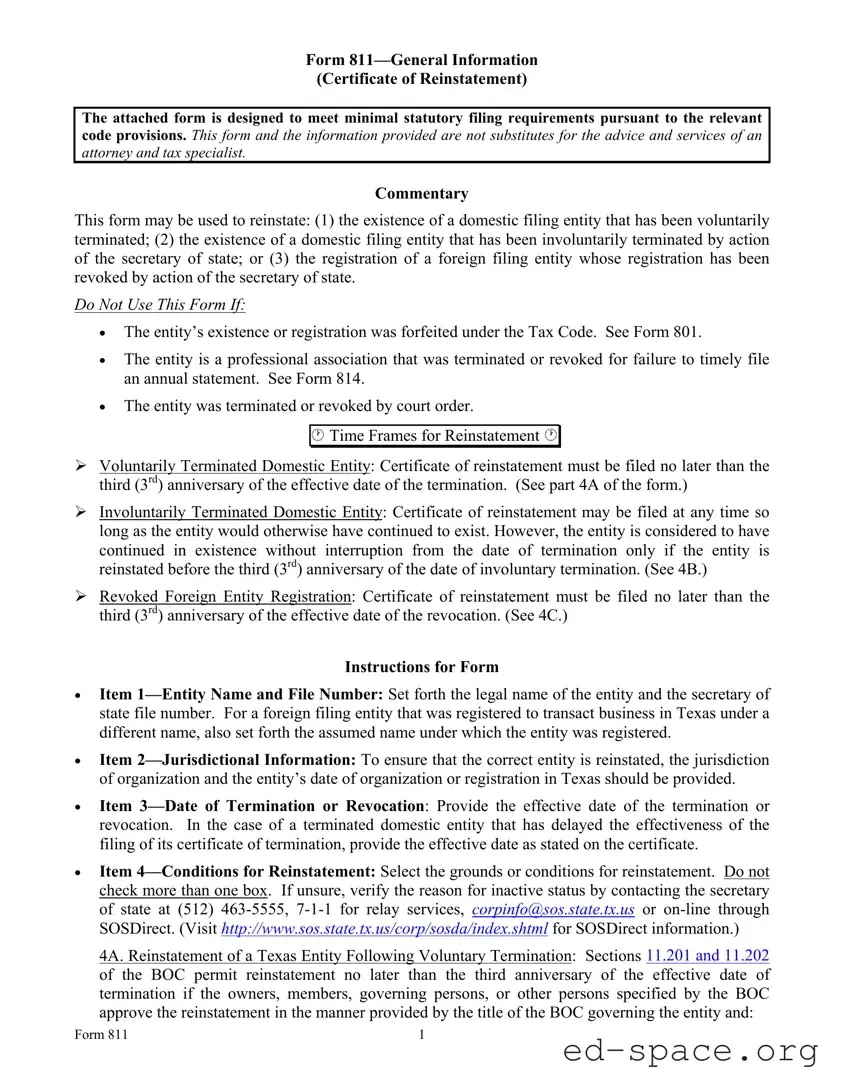
Form 811—General Information
(Certificate of Reinstatement)
The attached form is designed to meet minimal statutory filing requirements pursuant to the relevant
code provisions. This form and the information provided are not substitutes for the advice and services of an
attorney and tax specialist.
Commentary
This form may be used to reinstate: (1) the existence of a domestic filing entity that has been voluntarily
terminated; (2) the existence of a domestic filing entity that has been involuntarily terminated by action
of the secretary of state; or (3) the registration of a foreign filing entity whose registration has been
revoked by action of the secretary of state.
Do Not Use This Form If:
The entity’s existence or registration was forfeited under the Tax Code. See Form 801.
The entity is a professional association that was terminated or revoked for failure to timely file
an annual statement. See Form 814.
The entity was terminated or revoked by court order.
Time Frames for Reinstatement
Voluntarily Terminated Domestic Entity: Certificate of reinstatement must be filed no later than the
third (3
rd
) anniversary of the effective date of the termination. (See part 4A of the form.)
Involuntarily Terminated Domestic Entity: Certificate of reinstatement may be filed at any time so
long as the entity would otherwise have continued to exist. However, the entity is considered to have
continued in existence without interruption from the date of termination only if the entity is
reinstated before the third (3
rd
) anniversary of the date of involuntary termination. (See 4B.)
Revoked Foreign Entity Registration: Certificate of reinstatement must be filed no later than the
third (3
rd
) anniversary of the effective date of the revocation. (See 4C.)
Instructions for Form
Item 1—Entity Name and File Number: Set forth the legal name of the entity and the secretary of
state file number. For a foreign filing entity that was registered to transact business in Texas under a
different name, also set forth the assumed name under which the entity was registered.
Item 2—Jurisdictional Information: To ensure that the correct entity is reinstated, the jurisdiction
of organization and the entity’s date of organization or registration in Texas should be provided.
Item 3—Date of Termination or Revocation: Provide the effective date of the termination or
revocation. In the case of a terminated domestic entity that has delayed the effectiveness of the
filing of its certificate of termination, provide the effective date as stated on the certificate.
Item 4—Conditions for Reinstatement: Select the grounds or conditions for reinstatement. Do not
check more than one box. If unsure, verify the reason for inactive status by contacting the secretary
of state at (512) 463-5555, 7-1-1 for relay services,
[email protected] or on-line through
SOSDirect. (Visit http://www.sos.state.tx.us/corp/sosda/index.shtml for SOSDirect information.)
4A. Reinstatement of a Texas Entity Following Voluntary Termination: Sections
11.201 and 11.202
of the BOC permit reinstatement no later than the third anniversary of the effective date of
termination if the owners, members, governing persons, or other persons specified by the BOC
approve the reinstatement in the manner provided by the title of the BOC governing the entity and:
Form 811
1
(1) the termination was by mistake or was inadvertent;
(2) the termination occurred without the approval of the entity’s governing persons when approval
is required by the title of the BOC governing the entity;
(3) the process of winding up before termination had not been completed by the entity; or
(4) the legal existence of the entity is necessary to convey or assign property, to settle or release a
claim or liability, to take an action, or to sign an instrument or agreement.
4B. Reinstatement of a Texas Entity Following Involuntary Termination: Section 11.251 of the BOC
authorizes the secretary of state to involuntarily terminate a domestic filing entity, other than a
domestic real estate investment trust, if the secretary finds that the entity has failed to:
(1) file a report within the period required by law or to pay a fee or penalty prescribed by law
when due and payable;
(2) maintain a registered agent or registered office in Texas as required by law; or
(3) pay a fee required in connection with a filing, or payment of the fee was dishonored when
presented by the state for payment.
As a condition to reinstatement, the entity must correct the circumstances that led to termination and
any other circumstances of the type described above, including paying any fees, interest or penalties.
4C. Reinstatement of a Foreign Entity Following Revocation: Section 9.101 of the BOC authorizes
the secretary of state to revoke the registration of a foreign filing entity if the secretary finds that the
entity has failed to:
(1) file a report within the period required by law or to pay a fee or penalty prescribed by law
when due and payable;
(2) maintain a registered agent or registered office in Texas as required by law;
(3) amend its registration when required by law; or
(4) pay a fee required in connection with a filing, or payment of the fee was dishonored when
presented by the state for payment.
As a condition to reinstatement, the entity must correct the circumstances that led to revocation and
any other circumstances of the type described above, including paying any fees, interest or penalties.
Item 5—Registered Agent and Registered Office: An entity requesting reinstatement must
provide the secretary of state with current registered agent and registered office information. The
registered agent can be either (option A) a domestic entity or a foreign entity that is registered to do
business in Texas or (option B) an individual resident of the state. The entity cannot act as its own
registered agent; do not enter the entity name as the name of the registered agent.
An entity that was involuntarily terminated or that had its registration revoked for failure to maintain
a registered agent or registered office in Texas need not submit an additional filing to change the
registered agent or registered office.
Consent: A person designated as the registered agent of an entity must have consented, either in a
written or electronic form, to serve as the registered agent of the entity. Although consent is
required, a copy of the person’s written or electronic consent need not be submitted with the
reinstatement. The liabilities and penalties imposed by sections 4.007 and 4.008 of the BOC apply
with respect to a false statement in a filing instrument that names a person as the registered agent of
an entity without that person’s consent. (BOC § 5.207)
Office Address Requirements: The registered office address must be located at a street address
where service of process may be personally served on the entity’s registered agent during normal
Form 811
2
business hours. Although the registered office is not required to be the entity’s principal place of
business, the registered office may not be solely a mailbox service or telephone answering service
(BOC § 5.201).
Entity Name Availability: The reinstatement cannot be filed if the entity name is the same as,
deceptively similar to, or similar to the name of any existing domestic or foreign filing entity, or any
name reservation or registration filed with the secretary of state. The administrative rules for
determining entity name availability (Texas Administrative Code, title 1, part 4, chapter 79,
subchapter C) may be viewed at http://www.sos.state.tx.us/tac/index.shtml.
If the entity name is no longer available or written consent for the use of the name is required but
cannot be obtained, the entity must amend its certificate of formation or application for registration,
as appropriate, to state an available name. The amendment must be submitted at the same time as the
certificate of reinstatement.
Tax Clearance: Unless the entity is a nonprofit corporation, a certificate of reinstatement must be
accompanied by a tax clearance letter from the Texas Comptroller of Public Accounts stating that
the entity has satisfied all franchise tax liabilities and may be reinstated.
Contact the Comptroller for assistance in complying with franchise tax filing requirements and
obtaining the necessary tax clearance letter. The Comptroller may be contacted by e-mail at
[email protected] or by calling (800) 252-1381 or (512) 463-4600.
Execution: The reinstatement must be signed by a person authorized to act on behalf of the entity in
regard to the filing instrument. Generally, a governing person or managerial official of the entity
signs a filing instrument.
The certificate of reinstatement need not be notarized. However, before signing, please read the
statements on this form carefully. The designation or appointment of a person as the registered
agent by a managerial official is an affirmation by that official that the person named in the
instrument has consented to serve as registered agent. (BOC § 5.2011)
A person commits an offense under section 4.008 of the BOC if the person signs or directs the filing
of a filing instrument the person knows is materially false with the intent that the instrument be
delivered to the secretary of state for filing. The offense is a Class A misdemeanor unless the
person’s intent is to harm or defraud another, in which case the offense is a state jail felony.
Payment and Delivery Instructions: Unless the entity is a nonprofit corporation or cooperative
association, the filing fee for reinstatement following an involuntary termination or revocation is
$75, and the filing fee for reinstatement following a voluntary termination is $15. The filing fee for
reinstating a nonprofit corporation or a cooperative association is $5.
Fees may be paid by personal checks, money orders, LegalEase debit cards, or American Express,
Discover, MasterCard, and Visa credit cards. Checks or money orders must be payable through a
U.S. bank or financial institution and made payable to the secretary of state. Fees paid by credit card
are subject to a statutorily authorized convenience fee of 2.7 percent of the total fees. Applicable
fees for any additional filings required as a condition for reinstatement must be submitted together
with the appropriate filing fee for the certificate of reinstatement.
Submit the completed form in duplicate along with the filing fee. The form may be mailed to P.O.
Box 13697, Austin, Texas 78711-3697; faxed to (512) 463-5709; or delivered to the James Earl
Rudder Office Building, 1019 Brazos, Austin, Texas 78701. If a document is transmitted by fax,
credit card information must accompany the transmission (Form 807). On filing the document, the
secretary of state will return the appropriate evidence of filing to the submitter together with a file-
stamped copy of the document, if a duplicate copy was provided as instructed.
Revised 05/11
Form 811
3
This space reserved for office use.
Form 811
(Revised 05/11)
Submit in duplicate to:
Secretary of State
P.O. Box 13697
Austin, TX 78711-3697
512 463-5555
FAX: 512 463-5709
Filing Fee: See instructions
Certificate of
Reinstatement
1. The name of the entity is:
The entity is a foreign entity that was required to obtain its registration under a name that differs from
the legal name stated above. The name under which the entity is registered is:
The file number issued to the filing entity by the secretary of state is:
2. The jurisdiction of organization of the entity is:
(state or country)
The entity was organized or obtained its certificate of registration on:
mm/dd/yyyy
3. The effective date of the entity’s termination or revocation is:
mm/dd/yyyy
4. The condition giving rise to the termination of the entity’s existence or the revocation of its
registration is described below. The entity requests reinstatement under the following code provision:
(Select the appropriate box below. Do not check more than one box.)
4A. Reinstatement of a Texas Entity Following a Voluntary Termination (3 year limit)
The domestic filing entity requests reinstatement under section 11.202 of the BOC following the
filing of a certificate of termination. The undersigned certifies that the conditions for reinstatement of
the entity’s certificate of formation are met and that the reinstatement of the filing entity has been
approved in the manner provided by the Texas Business Organizations Code.
4B. Reinstatement of a Texas Entity Following an Involuntary Termination
The domestic filing entity requests reinstatement of its certificate of formation after the
involuntary termination of its existence by the secretary of state pursuant to subchapter F of chapter 11
of the Code. The entity has corrected the circumstances giving rise to its involuntary termination and
has taken any other action required for its reinstatement, including the payment of any fees, interest,
or penalties. The undersigned certifies that the reinstatement of the filing entity has been approved in
the manner required by the Texas Business Organizations Code.
4C. Reinstatement Following Revocation of Registration of a Foreign Entity (3 year limit)
The foreign filing entity requests the reinstatement of its certificate of registration after its
revocation by the secretary of state pursuant to subchapter C of chapter 9 of the BOC. The entity has
corrected the circumstances giving rise to its revocation and has taken any other action required for its
reinstatement, including the payment of any fees, interest, or penalties.
Form 811
4
5. The name of the entity’s registered agent and the address of the entity’s registered office are as
follows: (Select and complete either A or B and complete C)
A. The registered agent is an organization (cannot be the entity seeking reinstatement) by the name of:
OR
B. The registered agent is an individual resident of the state whose name is set forth below:
First Name M.I. Last Name Suffix
C. The business address of the registered agent and the registered office address is:
Street Address City
TX
State Zip Code
The street address of the registered office as stated in this instrument is the same as the registered
agent’s business address.
Additional Documentation or Filings
Comptroller of Public Accounts Tax Clearance Letter (Required, unless entity is a nonprofit corporation.)
Amendment to Certificate of Formation or Registration (Required if entity name is no longer available.)
Other
(A certificate of reinstatement may be conditioned on the submission of additional filings. See instructions.)
Execution
The undersigned affirms that the person designated as registered agent has consented to the
appointment. The undersigned signs this document subject to the penalties imposed by law for the
submission of a materially false or fraudulent instrument and certifies under penalty of perjury that the
undersigned is authorized under the provisions of law governing the entity to execute the filing
instrument.
Date:
By:
Signature of authorized person (see instructions)
Printed or typed name of authorized person
Form 811
5

Form Specifications

Fact Name Description
Purpose The Texas 811 form is used to reinstate the existence of certain domestic and foreign filing entities.
Governing Laws This form is governed by the Texas Business Organizations Code (BOC), specifically sections 11.201, 11.202, and 9.101.
Eligibility Entities eligible for reinstatement include those that were voluntarily or involuntarily terminated, or whose foreign registration was revoked.
Time Limit For reinstatement, the application must be filed no later than three years from the effective date of termination or revocation.
Registered Agent The reinstatement form requires current registered agent information, which cannot be the entity itself.
Tax Clearance A tax clearance letter from the Texas Comptroller is required unless the entity is a nonprofit corporation.
Filing Fees Filing fees vary: $15 for voluntary termination, $75 for involuntary termination, and $5 for nonprofit entities.
Signature Requirement The form must be signed by an authorized person, affirming that the registered agent has consented to serve.
Submission Methods The completed form can be mailed, faxed, or delivered in person to the Secretary of State in Texas.

Texas 811: Usage Guidelines

Filling out the Texas 811 form requires attention to detail. Once you complete the form, you will submit it along with the required fees to the Secretary of State. This process helps to reinstate your entity's existence or registration.

  1. Entity Name and File Number: Write the legal name of your entity and its file number issued by the Secretary of State. If applicable, include the assumed name under which the entity was registered.
  2. Jurisdictional Information: Indicate the state or country where your entity was organized and provide the date of organization or registration in Texas.
  3. Date of Termination or Revocation: Enter the effective date when your entity was terminated or its registration was revoked.
  4. Conditions for Reinstatement: Select the appropriate box that describes the reason for reinstatement. Ensure you check only one box. If unsure, contact the Secretary of State for clarification.
  5. Registered Agent and Registered Office: Provide the name of your registered agent and the address of the registered office. Choose either an organization or an individual as the registered agent.
  6. Tax Clearance: If your entity is not a nonprofit corporation, attach a tax clearance letter from the Texas Comptroller of Public Accounts to confirm that all franchise tax liabilities are satisfied.
  7. Execution: Have an authorized person sign the form. Ensure that this person is aware of the responsibilities and penalties associated with the submission.
  8. Payment and Delivery: Include the appropriate filing fee. Submit the completed form in duplicate along with the payment. You can mail, fax, or deliver it in person to the Secretary of State.

Your Questions, Answered

What is the purpose of the Texas 811 form?

The Texas 811 form, also known as the Certificate of Reinstatement, is used to reinstate the existence of a domestic filing entity that has been voluntarily or involuntarily terminated, or to reinstate the registration of a foreign filing entity whose registration has been revoked. This form is essential for entities seeking to restore their legal status and continue operations in Texas.

Who can use the Texas 811 form?

This form is intended for domestic filing entities that have voluntarily terminated their existence, those that have been involuntarily terminated by the Secretary of State, and foreign filing entities that have had their registration revoked. However, it cannot be used if the entity was forfeited under the Tax Code or terminated by court order.

What are the time frames for reinstatement?

For a voluntarily terminated domestic entity, the reinstatement must be filed within three years from the termination date. An involuntarily terminated entity can be reinstated at any time, but it must be done within three years to ensure continuous existence. For foreign entities, reinstatement must also occur within three years of revocation.

What information is required to complete the Texas 811 form?

To complete the Texas 811 form, you will need to provide the entity's legal name, file number, jurisdiction of organization, date of termination or revocation, and the conditions for reinstatement. Additionally, you must include information about the registered agent and registered office, as well as any necessary tax clearance letters.

What is a registered agent, and why is it important?

A registered agent is an individual or organization designated to receive legal documents on behalf of the entity. It is crucial for maintaining compliance with state regulations. The registered agent must be located in Texas and cannot be the entity itself. Consent from the registered agent to serve in this capacity is also required.

What fees are associated with filing the Texas 811 form?

The filing fee for reinstatement varies depending on the type of entity. For a domestic entity reinstated after voluntary termination, the fee is $15. If the reinstatement follows an involuntary termination, the fee is $75. Nonprofit corporations or cooperative associations pay a reduced fee of $5. Payment can be made via check, money order, or credit card, subject to a convenience fee.

What happens after the Texas 811 form is submitted?

Once the Texas 811 form is submitted, the Secretary of State will review it. If everything is in order, they will process the reinstatement and return evidence of filing along with a file-stamped copy of the document. If there are any issues, the Secretary of State may contact you for clarification or additional information.

Is legal advice necessary when completing the Texas 811 form?

While the Texas 811 form provides a basic framework for reinstatement, it is advisable to consult with an attorney or tax specialist. They can provide guidance tailored to your specific situation, ensuring that all requirements are met and minimizing the risk of errors in the filing process.

Common mistakes

  1. Incorrect Entity Name: Failing to provide the exact legal name of the entity can lead to rejection of the form. Ensure the name matches the records with the Secretary of State.

  2. Omitting the File Number: Not including the Secretary of State file number can create confusion. This number is essential for identifying the entity in question.

  3. Wrong Jurisdictional Information: Providing incorrect jurisdiction or date of organization can result in delays. Double-check this information for accuracy.

  4. Multiple Boxes Checked: Selecting more than one condition for reinstatement is a common mistake. Only one box should be checked to avoid confusion.

  5. Missing Registered Agent Information: Not providing the current registered agent's name and address can lead to issues. Make sure the agent is either a registered entity or an individual resident of Texas.

  6. Lack of Tax Clearance: Failing to include a tax clearance letter, if required, can prevent reinstatement. Confirm whether this document is necessary based on your entity type.

Documents used along the form

The Texas 811 form is an essential document for entities seeking reinstatement after termination or revocation. However, several other forms and documents are often required or recommended to accompany the Texas 811 form. Each of these documents serves a specific purpose in the reinstatement process, ensuring compliance with Texas law and facilitating a smoother reinstatement experience.

  • Form 801: This form is used when an entity's existence or registration has been forfeited under the Tax Code. It helps address issues related to tax obligations before reinstatement can occur.
  • Form 814: This document is necessary for professional associations that have been terminated or revoked due to failure to file an annual statement. It outlines the process for reinstatement specific to these entities.
  • Tax Clearance Letter: Required for most entities, this letter from the Texas Comptroller confirms that all franchise tax liabilities have been satisfied. It is essential for reinstatement, as it demonstrates compliance with tax obligations.
  • Amendment to Certificate of Formation: If the entity's name is no longer available due to conflicts with other registered entities, this amendment is necessary. It allows the entity to change its name before reinstatement.
  • Form 807: This form may be required if submitting documents via fax. It includes credit card information for payment of filing fees and is essential for ensuring the transaction is processed correctly.
  • Certificate of Good Standing: Sometimes requested, this document verifies that an entity is compliant with state requirements and has no outstanding issues. It can be beneficial in supporting the reinstatement request.
  • Registered Agent Consent Form: Although not always required, this form can provide proof that the designated registered agent has consented to their appointment. It helps establish the legitimacy of the registered agent's role.

Understanding the various forms and documents associated with the Texas 811 form can greatly enhance the reinstatement process. Ensuring that all necessary paperwork is completed accurately and submitted on time will help avoid delays and complications, allowing entities to regain their standing effectively.

Similar forms

The Texas 811 form, known as the Certificate of Reinstatement, shares similarities with several other legal documents. Each of these forms serves a specific purpose in the realm of business filings and reinstatements. Here are five documents that are similar to the Texas 811 form:

  • Form 801—Certificate of Termination: This form is used when a business entity voluntarily dissolves its operations. While the Texas 811 form reinstates an entity, Form 801 formally terminates it, marking the end of its existence.
  • Form 814—Certificate of Reinstatement for Professional Associations: Similar to the Texas 811, this form is specifically for professional associations that have been terminated. It outlines the process for reinstating these entities, focusing on compliance with specific regulations applicable to professionals.
  • Form 205—Certificate of Formation: This document is essential for creating a new business entity in Texas. While the Texas 811 form reinstates an existing entity, Form 205 initiates the formation of a new one, establishing its legal existence from the outset.
  • Form 807—Certificate of Filing: This form serves as proof that a document has been filed with the Secretary of State. Similar to the Texas 811, it confirms the legal status of a business entity, but it is used primarily to acknowledge the filing of various business documents rather than reinstatement.
  • Form 404—Application for Registration of a Foreign Entity: This form allows a foreign business entity to register to do business in Texas. Like the Texas 811 form, it involves compliance with state regulations, but it focuses on the initial registration rather than reinstatement.

Dos and Don'ts

When filling out the Texas 811 form, it is essential to follow specific guidelines to ensure a smooth reinstatement process. Here are four key dos and don’ts to keep in mind:

  • Do provide accurate entity information. Include the legal name of the entity and the secretary of state file number. This helps prevent any delays in processing.
  • Do check the conditions for reinstatement. Ensure that you select the correct box that reflects the reason for your entity's termination or revocation. Only one box should be checked.
  • Do obtain a tax clearance letter. If your entity is not a nonprofit corporation, make sure to include a tax clearance letter from the Texas Comptroller stating that all franchise tax liabilities have been satisfied.
  • Do submit the form in duplicate. Send two copies of the completed form along with the appropriate filing fee to the Secretary of State’s office.
  • Don’t use this form if your entity was forfeited under the Tax Code. In such cases, a different form (Form 801) is required.
  • Don’t check more than one box for conditions of reinstatement. This could lead to confusion and potential rejection of your application.
  • Don’t act as your own registered agent. The registered agent must be an individual resident of Texas or a registered entity, but not the entity itself.
  • Don’t forget to sign the form. Ensure that the document is signed by someone authorized to act on behalf of the entity.

Misconceptions

  • Misconception 1: The Texas 811 form can be used for any type of entity reinstatement.
  • This form is specifically designed for certain types of reinstatements, including domestic entities that have been voluntarily or involuntarily terminated, as well as foreign entities whose registrations have been revoked.

  • Misconception 2: Filing the Texas 811 form guarantees reinstatement.
  • Filing the form does not guarantee reinstatement. The entity must meet specific conditions and correct any issues that led to termination or revocation.

  • Misconception 3: There is no time limit for filing the Texas 811 form after termination.
  • There are strict time frames. For voluntarily terminated entities, the form must be filed within three years of termination. For involuntarily terminated entities, reinstatement must occur within three years to maintain uninterrupted existence.

  • Misconception 4: Any person can serve as a registered agent.
  • The registered agent must be either a domestic or foreign entity registered to do business in Texas, or an individual resident of Texas. The entity cannot act as its own registered agent.

  • Misconception 5: A notarized signature is required for the Texas 811 form.
  • The form does not require notarization. However, it must be signed by someone authorized to act on behalf of the entity.

  • Misconception 6: A tax clearance letter is not needed for reinstatement.
  • Unless the entity is a nonprofit corporation, a tax clearance letter from the Texas Comptroller is required to confirm that all franchise tax liabilities have been satisfied.

  • Misconception 7: You can file the Texas 811 form without verifying your entity's status.
  • Before filing, it is essential to verify the reason for the entity's inactive status. This can be done by contacting the secretary of state.

  • Misconception 8: The entity name can be the same as an existing entity's name.
  • The reinstatement cannot be filed if the entity name is the same as or deceptively similar to any existing domestic or foreign entity names. Name availability must be checked before submission.

  • Misconception 9: The filing fee is the same for all entities.
  • The filing fee varies. For example, it is $75 for reinstatement following an involuntary termination, while it is only $15 for voluntary termination. Nonprofit corporations have a different fee structure.

Key takeaways

Filling out and using the Texas 811 form can seem daunting, but understanding the key aspects can simplify the process. Here are some essential takeaways:

  • Purpose of the Form: The Texas 811 form is used to reinstate entities that have been voluntarily or involuntarily terminated, or to reinstate foreign entities whose registration has been revoked.
  • Eligibility: Do not use this form if the entity was forfeited under the Tax Code, terminated for failing to file an annual statement, or terminated by court order.
  • Time Limits: For voluntary terminations, the form must be filed within three years of the termination date. Involuntary terminations also allow for reinstatement within three years, but the entity must correct the issues that led to termination.
  • Registered Agent Requirements: The reinstatement request must include current information about the registered agent, who cannot be the entity itself. Consent from the registered agent is required.
  • Name Availability: Ensure the entity name is available and not similar to existing entities. If the name is unavailable, an amendment to the certificate of formation may be needed.
  • Tax Clearance: A tax clearance letter from the Texas Comptroller is necessary unless the entity is a nonprofit corporation. This letter confirms that all franchise tax obligations have been met.
  • Filing Fees: The fees for reinstatement vary based on the type of entity. Generally, the fee is $75 for involuntary terminations and $15 for voluntary terminations.

By following these key points, individuals can navigate the Texas 811 form process more effectively and ensure compliance with the necessary regulations.