Homepage Blank Texas 5913 PDF Form
Content Overview

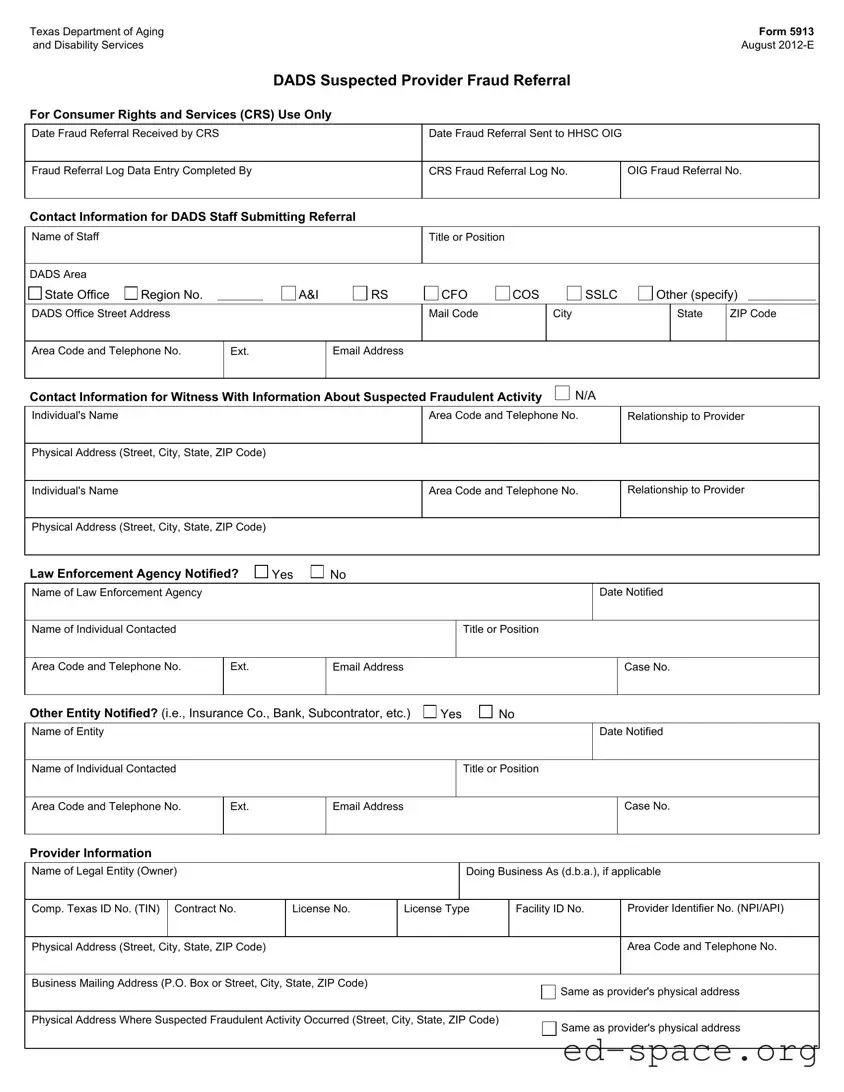
The Texas 5913 form plays a crucial role in addressing concerns related to suspected provider fraud within the state's Department of Aging and Disability Services. This form is specifically designed for the referral of suspected fraudulent activities involving various providers, including adult foster care, nursing facilities, and home and community-based services. It serves as a formal mechanism for individuals or staff to report irregularities such as billing discrepancies, falsification of records, and trust fund irregularities. The form collects essential information, including details about the provider, the nature of the suspected fraud, and any witnesses who may have relevant information. Additionally, it prompts the reporter to indicate whether law enforcement or other entities have been notified. By ensuring that all pertinent details are captured, the Texas 5913 form aids in the thorough investigation of potential fraud, thereby protecting consumer rights and maintaining the integrity of services provided to vulnerable populations. Its structured approach helps streamline the referral process, making it easier for concerned parties to take action when they suspect wrongdoing.


Document Preview

Texas Department of Aging
and Disability Services
Form 5913
August 2012-E
DADS Suspected Provider Fraud Referral
For Consumer Rights and Services (CRS) Use Only
Date Fraud Referral Received by CRS
Date Fraud Referral Sent to HHSC OIG
Fraud Referral Log Data Entry Completed By
CRS Fraud Referral Log No.
OIG Fraud Referral No.
Contact Information for DADS Staff Submitting Referral
Name of Staff
Title or Position
DADS Area
State Office Region No. A&I RS CFO COS SSLC Other (specify)
DADS Office Street Address
Mail Code
City
State
ZIP Code
Area Code and Telephone No.
Ext.
Email Address
Contact Information for Witness With Information About Suspected Fraudulent Activity
N/A
Individual's Name
Area Code and Telephone No.
Relationship to Provider
Physical Address (Street, City, State, ZIP Code)
Individual's Name
Area Code and Telephone No.
Relationship to Provider
Physical Address (Street, City, State, ZIP Code)
Law Enforcement Agency Notified?
Yes No
Name of Law Enforcement Agency
Date Notified
Name of Individual Contacted Title or Position
Area Code and Telephone No. Ext.
Email Address
Case No.
Other Entity Notified? (i.e., Insurance Co., Bank, Subcontrator, etc.)
Yes No
Name of Entity Date Notified
Name of Individual Contacted Title or Position
Area Code and Telephone No. Ext. Email Address
Case No.
Provider Information
Name of Legal Entity (Owner)
Doing Business As (d.b.a.), if applicable
Comp. Texas ID No. (TIN)
Contract No.
License No.
License Type Facility ID No.
Provider Identifier No. (NPI/API)
Physical Address (Street, City, State, ZIP Code)
Area Code and Telephone No.
Business Mailing Address (P.O. Box or Street, City, State, ZIP Code)
Same as provider's physical address
Physical Address Where Suspected Fraudulent Activity Occurred (Street, City, State, ZIP Code)
Same as provider's physical address
Form 5913
Page 2 / 08-2012-E
Type of Provider
1 Adult Foster Care
2 Area Agencies on Aging
3 Assisted Living/Residential Care
4 CCAD Residential Care
5 CLASS (CMA, DSA, SFS)
6 Client Managed Personal Attendant Services
7 Consumer Directed Services
8 Day Activity and Health Services
9 Deaf Blind with Multiple Disabilities
10 Emergency Response Services
11 Guardianship
12 Home and Community-based Services
13 HCSSA
14 Home-Delivered Meals
15 Hospice
16 Intermediate Care Facilities
17 Medically Dependent Children Program
18 Medicaid Administrative Claiming
19 ID Service Coordination
20 Nursing Facilities
21 Out-of-Home Respite
22 Performance Contract (with Local Authorities)
23 PHC/FC/CAS
24 PACE
25 Relocation Assistance Services
26 SSPD/SSPD-SAC
27 Texas Home Living
28 Transition Assistance Services
Type of Suspected Fraudulent Activity
1 Billing Irregularities 2 Falsification/Alteration of Records 4 Other3 Trust Fund Irregularities
If Other, specify
Date or Date Range of Suspected Fraudulent Activity
Type of Review
Administrative Review
Billing and Payment
Formal Monitoring
Follow-up Monitoring
Investigation On Site
Investigation Desk Review
Follow-up Investigation On Site
Follow-up Investigation Desk Review
HCS/TxHml Certification Review
HCS/TxHml Follow-up Review
HCS/TxHml Intermittent Review
Regulatory Services Survey
Trust Fund Monitoring
Other
Review Information
Review Period Total Sample Size Total Individuals Served
Was suspected fraudulent activity noted outside the sample or review period?
Yes No Unknown
Was corrected action or recoupment requested as a result of this review?
Yes No
Corrective Action Recoupment Other (specify)
Amount due DADS as a result of this review
How much of this amount is suspected to be fraudulent?
Other Information (as of date of referral)
Has the provider received technical assistance on billing during the past two years?
Yes No Unknown
Date(s) technical assistance was provided:
For HCSSA, Adult Day Care and Assisted Living licensed providers only, use the links below to enter the number of level B citations issued for
the license associated with this contract.
http://dadsview.dads.state.tx.us/coo/contract/hcssadirectory.html
or
http://dadsview.dads.state.tx.us/coo/contract/adcalfdirectory.html
Number of Level B Citations:
OIG/OAG Investigator Only
For more information about skilled nursing facilities ratings score, go to the DADS Long Term Care Quality Reporting System (QRS) website
at:
http://facilityquality.dads.state.tx.us/qrs/public/qrs.do?page=geoArea&serviceType=nh&lang=en&mode=P&dataSet=1&ctx=807802
Regulatory Services Only
Compliance Review ID No.
Exit Date
Form 5913
Page 3 / 08-2012-E
Regulatory Services Only
Provide a detailed description of the suspected fraudulent activity.
Form 5913
Page 4 / 08-2012-E
If the provider's payments are suspended as a result of this referral and the provider must cease
operations or significantly curtail services, would access to care be jeopardized for displaced individuals?
Access to Care
Yes
No
Unknown
If yes, provide a detailed explanation below.
Suspension of Payments
Are you aware of any reason why the provider's payments should not be suspended or suspended only in part?
Yes
No
If yes, provide a detailed explanation below.
Regional and state office management: After reviewing the referral form, email form to [email protected].
OIG/OAG investigator: Contact COS at [email protected]
if additional contract information is needed.

Form Specifications

Fact Name Description
Form Purpose The Texas 5913 form is used to report suspected provider fraud related to consumer rights and services.
Governing Law This form operates under Texas Health and Safety Code, Chapter 531.
Submission Process Referrals must be submitted to the Consumer Rights and Services (CRS) department for review.
Fraud Referral Log The form includes a log for tracking fraud referrals, including log numbers and contact details.
Contact Information Contact details for both the submitting staff and any witnesses must be provided on the form.
Type of Provider The form covers various provider types, including nursing facilities and assisted living services.
Suspected Fraud Types Common types of suspected fraud include billing irregularities and falsification of records.
Corrective Action The form allows for notes on corrective actions or recoupments requested as a result of the review.
Technical Assistance It inquires whether the provider has received technical assistance on billing in the past two years.

Texas 5913: Usage Guidelines

Filling out the Texas 5913 form requires careful attention to detail. This form is used to report suspected provider fraud. Ensure that all required fields are completed accurately to facilitate the review process. Follow the steps below to fill out the form correctly.

  1. Obtain the Form: Download the Texas 5913 form from the Texas Department of Aging and Disability Services website or obtain a physical copy.
  2. Enter Contact Information: Fill in the contact information for the DADS staff submitting the referral, including name, title, office address, and phone number.
  3. Provide Witness Information: If there are witnesses with information about the suspected fraud, include their names, contact numbers, and relationships to the provider.
  4. Law Enforcement Notification: Indicate whether law enforcement has been notified. If yes, provide the agency's name and the date of notification.
  5. Other Entities Notified: If any other entities (like insurance companies or banks) have been notified, indicate this and provide relevant details.
  6. Provider Information: Fill out the provider’s legal entity name, doing business as (d.b.a.), Texas ID number, contract number, license number, and other relevant details.
  7. Type of Provider: Select the type of provider from the list provided on the form.
  8. Type of Suspected Fraudulent Activity: Check the box next to the type of suspected fraudulent activity. If applicable, specify any other type.
  9. Date of Suspected Activity: Enter the date or date range of the suspected fraudulent activity.
  10. Type of Review: Indicate the type of review conducted (administrative, investigation, etc.) by checking the appropriate box.
  11. Sample Size and Individuals Served: Provide the total sample size and the number of individuals served during the review period.
  12. Corrective Action: Indicate whether corrective action or recoupment was requested as a result of the review.
  13. Amount Due: Specify the amount due to DADS as a result of the review and how much of that amount is suspected to be fraudulent.
  14. Technical Assistance: Indicate if the provider received technical assistance on billing in the past two years and provide dates if applicable.
  15. Detailed Description: Provide a detailed description of the suspected fraudulent activity in the space provided.
  16. Access to Care: Answer whether suspension of the provider's payments would jeopardize access to care for displaced individuals.
  17. Suspension of Payments: State if there is any reason why the provider's payments should not be suspended.
  18. Email the Form: Once completed, email the form to [email protected] as instructed on the form.

Your Questions, Answered

What is the Texas 5913 form used for?

The Texas 5913 form is a referral document used to report suspected provider fraud in the Department of Aging and Disability Services (DADS). It is specifically designed for Consumer Rights and Services (CRS) use only. The form collects information about the suspected fraudulent activity, the provider involved, and any witnesses who may have relevant information.

Who can submit the Texas 5913 form?

Any staff member from DADS can submit the Texas 5913 form. This includes individuals in various roles such as case managers or administrative staff. It is important that the person submitting the form has accurate and detailed information about the suspected fraud to ensure a thorough review.

What types of fraudulent activities can be reported using this form?

The form allows for the reporting of several types of suspected fraudulent activities. Common examples include billing irregularities, falsification or alteration of records, and trust fund irregularities. If the suspected activity does not fit these categories, there is an option to specify other types of fraud.

What information is required to complete the Texas 5913 form?

To complete the form, you will need to provide detailed information about the suspected fraudulent activity, including the type of provider involved and the specific nature of the fraud. Additionally, contact information for witnesses, the provider's details, and any law enforcement notifications must be included. Accurate data ensures that the referral is processed efficiently.

What happens after the form is submitted?

Once the Texas 5913 form is submitted, it is reviewed by the appropriate authorities within DADS. They will determine the next steps, which may include further investigation or administrative review. The form also serves as a record for tracking the referral and any actions taken as a result.

Can the provider's payments be suspended during the investigation?

Yes, if the referral indicates that the provider's payments should be suspended due to suspected fraud, this action may be taken. However, if the suspension could jeopardize access to care for individuals served by the provider, this must be noted on the form to consider the implications of such a decision.

How can I get more information about the Texas 5913 form?

For additional information about the Texas 5913 form, you can reach out to the relevant DADS staff or visit their official website. They can provide guidance on completing the form and the referral process. It’s important to ensure that all information is accurate and complete to facilitate a thorough review.

Common mistakes

  1. Incomplete Contact Information: Failing to provide all necessary contact details for both the staff submitting the referral and any witnesses can delay the investigation process.

  2. Incorrect Provider Information: Entering inaccurate details about the provider, such as the legal entity name or license number, can lead to confusion and hinder the referral's effectiveness.

  3. Missing Description of Fraudulent Activity: Not providing a detailed description of the suspected fraudulent activity can result in insufficient information for the investigation team.

  4. Failure to Indicate Notification of Law Enforcement: Omitting whether law enforcement has been notified can create gaps in the investigation and coordination efforts.

  5. Inaccurate Dates: Entering incorrect dates for when the suspected activity occurred or when notifications were made can complicate the timeline of events.

  6. Not Specifying Type of Fraudulent Activity: Failing to select the appropriate type of suspected fraudulent activity may lead to misclassification and improper handling of the case.

  7. Neglecting to Follow Up: After submission, not following up on the status of the referral can result in missed opportunities to provide additional information or clarification.

Documents used along the form

The Texas 5913 form is a crucial document used for reporting suspected provider fraud related to consumer rights and services. Alongside this form, several other documents are commonly utilized to support the referral process. Below is a list of these documents, each with a brief description.

  • Texas Department of Aging and Disability Services (DADS) Fraud Investigation Report: This report provides a detailed account of the findings from an investigation into suspected fraudulent activities. It includes evidence, witness statements, and conclusions drawn by investigators.
  • Incident Report Form: This form is used to document specific incidents of suspected fraud or abuse. It captures essential details about the event, including date, time, location, and involved parties.
  • Witness Statement Form: Individuals who have information regarding the suspected fraud may complete this form. It allows witnesses to provide their accounts and any relevant details that could assist in the investigation.
  • Provider Compliance History: This document outlines the provider's past compliance with regulations and any previous infractions. It is essential for understanding the provider's history and potential patterns of misconduct.
  • Law Enforcement Notification Form: If law enforcement is notified of the suspected fraud, this form records the details of the notification, including the agency contacted and the date of the report.
  • Corrective Action Plan: In cases where fraud is confirmed, a corrective action plan may be required. This document outlines the steps the provider will take to rectify the situation and prevent future occurrences.

These documents work together to ensure a thorough and effective response to suspected fraud. They provide a comprehensive framework for investigation and accountability within the Texas Department of Aging and Disability Services system.

Similar forms

  • Texas Form 5914: Similar to the Texas 5913 form, this document is used for reporting suspected provider fraud. It includes sections for contact information, details about the provider, and a description of the suspected fraud.
  • Texas Form 5915: This form is utilized for reporting complaints about providers. Like the 5913, it gathers information about the provider and the nature of the complaint, ensuring that all necessary details are captured for review.
  • Texas Form 5916: This document serves to report incidents of abuse or neglect within care facilities. It shares a similar structure to the 5913, focusing on the details of the incident and the individuals involved.
  • Texas Form 5917: Used for reporting quality of care issues, this form collects information about the provider and the specific concerns raised. It parallels the 5913 in its emphasis on detailed reporting.
  • Texas Form 5918: This form is for reporting violations of patient rights. It is structured similarly to the 5913, allowing individuals to provide comprehensive information about the violation.
  • Texas Form 5919: This document is designed for reporting financial exploitation of vulnerable individuals. It shares a common goal with the 5913, focusing on protecting consumers from fraudulent activities.
  • Texas Form 5920: This form addresses complaints regarding service delivery issues. It mirrors the 5913 in its layout and purpose, ensuring that issues are documented and addressed effectively.

Dos and Don'ts

When filling out the Texas 5913 form, it is important to follow specific guidelines to ensure accuracy and completeness. The following list outlines key dos and don'ts:

  • Do provide complete contact information for all individuals involved, including witnesses and law enforcement contacts.
  • Do specify the type of suspected fraudulent activity clearly and accurately.
  • Do indicate the date or date range of the suspected fraudulent activity.
  • Do ensure that all required fields are filled out to avoid delays in processing.
  • Don't omit any relevant details about the suspected fraud; thoroughness is essential.
  • Don't provide false or misleading information, as this can have serious consequences.

By adhering to these guidelines, you can help facilitate a smoother review process and contribute to the integrity of the reporting system.

Misconceptions

Understanding the Texas 5913 form is essential for those involved in reporting suspected provider fraud. However, several misconceptions exist about this form. Below are some of the common misunderstandings:

  • The form is only for large-scale fraud cases. Many believe that only significant fraud cases warrant the use of the Texas 5913 form. In reality, it can be used for any suspected fraudulent activity, regardless of its scale.
  • Only professionals can submit the form. Some think that only legal or healthcare professionals can file a referral. In fact, anyone with knowledge of suspected fraud can submit the form.
  • Submitting the form guarantees an investigation. There is a misconception that submitting the Texas 5913 form automatically triggers an investigation. While it initiates the review process, an investigation may depend on various factors.
  • All information provided is confidential. Although the form allows for anonymity, not all information is guaranteed to remain confidential. Certain details may be disclosed during the investigation process.
  • Only specific types of fraud can be reported. Some individuals believe that the form is limited to certain types of fraud. However, it covers a wide range of fraudulent activities, including billing irregularities and record falsification.
  • The form must be submitted in person. There is a belief that the Texas 5913 form must be physically submitted. However, it can be sent electronically via email, making the process more accessible.

Addressing these misconceptions can help individuals better understand the Texas 5913 form and its purpose in combating fraud in the healthcare system.

Key takeaways

When dealing with the Texas 5913 form, which is used to report suspected provider fraud, it’s essential to understand several key points to ensure the process is smooth and effective. Here are some important takeaways:

  • Purpose of the Form: The Texas 5913 form is specifically designed to report suspected fraud within the Texas Department of Aging and Disability Services (DADS) system. Understanding its purpose is crucial for accurate completion.
  • Who Can Submit: Any staff member or individual with relevant information can submit the form. This includes DADS staff, witnesses, or anyone who has observed fraudulent activity.
  • Contact Information: Accurate contact details for both the person submitting the referral and any witnesses are vital. This information facilitates follow-up and investigation.
  • Detailed Description Required: A thorough description of the suspected fraudulent activity must be provided. This includes specifics about the nature of the fraud and any relevant dates.
  • Types of Fraud: The form allows you to specify various types of suspected fraud, such as billing irregularities or falsification of records. Be precise in your selection to aid in the investigation.
  • Impact on Services: If the provider's payments are suspended, the form asks if access to care for individuals would be jeopardized. It’s important to consider this when filling out the form.
  • Submission Process: After completing the form, it must be emailed to the designated DADS address. Ensure that all information is accurate and complete before submission to avoid delays.

By keeping these points in mind, individuals can effectively navigate the process of reporting suspected fraud using the Texas 5913 form. Properly completing the form not only supports accountability but also helps protect the integrity of the services provided to vulnerable populations.